
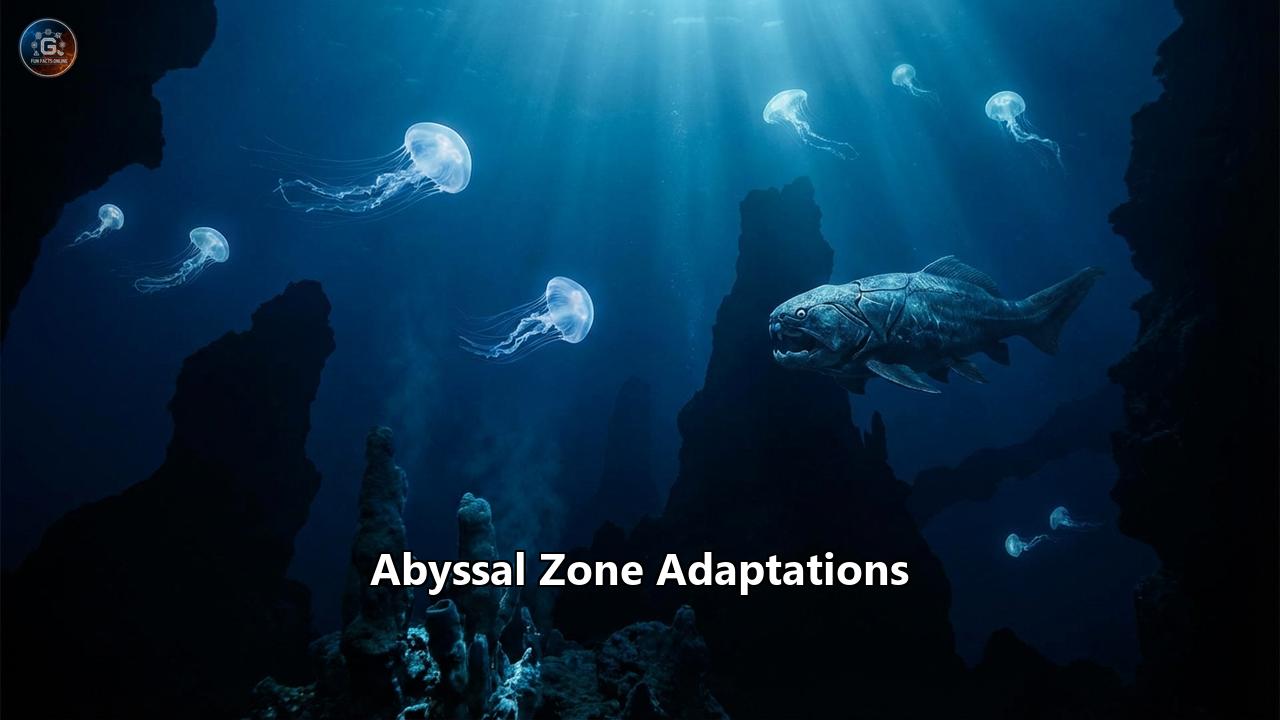
The ocean is not merely a body of water; it is a layered cake of realities, each more alien than the last. As we descend past the sunlit epipelagic zone, through the twilight of the mesopelagic, we eventually reach a boundary where the familiar rules of biology seem to dissolve. Welcome to the Abyssal Zone (from the Greek ἄβυσσος, meaning "bottomless"), a realm extending roughly 4,000 to 6,000 meters (13,000 to 20,000 feet) beneath the surface.
To the uninitiated, this zone is a cold, dark, high-pressure void—a biological desert. To the marine biologist, it is perhaps the most exciting evolutionary laboratory on Earth. Here, in the crushing blackness, life has not just survived; it has masterfully sculpted itself to thrive in conditions that would instantly annihilate a human being.
This comprehensive exploration will take you deep into the physiology, morphology, and behavior of abyssal life. We will uncover how creatures survive pressures that can crush titanium, how they find mates in an infinite dark room, and why some have evolved into giants while others have dissolved into gelatinous ghosts.
1. The Physics of the Abyss: Defining the Gauntlet
To understand the adaptation, one must first understand the adversary. The Abyssal Zone presents four primary physical challenges that drive every evolutionary decision in this environment.
The Crushing Weight (Hydrostatic Pressure)
At sea level, we experience 1 atmosphere (atm) of pressure. In the abyssal zone, pressure ranges from 400 to 600 atm. That is roughly equivalent to having a small elephant stand on your thumb, or a stack of jumbo jets resting on your chest.
- The Challenge: Air pockets, such as lungs or standard swim bladders, would be instantly compressed to nothingness. Furthermore, high pressure distorts complex molecules. It forces water molecules into the interior of proteins, causing them to unfold or denature, rendering enzymes useless.
- The Adaptation: Abyssal life has abandoned gas. You will not find compressible air cavities here. Instead, their bodies are permeated with water and incompressible fluids. More impressively, they have evolved piezolytes (pressure-counteracting molecules) like trimethylamine N-oxide (TMAO). These chemicals bind to water molecules in a way that prevents them from crushing vital proteins, effectively acting as a structural brace for their biochemistry.
The Eternal Chill
Temperatures in the abyss hover near freezing, typically between 2°C and 3°C (35°F - 37°F).
- The Challenge: Chemical reactions slow down as temperature drops. In most animals, this would cause muscles to seize and nerves to stop firing. Cell membranes, made of lipid (fat) bilayers, would turn into butter-like solids, preventing cells from communicating or taking in nutrients.
- The Adaptation: Abyssal creatures have "antifreeze" physiology. Their cell membranes are packed with unsaturated fatty acids (think olive oil vs. butter), which remain fluid and flexible even at near-freezing temperatures. Their enzymes are adapted to work efficiently at a glacial pace, allowing life to proceed in slow motion.
The Absolute Darkness
Below 1,000 meters, sunlight is a distant memory. The abyss is the realm of the aphotic zone.
- The Challenge: Photosynthesis is impossible. Primary producers (plants/algae) cannot exist here. Without light, visual predation and mating become incredibly difficult.
- The Adaptation: Life has two choices: abandon sight or create its own light. We see the evolution of bioluminescence as the primary light source, and sensory systems that detect pressure waves and chemical trails rather than photons.
The Nutrient Void
The abyss is far removed from the productive sunlit surface. Food is scarce and erratic.
- The Challenge: Most abyssal life relies on "marine snow"—a ceaseless, light dusting of dead plankton, fecal pellets, and organic detritus falling from above. It is a low-energy diet. Occasionally, a "food fall" (like a whale carcass) occurs, but these are rare lottery wins.
- The Adaptation: Extreme energy efficiency. "Sit-and-wait" predation strategies, slow metabolisms, and bodies that are mostly water (which is metabolically cheap to maintain) are the norm.
2. Physiological Adaptations: Engineering for the Deep
The most profound adaptations in the abyss are the ones you cannot see with the naked eye. They happen at the molecular and cellular level.
The Piezolyte Strategy: Chemical Armor
As mentioned, high pressure tends to force water molecules into proteins, breaking them apart. Deep-sea fish fight back with TMAO (Trimethylamine N-oxide). This molecule has a strong affinity for water. By filling their cells with TMAO, abyssal fish essentially structure the water within their cells, preventing it from forcing its way into proteins.
- The Smell of the Deep: Interestingly, TMAO is the same chemical that gives decomposing fish their "fishy" smell. Deep-sea fish are packed with so much of it that they would likely smell incredibly pungent if brought to the surface!
Metabolic Minimalism: The "Slow Life" Hypothesis
In the abyss, speed is expensive. Moving fast burns calories, and calories are rare. Therefore, many abyssal creatures have adopted a low-energy strategy.
- Reduced Muscle Mass: Many deep-sea fish, like the Blobfish (Psychrolutes marcidus), have barely any muscle. They rely on neutral buoyancy to float just above the seafloor, waiting for current to drift prey into their mouths.
- Enzyme Efficiency: Their metabolic enzymes are tuned to function with very little activation energy. This means they can digest food and repair cells with a fraction of the caloric intake a surface fish would need.
- The Coma State: Some creatures, like the Hagfish, can lower their metabolic rate to almost suspended animation, allowing them to survive for months without a meal.
Visual biochemicals
For those that still have eyes, the visual pigments (opsins) are tuned specifically to the wavelength of bioluminescence—blue-green (around 470–490 nanometers). This blue light travels furthest in water. Some predators, like the Dragonfish (Malacosteus), have evolved a "secret weapon": they produce red bioluminescence and have eyes sensitive to red light. Since most other abyssal prey cannot see red, the Dragonfish acts like a sniper with night-vision goggles, illuminating prey without them ever knowing they are being watched.
3. Morphological Adaptations: Monsters or Masterpieces?
The physical shapes of abyssal animals often strike humans as monstrous. However, every fang, spine, and gelatinous blob is a solution to a specific problem.
The Glass Bodies: Invisibility & Gelatinous Tissue
To survive pressure and hide from predators, many abyssal animals, including jellyfish, comb jellies, and even some octopuses, have bodies composed of mesoglea—a jelly-like substance that is 95% water.
- Benefits:
1. Incompressibility: Being mostly water means they don't get crushed.
2. Camouflage: Transparency is the ultimate camouflage in the dark (against the occasional bioluminescent flash).
3. Energy Economy: Jelly tissue takes very little energy to grow and maintain compared to bone or muscle.
The Feeding Apparatus: Jaws of Death
When food is rare, you cannot afford to let anything escape. This evolutionary pressure has created some of the most terrifying mouths in the animal kingdom.
- The Viperfish (Chauliodus): Its teeth are so long they don't fit inside its mouth. When it closes its jaws, the teeth curve back over its eyes, forming a cage that entraps prey.
- The Gulper Eel (Eurypharynx pelecanoides): This creature is essentially a giant mouth attached to a tail. Its jaw is loosely hinged and can swing open to swallow prey larger than the eel itself. Its stomach is highly distensible (stretchy), allowing it to store massive meals that might need to last it for weeks.
- The Fangtooth (Anoplogaster cornuta): Proportionally, it has the largest teeth of any fish in the ocean. It has evolved sockets in its braincase to accommodate its lower fangs when it closes its mouth.
Sensory Modifications: Seeing in the Dark
- Tubular Eyes: Some fish, like the Barreleye, have tubular eyes that point upward to silhouette prey against the faint light trickling down from the mesopelagic zone. These eyes are incredibly sensitive, sacrificing peripheral vision for extreme focus and light-gathering capability.
- The Lateral Line: Since vision is limited, the lateral line system—a row of sensory cells running down the side of fish—becomes a primary sense. It detects minute pressure changes and vibrations in the water, allowing a predator to "feel" a swimming shrimp meters away in total darkness.
4. Bioluminescence: The Language of Light
In a world without sun, life invented its own fire. Bioluminescence is the chemical production of light, typically involving a molecule called luciferin reacting with oxygen, catalyzed by an enzyme called luciferase. In the abyss, this is not just a cool trick; it is the primary mode of communication.
Offensive Bioluminescence
- Lures: The Anglerfish is the icon of this strategy. The female possesses a modified dorsal fin spine (the illicium) tipped with a glowing bulb (the esca). The glowing bacteria inside the esca attract curious prey close enough to be snapped up.
- Headlights: As mentioned, the Dragonfish uses red bioluminescence to hunt. Lanternfish have photophores (light organs) on their heads to illuminate the water immediately in front of them.
Defensive Bioluminescence
- Counter-illumination: Many predators hunt by looking upward, watching for the shadow of prey against the faint light from above. To combat this, creatures like the Hatchetfish have photophores along their bellies. They adjust the brightness of these lights to match the intensity of the light coming from the surface, effectively erasing their own shadow. This is called counter-illumination.
- Startle Displays: The Vampire Squid (Vampyroteuthis infernalis) does not shoot ink (which is useless in the dark). Instead, it ejects a cloud of glowing, bioluminescent mucus. This dazzling display confuses predators, leaving them snapping at "light ghosts" while the squid escapes into the dark.
- Burglar Alarms: Some jellies, like the Atolla jellyfish, flash like a police strobe light when attacked. The hope is to attract a larger predator to eat the creature attacking the jelly.
5. Reproductive Strategies: Finding a Mate in the Infinite
The abyssal zone is vast and sparsely populated. The chances of a male meeting a female of the same species are astronomically low. Evolution has devised bizarre solutions to the "mate search" problem.
Sexual Parasitism: The Anglerfish Solution
This is perhaps the most extreme reproductive strategy in nature. In certain anglerfish species (like the Ceratioid), the male is born with one purpose: find a female. He is tiny, dwarfed by the massive female, and has massive nostrils to detect her pheromones.
When he finds her, he bites into her flesh. An enzyme is released that digests the skin of both mouth and body, fusing them together. Their blood vessels connect. The male atrophies, losing his eyes, fins, and internal organs, until he is nothing more than a pair of testes attached to the female's body.
- The Advantage: The female now has a permanent supply of sperm. She never needs to search for a mate again. She can spawn whenever she has enough energy.
Simultaneous Hermaphroditism
Many deep-sea fish, such as the Tripod Fish, are simultaneous hermaphrodites—they possess both male and female reproductive organs.
- The Advantage: If you are a Tripod Fish and you meet another Tripod Fish, you don't need to worry about gender. You can both mate. In extreme isolation, some can even self-fertilize, ensuring the lineage continues even if they never meet another soul.
Broadcasting
For benthic (bottom-dwelling) invertebrates like sea cucumbers and sea stars, the strategy is often "broadcast spawning." They release millions of eggs and sperm into the water column, relying on currents to mix them. To maximize success, they often synchronize these releases using chemical cues or subtle shifts in current.
6. Deep-Sea Gigantism: The Mystery of Size
One of the most fascinating phenomena of the abyss is Abyssal Gigantism. Why do small surface creatures have colossal cousins in the deep?
- Examples: The Giant Isopod (a pill bug the size of a football), the Giant Squid (up to 13 meters long), and the Japanese Spider Crab (leg span of 3.8 meters).
The Theories
- Kleiber's Rule & Metabolism: Larger animals are more metabolicly efficient. In an environment with scarce food, being big might actually be more energy-efficient per gram of body weight than being small. A large body can also store more energy reserves (fat/oil) to weather long periods of famine.
- Bergmann’s Rule: This ecological rule states that animals in colder climates tend to be larger. The cold water of the abyss may trigger slower cell division but prolonged growth periods, resulting in larger final sizes.
- High Oxygen Levels: The cold waters of the deep ocean hold more dissolved oxygen than warm surface waters. Some scientists hypothesize that this abundance of oxygen removes the size constraints that limit growth in oxygen-poor environments.
- Reduced Predation: In the deep, there are fewer fast-moving, high-energy predators. This reduced predation pressure might allow invertebrates (like isopods and amphipods) to grow to sizes that would make them easy snacks in the shallow, predator-rich waters.
7. Case Studies: Icons of the Abyss
The Tripod Fish (Bathypterois grallator)
This fish is the ultimate "sitter." It has elongated rays on its pelvic and caudal fins that act like stilts. It "stands" on the abyssal mud, facing into the current.
- Adaptation: By standing, it keeps its body out of the boundary layer (the stagnant water right against the mud) and in the current where food particles drift. It is blind, relying entirely on its pectoral fins, which extend forward like antennae to feel for prey.
The Dumbo Octopus (Grimpoteuthis)
The deepest living octopus, found down to 7,000 meters. It lacks the jet-propulsion system of shallow-water octopuses.
- Adaptation: It flaps ear-like fins (hence "Dumbo") to hover gracefully. This movement uses far less energy than jet propulsion. It swallows prey whole rather than tearing it apart with a beak, adapted for worms and amphipods found in the ooze.
The Zombie Worm (Osedax)
These worms do not have a mouth or a stomach. They are found on whale falls (dead whale carcasses).
- Adaptation: They secrete acid to dissolve the whale bone. Then, they use symbiotic bacteria stored in root-like structures to digest the fats and proteins inside the bone. They are the cleanup crew of the abyss.
8. The Future of the Abyss
For millions of years, the Abyssal Zone was protected by its inaccessibility. That is changing.
- Deep Sea Mining: The abyssal plains are rich in polymetallic nodules—rocks containing manganese, nickel, cobalt, and rare earth elements needed for batteries and smartphones. Mining these nodules involves dredging the seafloor, which creates sediment plumes that could choke the delicate filter-feeders of the abyss.
- Climate Change: As surface oceans warm, the mixing of layers slows down. This could reduce the oxygen reaching the deep ocean, potentially causing anoxic events that would suffocate abyssal life. Furthermore, ocean acidification threatens the calcium carbonate shells of deep-sea invertebrates.
Conclusion
The adaptations of the Abyssal Zone are a testament to life’s tenacity. In a place of crushing pressure, freezing cold, and eternal night, nature did not pack up and leave. Instead, it innovated. It turned the dark into a canvas for bioluminescent art, turned the pressure into a structural embrace, and turned the scarcity of food into a masterclass in efficiency.
The abyss is not a dead zone; it is a vibrant, slow-motion galaxy of stars blinking in the dark, reminding us that life will find a way, even at the bottom of the world.
Reference:
- https://en.wikipedia.org/wiki/Abyssal_zone
- https://www.noaa.gov/jetstream/ocean/layers-of-ocean
- https://study.com/academy/lesson/abyssal-zone-definition-examples.html
- https://www.iberdrola.com/sustainability/abyssal-creatures
- https://www.vedantu.com/geography/abyssal-zone
- https://fiveable.me/key-terms/marine-biology/abyssal-zone
- https://prism.sustainability-directory.com/term/abyssal-adaptation-pathways/
- https://en.wikipedia.org/wiki/Deep-sea_fish
- https://www.youtube.com/watch?v=FmR14Yng9kI
- https://www.forbes.com/sites/scotttravers/2024/02/28/2-super-weird-mating-strategies-found-in-the-deep-ocean/
- https://www.sciencing.com/animals-abyssal-ecosystem-19407/
- https://www.marinebiodiversity.ca/secret-light-shows-how-deep-sea-creatures-use-bioluminescence-to-survive-and-thrive/
- https://www.youtube.com/watch?v=Pk6DJxpqZhg
- https://www.nausicaa.fr/en/the-ocean-magazine/life-depths-how-do-creatures-abyss-adapt-extreme-living-conditions
- https://oceanexplorer.noaa.gov/wp-content/uploads/2025/04/bioluminescent-creatures-adaptations-investigations.pdf