
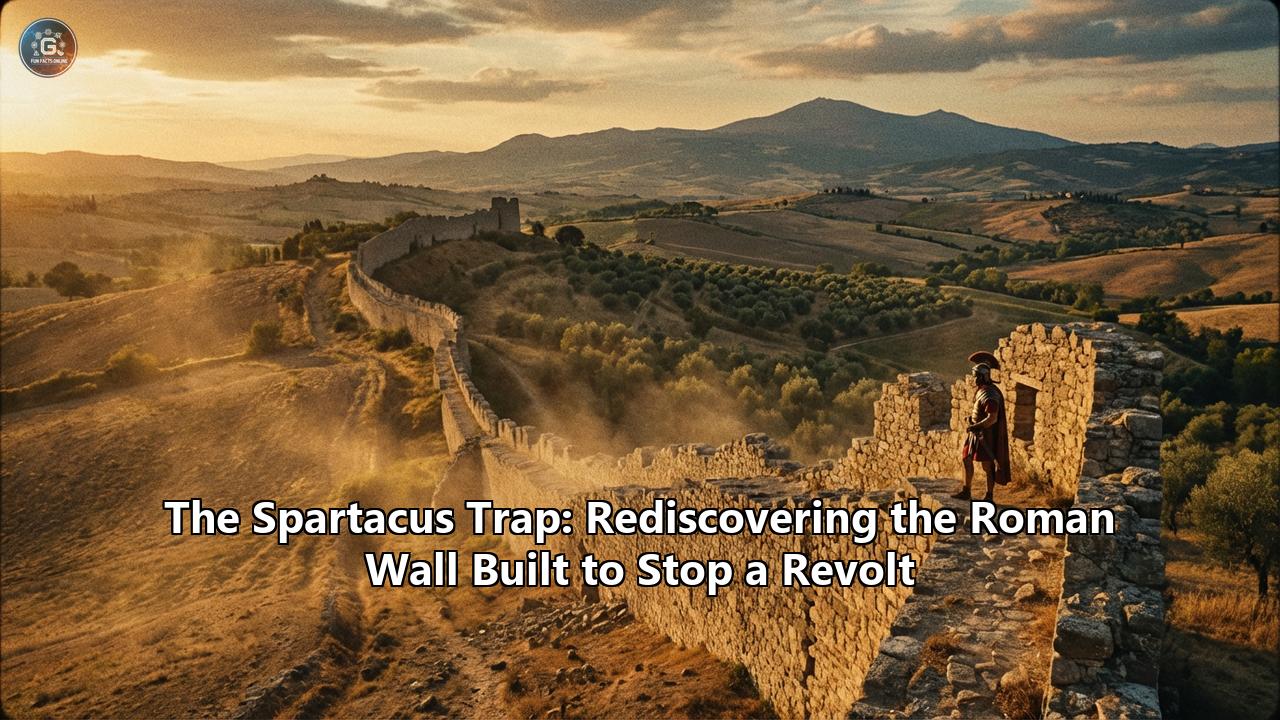
The moss-covered stones in the Dossone della Melia forest have been silent for over two thousand years. Hikers passed them, locals knew of them as a strange, linear mound running through the trees, but the true nature of this structure remained a ghost story of history—until now.
In a stunning convergence of modern technology and ancient legend, archaeologists have unearthed what is believed to be the "Spartacus Trap"—the very fortifications built by the Roman general Marcus Licinius Crassus to cage the most famous rebel in history. This discovery does not just add a footnote to a textbook; it brings the terrifying final days of the Third Servile War into sharp, physical focus.
The Discovery: A Secret in the Calabrian Woods
For decades, the dense forests of the Dossone della Melia plateau in south-central Calabria held a secret. It began with a tip—not from a historian or a treasure hunter, but from a local group of environmentalists. They had observed a long, unnatural stone barrier winding through the wilderness, covered in layers of earth and moss, and they suspected it was more than just an old property line.
They contacted Dr. Paolo Visonà, an archaeologist at the University of Kentucky. Intrigued, Visonà assembled a team that included experts from the Italian Ministry of Culture and specialists in geophysics. They didn't just bring trowels and brushes; they brought the full weight of 21st-century technology. Using Ground-Penetrating Radar (GPR), Lidar (Light Detection and Ranging), and magnetometry, they stripped away the canopy and the soil digitally.
What they saw on their screens was unmistakable. It wasn't just a wall; it was a military machine.
The structure ran for approximately 2.7 kilometers (1.7 miles). It was accompanied by a deep ditch, or fossa, and a mound system known as an agger. This specific combination—fossa and agger—is the fingerprint of Roman military engineering. It is the same system Julius Caesar used to starve out the Gauls at the Siege of Alesia. But this wall wasn't in Gaul. It was in the "toe" of Italy, exactly where historical sources claimed Crassus had trapped Spartacus.
The Smoking Gun: Iron and Blood
A wall alone proves only construction, not conflict. To confirm this was indeed the site of the legendary standoff, the team needed evidence of a fight. They found it.
Buried in the soil along the wall were the rusted remnants of a desperate, violent clash. The team recovered numerous broken iron weapons, including:
- Sword handles typical of the late Roman Republic.
- Javelin points used by Roman legionaries.
- Large, curved blades.
The curved blades are the most chilling find. They strongly resemble the sica, a curved dagger or short sword that was the signature weapon of Thracian gladiators. Finding these alongside Roman military hardware was the archaeological equivalent of a smoking gun. It suggested that Thracian fighters—Spartacus’s own people—had thrown themselves against this wall in a bid for freedom.
The Historical Context: The War That Shook Rome
To understand why this wall exists, we must understand the terror that spawned it. By 71 BCE, the Third Servile War had raged for two years. Spartacus, a gladiator who escaped a training school in Capua with 70 others, had built an army of over 70,000 escaped slaves, shepherds, and outcasts. They had defeated every Roman army sent against them, humiliating the Senate and striking fear into the heart of the Republic.
Rome turned to Marcus Licinius Crassus, the wealthiest man in Rome, a man desperate for military glory to match his rival, Pompey the Great. Crassus was ruthless. When he took command, he decimated his own troops—executing one in every ten men of a cowardly unit—to instill a fear of him that was greater than their fear of the enemy.
Spartacus had marched his people south to the very tip of Italy, intending to sail to Sicily. He had paid Cilician pirates to ferry his army across the Strait of Messina, hoping to ignite a new slave revolt on the island. But the pirates took the gold and sailed away, leaving Spartacus stranded.
He was trapped in the toe of Italy, with the sea at his back and Crassus’s legions closing in.
The Trap: Crassus’s Engineering Marvel
Crassus saw his opportunity. If he couldn't defeat Spartacus in a fair fight, he would imprison him. He ordered his legions to construct a massive fortification across the isthmus of the peninsula.
The Greek historian Plutarch described the feat:
"Crassus... set to work to build a wall across the isthmus; thus keeping his soldiers at once from idleness and his foes from forage. This great and difficult work he perfected in a space of time short beyond all expectation, making a ditch from one sea to the other... fifteen feet in width and depth alike."
The wall discovered in Dossone della Melia is almost certainly a section of this "great and difficult work." The location is strategic perfection. The plateau serves as a natural bottleneck between the Tyrrhenian and Ionian seas. By fortifying this pass, Crassus effectively put a cork in the bottle of Italy.
The wall was not just a pile of stones. It was a psychological weapon. It told the rebel army: You are no longer an army; you are prisoners. Behind the wall, supplies ran out. The winter set in. The rebels began to starve.
The Night of the Storm: The Breakthrough
The archaeological site tells the story of the end. The wall has no gates. It was not built to let people through; it was built to keep them in. But the presence of the broken weapons indicates a breach.
According to historical accounts, Spartacus did not go quietly. Realizing his army would die of hunger, he waited for a snowy winter night. A storm howled across the peninsula, blinding the Roman sentries and muffling the sound of movement.
Under the cover of the blizzard, the rebels frantically worked to fill the ditch. Plutarch tells us they used "earth and timber and the boughs of trees." Other darker legends suggest they used the bodies of their dead and the carcasses of their cattle to create a bridge of flesh and wood over the Roman fossa.
The rebels poured over the filled ditch, crashing into the wall. The broken curved blades found by Dr. Visonà’s team likely date to this chaotic, freezing night. We can imagine the scene: the screaming of men in the wind, the clash of Roman iron against gladiator steel, the desperate push of thousands of people trying to escape the trap.
Spartacus succeeded. He broke through the line with a portion of his army, forcing Crassus to abandon his siege and chase them down.
The Aftermath: A Legacy in Stone
The breakthrough at the wall was a tactical victory but a strategic defeat. It forced the rebels into the open, where Crassus—and the approaching armies of Pompey—could hunt them down. The final battle took place shortly after, where Spartacus is said to have died fighting his way toward Crassus himself, seeking to kill the general or die trying. His body was never found.
The 6,000 survivors of the rebellion were crucified along the Appian Way, a grim warning from Crassus to any other slave who dared to dream of freedom.
Why This Discovery Matters
For two millennia, the "Wall of Crassus" was a line in a history book. Now, it is a place you can stand. The discovery in Calabria grounds the legend of Spartacus in reality. It validates the ancient texts of Plutarch and Appian, proving that the scale of Roman engineering was as massive as claimed.
But more importantly, it gives a voice to the voiceless. The broken sica blade in the dirt speaks of the individual fighter who held it—a man who stood in the freezing snow, facing the might of the greatest empire on earth, and swung his sword against a wall of stone.
This discovery is not just about a Roman general’s trap; it is a monument to the desperation and defiance of the human spirit. The wall failed to hold Spartacus, just as history has failed to forget him.
Reference:
- https://www.ancient-origins.net/news-history-archaeology-ancient-places-europe-history-famous-people/spartacus-wall-0021020
- https://archaeologymag.com/2024/07/roman-wall-and-site-of-clash-with-spartacus/
- https://www.warhistoryonline.com/news/spartacus-marcus-licinius-crassus-wall-discovery.html
- https://www.popularmechanics.com/science/archaeology/a61688205/archaeologists-uncover-spartacus-rebellion-proof/
- https://www.smithsonianmag.com/smart-news/archaeologists-discover-the-roman-wall-spartacus-broke-through-with-his-rebel-army-180984738/
- https://greekreporter.com/2024/07/03/roman-defensive-wall-trap-spartacus-uncovered-italy/
- https://www.finestresullarte.info/en/archaeology/calabria-site-of-a-battle-between-spartacus-and-the-romans-discovered
- https://www.zmescience.com/science/news-science/roman-wall-spartacus-italy/
- https://www.archaeological.org/wall-built-to-contain-spartacus-discovered/
- https://www.stone-ideas.com/107984/stone-wall-rome-against-spartacus-rebels/
- https://www.livescience.com/archaeology/romans/site-of-epic-clash-between-spartacus-and-romans-uncovered
- https://www.sci.news/archaeology/spartacus-wall-13239.html
- https://grokipedia.com/page/Battle_of_Cantenna
- http://classics.mit.edu/Plutarch/crassus.html
- https://www.livius.org/sources/content/plutarch/plutarchs-crassus/plutarch-on-spartacus/
- https://www.reddit.com/r/history/comments/1dszur5/wall_built_to_contain_spartacus_discovered/
- https://en.wikipedia.org/wiki/Agger_(ancient_Rome))
- https://penelope.uchicago.edu/Thayer/E/Roman/Texts/Plutarch/Lives/Crassus.html