
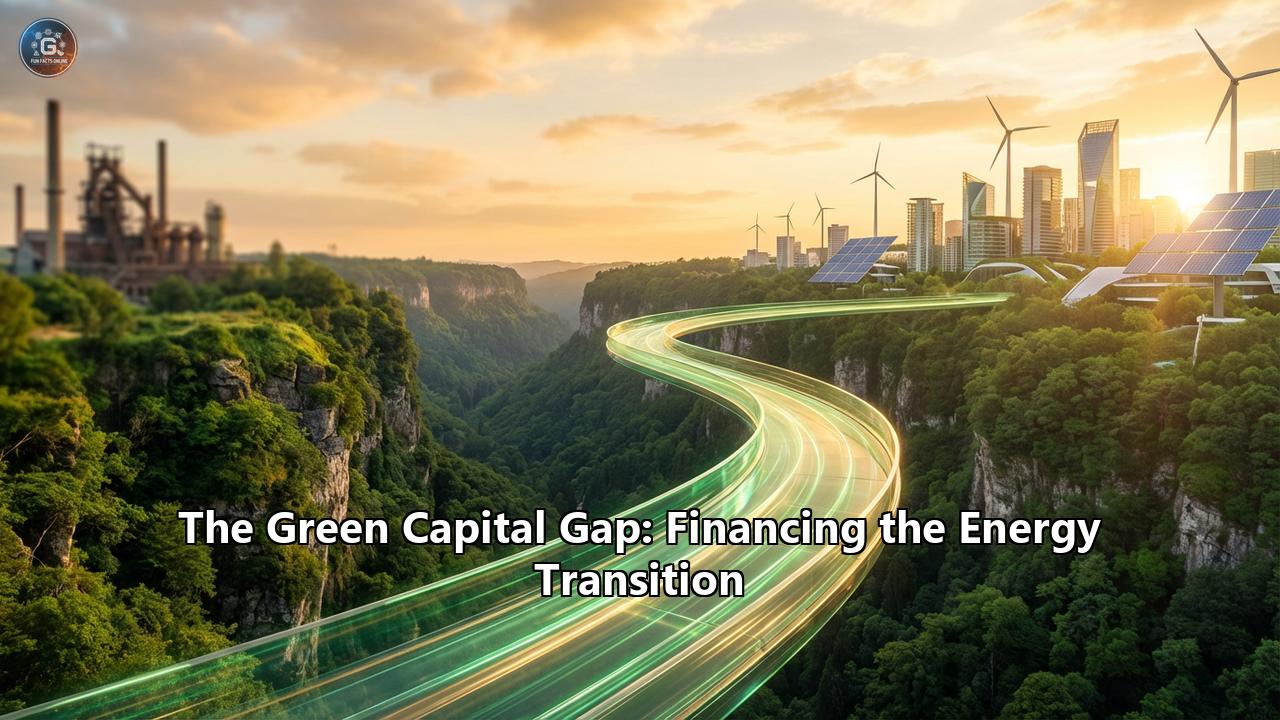
The Great Transition of the 21st century is no longer a question of technology, but a question of capital. We have the solar panels to harvest the sun, the turbines to catch the wind, and the electrolyzers to split water. What we lack—or rather, what we have failed to mobilize in the right places—is the money.
As we stand in early 2026, the global energy landscape presents a paradox of historic proportions. On the surface, the numbers are dazzling. Global investment in energy has surged to a record $3.3 trillion, with clean technologies attracting two dollars for every single dollar spent on fossil fuels. Solar power has become the cheapest source of electricity in history, attracting more capital than all upstream oil production combined. The "Age of Electricity" is officially upon us, driven by the relentless electrification of transport, heating, and the voracious appetite of artificial intelligence data centers.
Yet, beneath this veneer of progress lies a profound and widening chasm: The Green Capital Gap.
This gap is not merely a shortfall in accounting; it is a structural failure of the global financial system to allocate resources where they are most needed. While the Global North and China race ahead, capitalizing on deep financial markets and fiscal largesse, the Global South—home to the vast majority of the world’s population and the fastest-growing energy demand—is being left behind. The gap between the $2 trillion we are spending on clean energy and the $5 trillion required annually to stay on a 1.5°C pathway is measured not just in dollars, but in future stranded assets, geopolitical instability, and accelerated climate catastrophe.
This article explores the anatomy of this financial divide. It delves into the mechanics of why capital flows like water to the path of least resistance rather than the path of greatest need. It examines the "unbankable" projects of the emerging world, the stagnant funding for hard-to-abate sectors like steel and shipping, and the desperate need for grid modernization. But more importantly, it outlines the solutions—the financial engineering, the policy shifts, and the institutional reforms—that are attempting to build a bridge across the gap.
Part I: The Anatomy of the Gap
To understand the solution, one must first respect the scale of the problem. For decades, the energy transition was framed as a technological hurdle. The argument was that green energy was simply too expensive. That argument is dead. Today, the Levelized Cost of Energy (LCOE) for utility-scale solar and onshore wind is lower than coal and gas in the vast majority of the world. Economics has done its job. Finance, however, has not.
The "Green Capital Gap" refers to the difference between the current flows of climate finance and the needs estimated by models compliant with the Paris Agreement. By 2030, the International Energy Agency (IEA) and the International Renewable Energy Agency (IRENA) estimate that annual investment in clean energy must more than triple from 2023 levels. We are currently mobilizing roughly $2 trillion for clean energy. We need $4.5 to $6 trillion.
But the aggregate number hides the true crisis. The gap is not evenly distributed. If you are a developer building a solar farm in Texas or a wind park in the North Sea, capital is abundant. In fact, there is often too much capital chasing too few "bankable" projects in the OECD, compressing returns. Conversely, if you are trying to build the same solar farm in Nigeria, Pakistan, or Indonesia, capital is either nonexistent or prohibitively expensive.
This creates a vicious cycle. The countries most vulnerable to climate change and most in need of energy access are the ones charged the highest risk premiums. The cost of capital—the return investors demand to lend money—can be up to seven times higher in emerging markets than in advanced economies. A project that is profitable with a 4% interest rate in Germany becomes a financial disaster with a 15% interest rate in Kenya. This "capital cost trap" is the single greatest barrier to the global energy transition.
Furthermore, the gap is sector-specific. We are witnessing a "green asset bubble" in mature technologies like solar PV and electric vehicles (EVs), while "hard-to-abate" sectors—cement, steel, aviation, and heavy shipping—remain starved of transition finance. These industries require massive upfront capital for technologies that are not yet commercially mature, such as Green Hydrogen or Carbon Capture, Utilization, and Storage (CCUS). Investors, driven by quarterly returns and fiduciary duties that prioritize low risk, shy away from the technological and execution risks associated with these industrial giants.
Part II: The Great Divergence (North vs. South)
The energy transition is currently a "two-speed" phenomenon. In the fast lane are the Advanced Economies and China. In the slow lane is the rest of the world.
China continues to be the undisputed titan of green investment, accounting for nearly a third of the global total. Its state-directed capitalism allows for massive, coordinated deployment of renewables, grid infrastructure, and supply chain manufacturing. Similarly, the United States, propelled by the Inflation Reduction Act (IRA), and the European Union, driven by the Green Deal, have created robust domestic markets where tax credits and subsidies de-risk investment. In these regions, the transition is self-sustaining; the sheer volume of deployment drives down costs, which in turn invites more investment.
Contrast this with the "Global South"—a term that encompasses a vast diversity of nations but shares a common struggle in accessing affordable finance. Despite holding 60% of the world’s best solar resources, Africa attracts less than 3% of global clean energy investment. This is not due to a lack of demand; nearly 600 million people on the continent still lack access to electricity. It is due to the perception of risk.
The Perception-Reality ArbitrageInternational investors often cite "political risk," "currency risk," and "regulatory instability" as reasons to avoid emerging markets. While these risks are real, data suggests they are often overstated. Default rates on infrastructure projects in Africa, for instance, are historically lower than those in many parts of the developed world. Yet, the credit rating agencies and internal risk models of major Western banks heavily penalize these regions.
The result is a "sovereign ceiling" problem. A private solar company in a developing nation cannot be rated higher than the sovereign government of that country. If the country has a "junk" credit rating, the solar project is deemed junk, regardless of its individual economics or the creditworthiness of the off-taker.
The Debt Crisis HangoverCompounding this is the post-pandemic debt crisis. Many emerging economies are drowning in debt service payments, exacerbated by high global interest rates from 2022 to 2025. When a government spends 40% of its revenue servicing external debt, it has no fiscal space to offer sovereign guarantees for power purchase agreements (PPAs). Without these guarantees, international developers cannot secure debt financing. The public balance sheets that usually underpin energy infrastructure are tapped out.
This divergence threatens to fracture the global economy. If the Global North decarbonizes while the Global South is forced to rely on coal and gas to meet its development needs, the world will still breach its climate targets. Carbon dioxide does not respect borders. A ton of carbon emitted in Mumbai has the same atmospheric effect as a ton emitted in Manhattan. Therefore, closing the capital gap in the Global South is not charity; it is a prerequisite for the survival of the Global North.
Part III: The Age of Electricity and the Grid Bottleneck
While financing generation (solar and wind) has become easier, a new, more insidious gap has emerged: the grid.
We are entering the "Age of Electricity." The demand for power is decoupling from general economic growth, driven by three simultaneous revolutions: the electrification of transport (EVs), the electrification of heat (heat pumps), and the digitalization of everything (AI and data centers). In some regions, AI data centers alone are projected to double regional power demand by 2030.
This surge is crashing into a grid infrastructure built for the 20th century. In the US and Europe, "interconnection queues"—the waiting lists for renewable projects to connect to the grid—stretch for years. There are terawatts of solar and wind projects that are fully financed and ready to build but are stuck in regulatory limbo because the grid cannot handle them.
The Silent Crisis of TransmissionFinancing grids is fundamentally different from financing a solar farm. A solar farm is a discrete asset with a clear revenue stream. A transmission line is a linear infrastructure project that crosses hundreds of miles, multiple jurisdictions, and thousands of properties. It faces immense permitting hurdles and local opposition (NIMBYism). Furthermore, grids are natural monopolies, usually owned by state utilities or regulated entities. Their investment is constrained by what regulators allow them to charge ratepayers.
In the developing world, the grid problem is even more acute. Many utilities are technically insolvent. They lose money on every kilowatt-hour they sell due to technical losses (old wires), commercial losses (theft), and tariffs that are set below the cost of recovery for political reasons. Investors will not pour money into adding generation capacity if the grid utility—the primary customer—cannot pay its bills.
The Storage GapAlongside grids, energy storage is the critical enabler of a high-renewables future. While lithium-ion battery costs have plummeted, making short-duration storage (4-hour) commercially viable, we face a massive gap in "Long-Duration Energy Storage" (LDES). To run a grid on wind and solar, we need to store energy not just for hours, but for days and weeks to cover "dunkelflaute" (dark doldrums) periods. Technologies like pumped hydro, compressed air, and flow batteries are technically proven but financially risky. They require long lead times and massive capital, and current power markets do not adequately reward the "insurance value" they provide to the grid.
Part IV: The Hard-to-Abate Frontier
If renewable energy is the "low-hanging fruit" of climate finance, the heavy industry is the tree that requires a ladder we haven't built yet. Steel, cement, aluminum, chemicals, aviation, and shipping account for nearly 30% of global emissions. These sectors are deemed "hard-to-abate" because electricity cannot easily provide the intense heat or energy density they require.
The solutions exist: Green Hydrogen (hydrogen produced via electrolysis using renewables), Green Ammonia for shipping, and Carbon Capture for cement. However, the "Green Premium"—the extra cost of the clean product versus the dirty incumbent—remains high. Green steel costs 20-30% more than conventional steel. Green jet fuel is 2-3 times more expensive than kerosene.
The Chicken-and-Egg ProblemFinancing these projects faces a classic chicken-and-egg dilemma. A green hydrogen developer cannot secure billions in debt financing without a long-term off-take agreement from a buyer. A steelmaker will not sign a long-term contract for expensive green hydrogen unless they have a guarantee that car manufacturers will buy their expensive green steel. The car manufacturer hesitates to commit unless consumers are willing to pay a premium.
Breaking this deadlock requires "Transition Finance." This is a controversial but necessary evolution of green finance. Pure "Green Bonds" usually exclude anything related to fossil fuels or heavy industry. Transition finance allows for investments in dirty sectors if they are on a credible path to decarbonization. For example, a bond issued by a shipping company to retrofit its fleet for dual-fuel methanol engines.
However, transition finance is plagued by fears of "greenwashing." Investors are terrified of headlines accusing them of funding polluters. Consequently, capital remains on the sidelines, waiting for perfect taxonomy definitions while the blast furnaces continue to burn coal.
Part V: The Financial Toolbox – Innovation and Engineering
Given these structural barriers, how do we move the money? The past few years have seen an explosion of financial innovation designed to bridge the gap.
1. Blended Finance: The Holy Grail?Blended finance is the strategic use of development finance and philanthropic funds to mobilize private capital flows to emerging and frontier markets. The logic is simple: If a project is too risky for a pension fund, a public institution (like the World Bank or a government aid agency) steps in to take the "first loss" tranche. If the project goes bust, the public money is lost first, protecting the private investor. This improves the risk-return profile, making the "unbankable" bankable.
While intellectually appealing, blended finance has struggled to scale. It often involves bespoke, complex deal structures that take years to negotiate. To close the gap, we need to move from "artisanal" blended finance to "industrial" scale. This means standardized portfolio guarantees where a development bank covers a basket of loans across multiple countries, rather than negotiating deal-by-deal.
2. The Green Bond ExplosionThe market for Green, Social, and Sustainability (GSS) bonds has matured into a multi-trillion-dollar asset class. Sovereigns from France to Fiji have issued green bonds. Corporations use them to signal their commitment to sustainability.
A potent variation is the Sustainability-Linked Bond (SLB). Unlike a traditional green bond where the proceeds are "ring-fenced" for specific green projects, an SLB can be used for general corporate purposes. However, the interest rate (coupon) is tied to the company's performance against specific Key Performance Indicators (KPIs), such as reducing total carbon emissions by 25% by 2030. If the company misses the target, the interest rate goes up. This aligns the financial incentives of the CFO with the sustainability goals of the CSO.
3. Carbon Markets 2.0Carbon markets have historically been volatile and fragmented. However, the operationalization of Article 6 of the Paris Agreement is creating a framework for countries to trade carbon credits. A country that over-delivers on its climate targets can sell the excess "mitigation outcomes" to a country that is lagging.
Simultaneously, the Voluntary Carbon Market (VCM) is undergoing a painful but necessary "flight to quality." After scandals involving worthless forestry credits, new integrity standards (like the ICVCM) are emerging. High-quality carbon credits can provide a vital revenue stream for projects in the Global South, such as mangrove restoration or clean cookstove distribution, which otherwise offer no financial return.
4. "Green Banks" and National FundsMany countries are establishing dedicated Green Investment Banks (GIBs). These are public entities with a specific mandate to crowd in private capital. By understanding local risks better than Wall Street, they can offer concessional loans, guarantees, or equity to kickstart local markets. The US Greenhouse Gas Reduction Fund (part of the IRA) is effectively a $27 billion national green bank, designed to leverage private capital at a ratio of 7:1 or higher.
Part VI: The Role of Institutional Investors
The deepest pockets in the world belong to institutional investors: pension funds, insurance companies, and sovereign wealth funds. Collectively, they manage over $100 trillion in assets. The Green Capital Gap could be closed if just 1-2% of these assets were reallocated from high-carbon to low-carbon investments.
However, these giants are conservative by nature. They need "investment-grade" assets. They cannot easily invest in a greenfield wind farm in Namibia. They need aggregated vehicles—funds of funds or securitized portfolios—that look and behave like the bonds they are used to buying.
Fiduciary Duty ReimaginedA legal transformation is underway regarding "fiduciary duty." Historically, asset managers interpreted this as maximizing short-term financial returns. Now, there is a growing legal consensus that ignoring climate risk is a breach of fiduciary duty. If an asset manager ignores the transition risk (the risk that policy or technology will make fossil fuel assets worthless) or physical risk (floods and fires destroying assets), they are failing their clients. This shift is slowly forcing capital allocation changes, not out of altruism, but out of self-preservation.
The Rise of Climate PE and VCAt the riskier end of the spectrum, Private Equity (PE) and Venture Capital (VC) are flooding into Climate Tech. This is no longer just about software. We are seeing a resurgence of "Deep Tech" investing: novel battery chemistries, nuclear fusion, advanced geothermal, and direct air capture. While this capital doesn't solve the deployment gap for mature technologies in poor countries, it is vital for solving the technology gap for the hard-to-abate sectors.
Part VII: The Geopolitical Overlay
Money does not exist in a vacuum. The Green Capital Gap is being shaped by intense geopolitical rivalry.
The Subsidy WarsThe US Inflation Reduction Act changed the global gravity of capital. By offering uncapped tax credits for domestic production of clean energy, it sucked capital away from other regions. The EU responded with the Net Zero Industry Act. While this competition accelerates deployment in the West, it risks fragmenting the global market. "Friend-shoring"—building supply chains only in allied nations—increases costs. If the West blocks cheap Chinese solar panels or EVs in the name of "security," the cost of the transition rises, and the capital gap widens.
Critical Minerals SecurityThe transition requires copper, lithium, cobalt, and nickel. Financing the mines to extract these minerals is fraught with Environmental, Social, and Governance (ESG) challenges. Western investors are hesitant to fund mines in jurisdictions with poor labor or environmental records. Yet, without this financing, supply shortages will cause clean tech prices to spike. This has opened the door for Chinese state-backed entities, which have shown a higher risk appetite, to dominate the critical mineral supply chain in Africa and Latin America.
Part VIII: Adaptation – The Forgotten Half
Almost all the discussion above focuses on "Mitigation" (reducing emissions). But for the Global South, "Adaptation" (surviving the impacts) is equally urgent. Building sea walls, drought-resistant agriculture, and resilient infrastructure requires trillions.
The financing gap for adaptation is catastrophic. Unlike a solar farm, a sea wall generates no cash flow. It is a public good. Therefore, private finance has little interest in it. Adaptation finance is almost entirely dependent on public grants and aid, which are shrinking as Western budgets tighten.
Innovative mechanisms are emerging, such as "Resilience Bonds" (where insurance savings pay for the bond) or "Debt-for-Nature Swaps" (where a country's debt is forgiven in exchange for investing the savings in conservation). For instance, Ecuador recently completed the largest debt-for-nature swap in history to protect the Galapagos Islands. Scaling these instruments is vital to protect the most vulnerable from a crisis they did not create.
Conclusion: The Cost of Inaction
The "Green Capital Gap" is not just a financial statistic. It is a measure of our collective inability to align our economic systems with physical reality.
Closing the gap requires a fundamental rewiring of the global financial architecture.
It requires Multilateral Development Banks (MDBs) like the World Bank to become bigger, bolder, and riskier, leveraging their balance sheets to de-risk private capital.
It requires policymakers to provide long-term certainty, removing the regulatory flip-flops that kill investment.
It requires central banks to recognize climate stability as a prerequisite for price stability.
And it requires private capital to look beyond the quarter, recognizing that there is no profit on a dead planet.
The cost of closing the gap is high—$4 trillion, $5 trillion, perhaps $6 trillion a year. But the cost of not closing it is incalculable. It is the cost of lost cities, collapsed food systems, and unmanageable migration.
The money exists. The world has never been wealthier. The "Green Capital Gap" is ultimately a gap in will, imagination, and coordination. Bridging it is the defining challenge of our time, and the bridge is being built, dollar by dollar, policy by policy, innovation by innovation. The only question remaining is: will we finish it in time?
Deep Dive Section 1: The Bankability Paradox in Emerging Markets
To truly understand why capital doesn't flow to the Global South, we must dissect the concept of "bankability." In the glass towers of London, New York, or Singapore, a project is "bankable" if it fits a specific, rigid template.
- The Off-Taker Risk: A solar project is only as good as the entity buying the electricity. In many African and Asian nations, the state-owned utility is effectively bankrupt. If the buyer can't pay, the project has no revenue. In developed markets, if a utility is shaky, the government guarantees the contract. In emerging markets, the government's guarantee is often deemed worthless by credit committees because the government itself is over-leveraged.
Solution in Action: The World Bank's MIGA (Multilateral Investment Guarantee Agency) provides insurance against this specific risk. However, MIGA's capacity is small compared to the need. New platforms like the Africa GreenCo act as a creditworthy intermediary, buying power from independent producers and selling it to the regional power pool, effectively decoupling the project risk from a single national utility.
- Currency Mismatch: Energy projects usually earn revenue in local currency (Naira, Rupees, Shillings). But the debt to build them is usually in hard currency (Dollars, Euros). If the local currency crashes (as seen recently in Egypt, Nigeria, and Pakistan), the project's revenue shrinks in dollar terms, making it impossible to service the debt.
Solution in Action: TCX (The Currency Exchange Fund) was created to offer hedging products for exotic currencies where no commercial market exists. However, hedging is expensive. It adds cost to the project, raising the tariff for poor consumers. A systemic solution involves developing deep local capital markets so that projects can be funded in local currency by local pension funds, removing the currency mismatch entirely.
- Ticket Size: Institutional investors like to write checks for $100 million or more. Due diligence costs are fixed; it costs the same to assess a $10 million project as a $100 million one. Many renewable projects in developing nations are small-scale (mini-grids, commercial & industrial rooftop solar), often in the $5-20 million range. They are "too small to care" for Wall Street.
Solution in Action: Aggregation. Investment platforms like SunFunder (acquired by Mirova) or CrossBoundary Energy bundle dozens of small projects into a single portfolio. By diversifying the risk and increasing the total deal size, they create a vehicle that institutional capital can swallow.
Deep Dive Section 2: The Grid Modernization Challenge
The grid is the largest machine on earth, and rebuilding it while it's running is akin to performing open-heart surgery on a marathon runner.
The Physical Constraint:Traditional grids are "unidirectional"—power flows from a massive coal plant down to the consumer. The new grid is "bidirectional." A home with solar panels and an EV battery is both a consumer and a producer ("prosumer"). The distribution grid (the poles and wires on your street) was not built to handle power flowing backwards. Without massive investment in "Smart Grid" digital technologies—sensors, automated transformers, software management—the grid becomes unstable.
The Permitting Purgatory:In the West, money is ready to flow into transmission, but local opposition stops it. Building a high-voltage line to carry wind power from Wyoming to California involves crossing private land, federal land, tribal land, and state borders. Each has veto power.
- Reform: The US and EU are trying to centralize permitting authority, overriding local objections for projects deemed in the "national interest." This is politically explosive but necessary.
To solve the intermittency of wind and solar, we need to connect larger geographic areas. If the wind isn't blowing in Germany, it might be blowing in Scotland. If it's night in China, the sun is shining in Saudi Arabia.
- Megaprojects: The Xlinks project proposes to lay the world's longest undersea cable from Morocco to the UK, carrying solar and wind power. The Sun Cable project aims to link Australia to Singapore. These projects cost tens of billions and require unprecedented cross-border diplomatic and financial agreements. They represent the new frontier of infrastructure finance.
Deep Dive Section 3: Transition Finance and the Heavy Industry
The "Green" label is easy for wind farms. It is hard for a steel company that currently emits millions of tons of CO2 but wants to change.
The Steel Dilemma:Steel production accounts for ~8% of global emissions. To decarbonize, we must switch from Blast Furnaces (using coal) to Direct Reduced Iron (DRI) using Green Hydrogen. This requires rebuilding the entire plant.
- The Capital Stack: A green steel plant is a mega-project. It carries technology risk (will the hydrogen electrolyzers work at scale?), market risk (will anyone buy the expensive steel?), and execution risk.
- The Solution: "Advance Market Commitments" (AMCs). The First Movers Coalition is a group of companies (like Ford, Volvo, Maersk) that have committed to buying green materials even at a premium. This demand signal gives financiers the confidence to lend to the steel plant. It is a demand-pull mechanism rather than a supply-push one.
Ships have a lifespan of 25 years. A ship ordered today will still be sailing in 2050. If it runs on oil, it becomes a stranded asset.
- The Solution: "Green Corridors." Ports like Shanghai and Los Angeles agree to create a route where green methanol or ammonia bunkering is available. Finance flows to the infrastructure at these specific nodes, lowering the risk for shipowners to order dual-fuel vessels.
Deep Dive Section 4: The Role of Carbon Pricing
Ideally, we wouldn't need subsidies or complex blended finance if the price of pollution reflected its true cost. A robust global carbon price would make green projects instantly more profitable than fossil ones.
The European Model:The EU Emissions Trading System (ETS) has successfully driven coal off the grid by making it expensive. The price of carbon in Europe hovers around €60-€80 per ton.
The CBAM Shock:The EU's Carbon Border Adjustment Mechanism (CBAM) is a tariff on imports from countries that do not tax carbon. This is forcing industrial exporters in Turkey, India, and China to clean up their production to maintain access to the European market. It is exporting the carbon price globally.
The Voluntary Market:For projects in the Global South that cannot access compliance markets, the Voluntary Carbon Market (VCM) is a lifeline. Corporations buy credits to offset their emissions. Despite skepticism, this market channels billions into forest protection (REDD+) and renewable energy in developing nations. The key trend for 2026 is "integrity." New "Core Carbon Principles" ensure that a credit represents a real, permanent reduction. We are moving from "offsetting" (paying to pollute) to "contribution" (financing global decarbonization).
Deep Dive Section 5: The Human Element – Just Transition
Finally, the capital gap cannot be closed without addressing the human cost. The transition will destroy jobs in coal mining and oil drilling while creating jobs in solar installation and battery manufacturing. But a coal miner in West Virginia cannot easily become a solar installer in Arizona.
The "Just Energy Transition Partnerships" (JETPs):This is a new financing model piloted with South Africa, Indonesia, and Vietnam. A coalition of rich nations (G7) offers a package of billions (loans, grants, guarantees) to help a specific coal-dependent country retire its coal plants early and build renewables.
- The Challenge:* The money is often mostly loans, adding to the country's debt burden. The grant component (free money) is small. Furthermore, closing coal plants affects entire regional economies. The "Just" part of the transition requires funding for social safety nets, retraining, and regional economic diversification. This "social infrastructure" is harder to finance than a power plant because it generates no revenue.
Final Thoughts: The Roadmap to 2030
As we look toward the end of the decade, the path to closing the Green Capital Gap is becoming clearer, even if it remains steep.
- Reform the Bretton Woods Institutions: The World Bank and IMF must embrace "callable capital" to expand their lending capacity without needing new cash injections from shareholders. They must prioritize climate as a development issue.
- Standardize to Securitize: We need to turn green projects into standardized commodities that can be bundled and sold to pension funds, just like mortgages.
- Taxonomy Harmonization: The world needs a common language for what counts as "green" and "transition" to prevent fragmentation and greenwashing.
- Radical Collaboration: The public and private sectors must stop viewing each other with suspicion. Public money must be used aggressively to de-risk private money.
The energy transition is the largest capital reallocation in human history. It is an industrial revolution, a financial restructuring, and a geopolitical realignment all rolled into one. The gap is the friction between the old world and the new. Closing it is not just an opportunity for profit; it is the prerequisite for a habitable future.
Reference:
- https://www.renewableinstitute.org/global-energy-investment-hits-record-high-key-takeaways-from-the-ieas-2025-report/
- https://www.hanwha.com/newsroom/news/feature-stories/iea-world-energy-investment-report-2025-where-is-global-capital-flowing.do
- https://www.iigcc.org/insights/world-energy-investment-2025-highlights-electricity-demand-and-energy-security-new-drivers
- https://www.iea.org/reports/world-energy-investment-2025/executive-summary
- https://assets.kpmg.com/content/dam/kpmgsites/az/pdf/2024/Energy-transition-investment-outlook.pdf.coredownload.inline.pdf
- https://www.wri.org/update/5-barriers-hinder-green-financing
- https://assets.bbhub.io/professional/sites/24/951623_BNEF-Energy-Transition-Trends-2025-Abridged.pdf
- https://www.adb.org/publications/an-overview-of-approaches-to-transition-finance-for-hard-to-abate-sectors
- https://www.oecd.org/en/publications/global-outlook-on-financing-for-sustainable-development-2025_753d5368-en.html
- https://www.climatepolicyinitiative.org/wp-content/uploads/2000/06/compressed_Global-Landscape-of-Climate-Finance-2025.pdf
- https://medium.com/@benjamincharity801/blended-finance-for-the-energy-transition-mobilising-capital-at-scale-5ce955fd6498
- https://www.orfonline.org/research/the-green-development-compact-atlantic-ambition-southern-scale
- https://www.irena.org/Publications/2025/Nov/Global-landscape-of-energy-transition-finance-2025
- https://www.nationthailand.com/business/economy/40060566