
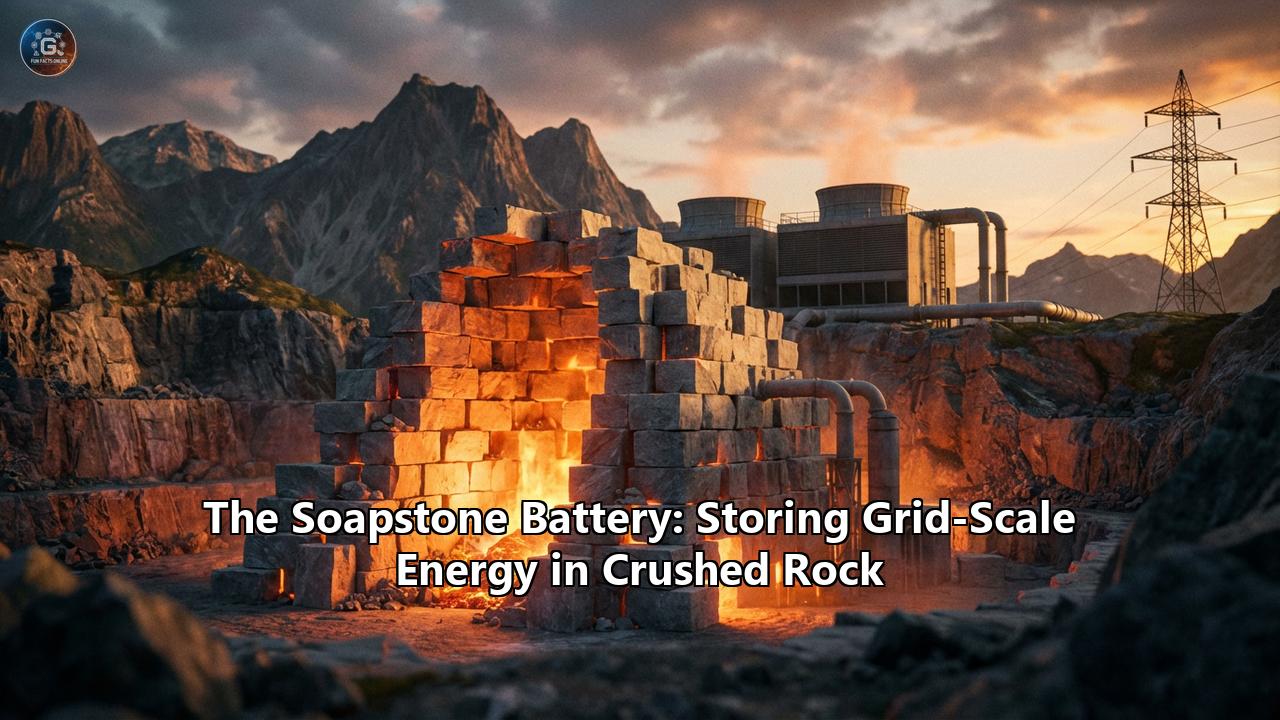
The world of energy storage is dominated by the gleaming, high-tech imagery of lithium-ion cells, gigafactories, and flow batteries. We imagine the future of the grid as a silent hum of chemical reactions inside hermetically sealed metal containers. But in the forests of Southern Finland, a quiet revolution is taking place that looks less like a laboratory and more like a quarry.
The solution to one of humanity’s most complex problems—how to store massive amounts of renewable energy for days or weeks at a time—might not lie in rare earth metals or complex polymers. It might be hiding in a pile of crushed rock.
Welcome to the age of the Soapstone Battery.
While the media has popularized the term "Sand Battery," the cutting edge of this technology has graduated from common quartz sand to something far more thermally potent: steatite, commonly known as soapstone. This ancient rock, once carved by Vikings for cooking pots and by artisans for sculptures, is now being crushed by the thousands of tons to act as a thermal heart for modern district heating.
This is the comprehensive story of how a waste product from fireplace manufacturing is challenging our understanding of "batteries," stabilizing the electrical grid, and offering a low-tech, high-impact solution to the intermittency of green energy.
Part I: The Magic Stone (Steatite)
To understand why engineers are turning to soapstone, we must first understand the rock itself. To a geologist, it is steatite, a metamorphic rock composed largely of talc and magnesite. To the layman, it is soapstone, named for the soft, soapy feel of its surface due to the talc content.
For thousands of years, humans have recognized soapstone as a "magic stone" for one specific property: thermal mass.
Most rocks are decent at holding heat, but soapstone is a thermal outlier. It has a high specific heat capacity (the amount of energy required to raise its temperature) and, critically, a thermal conductivity that is far superior to standard brick or granite.
- Heat Capacity: Soapstone can store significantly more heat per unit of volume than ordinary concrete or clay brick.
- Conductivity: It absorbs heat rapidly and releases it slowly and evenly. This is why it has been the gold standard for masonry heaters (fireplaces that radiate heat for hours after the fire goes out) in Nordic countries for centuries.
The Circular Economy of Rock
The most elegant aspect of the modern soapstone battery is its supply chain. Mining fresh rock for energy storage would be environmentally costly. However, the soapstone being used in the latest grid-scale projects—specifically the flagship facility in Pornainen, Finland—is not mined for this purpose.
It is industrial waste.
Finland is home to companies like Tulikivi, the world’s largest manufacturer of heat-retaining soapstone fireplaces. When these fireplaces are cut and carved, massive amounts of off-cuts and crushed by-products are generated. For decades, this was just waste rock. Now, it is the active medium of a thermal battery. By using crushed soapstone, the battery achieves a double environmental victory: it provides zero-carbon storage while utilizing a material that has already been mined, effectively closing the loop on a circular economy.
Part II: How the Soapstone Battery Works
The principle behind the soapstone battery is disarmingly simple, relying on 19th-century thermodynamics rather than 21st-century electrochemistry. It is a system known as Sensible Heat Storage.
The Architecture
Imagine a massive steel silo, insulated heavily to prevent heat leakage. In the Pornainen project, this silo stands approximately 13 meters (43 feet) tall and 15 meters (49 feet) wide. Inside, there are no electrolytes, no cathodes, and no anodes. There is only a massive bed of crushed soapstone—about 2,000 tons of it.
Buried within this mountain of rock is a system of heat transfer pipes and electrical resistive heating elements (similar to the coils in a toaster, but on an industrial scale).
The Charging Cycle (Power-to-Heat)
The battery "charges" when there is excess electricity on the grid.
- Renewable Surge: On a windy night or a sunny afternoon, wind turbines and solar panels often produce more electricity than the grid can use. This drives electricity prices down, sometimes even into negative territory.
- Resistive Heating: An automated algorithm switches on the resistive heaters inside the silo. These heaters convert the cheap electricity into thermal energy with nearly 99% efficiency.
- Soaking the Stone: The heat is transferred to the crushed soapstone. Because soapstone is thermally stable, it can be heated to temperatures as high as 500°C to 600°C (932°F to 1112°F) without degrading, melting, or cracking.
The Storage Cycle
Once heated, the soapstone mass acts as a thermal flywheel. The insulation of the silo ensures that heat loss is minimal. The battery can hold this high-grade heat for days, weeks, or even months. This duration is the "killer app" of thermal storage. While a lithium-ion battery might store energy for 4 hours to cover the evening peak, a soapstone battery can store "summer sunshine" to be used during a "winter blizzard."
The Discharging Cycle (Heat-to-Heat)
When the community needs energy—specifically heat—the system discharges.
- Air Flow: Cool air is circulated through pipes embedded in the hot rock.
- Heat Transfer: The air absorbs the thermal energy from the soapstone, becoming superheated.
- District Heating: This hot air is used to heat water, which is then pumped into the local district heating network. This water circulates through underground pipes to heat homes, offices, and swimming pools.
Part III: The "Grid-Scale" Reality Check
A common misconception is that this battery takes electricity in and sends electricity back out. While that is technically possible using a steam turbine, the thermodynamics make it inefficient (returning only about 30-40% of the energy as electricity).
The true genius of the soapstone battery lies in Sector Coupling.
In cold climates (Northern Europe, Canada, Northern US, China, Russia), a huge percentage of total energy consumption is not for lights or computers, but for space heating. Traditionally, this heat comes from burning gas, coal, or biomass.
The Soapstone Battery replaces the burning of stuff. It takes electrical energy (which is becoming green and cheap) and converts it into thermal energy (which is what the city actually needs).
By absorbing 1 MW of electricity to heat the rocks, the battery stops the local power plant from needing to burn oil or wood chips to heat the water. It acts as a massive buffer for the electrical grid by soaking up "spilled" wind energy that would otherwise be curtailed (wasted) because there was nowhere to put it.
Key Stats of the Pornainen Project (Polar Night Energy):- Capacity: 100 MWh (Megawatt-hours) of thermal energy.
- Power Output: 1 MW (Megawatt) of thermal power.
- Material: 2,000 tons of crushed soapstone.
- Equivalent: It holds enough heat to keep the town warm for roughly one week in winter or one month in summer.
Part IV: Soapstone vs. The World
Why choose crushed soapstone over other materials?
1. Soapstone vs. Lithium-Ion
Lithium-ion batteries are champions of electrical density. They are perfect for cars and phones. But they are:
- Expensive: Costing hundreds of dollars per kWh.
- Degradable: They lose capacity over a few thousand cycles.
- Flammable: Thermal runaway is a safety risk.
Soapstone is dirt cheap (literally rock cheap), never degrades (a hot rock is the same as a cold rock), and cannot explode. While you can't run a Tesla on soapstone, you shouldn't waste a Tesla battery to heat a swimming pool. Soapstone handles the heavy lifting of thermal demand so lithium can focus on high-value electrical demand.
2. Soapstone vs. Water
Water is the traditional medium for thermal storage (large hot water tanks).
- Limitation: Water boils at 100°C (unless pressurized, which is dangerous and expensive).
- Soapstone Advantage: Soapstone can safely go to 600°C or higher. Because energy storage is a function of temperature difference (Delta T), the ability to reach these scorching temperatures means a soapstone battery can store much more energy in a smaller footprint than a water tank.
3. Soapstone vs. Ordinary Sand
The original pilots used standard quartz sand.
- Conductivity: Sand is a poor conductor of heat. Getting heat into and out of the center of a giant sand pile is slow.
- Soapstone Advantage: Soapstone has superior thermal conductivity. This allows the battery to "charge" and "discharge" faster, making it more responsive to grid price fluctuations. It effectively "supercharges" the sand battery concept.
Part V: The AI Brain
A pile of hot rocks is useless without a brain. The modern soapstone battery is controlled by sophisticated algorithms.
The battery is not just a passive tank; it is an active trader on the electricity market. The control software monitors:
- Weather Forecasts: "Is it going to be windy tomorrow?" (Electricity will be cheap).
- Spot Prices: "Is electricity negative right now?" (Turn on the heaters!).
- Demand Forecasts: "Will the town need extra heat on Thursday?" (Save the heat until then).
By intelligently charging only when prices are rock-bottom and discharging when heat is expensive to generate otherwise, the battery essentially arbitrages the energy market, paying for itself while stabilizing the grid.
Part VI: The Future of Low-Tech Storage
The Soapstone Battery represents a shift in how we view technology. For decades, "progress" meant smaller, more complex, and more digital. This technology argues that "progress" can also mean massive, simple, and geological.
It is a specialized solution. It requires a district heating network to be most effective, which limits its immediate adoption in places like the suburban United States where homes heat individually with gas furnaces. However, for industrial processes requiring high heat (drying food, manufacturing textiles) and for the thousands of cities globally with district heating, it is a game changer.
As we move toward a grid powered by 100% renewables, the intermittency problem will get worse. We will need batteries of all kinds. We will need lithium for our cars, flow batteries for our substations, and great silos of hot crushed soapstone to keep our cities warm through the long, dark winters.
It turns out that the best way to store the fire of the sun might just be a rock.
Reference:
- https://www.youtube.com/watch?v=EbEVOa9IEgQ
- https://undecided.tech/how-a-sand-battery-could-revolutionize-home-energy-storage/
- https://www.youtube.com/shorts/mYzZ4-PB62U
- https://medium.com/@Wi-Fun/how-a-soapstone-battery-could-change-renewable-energy-forever-00482b4d2fb2
- https://inspenet.com/en/noticias/polar-night-energy-sand-battery-advances/
- https://www.pv-magazine.com/2024/03/07/polar-night-energy-to-build-1-mw-sand-based-heat-storage-battery-in-finland/