
Prologue: The Ghost in the Machine
In the grand and often chaotic theatre of particle physics, few characters are as elusive, frustrating, and compelling as the neutrino. Often dubbed the "ghost particle," the neutrino is a subatomic whisper—a fundamental building block of the universe that outnumbers atoms by a billion to one, yet passes through our bodies, our planet, and our detectors with total indifference. For decades, the Standard Model of particle physics—the wildly successful theory that catalogs the universe’s matter and forces—has described neutrinos in a neat, three-part harmony: the electron neutrino, the muon neutrino, and the tau neutrino.
But for the last thirty years, a discordant note has rung out from the underground caverns and accelerator halls where physicists hunt these phantoms. Since the mid-1990s, a series of experimental anomalies hinted that the three-part harmony might actually be a quartet. Data from Los Alamos and Fermilab suggested the existence of a fourth, even ghostlier family member: the sterile neutrino.
This hypothetical particle was no mere curiosity. If it existed, it would break the Standard Model. It would be a portal to a "dark sector" of the universe, a particle that felt no force but gravity, offering potential explanations for everything from the asymmetry of matter and antimatter to the nature of dark matter itself. It was the great hope of "New Physics."
For two decades, the sterile neutrino haunted the data, hiding in the statistical margins, refusing to be confirmed but refusing to die. That is, until the MicroBooNE experiment at Fermilab opened its eyes.
In a landmark series of results culminating in late 2025, the MicroBooNE collaboration delivered a verdict that has shaken the foundations of neutrino physics. Armed with liquid argon technology that acts as a "subatomic retina," MicroBooNE peered into the heart of the anomaly that birthed the sterile neutrino hypothesis.
They found... nothing.
This is the story of that nothing. It is a story of a thirty-year chase, of a technology that revolutionized how we see the invisible, and of a scientific triumph that—by finding nothing—has told us everything about where we must go next.
Chapter 1: The Anomaly That Wouldn’t Die
To understand the weight of the MicroBooNE verdict, we must first understand the "crisis" it was built to solve. The story begins not at Fermilab, but in the high desert of New Mexico in the 1990s, at the Los Alamos National Laboratory.
The LSND Bombshell
In 1993, the Liquid Scintillator Neutrino Detector (LSND) began an experiment designed to study neutrino oscillations. By then, physicists knew that neutrinos came in three "flavors" (electron, muon, tau) and that they could morph, or "oscillate," from one flavor to another as they traveled. This shape-shifting ability is a direct consequence of quantum mechanics and implies that neutrinos have mass—a revelation that had already earned a Nobel Prize.
However, the rate at which neutrinos oscillate is determined by the difference in their masses. The Standard Model, combined with data from solar and atmospheric neutrinos, set strict limits on how fast these oscillations should occur.
LSND looked for muon antineutrinos transforming into electron antineutrinos over a relatively short distance (about 30 meters). According to the standard three-neutrino picture, this transformation should have been rare to the point of invisibility over such a short baseline.
But LSND saw something else. They detected a significant excess of electron antineutrinos—far more than the Standard Model could explain. The data implied that neutrinos were oscillating much faster than allowed, suggesting a mass difference that didn't fit into the three-neutrino hierarchy. To make the math work, you needed a fourth mass state. You needed a fourth neutrino.
The Birth of the "Sterile"
This fourth neutrino had to be different. The existing three neutrinos interact with matter via the Weak Nuclear Force—the force responsible for radioactive decay. We detect them because, very rarely, they strike an atom and exchange a W or Z boson.
But precise measurements of the Z boson’s decay width at the LEP collider in Europe had already proven that there are only three "active" neutrinos that feel the weak force. If a fourth neutrino existed, it could not interact via the weak force. It would be "sterile"—blind to the electromagnetic, strong, and weak forces, feeling only gravity. It would participate in the oscillation game solely through quantum mixing with the active neutrinos.
The idea was radical, but the LSND data was stubborn. The physics community was split. Was LSND a Nobel-worthy discovery, or a subtle experimental error?
Enter MiniBooNE
To settle the debate, Fermilab built the MiniBooNE experiment (Mini Booster Neutrino Experiment). Designed to operate at the same ratio of distance-to-energy (L/E) as LSND, MiniBooNE was the referee. If LSND was right, MiniBooNE would see the same excess of electron neutrinos.
MiniBooNE ran for over a decade, collecting data that would become infamous. Instead of resolving the mystery, it deepened it. MiniBooNE observed an excess of electron-like events, but not exactly where LSND predicted. More confusingly, they saw a large, unexplained spike in events at very low energies—the so-called Low Energy Excess (LEE).
The MiniBooNE anomaly was a "bump" in the data graph that refused to go away. It looked like electron neutrinos appearing where they shouldn't. It was consistent with some versions of the sterile neutrino hypothesis, but it was also messy.
The problem was MiniBooNE's eye. The detector was a giant tank of mineral oil lined with photomultiplier tubes. It detected neutrinos by watching for the faint ring of Cherenkov light produced when a charged particle moved through the oil faster than light travels in that medium.
Cherenkov detectors are powerful, but they have a fatal flaw: they struggle to tell the difference between an electron and a photon (a particle of light). Both produce fuzzy rings of light in the detector.
- If the MiniBooNE excess was electrons, it was evidence of oscillating neutrinos (potentially sterile).
- If the excess was photons, it was likely a misunderstood background process (like neutral pion decay) and the "anomaly" was just a mistake.
MiniBooNE couldn't tell them apart. The ghost particle survived in that ambiguity. The physics community was left in a state of purgatory, with a 4.8-sigma anomaly that could be the biggest discovery in decades or a simple instrumental limitation.
Chapter 2: The 3+1 Model and the Dark Sector
Before MicroBooNE could be built, theorists had already constructed vast edifices on the foundation of the LSND and MiniBooNE anomalies. The most popular was the 3+1 Model.
The Simple Solution
The 3+1 model is the "Vanilla Sky" of sterile neutrino theories. It posits the three known neutrinos plus one heavy, sterile neutrino (mass ~1 eV). This sterile state mixes slightly with the electron and muon neutrinos, allowing muon neutrinos to oscillate into sterile neutrinos, which then oscillate into electron neutrinos over short distances. This double-step dance would explain why MiniBooNE saw extra electrons.
The appeal of the 3+1 model was its simplicity. It required minimal changes to the equations. However, it was under siege from other directions. If sterile neutrinos existed, they should also cause muon neutrinos to disappear in other experiments (like IceCube or MINOS), but those experiments saw no such disappearance.
This "tension" between appearance experiments (LSND/MiniBooNE) and disappearance experiments forced theorists to get creative.
The Exotic Zoo
If the simple 3+1 model didn't fit all the data, perhaps the sterile neutrino was more complex.
- Decaying Sterile Neutrinos: Maybe the heavy sterile neutrino decays into a lighter neutrino and a photon (or a dark photon) inside the detector. This would look like an "excess" of energy.
- The Dark Sector: Perhaps the sterile neutrino is a portal to a hidden universe of particles—dark matter, dark photons, and dark scalars—that interact amongst themselves but rarely with us. The MiniBooNE anomaly might not be an oscillation at all, but the debris of a dark sector collision.
By 2015, the sterile neutrino had transformed from a simple oscillation fix into a gateway drug for exotic physics. The stakes were incredibly high. Confirming the MiniBooNE anomaly as "new physics" would be the first departure from the Standard Model since its inception.
But to do that, physicists needed a better camera. They needed to see the difference between an electron and a photon.
Chapter 3: The Technology of Truth
The resolution to the MiniBooNE crisis required a technological leap. It required the Liquid Argon Time Projection Chamber (LArTPC).
The Bubble Chamber Reborn
In the mid-20th century, physicists used bubble chambers—vessels filled with superheated liquid that boiled along the tracks of charged particles. These chambers produced beautiful, intricate photographs of subatomic interactions, allowing physicists to distinguish particles by the specific curvature and "dE/dx" (energy loss) of their tracks.
However, bubble chambers were slow and hard to digitize. They were replaced by electronic detectors (like MiniBooNE's Cherenkov tank) which were fast and digital but offered "fuzzy" resolution. They could tell you something happened, but they couldn't draw you a picture of it.
The LArTPC is the digital resurrection of the bubble chamber. It combines the massive target volume needed to catch elusive neutrinos with the high-resolution imaging of a photograph.
How MicroBooNE Works
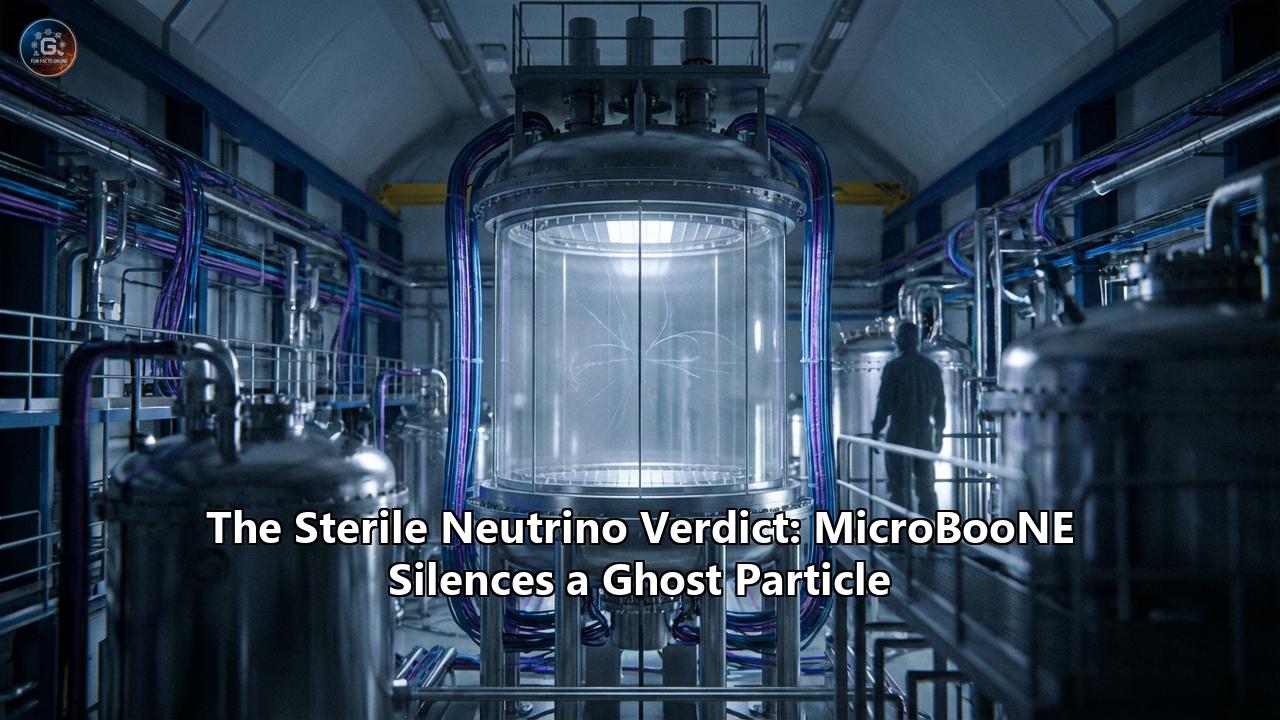
MicroBooNE is a school-bus-sized cryostat filled with 170 tons of liquid argon, cooled to -186°C. It sits in the path of the Booster Neutrino Beam at Fermilab, just upstream of the old MiniBooNE detector.
The principle of operation is elegant:
- Ionization: When a neutrino smashes into an argon atom, it produces charged particles (protons, electrons, muons, pions). As these particles shoot through the liquid argon, they strip electrons from the argon atoms they pass, leaving a trail of ionization charge.
- The Drift: A massive high-voltage field (70,000 volts) pulls these liberated electrons sideways across the tank toward a wall of sensing wires.
- The Readout: Three planes of wires, angled differently, record the arrival of the electrons. By combining the timing of the signals (the "Time" in TPC) with the wire positions, computers can reconstruct a precise 3D image of the interaction.
The Killer App: dE/dx
The superpower of the LArTPC is its ability to measure dE/dx—the amount of energy a particle deposits per centimeter of travel. This is the key to solving the MiniBooNE riddle.
- Electrons: An electron created by a neutrino interaction produces a "shower" of ionization. At the very start of the track, it is a single particle, so it deposits one unit of ionization energy (1 MIP).
- Photons: A photon is neutral and invisible until it converts into an electron-positron pair. This pair moves together initially, depositing two units of ionization energy (2 MIPs).
In MiniBooNE's oil tank, both looked like a fuzzy ring. In MicroBooNE's liquid argon, the difference is stark. You can look at the first few centimeters of the shower. If it's faint (1 MIP), it's an electron. If it's dark and heavy (2 MIPs), it's a photon.
This capability—electron/photon separation—was the silver bullet designed to kill the sterile neutrino controversy.
Chapter 4: MicroBooNE Rises
MicroBooNE (Micro Booster Neutrino Experiment) was proposed in 2007, began construction in 2010, and started taking data in 2015. It was a massive collaborative effort involving nearly 200 scientists from 36 institutions across five countries.
The Blind Analysis
From the outset, the MicroBooNE team knew they were walking into a minefield. The MiniBooNE anomaly was controversial, and confirmation bias is a powerful drug. If they looked at the data as it came in, they might unconsciously tweak their algorithms to "find" the excess they expected.
To prevent this, MicroBooNE adopted a strict blind analysis. For years, the physicists worked only with simulation data and small "sideband" samples of real data (boring, well-understood events). They tuned their reconstruction software, trained their Deep Learning neural networks (the first major use of AI in neutrino reconstruction), and perfected their error models without ever looking at the "signal box"—the low-energy events where the sterile neutrino was supposed to be hiding.
The tension was palpable. For five years, the detector ran. The computers churned. The "signal box" remained locked.
Two Beams, One Detector
MicroBooNE had another trick up its sleeve. While its primary goal was to check the Booster Neutrino Beam (BNB) that MiniBooNE used, the detector also sat slightly off-axis to a second, higher-energy beam called NuMI (Neutrinos at the Main Injector).
Using NuMI allowed MicroBooNE to cross-check its understanding of neutrino interactions at different energies and angles. It provided a vital control group. If they saw an anomaly in the BNB but not NuMI, it would point to specific oscillation physics. If they saw weirdness in both, it might imply a detector misunderstanding.
By late 2021, the analysis was ready. The software could identify electrons with unprecedented purity. The background predictions were robust. The collaboration voted to "open the box."
Chapter 5: The Unveiling (The 2021 Results)
On October 27, 2021, the physics world tuned in to a seminar at Fermilab. The MicroBooNE collaboration presented their first major results on the Low Energy Excess.
They had attacked the problem with three independent analysis chains—different teams using different algorithms (Deep Learning vs. Pandora reconstruction) to ensure the result wasn't a software glitch.
The plots were displayed. The data points (black dots) were overlaid on the Standard Model prediction (colored histograms).
The result was a flat line.In the region where MiniBooNE saw a massive spike of events—the "Low Energy Excess"—MicroBooNE saw... exactly what the Standard Model predicted.
- Electron Neutrinos: There was no excess of electron neutrinos. The data points hugged the predicted curve perfectly.
- Photons: They also checked for an excess of single photons (which would indicate a background error in MiniBooNE). There was no excess there either.
The "MiniBooNE anomaly," as a signal of simple electron neutrino appearance, had vanished in the higher-resolution detector.
The Significance
The result ruled out the interpretation that the MiniBooNE anomaly was due to electron neutrinos with 99% confidence (in some channels) and rejected the simple sterile neutrino hypothesis as the sole explanation for the LEE.
"We don't see what MiniBooNE saw," was the effective summary. The 4.8-sigma excess of electrons simply wasn't there.
However, the story didn't end in 2021. The 2021 result used only half the dataset. The collaboration went back to work, analyzing the full six-year dataset and combining the BNB and NuMI beam data to tighten the noose.
The 2025 Final Verdict
In late 2025, MicroBooNE released its final, comprehensive analysis. Using the full dataset and combining both beams, they placed the most stringent limits ever on the sterile neutrino mixing parameters.
The 2025 papers in Nature and Physical Review Letters were the final nails in the coffin. They didn't just fail to see an excess; they excluded the phase space where the sterile neutrino was supposed to live.
The verdict: The simple, light sterile neutrino (3+1 model) does not exist.Chapter 6: Assessing the Damage
The MicroBooNE results were a triumph of experimental physics, but they left theorists with a headache. The situation is now more complex than ever.
The Paradox: MiniBooNE vs. MicroBooNE
Here is the paradox: MiniBooNE (Cherenkov) saw a huge excess. MicroBooNE (LArTPC) looked at the same beam and saw nothing.
What does this mean?
- It wasn't Electrons: Since MicroBooNE is excellent at identifying electrons and saw no excess, the MiniBooNE signal was definitively not electron neutrinos. This kills the idea that muon neutrinos were oscillating into electron neutrinos (the hallmark of the sterile neutrino).
- It wasn't Simple Photons: MicroBooNE also ruled out the most common photon backgrounds (like Delta radiative decay) as the source of the excess.
- The "MiniBooNE Mistake" Hypothesis: The most boring (and perhaps most likely) explanation is that MiniBooNE simply misunderstood its background. Perhaps there was a subtle instrumental effect or a rare interaction involving neutrons or pi-zeros that the older, fuzzier detector couldn't distinguish, fooling it into thinking it saw electrons. MicroBooNE, with its "retina-like" vision, correctly identified these as backgrounds and threw them out.
If this is true, the sterile neutrino was never there. It was a ghost generated by the limitations of 2002-era technology.
The "New Physics" Loophole
However, physics is rarely that tidy. The fact that MicroBooNE didn't see the excess could mean the excess is made of something MicroBooNE threw away.
MicroBooNE's analysis was tuned to look for standard electron neutrino interactions. If the "New Physics" looks very different—say, a complex shower of dark particles—MicroBooNE's automated filters might have rejected it as "junk" or "cosmic rays."
This leads us to the "Dark Sector."
Chapter 7: Into the Dark Sector
With the vanilla sterile neutrino dead, the hunt has shifted to the "Exotic" explanations. If the anomaly wasn't simple oscillation, could it be the decay of a heavier, more complex particle?
The Heavy Neutral Lepton (HNL)
One surviving theory is the Heavy Neutral Lepton. This is a heavier sterile neutrino (mass > 100 MeV) produced in the beam. It travels to the detector and then decays.
- If it decays into a neutrino and a photon, MicroBooNE might have missed it if the photon didn't point back to the vertex correctly.
- If it decays into an electron-positron pair (e+e-), it would look like a "double shower."
MiniBooNE couldn't distinguish an e+e- pair from a single electron (the rings overlap). MicroBooNE can.
The 2025 Dark Sector Results
Alongside its sterile neutrino verdict, MicroBooNE published searches for these exotic decays.
- e+e- Pairs: They looked for the "dark tridents" or HNL decays that produce electron-positron pairs.
- Result: Null. They found no excess of e+e- pairs.
This result is devastating for many "Dark Sector" models that were invented specifically to save the MiniBooNE anomaly. It rules out a vast swath of parameter space for dark photons and heavy sterile neutrinos.
The "Higgs Portal" Scalar
Another exotic idea involves a light scalar boson mixing with the Higgs. This particle could be produced in the beam and decay into distinct signatures. MicroBooNE has placed world-leading limits on this as well.
Essentially, MicroBooNE is acting like a broom, sweeping away not just the sterile neutrino, but a whole family of "ghost stories" that physicists had invented. The room is looking increasingly empty.
Chapter 8: The Road Ahead: SBN and DUNE
MicroBooNE has finished its data taking, but the show is far from over. It was merely the first phase of the Short-Baseline Neutrino (SBN) program at Fermilab.
The Power of Three
The SBN program is designed to be the ultimate sterile neutrino hunter. It consists of three LArTPC detectors along the same beamline:
- SBND (Short-Baseline Near Detector): Sitting just 110 meters from the source. It will measure the un-oscillated beam with incredible precision, characterizing the "before" picture.
- MicroBooNE: (The intermediate detector, now complete).
- ICARUS: The legendary detector, moved from Italy to Fermilab, sitting 600 meters away. It acts as the "far" detector.
By comparing the data from SBND and ICARUS, physicists will be able to cancel out almost all systematic errors (beam uncertainties, cross-section errors). If there is any oscillation—even a very subtle one—the SBN trio will find it.
Data taking for the full SBN program is ramping up now (2025-2026). While MicroBooNE has likely killed the interpretation of the MiniBooNE anomaly, SBN will perform the definitive search for sterile neutrinos across a much wider mass range.
DUNE: The Megaproject
All of this—the LArTPC technology, the reconstruction software, the AI algorithms—is a dress rehearsal for the main event: DUNE (Deep Underground Neutrino Experiment).
DUNE is currently under construction. It will fire a neutrino beam from Fermilab in Illinois to a massive, 70,000-ton LArTPC located 1.5 kilometers underground in South Dakota.
MicroBooNE proved that LArTPC technology works at scale. It proved that we can use automated software to reconstruct complex events in liquid argon. It proved that we can distinguish electrons from photons.
Without the success of MicroBooNE, DUNE would be a billion-dollar gamble. With MicroBooNE's success, DUNE is a calibrated precision instrument ready to unlock the secrets of CP violation (why matter exists) and proton decay.
Conclusion: The Value of "Nothing"
In science, a "null result" is often viewed by the public as a failure. "Scientists searched for X and didn't find it." It sounds like a waste of time and money.
But in physics, a null result is a powerful weapon. It is the razor that trims the hedges of theory. For thirty years, the sterile neutrino was a tantalizing possibility that distracted us, a "loophole" that allowed us to hope the Standard Model was easily broken.
MicroBooNE has closed that loophole. By finding "nothing," it has told us something profound: The Standard Model is far more resilient than we thought. The anomalies of the past were likely illusions of imperfect vision.
The ghost particle has been silenced. The MiniBooNE anomaly, stripped of its sterile neutrino disguise, stands revealed likely not as a portal to a new dimension, but as a lesson in the difficulty of experimental physics.
Yet, the mystery isn't entirely gone. The universe is still full of dark matter, neutrino masses are still unexplained, and the asymmetry of the universe remains a puzzle. The sterile neutrino may not be the answer, but the technology built to hunt it—the Liquid Argon TPC—is the tool that will eventually find the real answers.
MicroBooNE didn't find the ghost. But it built the ghost-busting gear that will serve us for the next fifty years. And in the dark, quiet chambers of the subatomic world, that is a victory that rings louder than any discovery.
Glossary of Key Terms
- Neutrino Oscillation: The quantum mechanical phenomenon where a neutrino changes its flavor (electron, muon, tau) as it travels.
- Sterile Neutrino: A hypothetical fourth type of neutrino that does not interact via the weak force, only gravity.
- LArTPC (Liquid Argon Time Projection Chamber): A high-resolution particle detector that uses liquid argon to create 3D images of particle tracks.
- Cherenkov Radiation: Light produced when a charged particle moves through a medium faster than the phase velocity of light in that medium (used by MiniBooNE).
- dE/dx: The rate of energy loss per unit length. Crucial for distinguishing electrons (1 MIP) from photons (2 MIPs) in LArTPCs.
- Fiducial Volume: The inner core of the detector volume used for analysis to avoid edge effects.
- Sideband: A subset of data known to contain only background events, used to calibrate the detector and software.
- Standard Model: The theory describing three of the four known fundamental forces (electromagnetic, weak, strong) and all known elementary particles.
Further Reading & References
- The MicroBooNE Collaboration. "Search for an Excess of Electron Neutrino Interactions in MicroBooNE Using Multiple Final State Topologies." Physical Review Letters, 2022.
- The MicroBooNE Collaboration. "Search for long-lived heavy neutral leptons and dark sector models." Nature, 2024-2025.
- Aguilar-Arevalo, A. A., et al. (MiniBooNE Collaboration). "Significant Excess of Electron-Like Events in the MiniBooNE Short-Baseline Neutrino Experiment." Physical Review Letters, 2018.
- Fermilab News. "MicroBooNE releases first results on the MiniBooNE anomaly." October 2021.
Reference:
- https://news.ucsb.edu/2025/022281/microboone-experiment-finds-no-sign-light-sterile-neutrinos
- https://www.sci.news/physics/sterile-neutrino-14415.html
- https://arxiv.org/html/2508.15888v2
- https://arxiv.org/pdf/2508.15888
- https://www.youtube.com/watch?v=HLN5Dxvk3ZE
- https://microboone.fnal.gov/wp-content/uploads/MICROBOONE-NOTE-1105-PUB.pdf
- https://www.bnl.gov/newsroom/news.php?a=119153
- https://news.umich.edu/microboone-experiments-first-results-show-no-hint-of-a-sterile-neutrino/
- https://lss.fnal.gov/archive/2020/conf/fermilab-conf-20-771-v.pdf
- https://arxiv.org/html/2502.10900v1
- https://www.researchgate.net/publication/397339162_Testing_the_heavy_decaying_sterile_neutrino_hypothesis_at_the_DUNE_near_detector
- https://indico.cern.ch/event/1454726/contributions/6376515/attachments/3016477/5320234/MicroBooNE_LEE_search_results_XL.pdf
- https://indico.cern.ch/event/767069/contributions/3402704/attachments/1855948/3053035/03_arguelles.pdf
- https://www.eurekalert.org/news-releases/1110713
- https://microboone.fnal.gov/ee-2025/
- https://www.researchgate.net/publication/389091270_First_Search_for_Dark_Sector_ee-_Explanations_of_the_MiniBooNE_Anomaly_at_MicroBooNE
- https://www.miragenews.com/experiment-debunks-sterile-neutrino-theory-1594034/
- https://research.lancaster-university.uk/en/publications/first-search-for-dark-sector-ee-explanations-of-the-miniboone-ano/