
For centuries, astronomers have chased the moon's shadow across the globe, hoping for a few fleeting minutes of darkness to glimpse the sun’s most elusive secret: the solar corona. This ghostly halo of plasma, millions of degrees hotter than the sun’s surface, holds the key to understanding space weather that can disrupt life on Earth. But the moon is a fickle partner. Its eclipses are rare, short, and confined to narrow paths on Earth.
As of late 2025, that limitation has been shattered.
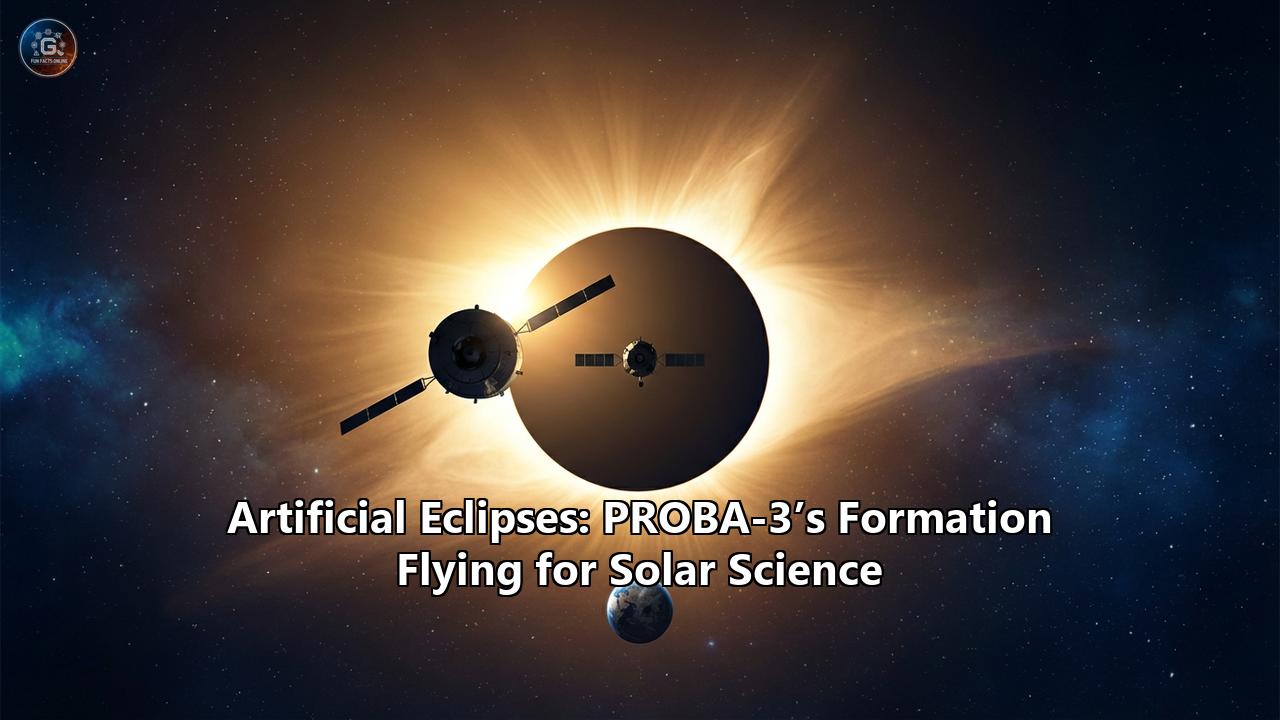
The European Space Agency’s PROBA-3 mission, launched in December 2024, has fundamentally altered the landscape of solar physics. By launching two satellites that fly in a precise, autonomous formation, humanity has created a "statue" in space—a giant, rigid observatory made of two unconnected parts held together only by light beams and sensors. Together, they generate an artificial solar eclipse on demand, opening a permanent window into the sun’s fiery atmosphere.
The Eclipse Dilemma: Why We Needed an Artificial Moon
To understand the triumph of PROBA-3, one must first understand the problem of the coronagraph. The solar corona is tenuous and faint—about a million times dimmer than the solar disk (the photosphere). Viewing it is like trying to see a firefly hovering next to a stadium floodlight.
On Earth, the blue sky scatters sunlight, overwhelming the corona. During a total solar eclipse, the moon perfectly blocks the photosphere, and the sky goes dark, revealing the corona’s pearly white streamers. But totality lasts only a few minutes.
Space-based coronagraphs, like those on the SOHO or STEREO observatories, solve the atmospheric scattering problem but introduce a new one: diffraction. To block the sun, these telescopes use an internal "occulting disk." However, light bends (diffracts) around the edges of this small internal disk, creating noise that blinds the instrument to the inner part of the corona. To avoid this stray light, traditional space coronagraphs must over-occult, blocking not just the sun but a large region around it. This leaves a critical "blind spot" immediately above the solar surface—precisely where the most interesting physics happens, such as the birth of solar wind and the heating of coronal plasma.
The only way to see this inner region without diffraction noise is to move the occulting disk much farther away from the telescope. In fact, you need the disk to be about 150 meters away. Building a continuous telescope tube that long is impossible for a standard satellite.
PROBA-3’s solution was radical: remove the tube.
The Architecture of a Virtual Giant
PROBA-3 (Project for On-Board Autonomy-3) is not a single satellite, but a binary system. It consists of two spacecraft:
- The Occulter Spacecraft (OSC): A 200 kg satellite carrying a 1.4-meter diameter disk. Its primary job is to act as the "moon," blocking the sun.
- The Coronagraph Spacecraft (CSC): A 340 kg satellite carrying the telescope and the primary instrument, ASPIICS. It flies in the shadow cast by the Occulter.
When in formation, these two free-flying satellites function as a single, rigid optical instrument spanning 144 meters (approximately 472 feet). This makes PROBA-3, effectively, the longest instrument ever deployed in space.
Achieving this required a leap in spaceflight engineering known as high-precision formation flying. The satellites cannot just drift near each other; they must maintain their relative positions with millimeter-level accuracy. If the Occulter drifts by just a few millimeters, the shadow misses the telescope, and the blinding sunlight destroys the image.
The Dance of Precision: How It Works
The mission operates in a highly elliptical orbit around Earth, ranging from a perigee of 600 km to an apogee of 60,530 km. This orbit was chosen strategically. At perigee, Earth's gravity is strong, making precise formation flying fuel-intensive and difficult. But as the satellites climb towards apogee (the highest point), they slow down, and gravitational perturbations weaken.
For six hours during each 19.7-hour orbit, as they loop through the high apogee, the satellites enter "formation mode." This is where the magic happens.
1. The Metrology Loop
To keep the two spacecraft aligned, PROBA-3 uses a multi-stage system of sensors, acting like a narrowing funnel of precision:
- GPS and Radio Links: First, the satellites use GPS (relative navigation) and inter-satellite radio links to find each other and get within a few centimeters of their target positions.
- Visual Sensors: Cameras on the Coronagraph Spacecraft track LEDs on the Occulter Spacecraft to refine the alignment.
- Shadow Position Sensors: Once the shadow falls on the Coronagraph faceplate, photosensors detect the shadow's edge to ensure it is centered.
- Laser Metrology: For the ultimate precision, a laser beam is fired between the spacecraft. This allows them to measure their relative distance and alignment to within micrometers.
2. Autonomous Control
The control loop is entirely autonomous. The computers onboard process the sensor data and fire micro-thrusters to correct any drift instantly. The Occulter Spacecraft (the "moon") creates the shadow, but the Coronagraph Spacecraft (the "eye") is the active partner in some maneuvering phases, while the Occulter uses cold-gas thrusters for extremely fine adjustments. This "formation flying" is so precise that the two separate machines behave as a single rigid structure, despite travelling at thousands of kilometers per hour.
Scientific Payload: ASPIICS and Beyond
The heart of the mission is ASPIICS (Association of Spacecraft for Polarimetric and Imaging Investigation of the Corona of the Sun). This coronagraph looks through the lens of the "artificial eclipse."
Because the Occulter is 144 meters away, the diffraction fringe is minimized. ASPIICS can image the solar corona starting from just 1.1 solar radii (extremely close to the surface) out to about 3 solar radii. This inner region has been virtually invisible to continuous observation until now.
Key Scientific Objectives:- The Coronal Heating Mystery: The sun's surface is about 6,000°C, but the corona above it soars to millions of degrees. It’s like walking away from a campfire and feeling it get hotter. PROBA-3 is providing the high-resolution, continuous data needed to test theories about magnetic waves (Alfvén waves) and "nanoflares" that might be transferring this energy.
- Solar Wind Acceleration: The stream of charged particles that fills the solar system (solar wind) starts in the inner corona. PROBA-3 observes the exact region where this wind accelerates from subsonic to supersonic speeds.
- CME Origins: Coronal Mass Ejections are massive explosions of plasma that can cause geomagnetic storms on Earth. By monitoring the inner corona continuously, PROBA-3 can spot the early formation and trigger mechanisms of CMEs, improving space weather forecasting.
In addition to ASPIICS, the Occulter Spacecraft carries DARA (Digital Absolute Radiometer), which measures Total Solar Irradiance (TSI)—the total energy the sun sends to Earth. This helps track long-term climate impacts. A third instrument, 3DEES, measures energetic electron fluxes in the radiation belts the satellite passes through, contributing to our understanding of the Earth's own magnetic environment.
A Historic Year: From Launch to First Light
The journey to this success was a marathon. After years of development, PROBA-3 launched on December 5, 2024, aboard an ISRO PSLV-XL rocket (flight C59) from the Satish Dhawan Space Centre in India. The launch was a textbook success, placing the duo into their initial elliptical orbit.
The early months of 2025 were spent in a "Commissioning Phase." The teams at ESA's Redu centre in Belgium carefully tested the individual systems. Then came the critical moment in March 2025: the first attempt at formation flying. The tension was palpable. If the collision avoidance maneuvers failed, the satellites could crash; if the sensors failed, the mission would be blind.
The demonstration was flawless. The satellites locked onto each other, maintaining the 144-meter separation with the required millimeter accuracy.
By June 2025, the mission achieved its "First Light." The resulting images were breathtaking. They showed the solar corona with a clarity previously seen only during total solar eclipses, but with a stability and duration that ground observers could only dream of. Scientists could see fine magnetic loops, streamers, and the dynamic evolution of plasma structures over hours—data that is already rewriting textbooks in late 2025.
Implications for the Future
PROBA-3 is a "pathfinder" mission. While its solar science is revolutionary, its technology demonstration is equally vital for the future of astronomy.
The success of autonomous formation flying proves that we can build "virtual telescopes" of any size. We are no longer limited by the size of a rocket fairing. Future missions could involve:
- Huge X-ray Telescopes: With optics on one satellite and detectors on another kilometers away.
- Exoplanet Hunters: Using a giant external "starshade" (like PROBA-3’s Occulter but much larger and farther away) to block the light of distant stars and image Earth-like planets directly.
- Gravitational Wave Detectors: The LISA mission (Laser Interferometer Space Antenna) will require three spacecraft flying millions of kilometers apart with picometer precision. PROBA-3’s control algorithms are a stepping stone to this level of mastery.
Conclusion: The Sun in a New Light
As PROBA-3 continues its daily vigil, creating an eclipse every 19 hours, it stands as a testament to human ingenuity. We have not just observed nature; we have mimicked its grandest spectacles to suit our scientific needs. The "artificial eclipse" is no longer science fiction—it is the new standard for solar physics, illuminating the dark and violent mysteries of the star that sustains us all.
Reference:
- https://eijournal.com/news/business-2/esas-formation-flying-mission-proba-3-ready-to-travel-to-the-sun-with-spacebel-technology
- https://www.isro.gov.in/media_isro/pdf/PSLVC59/PSLV_C59_Brochure.pdf
- https://theweek.com/science/proba-3-solar-eclipse-satellite-launch-physics
- https://www.esa.int/Science_Exploration/Space_Science/Five_space_mysteries_Proba-3_will_help_solve
- https://www.group.sener/en/noticias/esas-proba-3-mission-captures-first-images-of-the-solar-corona/
- https://economictimes.indiatimes.com/news/science/proba-3-mission-would-significantly-advance-understanding-of-suns-corona-ex-isro-scientist/articleshow/116097752.cms?from=mdr
- https://www.sciencenews.org/article/artificial-solar-eclipse-satellites
- https://www.pmodwrc.ch/wp-content/uploads/2024/12/Proba3_news_media_kit.pdf
- https://indianexpress.com/article/technology/science/artificial-total-solar-eclipse-european-space-agency-proba-3-mission-10076169/
- https://forumias.com/blog/proba-3/
- https://www.esa.int/Enabling_Support/Space_Engineering_Technology/Proba_Missions/Proba-3_Mission3
- https://www.esa.int/Enabling_Support/Space_Engineering_Technology/Proba-3_s_first_artificial_solar_eclipse
- https://www.esa.int/Enabling_Support/Space_Engineering_Technology/Proba-3/Proba-3_stargazing_to_warm_up_for_corona_observations
- https://en.wikipedia.org/wiki/PROBA-3
- https://www.space.com/stargazing/solar-eclipses/behold-1st-images-of-artificial-solar-eclipse-captured-by-esas-proba-3-mission