
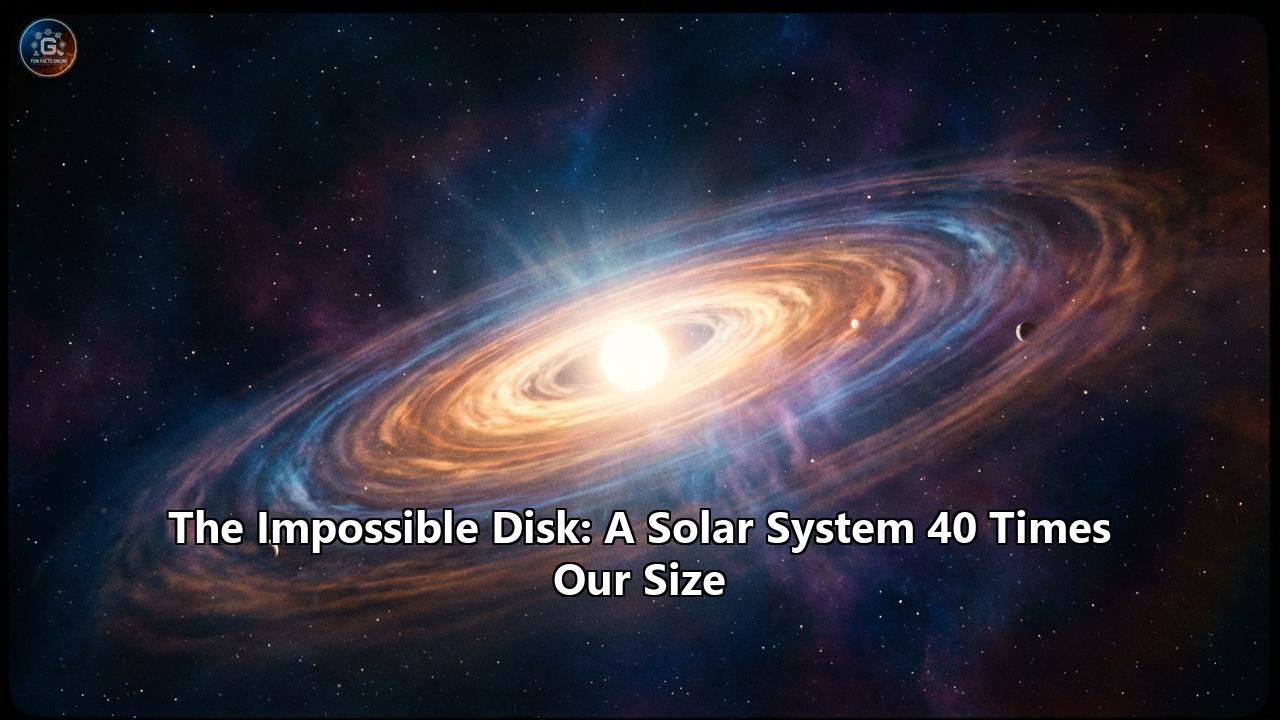
Part I: The Discovery of the "Impossible" Disk
The universe has a way of hiding its giants in plain sight. For decades, the object known as IRAS 23077+6707 sat as an unremarkable entry in astronomical catalogs, a faint source of infrared light located approximately 1,000 light-years away in the constellation Cepheus. To the automated surveys that swept the sky, it was just another young stellar object, likely a star shrouded in the dust of its birth.
But in 2016, the Pan-STARRS survey (Panoramic Survey Telescope and Rapid Response System) in Hawaii captured something that caught the eye of a team of researchers led by Dr. Ciprian Berghea. While trawling through data looking for active galactic nuclei—supermassive black holes feeding in distant galaxies—they noticed an object that didn't quite fit the profile. It wasn't a distant galaxy. It was something much closer, and strangely shaped.
Initial images revealed a peculiar structure: a dark, horizontal lane cutting through two bright, glowing lobes. It looked less like a star and more like a cosmic hamburger floating in the void. This "edge-on" orientation is a rare gift in astronomy. Usually, we see protoplanetary disks—the flattened rings of gas and dust that surround young stars—at an angle, appearing as ovals or bright rings. But seeing one perfectly from the side allows astronomers to block out the blinding glare of the central star and study the vertical structure of the disk itself.
However, it was the sheer scale of the object that sent shockwaves through the scientific community. As researchers began to calculate its dimensions, the numbers seemed impossible. The disk extended across an area of the sky that, at its distance, translated to a physical width of nearly 400 billion miles (644 billion kilometers).
To put that number into perspective:
- The distance from the Earth to the Sun is 93 million miles (1 Astronomical Unit, or AU).
- Neptune, the farthest known planet in our solar system, orbits at about 30 AU.
- The Kuiper Belt, the ring of icy debris that marks the "edge" of our planetary neighborhood, extends out to about 50 AU.
- IRAS 23077+6707 spans over 4,000 AU.
This single structure is 40 times larger than the diameter of our entire solar system out to the Kuiper Belt. It is a structure so vast that if you were to drive a car at highway speeds from one edge to the other, it would take you over 700 million years to complete the journey. It is the largest protoplanetary disk ever discovered, a true leviathan that has forced astronomers to rewrite the rulebook on how large these planet-forming factories can grow.
Part II: The Legend of "Dracula's Chivito"
In the dry, serious world of academic papers and spectral analysis, astronomers often find joy in giving their discoveries nicknames that reflect their appearance or the circumstances of their finding. The most famous edge-on disk prior to this discovery was "Gomez's Hamburger," a similar but smaller object found in the 1980s.
When the team led by Dr. Berghea and Dr. Kristina Monsch of the Center for Astrophysics (Harvard & Smithsonian) began to analyze this new giant, they knew it needed a name that matched its unique character.
The name "Dracula's Chivito" was born from a delightful collision of cultures and visual interpretation:
- Dracula: The lead author of the discovery paper, Ciprian Berghea, grew up in the Transylvania region of Romania, the legendary home of Count Dracula. But the connection wasn't just geographical. In the high-resolution images, the northern part of the disk featured faint, wispy "fangs"—filaments of gas extending away from the main structure, evocative of a vampire's bite.
- Chivito: The object's "hamburger" shape—a dark dust lane sandwiched between two bright halves—reminded co-author Ana Mosquera of a national dish from her home country of Uruguay. The chivito is a rich, towering sandwich often loaded with steak, ham, cheese, eggs, and mayonnaise. It is a "monster" of a sandwich, fitting for a monster of a disk.
Thus, "Dracula's Chivito" was christened—a name that is equal parts spooky, appetizing, and scientifically descriptive. It represents a cross-cultural collaboration in the pursuit of cosmic understanding, turning a catalogue number into a character in the story of the universe.
Part III: Anatomy of a Monster
What exactly are we looking at when we gaze upon Dracula's Chivito?
The structure is a protoplanetary disk, a rotating circumstellar disk of dense gas and dust surrounding a young, newly formed star. These disks are the leftovers of star formation. When a giant molecular cloud collapses to form a star, the conservation of angular momentum causes the remaining material to flatten out into a spinning pancake. Over millions of years, the dust grains in this disk stick together to form pebbles, then boulders, then planetesimals, and finally, planets.
However, Dracula's Chivito is not just any disk. It is a system in turmoil.
The Dark Lane
The defining feature of the object is the dark band running through its center. This is not empty space; remarkably, it is the densest part of the disk. It is so thick with dust and gas that it completely blocks the light of the central star (or stars) from reaching us. We are seeing the "shadow" of the disk's midplane, where the raw material for future planets is most concentrated.
The Glowing "Buns"
Above and below this dark lane are two bright lobes. This is starlight that has escaped from the poles of the star and scattered off the dust in the upper atmosphere of the disk. These "buns" are what allow us to see the disk at all in visible light. The fact that they are so bright and extensive suggests the central star is quite luminous, likely a massive young star or perhaps a binary pair, stripping away the surrounding cloud with intense radiation.
The "Fangs" and Filaments
This is where the "impossible" nature of the disk becomes most apparent. In standard models, protoplanetary disks are relatively smooth, flat structures that slowly fade away at the edges. But Hubble Space Telescope images of Dracula's Chivito revealed something chaotic.
The disk is surrounded by faint, wispy filaments of material—the "fangs"—that extend billions of miles into the surrounding space. Crucially, these filaments are asymmetrical. They appear prominently on the northern side of the disk but are almost absent on the south.
"The level of detail we're seeing is rare in protoplanetary disk imaging," said Dr. Kristina Monsch. "We're seeing this disk nearly edge-on and its wispy upper layers and asymmetric features are especially striking."
This asymmetry implies that the disk is not a calm, isolated island. It is likely interacting with its environment in a violent way. The filaments could be:
- Stellar Winds: The central star blasting material out into space.
- Infall: Fresh material from the surrounding molecular cloud raining down onto the disk, feeding it and keeping it alive.
- Flybys: The gravitational wake left by another star passing nearby, dragging streamers of gas out of the disk.
This "chaos" challenges the serene image of planet formation. It suggests that baby solar systems can be turbulent, violent places, where the disk is constantly being shaped, torn, and fed by external forces.
Part IV: The "Impossible" Physics of Giant Disks
Why do astronomers call a disk of this size "impossible" or at least "unexpected"?
To understand this, we have to look at accretion theory. A star grows by pulling in material from its surrounding disk. However, gravity is not the only force at play. As the disk spins, material slowly spirals inward, but at the outer edges, the gas should eventually dissipate or be stripped away by the radiation of nearby stars.
In our own solar system, the "dense" part of the disk that formed the planets likely ended just beyond the orbit of Neptune (30 AU). The Kuiper Belt is a remnant of the thinner outer regions.
For a disk to sustain a radius of 3,000+ AU, it requires an immense reservoir of mass and a very specific environment.
- Mass Problem: Estimates suggest the disk of Dracula's Chivito contains between 10 and 30 times the mass of Jupiter in dust and gas alone. This is enough material to build thousands of Earths, or dozens of Jupiters. In most star-forming regions, this amount of material would have fragmented to form companion stars rather than staying in a single disk. The fact that it hasn't fragmented suggests the disk is hot or turbulent enough to resist gravitational collapse, yet stable enough to remain bound to the star.
- The Photoevaporation Problem: Massive disks are usually found around massive stars. But massive stars emit huge amounts of UV radiation, which typically boils away their disks (a process called photoevaporation) relatively quickly—often before planets can form. For Dracula's Chivito to be this large, it must be young enough that photoevaporation hasn't destroyed it, yet old enough to have settled into a disk shape. It exists in a delicate temporal "sweet spot."
- The Planet Formation Paradox: Current theories of planet formation (like "pebble accretion") work very efficiently in compact disks. In a disk this large, the orbital periods are immense. A planet forming at the edge of this disk would take thousands of years to complete a single orbit around its star. At those speeds, the collision of dust grains happens in slow motion. Can planets actually form 2,000 AU from their star? Or is this outer region destined to remain a sterile wasteland of frozen dust?
If planets did form in the outer reaches of Dracula's Chivito, they would be unlike anything in our solar system. They would be frozen "super-Neptunes" or gas giants orbiting in eternal twilight, so far from their sun that it would appear as just a particularly bright star in the sky.
Part V: A Mirror to Our Own Past?
One of the most compelling reasons to study monsters like IRAS 23077+6707 is that they act as a funhouse mirror for our own history.
4.5 billion years ago, our Sun was a young star surrounded by a similar, though much smaller, disk. We cannot travel back in time to see it, but we can look at objects like Dracula's Chivito to see the physics of formation in action.
The "chaos" observed in this giant disk—the infalling gas, the filaments, the turbulence—might have played a role in our own system.
- Did our solar system once have long, wispy filaments that were stripped away by passing stars?
- Did a "feeding frenzy" of infalling gas trigger the rapid formation of Jupiter and Saturn?
The sheer size of Dracula's Chivito also raises the question: Was our solar system once much larger?
It is possible that our Sun's original disk extended much further out, but was truncated (cut short) by the gravity of passing stars in the crowded cluster where the Sun was born. Dracula's Chivito might be what a solar system looks like when it is allowed to grow in isolation, free from the "cosmic pruning" of neighbors.
Alternatively, it represents a different class of planetary system entirely—a "scaled-up" version of the Solar System where everything is bigger, more massive, and more spread out. If intelligent life were to one day evolve on a planet in this system, their "space race" would be infinitely harder. To send a probe to their equivalent of Pluto would not take 9 years (as New Horizons did); it could take centuries.
Part VI: The Future of the Leviathan
The discovery of Dracula's Chivito is just the beginning. The images that stunned the world came from the Hubble Space Telescope, an instrument that has been operating since the 1990s. While Hubble's visible-light capabilities are legendary, the true secrets of this disk lie in the wavelengths our eyes cannot see.
The James Webb Space Telescope (JWST):NASA's newest flagship telescope sees in the infrared—the very type of light that can peer through the dark dust lane of the Chivito. Future observations with JWST could reveal:
- The Central Star: Is it a single massive giant, or a tight binary pair dancing in the dark? Understanding the engine of this system is crucial to modeling its future.
- Planet Birth: JWST can detect the heat signatures of young planets. Are there glowing red embers of newborn gas giants hidden in that dark band?
- Chemistry: JWST can analyze the "ices" in the disk—water, ammonia, methane, and complex organic molecules. Is this giant disk stocked with the chemical ingredients for life?
This array of radio telescopes in Chile can see the cold dust and gas itself. ALMA can measure the speed at which the disk is spinning, allowing astronomers to "weigh" the central star with high precision. It can also map the distribution of pebble-sized particles, showing us exactly where the planets are beginning to clump together.
Conclusion: The Universe is Bigger Than We Thought
The "Impossible Disk" is a reminder of a fundamental truth in astronomy: Nature always has a bigger imagination than we do. Just when we think we understand the constraints of star and planet formation, the universe produces an object like IRAS 23077+6707—a structure so vast it defies easy explanation, named after a vampire and a sandwich, floating in the dark reaches of Cepheus.
It stands as a cosmic laboratory, a place where the laws of physics are tested on the grandest possible scale. For the scientists studying it, Dracula's Chivito is not just a curiosity; it is a key to unlocking the secrets of how the universe builds worlds, from the smallest rocky outposts to the largest gas giants, and perhaps, eventually, to the fragile blue marbles that can look back and wonder.
The "Impossible Disk" exists. And because it exists, the universe is a little more magical, and a lot more mysterious, than it was yesterday.Reference:
- https://circularastronomy.com/2024/06/17/draculas-chivito-iras-230776707-largest-known-protoplanetary-disc/
- https://en.wikipedia.org/wiki/Dracula%27s_Chivito
- https://www.autoevolution.com/news/dracula-s-chivito-is-a-giant-space-vampire-sandwich-where-new-planets-are-born-263450.html
- https://astrobiology.com/2025/12/hubble-reveals-the-largest-chaotic-birthplace-of-planets-yet-discovered.html
- https://www.sciencealert.com/hubble-reveals-extreme-chaos-inside-draculas-sandwich
- https://www.iflscience.com/hubble-telescopes-bite-of-draculas-chivito-reveals-chaos-in-the-largest-known-planet-forming-disk-82033
- https://science.nasa.gov/missions/hubble/nasas-hubble-reveals-largest-found-chaotic-birthplace-of-planets/
- https://starlust.org/nas-as-hubble-finds-largest-chaotic-sandwich-where-planets-are-born-baffling-astronomers/
- https://www.reddit.com/r/hubble/comments/1pu4dyw/hubble_reveals_largest_found_chaotic_birthplace/
- https://hubbletracker.com/4038/draculas-chivito-iras-230776707
- https://en.wikipedia.org/wiki/Kuiper_belt
- https://arxiv.org/abs/2510.11819
- https://thedebrief.org/draculas-chivito-a-chaotic-cosmic-sandwich-seen-by-nasas-hubble-space-telescope-defies-expectations/
- https://science.nasa.gov/asset/hubble/draculas-chivito-iras-230776707/