
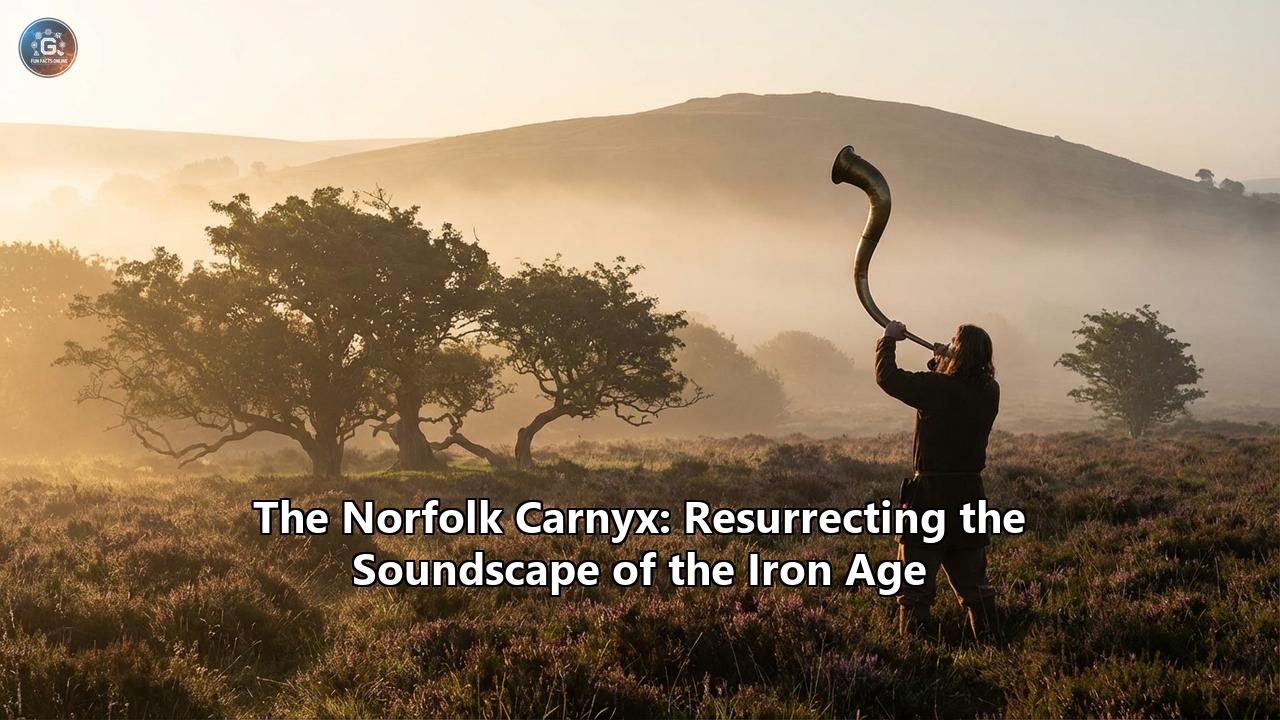
The wind that sweeps across the flat, open fields of West Norfolk has always carried a certain heaviness, a whisper of the ancient past. This is the land of the Iceni, the warrior people who, two millennia ago, rose in a fiery, blood-soaked rebellion that nearly drove the Roman Empire into the sea. For centuries, the voice of that rebellion has been silent, preserved only in the charcoal strata of burned Roman cities and the stoic Latin of historians like Tacitus. We knew the Iceni by their swords, their torcs, and their coins. But we had never truly heard them.
That changed in the summer of 2025.
In a discovery that has stunned the archaeological world and rewritten the history of Iron Age Europe, a team from Pre-Construct Archaeology (PCA), working ahead of a routine housing development near Thetford, unearthed the "Norfolk Carnyx." It is a find of staggering significance: a near-complete bronze battle trumpet, buried for 2,000 years, its mouth frozen in an eternal, silent roar. Found alongside it was a bronze boar’s head standard—the first of its kind ever discovered in Britain—and a cache of shield bosses.
This is not just a museum piece. It is a time capsule of sound. It is the resurrection of the Iron Age soundscape, a key to unlocking the sensory experience of a world where music was not just entertainment, but a weapon of war and a conduit to the gods.
The Awakening: A Hunch in the Mud
Archaeology is often a game of patience, defined by shards of pottery and postholes. But sometimes, the earth yields a miracle. The site, located on privately owned land in West Norfolk, was not expected to produce a find of this magnitude. It was a standard excavation, the kind of "box-ticking" exercise that precedes modern construction. Yet, as the excavators worked through the topsoil, a project manager at PCA reportedly had a "hunch" that this site was special.
That intuition proved prophetic. As the trowels scraped away the layers of sandy soil, the unmistakable green patina of ancient bronze began to emerge. But this was not the scrap metal or broken jewelry typical of the region. These were large, curved sheets, fragile as parchment, packed tightly together.
Recognizing the extreme fragility of the object, the team made a critical decision: they would not excavate it in the field. Instead, they cut a massive block of soil around the artifacts, encased it in plaster, and lifted it whole. It was a block of mystery, its contents hidden within the dark earth.
The true revelation came not in the mud, but in the sterile, humming environment of Addenbrooke’s Hospital. Here, the soil block was subjected to advanced CT scanning. As the X-rays sliced through the dirt, a 3D image appeared on the screens that made the experts gasp. There, suspended in the virtual void, was the distinctive, snout-nosed profile of a boar. It was a carnyx—the great war horn of the Celts. And it was not alone.
The Beast in the Bronze: Anatomy of the Norfolk Carnyx
To understand the magnitude of this discovery, one must understand the carnyx itself. Before the Norfolk find, our knowledge of these instruments in Britain was frustratingly fragmentary. The most famous example, the Deskford Carnyx found in Scotland in 1816, was just a head, stripped of its tube and mane. The River Witham carnyx, found in 18th-century Lincolnshire, was melted down for scrap before it could be properly studied—a tragedy of early science.
The Norfolk Carnyx, however, is a revelation of completeness.
The instrument stands—or rather, would have stood—tall and imposing. The bell is fashioned into the head of a wild boar, the totem animal of the Celtic warrior. This was not a crude representation; it was a masterpiece of repoussé metalworking, where the bronze was hammered from the reverse side to create relief.
The Face of the Beast:The boar’s head is terrified and terrifying. It features prominent, furrowed brows that give it an expression of aggressive intensity. The eyes are lozenge-shaped, and microscopic analysis has revealed traces of applied material, suggesting that 2,000 years ago, these eyes may have been colored or inlaid to glint in the sun, giving the beast a lifelike, staring quality.
The Mouth of War:The jaws are open, revealing a toothed mouth designed to project sound outward. But unlike the Deskford carnyx, which had a wooden clapper tongue to add a percussive rattle, the Norfolk carnyx’s acoustic mechanism is still being analyzed. The craftsmanship extends to the tusks, which were made separately and applied to the snout, emphasizing the danger of the animal.
The Torc and Crest:Perhaps most symbolic is the decoration around the neck. The bronze features a raised collar with paired discs, mimicking the appearance of a torc—the sacred neck ring worn by high-status Celts and gods alike. This suggests that the instrument itself was seen as a living entity, a high-ranking member of the warrior caste. Running down the spine of the head is a delicate openwork crest, a filigree of bronze that would have caught the light and added to the visual spectacle.
But the carnyx was not the only treasure in the block. Lying with it was a sheet-bronze boar’s head standard. This is a discovery without parallel in Britain. While carnyces are instruments, standards are rallying points—flags made of metal. To find both together suggests a deposit of immense military and ritual importance, a full regalia of the Iceni war machine.
The Soundscape of the Iceni: "A Terrible Noise"
Why create such an elaborate instrument? The answer lies in the specific way the Iron Age peoples waged war.
For the Roman legions, war was a matter of discipline, silence, and order. For the Celts, war was a sensory overload—a performance of individual bravery and supernatural terror. The Greek historian Polybius, writing about the Battle of Telamon in 225 BC, gave us the most visceral description of the carnyx in action:
"The parade and the clamour of the Celtic host were objects of terror... for there were such innumerable horns and trumpets, and the whole army was shouting its war-cries at the same time, that there arose such a confused din that the sound seemed to come not only from the trumpeters and the soldiers but from the countryside itself."
The carnyx was a psychological weapon. Its vertical design meant that the bell—the boar’s head—towered two meters above the heads of the warriors. When the player blew into it, the sound didn't blast into the back of the friendly troops; it soared over them, projecting directly toward the enemy lines.
In the flat fens and forests of Norfolk, the sound of the carnyx would have been unearthly. It was not a melodic instrument in the modern sense. It was designed to produce harsh, guttural blasts, mimicking the roar of the animal it depicted. It could scream, it could drone, and it could produce sub-frequencies that would be felt in the chest before they were heard by the ear.
The Norfolk Carnyx, dating from roughly 50 BC to AD 50, sits squarely in the most turbulent period of British history. This was the era of the Iceni kings, of tenuous alliances with Rome, and eventually, of Boudicca. It is entirely possible, perhaps even likely, that this specific instrument was present at the great gatherings of the tribe. Did this carnyx sound the charge at the ambush of the Ninth Legion? Did it wail in mourning as the Iceni lands were annexed?
A Straightforward Revelation: Rewriting the Acoustics
One of the most exciting aspects of the Norfolk discovery is a detail that challenges our previous assumptions. The famous reconstruction of the Deskford Carnyx—played masterfully by musician John Kenny—features a long, curved tube, similar to a lur or a lituus. This curvature was largely an educated guess based on Roman depictions on the Gundestrup Cauldron and Trajan's Column.
However, preliminary analysis of the Norfolk Carnyx suggests its tube was straight.
This is a massive acoustic and ergonomic shift. A straight tube changes the standing wave of the instrument. It changes the harmonic series it can produce. It also changes how it was held. A curved carnyx wraps around the player, balanced on the shoulder. A straight carnyx, two meters tall, is a balancing act, a towering staff of bronze.
This implies that the "Norfolk Sound" was distinct. It might have been sharper, more directional. The conservators at Norfolk Museums Service, working with acoustic experts, are already planning the creation of a playable replica. For the first time, we will not just be guessing what the Iceni sounded like; we will be able to measure it.
Ritual and Ruin: The Burial
Why was such a magnificent object in the ground? It was not lost; you do not lose a two-meter bronze trumpet and a military standard. It was buried.
The condition of the artifacts offers clues. The metal is "extremely brittle," but the carnyx shows clear signs of repair during its lifetime. This was a cherished object, used and maintained over generations. It was an heirloom of the tribe.
But its burial suggests a moment of crisis or closure. In the Iron Age, the deposition of high-status metalwork was rarely accidental. The Snettisham Hoards, found nearby, contained dozens of gold torcs buried in pits. These were likely votive offerings—gifts to the gods, perhaps to secure victory, or perhaps to safely decommission powerful objects that had become "too hot" to keep, either spiritually or politically.
The Norfolk Carnyx Hoard was buried around the time of the Roman conquest. Was it hidden to protect it from the legions who would have seen it as a trophy? Or was it a ritual sacrifice—a "killing" of the tribe’s voice to ensure it could never be used by the enemy?
The presence of the shield bosses stacks adds weight to the ritual theory. In many Iron Age deposits, items are deliberately broken or bent ("slighted") before burial to release their spirit. The Norfolk Carnyx appears to have been dismantled or collapsed, but its completeness suggests a desire to keep the entity intact within the earth.
The Resurrection: Science Meets Soul
The excavation was just the beginning. The Norfolk Carnyx is currently undergoing a painstaking conservation process. The soil block is being dissected grain by grain in the labs of the Norfolk Museums Service. It is a surgery of microns.
Conservators describe the bronze as being as thin as card in places, mineralized by the acidic soil. They are using air-abrasives and scalple-point tools to reveal the surface without destroying it.
The collaboration is unprecedented: Historic England, the National Museum of Scotland (who hold the Deskford Carnyx), and the Norfolk team are pooling resources. Their goal is twofold:
- Stabilization: Ensure the object doesn't disintegrate now that it is exposed to air.
- Replication: This is where the "resurrection" truly happens.
Using the sub-millimeter accurate CT scans, a digital twin of the carnyx is being created. From this, a master craftsman—likely a bronzesmith specializing in ancient techniques—will cast a replica. They will use the same alloys, the same sheet-beating techniques, and the same assembly methods.
When that replica is finished, a musician will step up to the mouthpiece. They will blow the first breath into the Norfolk Carnyx in 2,000 years.
Conclusion: The Voice Returns
The discovery of the Norfolk Carnyx is more than an archaeological triumph; it is a restoration of a lost human experience. For decades, we have looked at the Iron Age in black and white—silent bones and rusted swords. Now, we have the soundtrack.
We can imagine the mist rising off the Fens. We can imagine the Roman legions, disciplined and armored, freezing as a sound tears through the damp air—a sound that is half-animal, half-human, and entirely terrifying. The boar has woken up. The Iceni are speaking to us again, and their voice is loud, brazen, and undeniable.
As the conservation continues and the replica takes shape, we await that first note. It will be a ghost note, echoing from the time of Boudicca, reminding us that the past is never truly dead; it is just waiting for the right breath to bring it back to life.
Reference:
- https://arkeonews.net/britains-first-discovery-of-its-kind-a-2000-year-old-carnyx-and-boar-standard-unearthed-in-norfolk/
- https://en.wikipedia.org/wiki/Norfolk_Carnyx_Hoard
- https://www.spectator.com.au/2026/01/why-the-norfolk-carnyx-matters/
- https://www.independent.co.uk/news/science/archaeology/norfolk-iron-age-battle-trumpet-b2895331.html
- https://www.pre-construct.com/news/the-norfolk-carnyx-finds-friday/
- https://spectator.com/page/2/?search=http%3A%2F%2Fwww.spectator.co.uk%2Fbooks-arts
- https://www.zmescience.com/science/archaeology/archaeologists-unearth-a-rare-2000-year-old-iron-age-war-trumpet-in-britain/
- https://www.butserancientfarm.co.uk/blog
- https://www.butserancientfarm.co.uk/blog/2026/1/9/what-is-a-carnyx
- https://www.gbnews.com/science/archaeology-breakthrough-iron-age-battle-trumpet-norfolk-carnyx
- https://www.standard.co.uk/news/environment/norfolk-europe-celtic-historic-england-england-b1265276.html
- https://www.edp24.co.uk/news/25742073.iron-age-battle-trumpet-found-site-new-norfolk-homes/
- https://www.northwaleschronicle.co.uk/news/national/25745335.near-complete-iron-age-battle-trumpet-unearthed-norfolk/
- https://grokipedia.com/page/Norfolk_Carnyx_Hoard