
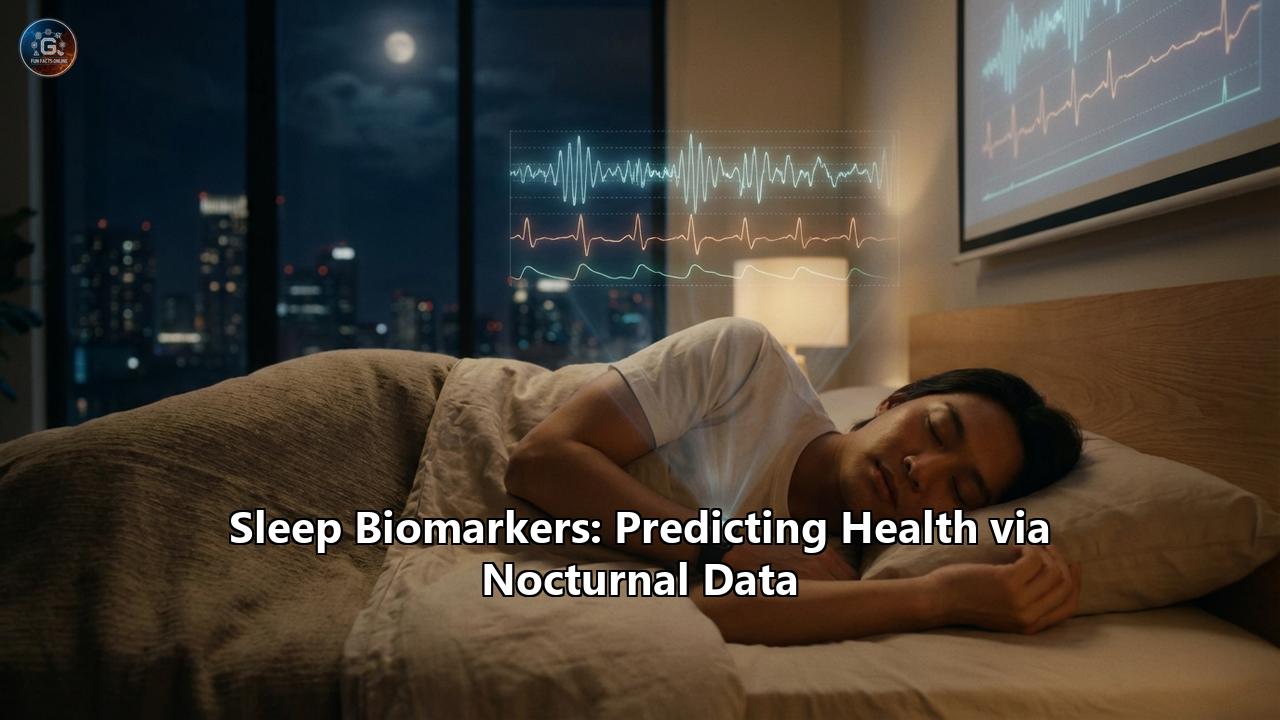
In the quiet hours of the night, while consciousness fades and the body lies still, a complex symphony of biological activity continues to play out beneath the surface. For decades, sleep was viewed primarily as a passive state of rest—a time for the body to recharge its batteries. But in the mid-2020s, a paradigm shift occurred. Sleep is no longer just a pillar of health; it has become a diagnostic window, a crystal ball capable of predicting our future medical biography with startling accuracy.
We have entered the era of Sleep Biomarkers.
The convergence of artificial intelligence, advanced sensors, and big data has revealed that the architecture of our sleep—the precise timing of our brain waves, the variability of our heartbeats, the microscopic twitches of our muscles—contains hidden codes. These codes, or biomarkers, are now being deciphered to predict the onset of neurodegenerative diseases, cardiovascular events, and metabolic disorders years, sometimes decades, before the first clinical symptom appears.
This article explores the revolutionary science of sleep biomarkers, tracing their journey from the sterile environment of sleep labs to the smart devices on our wrists, and examining how nocturnal data is reshaping the future of preventive medicine.
Part I: The Silent Signals — Defining Sleep Biomarkers
To understand the revolution, we must first redefine our subject. A biomarker (biological marker) is a measurable indicator of the severity or presence of some disease state. We are accustomed to biomarkers like blood pressure for heart health or blood sugar for diabetes. A sleep biomarker is a quantifiable characteristic of sleep physiology that serves the same purpose.
Traditionally, sleep medicine focused on "macro-architecture": How long did you sleep? How much REM (Rapid Eye Movement) sleep did you get? Did you stop breathing (apnea)? While these metrics remain important, the new frontier lies in the "micro-architecture"—subtle, often invisible patterns buried within the raw data of sleep.
The Two Classes of Sleep Biomarkers
Current research divides these markers into two broad categories:
- Physiological Biomarkers: These are derived from clinical-grade equipment, primarily Polysomnography (PSG), the gold standard of sleep tracking. They include specific brain wave oscillations (like sleep spindles and K-complexes), nocturnal blood pressure dipping patterns, and precise muscle tone measurements.
- Digital Biomarkers: These are data points captured by consumer or clinical-grade wearables and nearables (devices placed near the bed). They include aggregate metrics like Heart Rate Variability (HRV), Restless Sleep Index, and Sleep Depth Index. While less granular than PSG, their power lies in longitudinal data—tracking a patient every single night for years, rather than just one night in a lab.
Part II: The Neurological Crystal Ball
Perhaps the most profound application of sleep biomarkers is in the early detection of neurodegenerative diseases. The brain is the organ of sleep, so it is arguably the first organ to show signs of distress when sleep patterns fracture.
The Parkinson’s Prophecy: REM Sleep Behavior Disorder
One of the strongest known predictors in all of medicine involves a condition called Isolated REM Sleep Behavior Disorder (iRBD). Normally, during REM sleep, the brainstem induces a state of atonia, or paralysis, preventing us from acting out our dreams. In patients with iRBD, this safety lock is broken. They punch, kick, shout, and thrash in their sleep, often fighting off invisible attackers in vivid nightmares.
Research solidified in 2024 and 2025 has confirmed that iRBD is not just a sleep disorder; it is a prodromal (early) stage of synucleinopathies—diseases caused by the toxic accumulation of alpha-synuclein protein in the brain. The statistics are sobering: approximately 90% of men diagnosed with iRBD will eventually develop Parkinson’s Disease, Dementia with Lewy Bodies, or Multiple System Atrophy.
Crucially, this sleep biomarker appears decades before the tremors or memory loss associated with these conditions. This provides a massive window of opportunity. Clinical trials testing drugs to halt Parkinson’s are now specifically recruiting patients with iRBD, hoping to intervene before significant brain damage occurs.
Alzheimer’s and the Glymphatic System
While Parkinson’s is linked to REM sleep, Alzheimer’s Disease is increasingly tied to Deep Sleep (Slow Wave Sleep). It is during this deep, restorative phase that the brain's "glymphatic system" kicks into high gear, acting as a neurological dishwasher that flushes out metabolic waste products, including beta-amyloid and tau proteins—the hallmarks of Alzheimer’s.
New biomarkers, such as the Sleep Depth Index, measure the integrity of this deep sleep. A fragmented or "shallow" deep sleep prevents the glymphatic system from performing its nightly cleanse. Longitudinal studies have shown that a decline in slow-wave activity in the frontal lobe of the brain can predict the accumulation of beta-amyloid years later. Thus, a "bad night's sleep" is no longer just an annoyance; over a timeline of years, it is a risk factor that can be quantified and potentially treated.
Part III: The AI Revolution — Enter "SleepFM"
The sheer volume of data generated during a single night of sleep is staggering. A standard polysomnogram records brain waves (EEG), eye movements (EOG), muscle activity (EMG), heart rhythm (ECG), and breathing (respiratory inductance plethysmography) simultaneously for eight hours. For human doctors, analyzing this mountain of data is impossible; they must rely on summary statistics.
For Artificial Intelligence, however, this data is a playground.
In early 2026, researchers unveiled SleepFM, a "foundation model" trained on over 500,000 hours of sleep recordings. Unlike previous AI that was trained to look for one specific thing (like apnea), SleepFM was trained on the raw data itself, learning the fundamental language of sleep physiology.
The results were groundbreaking. By analyzing a single night of sleep, the model could predict the risk of over 130 different health conditions with high accuracy.
- Cardiovascular: It identified subtle variances in heart rate variability and beat-to-beat intervals that predicted heart failure and atrial fibrillation.
- Metabolic: It found respiratory patterns linked to chronic kidney disease and diabetes.
- Mortality: It could generate a "sleep age" for a patient. If your "sleep age" was significantly older than your chronological age—meaning your sleep architecture was degrading faster than it should—it was a potent predictor of all-cause mortality.
The "black box" nature of AI means we don't always know exactly what the computer is seeing. It might be detecting micro-arousals (moments where the brain wakes up for a second) that are too short for a human to score but, when accumulated over thousands of occurrences, signal immense stress on the cardiovascular system.
Part IV: From Lab to Living Room — The Rise of Wearables
While PSG and SleepFM represent the pinnacle of clinical accuracy, the revolution is being democratized by the device on your wrist. The market for wearables (smartwatches, rings) and nearables (smart mattresses, radar sensing) has matured from simple step-counters to sophisticated medical devices.
The Digital Biomarker Ecosystem
Modern devices now track a suite of digital biomarkers that serve as proxies for clinical health:
- Heart Rate Variability (HRV): A measure of the time variation between heartbeats. High HRV indicates a resilient autonomic nervous system; low HRV during sleep is a strong predictor of stress, inflammation, and impending illness.
- Nocturnal Dipping: In healthy individuals, blood pressure and heart rate should "dip" by 10-20% during sleep. "Non-dippers" are at significantly higher risk for hypertension and stroke. Wearables are getting better at estimating this without the need for an inflatable cuff.
- Respiratory Rate Stability: Sudden changes in nightly breathing rates have been shown to predict COVID-19 infections and flu days before symptoms manifest.
The FDA and "Fit-for-Purpose"
The regulatory landscape is shifting to accommodate this influx of data. The FDA and EMA (European Medicines Agency) are moving toward "fit-for-purpose" validation. This means a consumer device doesn't need to be perfect at everything; it just needs to be accurate enough for a specific claim. For example, the Apple Watch and Samsung Galaxy Watch have received clearance for detecting Atrial Fibrillation (AFib) and Sleep Apnea history.
However, a gap remains. Consumer devices are excellent at detecting sleep duration and circadian timing (when you sleep), but they still struggle with accurate sleep staging (differentiating light sleep from deep sleep). They often confuse "quiet wakefulness" (lying still in bed reading) with sleep, leading to skewed data.
Part V: The Dark Side — Orthosomnia and Privacy
As with any powerful technology, the rise of sleep biomarkers brings unintended consequences.
Orthosomnia: The Quest for the Perfect Score
A new clinical phenomenon has emerged: Orthosomnia (from "ortho" meaning straight or correct). This describes patients who develop insomnia or anxiety specifically because of their sleep trackers. They become obsessed with their "Sleep Score" or "Readiness Score."
The irony is palpable: the anxiety about getting a bad sleep score releases cortisol, which keeps the user awake, ensuring they get a bad sleep score. Clinicians are now seeing patients who sleep reasonably well subjectively but are distressed because their device tells them they didn't get enough "Deep Sleep." This highlights the need for "Emotional Ergonomics"—designing devices that inform users without inducing pathological performance anxiety.
The Privacy Frontier
If your sleep data can predict your risk of Parkinson’s or Heart Failure years in advance, who owns that prediction?
- Insurance: Could a life insurance company deny you coverage because your "Sleep Age" is five years older than your actual age?
- Employment: Could an employer monitoring "fatigue" in truck drivers or pilots use sleep biomarkers to fire employees who are technically compliant with hours-of-service regulations but show "biological" fatigue?
Currently, laws like HIPAA (in the US) and GDPR (in the EU) protect medical data, but consumer wellness data often falls into a gray area. As these biomarkers become more predictive, the data they are based on becomes more valuable—and more dangerous if mishandled.
Part VI: The Future of Medicine — Predictive and Preventive
Despite the challenges, the trajectory is clear. We are moving toward a future of preventive sleep medicine.
Imagine a scenario in 2030:
Your smart ring detects a subtle, month-long decline in your Sleep Depth Index and a reduction in HRV. It doesn't just give you a score. It cross-references this with your genetic risk profile. The AI assistant on your phone alerts you: "Your biomarkers suggest a high risk of cardiovascular strain. I've scheduled a proactive appointment with your cardiologist and adjusted your smart home thermostat to lower the bedroom temperature to optimize deep sleep."
In this future, sleep is not just a passive activity. It is an active health monitor, a nightly check-up that happens without you lifting a finger.
Conclusion
Sleep biomarkers represent one of the most exciting frontiers in modern healthcare. They transform the third of our lives we spend unconscious from a "black hole" of time into a rich source of biological insight. By listening to the whispers of our physiology in the night, we are learning to predict—and perhaps prevent—the storms of disease that await us in the day.
From the terrifying clarity of Parkinson's predictions to the broad surveillance of AI foundation models, nocturnal data is proving that while we sleep, our bodies are telling a story. The challenge now is to listen to that story responsibly, ensuring that this technology heals rather than harms, and that the promise of prediction leads to the reality of prevention.
Reference:
- https://www.rnz.co.nz/news/world/583468/ai-uses-sleep-study-data-to-accurately-predict-dozens-of-health-issues
- https://www.womenshealthmag.com/health/a69823477/what-is-orthosomnia/
- https://www.clinicalleader.com/doc/where-the-fda-and-ema-stand-on-digital-endpoints-0001
- https://www.woundsource.com/blog/artificial-intelligence-ethical-and-privacy-considerations
- https://www.jdsupra.com/legalnews/fda-issues-key-guidance-updates-for-2207955/
- https://globalwellnessinstitute.org/global-wellness-institute-blog/2025/04/02/sleep-initiative-trends-for-2025/
- https://www.healify.ai/blog/clinical-sleep-wearables-fda-approvals-explained
- https://snapapp.ai/knowledgebase/snapapp_blog/top-ai-platforms-for-clinical-trial-wearable-integration-in-2025
- https://www.chestphysician.org/consumer-sleep-trackers-in-clinical-practice/
- https://www.sprypt.com/blog/wearables-to-clinical-insights-bridging-gap-consumer-health-data-medical-decision-making
- https://sip2sleep.com/blogs/news/is-your-sleep-tracker-hurting-your-sleep-signs-of-orthosomnia-and-how-to-sleep-better-naturally