
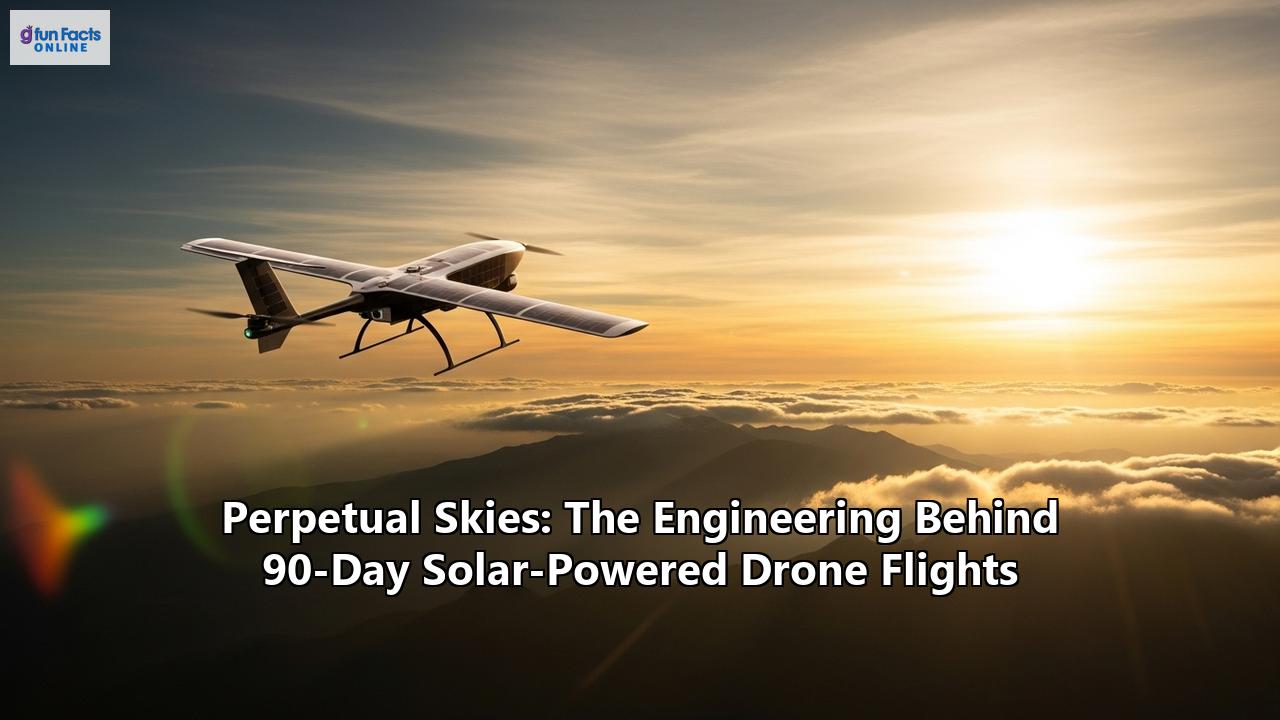
In an era defined by relentless technological advancement, the dream of perpetual flight is rapidly transitioning from science fiction to reality. High above the clouds, a new class of aircraft is emerging: solar-powered drones designed to stay aloft not just for hours or days, but for months on end. These "atmospheric satellites" or High Altitude Platform Stations (HAPS) represent a monumental leap in aviation, promising to reshape industries from telecommunications to defense. The quest to conquer the skies for 90 days or more is a symphony of cutting-edge engineering, a delicate balance of harvesting the sun's energy while defying gravity in the harsh environment of the stratosphere.
These unmanned aerial vehicles (UAVs) are more than just drones; they are marvels of efficiency and endurance. They operate in the stratosphere, an atmospheric layer between 60,000 and 70,000 feet, flying above weather and conventional air traffic. This ambitious undertaking pushes the boundaries of materials science, energy storage, aerodynamics, and autonomous control. At the heart of this revolution are pioneering projects like Airbus's Zephyr and Skydweller Aero's Skydweller, each pushing the limits of what's possible and paving the way for a future of perpetual skies.
The Intricate Dance of Perpetual Flight: An Engineering Overview
Achieving near-perpetual flight is not the result of a single breakthrough but the harmonious integration of multiple advanced technologies. A long-endurance solar drone is a system of systems, where every component is meticulously optimized for maximum efficiency and minimum weight. The fundamental challenge is deceptively simple: during the day, the aircraft must harvest enough solar energy to power its flight systems and simultaneously charge its batteries with enough energy to survive the long, cold night.
This continuous day-night cycle demands a holistic design approach encompassing:
- Energy Harvesting and Storage: The aircraft's wings are covered in highly efficient photovoltaic (PV) cells to capture solar radiation. This energy powers the motors and onboard systems while charging an advanced, lightweight battery system for nighttime operations.
- Lightweight Structures and Materials: To fly on the meager power generated by the sun, the airframe must be exceptionally light yet incredibly strong. This is achieved through the extensive use of advanced composite materials like carbon fiber.
- Aerodynamic Supremacy: These drones feature long, slender wings, similar to a glider, to maximize lift and minimize drag. This high-aspect-ratio design is crucial for conserving energy, especially in the thin air of the stratosphere.
- Intelligent and Autonomous Control: With missions lasting for months, human piloting is unfeasible. Sophisticated artificial intelligence (AI) and autonomous systems are required to navigate, manage energy consumption, and adapt to changing environmental conditions.
The Power Plant in the Sky: Solar Energy Harvesting
The journey to 90-day flight begins with the sun. The drone's ability to act as a flying power plant is the cornerstone of its endurance. This requires solar cell technology that is not only efficient but also incredibly lightweight and durable enough to withstand the harsh stratospheric environment.
The Photovoltaic Revolution
The solar cells laminated onto the wings of a HAPS are far from the conventional panels seen on rooftops. The primary technology used is often Gallium Arsenide (GaAs)-based multi-junction solar cells. These cells are chosen for their superior efficiency, with some achieving conversion rates of over 35%. This high efficiency is critical because the surface area of the wing is finite, and every square inch must generate the maximum possible power.
For example, the Skydweller aircraft boasts over 17,000 individual solar cells spread across its 72-meter wingspan, covering an area of about 270 square meters. In ideal sunlight conditions, these can generate up to 100 kilowatts of power. Similarly, the Airbus Zephyr S uses ultra-thin amorphous silicon arrays, no thicker than a sheet of paper, covering its wings to generate power.
A key challenge is the integration of these cells. They must be embedded into the wing structure without compromising its aerodynamic profile or structural integrity. The process often involves laminating flexible, micro-structured photovoltaic cells directly onto the lightweight composite wing material, creating a seamless and efficient energy-harvesting surface.
Maximizing Every Photon: Energy Management
Harvesting solar power is only half the battle; managing it is just as critical. A sophisticated system known as Maximum Power Point Tracking (MPPT) is essential. The intensity of solar radiation changes throughout the day and with the aircraft's orientation. The MPPT controller continuously adjusts the electrical load on the solar array to ensure it is always operating at its peak efficiency, extracting every possible watt of power from the available sunlight. This intelligent power harvesting is crucial for building up the necessary energy reserves for the night.
Surviving the Night: Advanced Energy Storage
As the sun sets, the atmospheric satellite faces its greatest test: flying for up to 12 hours or more in total darkness and extreme cold. This is where the energy storage system (ESS) takes over. The performance of the ESS is a defining factor in the drone's ability to achieve multi-month endurance.
The Battery Frontier: Beyond Lithium-Ion
Conventional lithium-ion batteries, while common, are often not ideal for the extreme demands of HAPS. The key metrics for a HAPS battery are high specific energy (the amount of energy stored per unit of mass) and the ability to withstand a high number of charge-discharge cycles without significant degradation.
The Airbus Zephyr program has utilized advanced lithium-ion batteries from Amprius, which feature silicon nanowire anodes. This technology offers a significantly higher specific energy (435 Wh/kg) compared to standard lithium-ion batteries (300-320 Wh/kg), allowing the aircraft to store more energy for the same weight. For the Zephyr S, the batteries account for a significant portion of its total mass, weighing 24 kg out of the aircraft's 60 kg total.
Other promising technologies include lithium-sulfur (Li-S) batteries, which are theoretically capable of even higher energy densities. The challenge with these next-generation batteries lies in ensuring their stability and cycle life.
Some designs also explore the use of regenerative fuel cells. In this system, excess solar power generated during the day is used to run an electrolyzer, which splits water into hydrogen and oxygen. At night, these elements are recombined in a fuel cell to generate electricity, with water as the only byproduct. This closed-loop system could offer very high energy storage capacity, though it presents greater complexity.
The Day-Night Energy Dance
The entire mission hinges on a delicate energy balance. During the day, the solar arrays must generate enough power to run the motors, payload, and all onboard systems, with enough left over to fully recharge the batteries. As dusk approaches, the flight strategy may change. The drone might climb to a higher altitude during the late afternoon, storing potential energy. Then, during the night, it can enter a slow, gliding descent to conserve battery power, a technique known as "energy-optimized altitude cycling."
The Battery Management System (BMS) acts as the brain of this operation, orchestrating the flow of energy. It manages the charging and discharging of the batteries to maximize their lifespan, prevents over- and under-charging, and provides the flight control system with real-time data on the energy state. For a 90-day mission, the batteries will need to endure nearly 90 deep discharge cycles, making robust BMS and battery chemistry absolutely essential.
The Gossamer Giant: Airframe and Materials Science
To fly efficiently at high altitudes on solar power, a HAPS must be a "gossamer giant"—possessing an enormous wingspan but an incredibly low weight. The Skydweller, for instance, has a wingspan longer than a Boeing 747 but weighs only 2.5 metric tons, about 160 times lighter than a fully loaded jumbo jet. This extraordinary characteristic is a testament to breakthroughs in materials science and structural engineering.
The Carbon Fiber Revolution
The material of choice for constructing these aircraft is Carbon Fiber Reinforced Polymer (CFRP). CFRP offers an unparalleled combination of high strength, high stiffness, and low density, making it far superior to traditional aerospace materials like aluminum for this application. Using composites allows designers to create structures that are both skeletal and strong, capable of supporting a massive wingspan while weighing as little as possible. The entire airframe of the Skydweller, including its fuselage and vast wings, is constructed from carbon fiber.
Designers can tailor the properties of composite parts by varying the direction of the carbon fiber layers. This allows for the optimization of specific components, such as creating wing spars that are exceptionally stiff to resist bending under aerodynamic loads, while keeping the overall structure light. For HALE aircraft, this material choice can result in a wing that is up to 60% lighter than an equivalent aluminum wing.
Designing for the Stratosphere
The structural design must account for the unique challenges of high-altitude flight. While the drone flies above most weather, it can still encounter turbulence and atmospheric waves. The long, flexible wings of a HAPS are susceptible to a phenomenon called aeroelasticity, where aerodynamic forces cause the structure to bend and twist. The catastrophic failure of the NASA Helios prototype in 2003 was attributed to the aircraft encountering turbulence that led to excessive structural oscillations.
Modern designs incorporate this flexibility. The structure is designed to be resilient, and the autonomous flight control systems are programmed to dampen these oscillations and alleviate gust loads. For example, the wings of the EAV-3 HALE UAV are designed to flex by as much as 404mm under normal flight conditions. The Skydweller's advanced software is specifically designed to reduce the effects of wind gusts, a crucial innovation that addresses a key failure point of past solar aircraft.
Sipping Air: The Art of Aerodynamic Efficiency
In the thin air of the stratosphere, where air density is less than 10% of that at sea level, every ounce of drag is a critical penalty on energy consumption. The design of a HAPS is therefore an exercise in extreme aerodynamic efficiency, aiming for the highest possible lift-to-drag (L/D) ratio.
The High-Aspect-Ratio Wing
The most striking feature of a solar drone is its long, narrow wings. This is known as a high-aspect-ratio design. The aspect ratio is the square of the wingspan divided by the wing area. For comparison, a commercial airliner might have an aspect ratio of 8-10, while a high-performance glider can exceed 30. HALE drones push this even further. The KARI EAV-3, for instance, has an aspect ratio of 17.4.
A high aspect ratio minimizes a type of drag known as induced drag, which is generated as a byproduct of lift. By reducing this drag, the aircraft requires significantly less power to maintain level flight. This is why these drones so closely resemble high-performance gliders. The wing airfoils are also specially designed to perform optimally at low Reynolds numbers—a regime characteristic of slow speeds in thin air—to maximize lift and minimize drag.
A Delicate Balance
The aerodynamic design is a careful trade-off. While a longer wingspan reduces induced drag, it increases structural weight and parasitic drag (drag from the skin friction of the aircraft's surfaces). The engineers must find the optimal balance where the overall power requirement for flight is minimized. This optimization is performed using advanced computational fluid dynamics (CFD) software to simulate and refine the aircraft's shape before it is ever built. Some designs, like the HeliPlat, even adopt a twin-boom tail or blended wing body (BWB) configuration to find the best compromise between aerodynamic performance and the available surface area for solar cells.
The Brains of the Operation: Autonomous Flight and Intelligent Control
A 90-day mission is far too long for a human to be in direct control. Perpetual flight is therefore inextricably linked to autonomous flight. These drones are not merely remotely piloted; they are intelligent agents capable of making their own decisions to ensure mission success and survival.
The AI Pilot
The flight control system is the drone's central nervous system. It must be completely autonomous, handling everything from takeoff and landing to navigating complex flight paths and managing onboard systems. For example, the Skydweller has already completed numerous uncrewed autonomous flights, some lasting nearly a full day, proving the reliability of its systems.
AI and machine learning algorithms are critical for several functions:
- Navigation and Station-Keeping: For many missions, such as providing internet connectivity, the drone must remain in a fixed position relative to the ground (geostationary). The autonomous system uses GPS and inertial navigation systems to maintain its designated patrol area for weeks on end.
- Energy-Aware Path Planning: The AI can plan the most energy-efficient route, taking into account wind patterns and solar radiation forecasts. It might, for instance, command the aircraft to fly into areas with less cloud cover to maximize solar charging or use stratospheric winds to linger over an area with minimal energy expenditure.
- Weather Avoidance: While flying above most weather, HAPS can still be affected by high-altitude jet streams or severe storms that reach into the stratosphere. The Skydweller has been tested in tough conditions, using its onboard systems to navigate around thunderstorms, a critical capability for long-term reliability.
Redundancy and Self-Healing
For a mission where retrieval for repair is impossible, reliability is paramount. The systems are designed with multiple layers of redundancy. The Skydweller, for example, employs "self-healing" algorithms and quadruple redundancy, meaning it has four backup systems ready to take over if a component fails. This ensures that a single point of failure does not jeopardize the entire multi-million-dollar aircraft and its mission.
Thrusting Through the Thin Air: Propulsion Systems
The propulsion system of a solar-powered HAPS must be a model of efficiency. It needs to provide just enough thrust to overcome drag while consuming the absolute minimum of precious electrical power.
The system consists of several key components:
- High-Efficiency Electric Motors: Brushless DC electric motors are used for their high power-to-weight ratio, reliability, and efficiency. These motors are optimized to operate in the near-vacuum conditions of the stratosphere.
- Optimized Propellers: The propellers are designed with a large diameter and a specific blade geometry to be highly efficient in low-density air. The design objective is to generate the required thrust at a low rotational speed to conserve energy. A design for a HALE UAV propeller, for example, might aim for 72% efficiency while producing just 7 Newtons of thrust.
- Propeller Slipstream Effects: An often-overlooked challenge is the effect of the propeller's slipstream (the accelerated air behind it) on the wing's aerodynamics. This can alter the airflow over the wing section behind the motor, potentially increasing drag and energy consumption. Advanced design frameworks now use deep neural networks to model and mitigate these adverse effects, ensuring that the propulsion system is truly optimized as part of the entire aircraft system.
The Goldilocks Zone: Thermal Management in the Stratosphere
The stratosphere is a world of thermal extremes. During the day, intense solar radiation can cause components to overheat, while at night, temperatures can plummet to below -70°C (-94°F). Managing these temperatures is a critical and complex engineering challenge.
Electronic components like avionics and batteries have specific operating temperature ranges. If they get too hot or too cold, their performance degrades, and they can fail permanently. Mathematical thermal modeling predicts that without intervention, onboard electronics could face temperatures ranging from -60°C to as high as 190°C.
Since active heating or cooling systems would consume too much energy, engineers rely on passive thermal management techniques. These include:
- Specialized Paints and Coatings: Surfaces can be painted with materials that have specific thermal properties, either reflecting solar radiation to keep components cool or absorbing it to provide warmth.
- Conductive Plates and Heat Sinks: These can be used to draw heat away from hot components like processors and distribute it throughout the airframe.
- Strategic Component Placement: Locating batteries and other critical systems inside insulated compartments within the fuselage helps protect them from the most extreme external temperature swings.
Case Studies in Persistence: The Titans of the Stratosphere
The journey towards perpetual flight is best illustrated by the pioneering platforms leading the charge.
Airbus Zephyr: The Record-Breaker
The Airbus Zephyr has been a trailblazer in the HAPS world for over a decade. Originally developed by the British company QinetiQ, the project was acquired by Airbus in 2013. The Zephyr S model is an ultra-lightweight marvel, with a 25-meter wingspan and a weight of just around 75 kg.
In the summer of 2022, a Zephyr S set a remarkable endurance record, flying continuously for 64 days, demonstrating the maturity of its solar-electric systems. It operates at altitudes up to 76,100 feet and can carry a 5 kg payload, making it suitable for surveillance and communications relay missions. Zephyr's success is a direct result of the successful integration of its lightweight carbon-fiber structure, efficient solar arrays, and high-density Amprius batteries.
Skydweller Aero: The Heavy-Lifter
Skydweller takes a different approach. Based on the proven airframe of the Solar Impulse 2 (the first solar-powered aircraft to circumnavigate the globe), Skydweller is designed to be a much larger and more capable platform. With its 72-meter wingspan and an ability to carry a payload of up to 800 pounds (363 kg), it is built for missions requiring more substantial equipment, such as advanced maritime radar and sophisticated sensor suites.
Skydweller aims to achieve 90-day continuous flight, effectively creating a "perpetual" platform for missions like maritime domain awareness, border patrol, and providing internet connectivity. Its combination of a massive solar array, advanced battery storage, and highly intelligent autonomous flight controls positions it to become one of the first truly operationally viable perpetual flight systems.
The Perpetual Promise: Applications of Atmospheric Satellites
The ability to place a persistent, re-deployable platform in the stratosphere opens up a world of possibilities, creating a new layer in the aerospace ecosystem that complements both ground-based infrastructure and orbital satellites.
The key applications include:
- Telecommunications: A single HAPS can provide mobile connectivity over an area of up to 7,500 square kilometers, acting as a "cell tower in the sky." This is a revolutionary way to bring internet access to remote and underserved regions of the world, a goal pursued by companies like Facebook and Google with their now-abandoned drone projects.
- Earth Observation and Surveillance: Equipped with high-resolution cameras, a HAPS can provide persistent surveillance of a specific area. Because they fly much closer to the Earth than satellites, they can deliver imagery with significantly higher resolution. This is invaluable for applications like border security, maritime patrol, monitoring for illegal fishing, tracking wildfires, and disaster response.
- Environmental and Climate Monitoring: These platforms can carry scientific instruments to monitor atmospheric composition, track wildlife migration, and assess crop health with a level of persistence that is impossible with conventional aircraft.
The major advantage of HAPS over satellites is their flexibility and cost-effectiveness. They can be launched when needed, repositioned, and returned to Earth for payload upgrades or maintenance, all at a fraction of the cost of launching a satellite.
Conclusion: An Engineering Symphony for the Skies
The achievement of a 90-day solar-powered drone flight is not just an aviation milestone; it is the culmination of decades of research and innovation across a vast array of engineering disciplines. It is a symphony where every instrument must play in perfect harmony: the silent efficiency of the solar cells, the enduring power of the batteries, the feather-light strength of the carbon-fiber wings, the elegant dance of the aerodynamic design, and the unerring intelligence of the autonomous pilot.
Projects like Zephyr and Skydweller are proving that the dream of perpetual skies is within our grasp. As this technology matures, these silent, sun-powered sentinels will become an integral part of our global infrastructure, watching over us, connecting us, and helping us understand our world in ways we are only just beginning to imagine. They are the embodiment of a cleaner, smarter, and more persistent form of aviation, engineered to fly endlessly in the perpetual skies.
Reference:
- https://www.thebrighterside.news/post/meet-skydweller-the-autonomous-solar-powered-drone-that-can-fly-for-3-months-without-landing/
- https://www.skydweller.aero/
- https://www.foxnews.com/tech/solar-powered-aircraft-achieves-groundbreaking-22-hour-autonomous-flight
- https://www.airbus.com/en/products-services/defence/uas/zephyr
- https://en.wikipedia.org/wiki/Airbus_Zephyr
- https://www.fzt.haw-hamburg.de/pers/Scholz/ewade/2005/JAERO2007_Romeo.pdf
- https://www.livescience.com/technology/robotics/meet-skydweller-a-solar-powered-drone-that-can-fly-for-90-days-straight-its-wider-and-160-times-lighter-than-a-boeing-747
- https://www.enovbattery.com/solar-powered-drone-battery-solutions-achieving-seamless-day-night-energy-transition-for-persistent-flight/
- https://roboticsbiz.com/everything-about-drone-airframes-and-their-lightweight-composite-materials/
- https://www.researchgate.net/publication/303528283_Aerodynamic_Design_of_the_Solar-Powered_High_Altitude_Long_Endurance_HALE_Unmanned_Aerial_Vehicle_UAV
- http://past.ijass.org/On_line/admin/files/(132~138)15-152.pdf15-152.pdf)
- https://bigthink.com/the-present/science-of-perpetual-flight-drones-satellites/
- https://www.icas.org/icas_archive/icas2024/data/papers/icas2024_0910_paper.pdf
- https://www.zdnet.com/article/zephyr-solar-powered-stratosphere-drone-takes-flight/
- https://www.mdpi.com/2076-3417/11/22/10890
- https://www.mdpi.com/2071-1050/14/4/2071
- https://ntrs.nasa.gov/api/citations/20070004936/downloads/20070004936.pdf
- https://www.mdpi.com/2071-1050/15/20/14972
- https://xray.greyb.com/drones/flying-drones-at-high-altitude
- https://www.aerospacetestinginternational.com/news/skydweller-drone-completes-first-uncrewed-flight-test-campaign.html
- https://www.researchgate.net/publication/250360084_HALE_UAV_Composite_Wing_Structure_Design
- https://www.idtechex.com/fr/research-article/perpetual-drones/10580
- https://arc.aiaa.org/doi/pdfplus/10.2514/1.2723
- https://isef.net/project/etsd050-skylinker-uav-autonomous-perpetual-solar-flight
- https://www.mdpi.com/1996-1073/13/21/5563
- https://arxiv.org/html/2404.02920v1
- https://www.researchgate.net/publication/345488210_Design_and_Optimization_of_a_High-altitude_Long_Endurance_UAV_Propeller
- https://www.mdpi.com/2504-446X/8/10/584
- https://www.researchgate.net/publication/361442135_Thermal_management_of_electrical_systems_in_a_solar-electric_stratospheric_HALE
- https://elib.dlr.de/187412/1/3679220_BeneitezOrtega_paper.pdf