
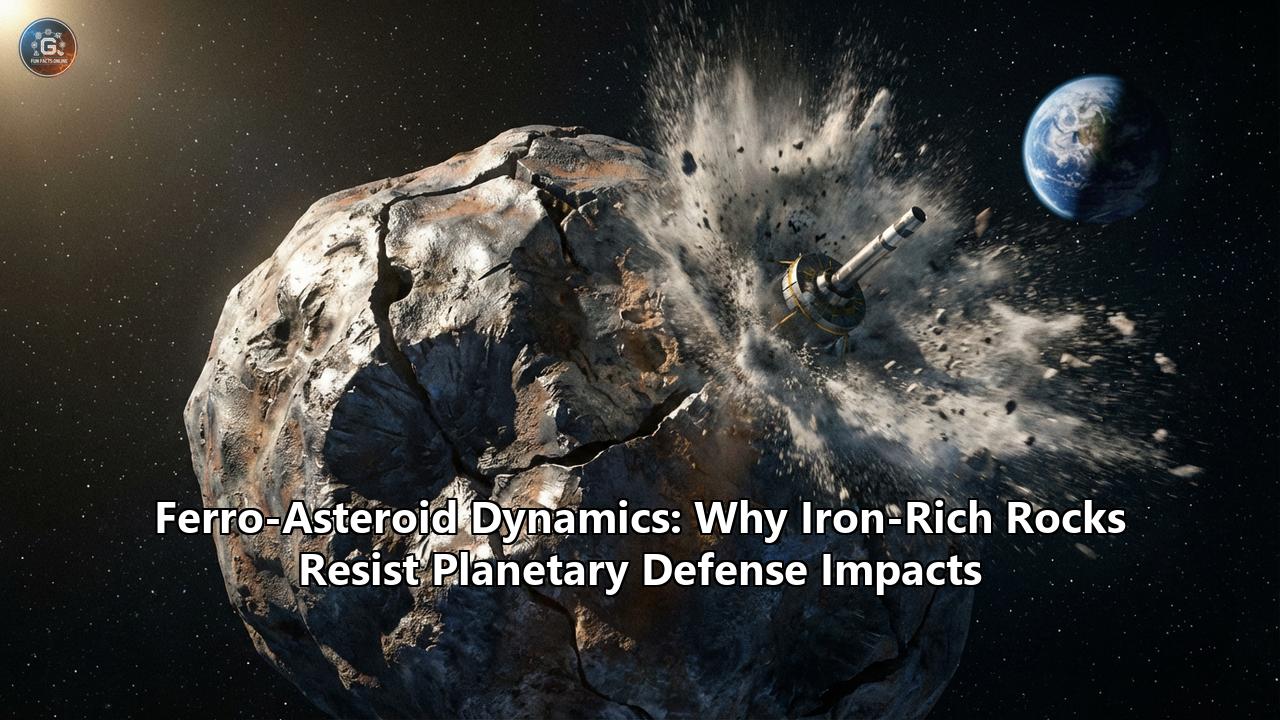
As humanity enters the era of active planetary defense, evidenced by the success of NASA’s Double Asteroid Redirection Test (DART), a new and formidable variable has emerged in the equations of orbital ballistics: the ferro-asteroid. While the DART mission successfully altered the trajectory of the rubble-pile moonlet Dimorphos, recent astrophysical simulations and material science studies suggest that this success may not translate to all near-Earth objects (NEOs). Specifically, M-type "ferro-asteroids"—dense, metallic remnants of planetary cores—possess unique dynamic properties that make them resistant to conventional kinetic impactors. This article explores the physics of hypervelocity impacts on metallic bodies, the material science of cosmic iron, and the specialized strategies required to deflect these "cannonballs" of the solar system.
Part I: The Metallic Menace
1.1 The M-Type Enigma
In the chaotic early days of our solar system, billions of planetesimals vied for dominance. Many grew large enough to undergo differentiation—the process where heavy metals sink to the center to form a core, surrounded by a silicate mantle and crust. Violent collisions subsequently stripped away the rocky exteriors of some of these protoplanets, leaving behind naked, metallic cores. These are the M-type asteroids, the "ferro-asteroids" of our study.
Unlike their C-type (carbonaceous) and S-type (silicate) cousins, which dominate the asteroid belt, M-types are relatively rare but disproportionately dangerous. They are not merely rocks; they are solid ingots of nickel-iron alloy, often doped with platinum, iridium, and cobalt.
1.2 The Density Discrepancy
The primary factor distinguishing ferro-asteroid dynamics is bulk density. A typical stony asteroid might have a density of 2.0 to 2.7 g/cm³, often riddled with void spaces (macroporosity). In contrast, a solid ferro-asteroid can exceed 7.0 g/cm³. This difference fundamentally alters the "impact physics" equation. When a kinetic impactor strikes a low-density rubble pile, it behaves like a bullet hitting a sandbag—energy is dissipated, but a massive cloud of debris (ejecta) is thrown backward. This ejecta acts like a rocket thruster, imparting a significant "momentum enhancement" (Beta factor) to the asteroid, pushing it further than the impactor’s force alone would suggest.
However, a ferro-asteroid is not a sandbag; it is an anvil.
Part II: The Physics of Resistance
2.1 Shockwave Propagation and Attenuation
The "Dynamics" in Ferro-Asteroid Dynamics refers largely to how shockwaves travel through the medium. In a stony asteroid, a hypervelocity impact creates a shockwave that exceeds the material's compressive strength, shattering the rock and creating a large crater. The energy is spent breaking chemical bonds and accelerating debris.
In a ferro-asteroid, the speed of sound is significantly higher (approx. 5,000–6,000 m/s for iron vs. 2,000–3,000 m/s for fractured rock). When an impactor strikes, the shockwave propagates rapidly and efficiently. However, metals possess a property rocks do not: ductility.
Instead of shattering, the crystal lattice of the iron-nickel alloy undergoes plastic deformation. The energy that would pulverize a rock is instead absorbed by the metal as it heats up and deforms. This phenomenon, known as strain-rate dependent damping, effectively muffles the blow. The impactor may gouge out a crater, but the massive ejection of material—the very mechanism relied upon for deflection—is severely reduced. The "Beta factor" drops closer to 1.0, meaning you only get the push of the spacecraft itself, losing the "free" thrust from the ejecta.
2.2 Hydrodynamic Flow
At hypervelocity speeds (typically >5 km/s), solids behave like fluids. Upon impact, the projectile and the target interface undergo "hydrodynamic flow." For a ferro-asteroid, this results in a splash rather than a shatter. The metal target liquefies momentarily at the impact site, absorbs the kinetic energy, and then resolidifies. The structural integrity of the asteroid remains largely compromised. While a rubble pile might be disrupted or reshaped, a ferro-asteroid simply absorbs the energy and continues on its path, largely unperturbed.
Part III: Case Studies in Metallic Dynamics
3.1 16 Psyche: The Monarch of Metal
The most famous of the M-types, 16 Psyche, offers a window into the complexity of these bodies. While long thought to be a solid core, recent data suggests Psyche may have significant porosity—a "rubble pile of metal." This creates a hybrid dynamic scenario. If Psyche is indeed a porous metal world, an impactor might not splash; it might crumple the asteroid like a car wreck. The void spaces would collapse (compaction), absorbing the impact energy completely with almost zero orbital deflection. This "crush-up" effect makes porous ferro-asteroids perhaps the most difficult objects to deflect of all.
3.2 216 Kleopatra: The Dog-Bone
Shaped like a giant dog bone with two moons, Kleopatra represents a different dynamic challenge. Its spin rate is high, and its strange shape means its center of mass is offset from its geometric center. A kinetic impact on one of the "lobes" of the bone would likely induce a tumble (torque) rather than a clean translational push. For a ferro-asteroid, this induced rotation consumes impact energy that was intended for deflection. We might successfully spin the asteroid up, but fail to push it off its collision course with Earth.
Part IV: Defeating the Iron Giant
Given the resistance of ferro-asteroids to standard kinetic impactors (the "punch" method), planetary defense strategies must evolve.
4.1 Nuclear Ablation: The X-Ray Hammer
For a solid iron body, the most viable deflection strategy is likely Nuclear Ablation. This involves detonating a nuclear device typically a few hundred meters to a few kilometers away from the asteroid's surface. The intense burst of X-rays instantly vaporizes a thin layer of the metal surface.
Because iron is dense and opaque to X-rays, the energy is deposited in a very shallow depth, creating a superheated plasma that explodes outward with extreme velocity. This "rocket exhaust" of vaporized iron imparts a thrust to the asteroid in the opposite direction. Unlike kinetic impact, which relies on the asteroid's brittleness, ablation relies on its surface area and thermal properties. Iron's high boiling point requires significant energy, but the density of the ejected iron vapor provides substantial thrust.
4.2 The Gravity Tractor: The Slow Tug
If time allows (decades of warning), the high density of ferro-asteroids becomes an asset. Their high mass creates a stronger gravitational pull than a stony asteroid of the same size. A heavy spacecraft could hover near the asteroid, using mutual gravity to slowly tug it off course. The density of the ferro-asteroid allows the spacecraft to orbit closer without hitting protruding debris, making the gravitational coupling more efficient.
4.3 Ion Beam Shepherding
Another non-contact method involves parking a spacecraft nearby and firing an ion thruster at the asteroid. The impacting ions transfer momentum. While the "sputtering" (erosion) of the iron surface would be minimal compared to rock, the momentum transfer is purely physics-based (Force = Mass x Acceleration). The challenge is that ferro-asteroids are often magnetic. A strong intrinsic magnetic field on a remnant core could deflect the ion beam, rendering this method useless or unpredictable.
Part V: Future Frontiers
The DART mission was a critical first step, but it was a test against a specific enemy: the stony rubble pile. The next frontier in planetary defense is understanding the ferro-asteroid.
The upcoming results from the Psyche mission (arriving 2029) will be pivotal. We need to determine if these bodies are solid monoliths, cosmic swiss cheese, or gravel pits of metal. We must understand their magnetic environments and their response to thermal shock.
Until then, the ferro-asteroid remains the "tank" of the solar system—heavy, armored, and dangerously resistant to our first line of defense. If we ever discover a dinosaur-killer made of iron heading our way, we will need more than a kinetic slap; we will need to bring the heat.
Reference:
- https://www.hou.usra.edu/meetings/lpsc2020/pdf/1421.pdf
- https://www.swri.org/newsroom/technology-today/understanding-how-deflect-dangerous-space-rubble
- https://hvit.jsc.nasa.gov/hypervelocity-testing/impact-physics.html
- https://impact.uwo.ca/meteorites/stony-iron-and-iron-meteorites/
- https://en.wikipedia.org/wiki/216_Kleopatra
- https://www.cps-jp.org/~21coeps/pub/SCHOOL/2007/PDF/Sharp1.pdf
- https://nineplanets.org/m-type-asteroids/
- https://www.researchgate.net/publication/342684841_Understanding_Asteroid_16_Psyche's_composition_through_3D_impact_crater_modeling
- https://www.engineering.org.cn/engi/EN/10.1016/j.eng.2025.04.019