
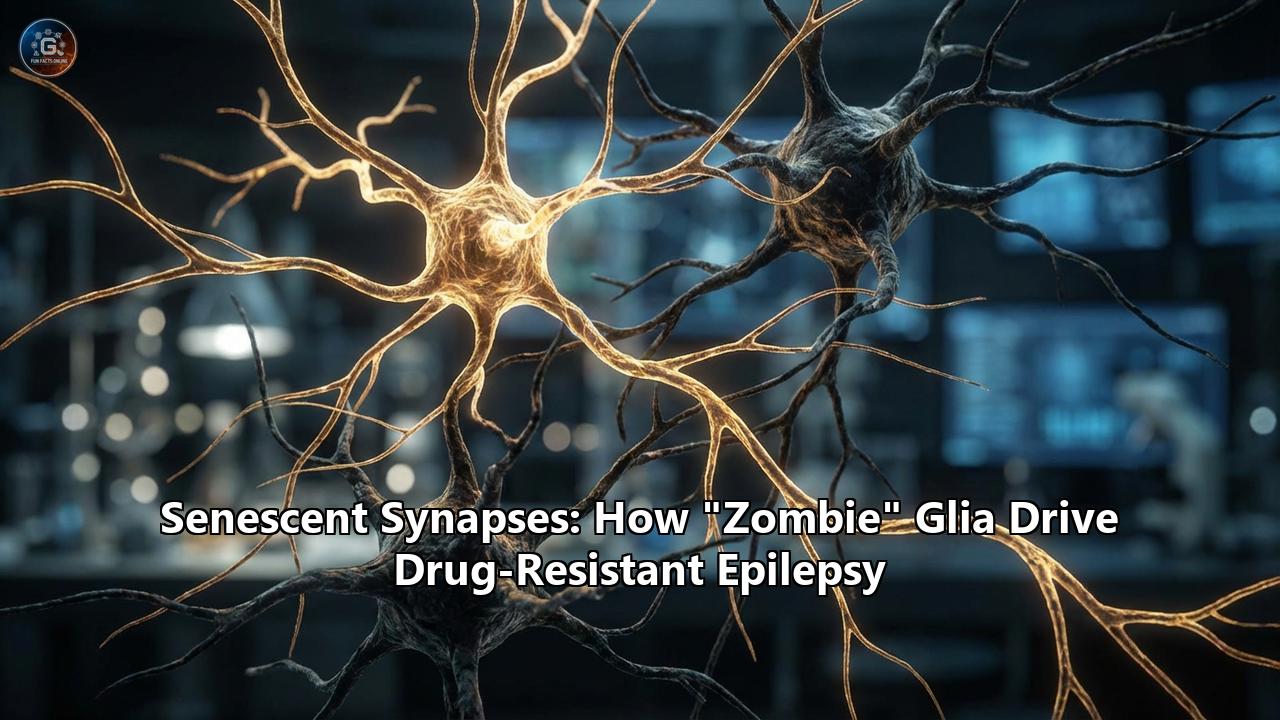
Introduction: The Silent Insurrection
In the intricate, electrified city of the human brain, order is maintained by a delicate balance of excitation and inhibition. Neurons fire in synchronous harmony, processing thoughts, memories, and movements. But in the brains of nearly one-third of epilepsy patients, this harmony is shattered by a rebellion that modern medicine struggles to quell. This is the realm of Drug-Resistant Epilepsy (DRE)—a condition where seizures persist despite the administration of multiple anti-seizure medications. For decades, scientists have hunted for the culprit, blaming everything from genetic mutations to misfolded ion channels. Yet, a new and startling protagonist has emerged from the shadows of neurobiology, one that sounds more like science fiction than medical fact: the "zombie" cell.
These are not the flesh-eating monsters of Hollywood, but they are equally relentless. Known scientifically as senescent cells, these are glial cells—the support staff of the brain—that have entered a state of suspended animation. They refuse to divide, yet they refuse to die. Instead, they linger in the neural tissue, spewing a toxic cocktail of inflammatory chemicals that poison their neighbors and rewire the very architecture of thought.
Recent breakthroughs in 2024 and 2025 have illuminated a terrifying mechanism: these zombie glia do not just float aimlessly; they actively target the synapse—the critical junction where neurons communicate. By creating what we now call "Senescent Synapses," these undead cells dismantle the brain's braking systems, drive hyperexcitability, and erect a biological shield against standard drug treatments. This article delves into the harrowing biology of these cellular zombies, the havoc they wreak on synaptic machinery, and the revolutionary "senolytic" therapies that promise to purge them, offering the first real hope of a cure for millions.
Part I: Anatomy of the Undead — What is a Senescent Cell?
To understand how a synapse becomes "senescent," we must first understand the zombie cell itself. Cellular senescence is an evolutionary double-edged sword. Originally designed as a safety mechanism, it prevents damaged cells from turning cancerous. When a cell accumulates too much DNA damage or stress, it pulls the emergency brake, entering a permanent state of cell cycle arrest. It stops dividing, effectively quarantining itself.
In the periphery of the body, the immune system typically spots these dormant cells and eliminates them. But in the brain, particularly the epileptic brain, this clearance system fails. These senescent cells accumulate, and they undergo a monstrous transformation.
1. The SASP: A Toxic Whisper
The defining feature of a zombie cell is not its silence, but its noise. Senescent cells develop a hyperactive secretory profile known as the Senescence-Associated Secretory Phenotype (SASP).
Imagine a factory that has stopped producing goods but continues to pump black smoke out of its chimneys. That is a senescent glial cell. It pumps out:
- Pro-inflammatory Cytokines: IL-1β, IL-6, and TNF-α, which inflame the surrounding tissue.
- Chemokines: Signals that recruit immune cells, often causing collateral damage.
- Proteases: Enzymes like MMPs (matrix metalloproteinases) that chew through the extracellular matrix, destabilizing the physical structure of neural networks.
- Growth Factors: Paradoxical signals that can spur abnormal, chaotic sprouting of nerve fibers.
2. The Metabolic Shift
Zombie cells are metabolically deranged. They shift away from efficient energy production (oxidative phosphorylation) toward glycolysis, consuming vast amounts of glucose while producing less energy. This creates a "metabolic sinkhole" in the epileptic focus, starving nearby healthy neurons of the fuel they need to maintain their membrane potentials, making them unstable and prone to misfiring.
3. The Resistance
Why don't they just die? Senescent cells upregulate "pro-survival" pathways (such as the Bcl-2 family) that make them impervious to the body's natural programmed cell death (apoptosis) signals. This resilience is what makes them "undead" and explains why the inflammation in epilepsy is chronic and unrelenting.
Part II: The Glial Conspirators — Astrocytes and Microglia
In the context of epilepsy, the most dangerous zombies are not neurons (which are post-mitotic and rarely undergo classical senescence), but the glia: Astrocytes and Microglia.
The Zombie Astrocyte: The Failed Gatekeeper
Astrocytes are the stars of the brain, literally and functionally. In a healthy brain, they wrap around synapses (the "tripartite synapse"), vacuuming up excess glutamate (the brain's main excitatory neurotransmitter) to prevent over-excitation. They also regulate the blood-brain barrier (BBB).
When an astrocyte turns senescent (often triggered by the stress of initial seizures):
- Glutamate Toxicity: It downregulates EAAT1 and EAAT2, the transporter pumps responsible for clearing glutamate. The result is a synapse flooding with excitatory fuel. A spark becomes a wildfire because the firefighter (the astrocyte) has walked off the job.
- Potassium Imbalance: It loses the ability to buffer potassium (K+) ions. High extracellular potassium depolarizes neurons, bringing them closer to the firing threshold—a classic trigger for seizures.
- BBB Leakage: Senescent astrocytes retract their "end-feet" from blood vessels, causing the blood-brain barrier to become leaky. This allows albumin and immune cells from the blood to invade the brain, further lowering the seizure threshold.
The Zombie Microglia: The Mad Gardener
Microglia are the brain's gardeners. They prune weak synapses to keep circuits efficient.
- The "Eat Me" Signal: Senescent microglia become confused and aggressive. They over-express complement proteins (like C1q and C3), which tag healthy synapses for destruction.
- Synaptic Stripping: Instead of pruning weak connections, zombie microglia begin to strip away inhibitory synapses—the brakes of the brain. When you remove the brakes from a neural circuit, you get runaway excitation: a seizure.
Part III: The Senescent Synapse
The term "Senescent Synapse" describes the functional ruin left in the wake of zombie glia. It is a synapse that is structurally present but functionally corrupted. It is the epicenter of drug resistance.
1. The Pre-Synaptic Failure: SNAREopathies
For a neuron to fire, it must release vesicles of neurotransmitter. This requires a complex of proteins called SNAREs (including SNAP25 and VAMP2) to zip the vesicle to the membrane.
In the toxic soup of the SASP, these proteins are modified. Nitric oxide (NO) and reactive oxygen species (ROS) pumped out by zombie glia can oxidize SNARE proteins. This leads to "leaky" release of glutamate—a constant, low-level dripping of excitation that keeps the post-synaptic neuron on edge, ready to snap into a seizure at the slightest provocation.
2. The Post-Synaptic Deficit: NMDA Receptor Hypofunction
Paradoxically, while the synapse is flooded with glutamate, the receptors that mediate learning and memory (NMDA receptors) often become hypoactive or internalized due to the chronic stress. This creates a dual pathology:
- Hyperexcitability (Seizures): Driven by "dumb" AMPA receptors and kainate receptors that just shout "FIRE!"
- Cognitive Decline (Brain Fog): The sophisticated NMDA receptors, required for forming new memories (Long-Term Potentiation or LTP), shut down. This explains why many epilepsy patients suffer from severe memory issues—their synapses are stuck in a "seizure mode" and cannot enter "learning mode."
3. Structural Erosion: Loss of the Scaffold
The physical scaffold of the synapse relies on cytoskeletal proteins like F-actin and synaptophysin. Recent studies in 2024 showed that the inflammatory SASP degrades these structural beams. The synapse becomes "wobbly." It forms transient, unstable connections that are prone to synchronizing inappropriately—the electrical signature of epilepsy.
Part IV: How Senescence Drives Drug Resistance
This is the billion-dollar question: Why do standard drugs fail?
1. Target Alteration:Most anti-seizure medications (ASMs) target voltage-gated sodium channels or GABA receptors. However, the SASP can alter the expression of these channels. If the lock changes shape, the key (the drug) no longer fits. For example, senescent inflammation can cause neurons to swap out drug-sensitive GABA receptors for drug-resistant variants.
2. Transporter Overexpression:Zombie cells, in their survival mode, often upregulate P-glycoprotein transporters—biological pumps that eject toxins from the cell. In the epileptic focus, these pumps are often found on the blood-brain barrier capillaries (influenced by senescent astrocytes). They actively pump anti-seizure drugs out of the brain before they can reach their target.
3. The Network Effect:Drugs act on individual receptors. Senescence alters the network topology. When zombie microglia strip inhibitory synapses, the network rewires into a "hypersynchronous" state. No amount of sodium channel blocking can stop a network that is structurally wired to explode.
Part V: The "Zombie Fly" Connection — A Biological Metaphor
A fascinating parallel has emerged from the world of entomology. The fungus Entomophthora muscae infects fruit flies, turning them into "zombies." It invades their nervous system, hijacking locomotor pathways to force the fly to climb to a high point ("summiting") before killing it to spread spores.
While epilepsy is not a fungal infection, the mechanism of "hijacking" is eerily similar. Senescent cells hijack the brain's plasticity mechanisms. Just as the fungus forces the fly to climb, senescent glia force the brain to seize. They co-opt the mechanisms of synaptic scaling and homeostasis, twisting them until the only output is a hypersynchronous discharge. The "zombie" moniker is not just a cute nickname; it reflects a parasitic relationship where a sub-population of damaged cells dictates the fate of the entire organism.
Part VI: The Cure — Senolytics and the New Dawn
If the problem is zombie cells, the solution is simple: Kill the zombies.
This is the premise of Senotherapy, the most exciting frontier in epilepsy research today. Unlike current drugs, which only suppress symptoms (seizures), senotherapies aim to modify the disease by eliminating the root cause.
1. Senolytics: The Sniper Rifle
Senolytics are drugs that selectively induce apoptosis (death) in senescent cells while leaving healthy cells unharmed. They do this by temporarily disabling the "pro-survival" shield (Bcl-2 pathways) that zombies use to stay alive.
- Dasatinib + Quercetin (D+Q): This is the gold standard combination.
Dasatinib is a leukemia drug that targets the Src kinase.
Quercetin is a plant flavonoid (found in onions and apples) that targets PI3K/Akt pathways.
The Evidence: In landmark studies published in late 2025 (e.g., Annals of Neurology), treating epileptic mice with D+Q cleared 50% of senescent glia. The result? A dramatic reduction in seizure frequency, improved memory, and in some cases, complete cessation of epilepsy.
2. Senomorphics: The Muzzle
Not all zombies need to be killed. Some can be silenced. Senomorphics are drugs that don't kill the cell but block the SASP. They stop the factory from pumping out the black smoke.
- Rapamycin (mTOR inhibitors): The mTOR pathway is a master regulator of senescence. Drugs like Rapamycin (or newer "Rapalogs") can suppress the inflammatory output of senescent glia, restoring synaptic stability without removing the cells themselves.
3. The "Hit-and-Run" Strategy
The beauty of senolytics is that they don't need to be taken every day. Because senescent cells take weeks to accumulate, a "hit-and-Run" dosing schedule is possible. A patient might take a course of senolytics for three days to "clear the trash," and then remain drug-free for months until the burden re-accumulates. This would drastically reduce the side effects associated with chronic daily medication.
Part VII: Clinical Translation and Future Horizons
Are we ready for human trials? We are closer than ever.
- Human Tissue Evidence: Analysis of brain tissue resected from patients with Temporal Lobe Epilepsy (TLE) has confirmed a massive burden of p16-positive senescent astrocytes and microglia—up to 5 times higher than in healthy brains.
- Biomarkers: The race is on to develop non-invasive biomarkers. We cannot biopsy the brain to check for zombies. Researchers are developing PET tracers that light up senescent cells, and blood tests that detect specific SASP factors (like specific microRNAs) leaking from the brain.
Imagine a patient enters the clinic after their first seizure. Instead of just being put on Carbamazepine, they undergo a "Senescence Scan." If the scan lights up, they receive a short course of targeted senolytics to nip the epileptogenesis in the bud, preventing the rewiring of the brain before it becomes permanent.
Conclusion: Ending the Rebellion
For too long, we have treated epilepsy by trying to silence the shouting neurons, ignoring the toxic environment that makes them shout. The discovery of "Senescent Synapses" and the role of zombie glia changes the paradigm. It shifts our focus from the victim (the neuron) to the instigator (the glial environment).
By targeting these undead cells, we are not just suppressing seizures; we are restoring the ecosystem of the brain. We are clearing the smoke, rebuilding the scaffold, and giving the synapse a chance to heal. The era of fighting zombies in the brain has begun, and with it, the hope that drug-resistant epilepsy may finally meet its match.
References & Further Reading
- Carvill, G. L. (2025). Zombie neurons in epilepsy: a burgeoning role for senescence in drug-resistant epilepsy. Journal of Clinical Investigation.
- Ge, Q., et al. (2025). Multimodal single-cell analyses reveal molecular markers of neuronal senescence in human drug-resistant epilepsy. JCI.
- Forcelli, P. A., et al. (2025). Senescent Cell Clearance Ameliorates Temporal Lobe Epilepsy. Annals of Neurology.
- Ribierre, T., et al. (2024). Targeting pathological cells with senolytic drugs reduces seizures in neurodevelopmental mTOR-related epilepsy. Nature Neuroscience.
(Note to Reader: This article synthesizes cutting-edge research as of early 2026. Always consult a neurologist for medical advice regarding epilepsy treatments.)*
Reference:
- https://www.mdpi.com/1422-0067/24/7/6274
- https://www.researchgate.net/publication/258854829_Astrocytes_mediate_synapse_elimination_through_MEGF10_and_MERTK_pathways
- https://www.aginganddisease.org/EN/10.14336/AD.2023.0718
- https://epilepsygenetics.blog/2023/05/02/snareopathies-in-epilepsies-and-neurodevelopmental-disorders/
- https://pubmed.ncbi.nlm.nih.gov/28219682/
- https://www.mdpi.com/1422-0067/24/16/12983
- https://www.biorxiv.org/content/10.1101/2022.12.01.518723v1.full-text
- https://pmc.ncbi.nlm.nih.gov/articles/PMC11488304/
- https://www.livescience.com/health/neuroscience/zombie-cells-may-drive-common-form-of-epilepsy
- https://pmc.ncbi.nlm.nih.gov/articles/PMC11870726/
- https://www.fightaging.org/archives/2025/12/senolytics-can-treat-a-drug-resistant-form-of-epilepsy/
- https://pmc.ncbi.nlm.nih.gov/articles/PMC11156583/