
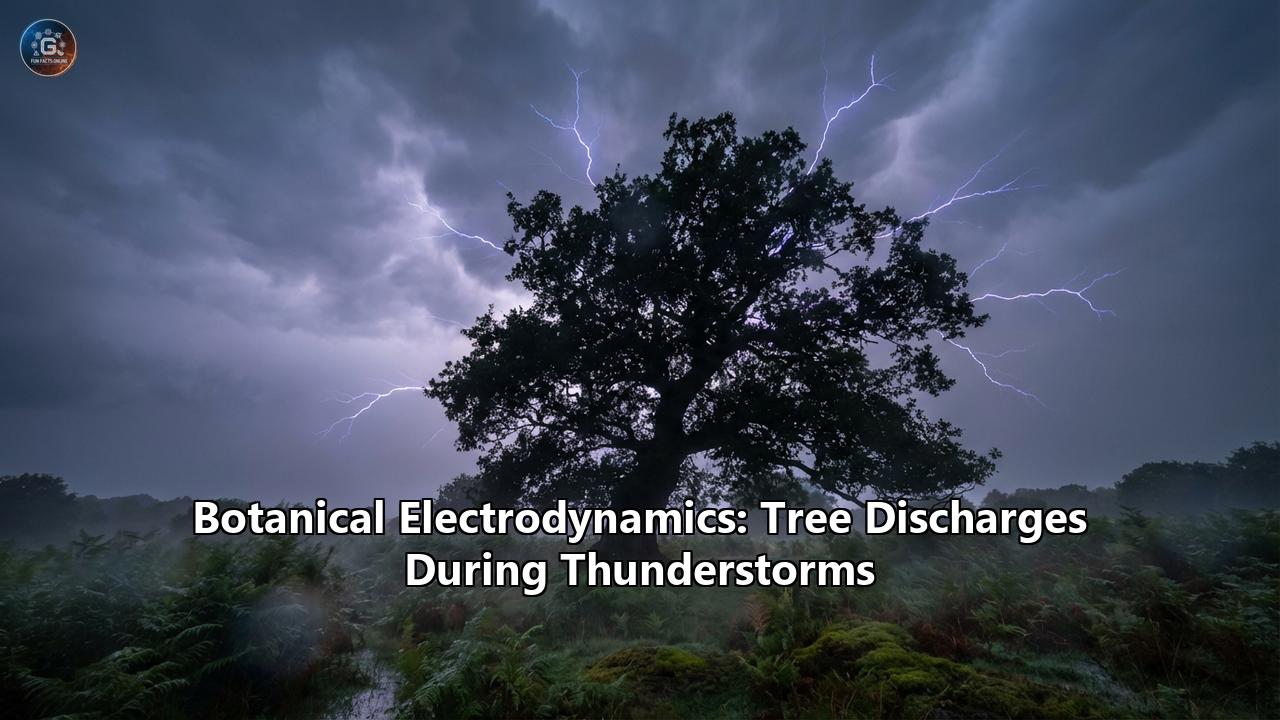
Long before the first drop of rain shatters against the forest floor, a silent, invisible dialogue begins between the sky and the earth. To the human eye, a tree during an approaching thunderstorm is simply a passive wooden giant, bending to the will of the wind. However, through the lens of atmospheric physics and botanical electrodynamics, the tree is revealed as a highly active participant in a spectacular planetary circuit. It is a biological lightning rod, a dynamic conduit of charge, and a breathing electrical sentry. The interaction between living vegetation and the colossal electrical forces of a thunderstorm is a tale of microscopic ionization, high-speed plasma physics, explosive thermodynamics, and forest ecology.
To understand what happens when a tree is struck by lightning, we must first dispel the illusion that a lightning strike is a sudden, one-sided assault from the heavens. In reality, the towering oaks, ancient pines, and sweeping willows are actively reaching out to the storm clouds long before the flash of light blinds the sky.
The Earth’s Spherical Capacitor and Fair-Weather Fields
The Earth and its ionosphere act as a gigantic spherical capacitor. In fair weather, the surface of the Earth carries a negative charge, while the upper atmosphere carries a positive charge. This creates a natural electric field in the air, typically measuring around 100 to 150 volts per meter near the ground. Because trees are rooted deep within the conductive soil, they are electrically continuous with the Earth. A tree, therefore, shares the ground's electrical potential.
When a towering cumulonimbus thundercloud rolls over the landscape, it radically violently disrupts this tranquil electrical state. The powerful updrafts and downdrafts within the storm cloud cause ice crystals and supercooled water droplets to collide, stripping electrons and separating charges. The base of the thundercloud becomes heavily loaded with negative charge, while the upper anvil accumulates positive charge.
This massive accumulation of negative charge at the cloud base repels the negative charges on the Earth’s surface beneath it, pushing them deep into the ground and leaving the surface—and everything protruding from it—with an intense, localized positive charge. The tree, standing tall above the landscape, suddenly finds itself acting as a highly concentrated spike of positive voltage, caught in an electric field that can skyrocket from 100 volts per meter to tens of thousands of volts per meter.
Point Discharge: The Forest Breeds Electricity
As the electric field intensifies, the tree begins to "bleed" electricity into the air. This phenomenon is known as point discharge or corona discharge. In physics, electric fields are always strongest around sharp, protruding points. A forest is essentially an ocean of sharp points: millions of pine needles, serrated leaf edges, and jagged twigs pointing directly at the charged cloud above.
When the electric field around a leaf tip exceeds the dielectric strength of the surrounding air, the air molecules are stripped of their electrons and become ionized. This localized pocket of plasma allows a steady stream of positive ions to flow upward from the tree into the atmosphere. In extreme weather conditions, this intense point discharge can become visible to the naked eye as a faint, eerie blue or violet glow known as St. Elmo's Fire, dancing along the tips of branches.
Historical studies in atmospheric electricity have revealed just how significant this silent process is. Early researchers, such as J.A. Chalmers and C.T.R. Wilson, discovered that while a single tree might only emit a tiny point discharge current—measured in microamperes—an entire forest emits a massive upward current. Measurements indicate that under a severe thundercloud, the point discharge from a grove of trees can collectively transfer amperes of current, profoundly influencing the electrical balance of the storm overhead. The forest is actively attempting to neutralize the storm before lightning is even necessary.
The Anatomy of the Strike: The Sky Reaches Down
Despite the forest's best efforts to bleed off the charge, the electrical potential between the cloud base and the ground often becomes too immense. The air, which is normally an excellent electrical insulator, can no longer hold back the voltage. The strike initiates within the cloud as a "stepped leader".
The stepped leader is a branching, invisible channel of ionized air and negative charge that surges downward from the cloud. It does not travel in a smooth, continuous line. Instead, it moves in staccato bursts or "steps," each about 50 to 100 meters long, pausing for a fraction of a millionth of a second before branching and stepping again. As it zigzags toward the Earth, traveling at hundreds of miles per second, it blindly searches for the path of least resistance to the positively charged ground.
As the stepped leader plunges closer, the electric field at the surface of the Earth reaches catastrophic levels. The positive charge concentrated in the trees becomes frantic. Grounded objects whose tops are closest to the approaching negative charge begin to react violently.
The Upward Streamer: The Tree Reaches Up
The tree does not merely wait to be struck. When the downward stepped leader is within a few hundred meters of the canopy, the intense electric field causes the tree to launch its own electrical channel. From the highest, sharpest points of the tree—the uppermost branches and leaves—a surge of positive charge violently ionizes the air, creating what is known as an "upward leader" or "upward streamer".
The tree literally reaches into the sky with tendrils of positively charged plasma. In a densely wooded area, multiple trees, and even multiple branches on the same tree, may launch upward leaders simultaneously. It is a high-stakes, microscopic race. These upward leaders grow toward the descending stepped leader.
When one of these positive upward leaders finally meets a branch of the negative downward stepped leader—an event called "attachment"—the circuit is complete. A low-resistance channel of ionized air now connects the thundercloud directly to the tree. High-speed cameras have captured breathtaking images of this exact moment, often revealing the "unattached streamers"—ghostly, glowing purple veins reaching up from surrounding trees that lost the race and failed to connect to the main lightning channel.
The Return Stroke and Explosive Thermodynamics
The moment the connection is made, the "return stroke" occurs. This is the brilliant, blinding flash of light that we perceive as lightning. A massive surge of electrical current—often exceeding 30,000 amperes and sometimes reaching up to 300,000 amperes—rockets from the ground, through the tree, and up the ionized channel into the cloud at a third of the speed of light. The temperature of this plasma channel instantly spikes to around 50,000 degrees Fahrenheit (nearly 30,000 degrees Celsius)—about five times hotter than the surface of the sun.
Now, the botanical electrodynamics shift into the realm of violent thermodynamics.
Wood itself is composed mostly of cellulose and lignin, which are very poor conductors of electricity. If a tree were perfectly dry, it would be an excellent insulator. However, a living tree is fundamentally a hydraulic system. Just beneath the outer bark lies the phloem and the sapwood (xylem), a network of vascular tissues responsible for transporting water, dissolved minerals, and nutrients from the roots to the canopy.
This sap is rich in dissolved salts and ions, giving the sapwood an electrical resistivity similar to that of tap water (roughly 10,000 ohm-cm). While still a relatively poor conductor compared to a copper wire, the moisture-rich sapwood is infinitely more conductive than the dry heartwood in the center of the trunk and the dead bark on the outside. Therefore, when the massive electrical current of the return stroke enters the tree, it seeks the path of least electrical resistance, violently forcing its way through the moisture-rich layer just beneath the bark.
The sheer magnitude of the voltage is enough to drive a massive current through the wood, but it comes at a catastrophic cost. As tens of thousands of amperes push through the narrow, high-resistance vascular channels of the tree, extreme Joule heating occurs. In a fraction of a millisecond, the sap inside the tree is superheated well beyond its boiling point.
The water in the sapwood undergoes an instantaneous phase change, flashing from liquid into steam. When water turns to steam, it expands to approximately 1,700 times its original volume. Because this expansion happens in less than a thousandth of a second while trapped beneath the heavy outer bark and solid wood fibers, it creates an explosive mechanical shockwave from within the living tissue.
The result is a literal botanical explosion. The immense pneumatic pressure blasts the bark off the tree. In many strikes, a spiral scar of missing bark is carved down the length of the trunk, marking the exact spiraling path the electrical current took through the vascular tissue. In more severe cases, where the lightning current penetrates deeper into the water-rich wood, the internal steam explosion is so catastrophic that it shatters the entire trunk, violently turning a multi-ton tree into a rain of wooden shrapnel scattered across the forest floor.
The Bark Shield: Why Some Trees Survive
A fascinating paradox in forest electrodynamics is that not all trees suffer the same fate when struck. Walk through any old-growth forest, and you will likely find massive trees bearing the long, healing scars of a lightning strike they survived years ago, while nearby lies the exploded, splintered corpse of another tree.
The determining factors in a tree's survival are often its species, its bark morphology, and the precise weather conditions at the exact moment of the strike.
During a thunderstorm, torrential rain often precedes the lightning. The way a tree's bark handles this rainwater dictates its electrical conductivity. Trees with smooth bark, such as beech and birch, tend to become completely drenched, allowing the water to form a continuous, unbroken, and highly conductive film over their entire outer surface. When lightning strikes a thoroughly wet smooth-barked tree, the current often travels over the outside of the bark, utilizing the rainwater as a conductive "wire". This phenomenon, known as a surface flashover, allows the massive electrical energy to reach the ground without penetrating the tree's interior. The tree may suffer singed leaves or minor external burns, but its vital internal vascular system remains largely intact, allowing it to survive.
Conversely, trees with thick, rough, deeply furrowed bark—such as oaks, elms, ashes, and pines—do not wet evenly. The rugged bark prevents the formation of a continuous sheet of water. When lightning strikes these trees, the surface moisture does not provide an adequate path to the ground. The current is forced to punch through the outer bark to find the moisture-rich cambium and sapwood inside. These rough-barked species are the ones most frequently subjected to the explosive, trunk-shattering steam thermodynamics described earlier.
Furthermore, the chemical composition of the tree's sap plays a critical role. Coniferous trees, such as spruce, fir, and pine, possess a high internal resin content. Resin is highly flammable and acts as a potent fuel when exposed to the 50,000-degree plasma of a lightning bolt. These highly resinous trees are far more susceptible to intense internal heating, violent explosions, and catching fire from the inside out.
Ground Currents and Root Systems: The Unseen Peril
The dramatic destruction of a tree's trunk is only half of the story. Once the millions of volts of electricity travel down the trunk, they do not simply vanish; they must dissipate into the Earth. This creates an incredibly dangerous phenomenon known as ground current or step voltage.
As the electricity enters the soil at the base of the tree, it spreads out radially in all directions. The ground offers resistance to the electricity, which means the voltage drops as the distance from the tree increases. However, over short distances, this creates massive voltage gradients along the surface of the earth.
If a person or an animal is standing near the tree, with their feet planted even a short distance apart, one foot will be in a zone of higher voltage than the other. The electricity will travel up one leg, through the body, and down the other leg to bridge this voltage gap. This deadly ground current is responsible for the vast majority of lightning-related deaths and injuries in humans and livestock during storms. Seeking shelter beneath a large tree during a thunderstorm places a person directly inside the most dangerous radius of both side flashes (where current jumps horizontally from the tree trunk to a highly conductive human body) and lethal ground currents.
The biological impact of the ground current on the forest itself is equally profound. As the charge dissipates through the soil, it travels aggressively through the tree’s root system. The roots, filled with water and extending far from the trunk, act like buried electrical cables. The immense heat generated in the roots literally boils them in the soil.
Frequently, a tree struck by lightning may show very little visible aboveground damage but will inexplicably wilt and die over the following weeks. The foliage turns brown, and the tree succumbs because its entire root system was silently incinerated underground, instantly cutting off its ability to absorb water. Even more remarkably, because tree roots frequently graft together beneath the soil—sharing nutrients and water in a symbiotic fungal network—a massive lightning strike can travel through the root grafts and kill neighboring trees, resulting in sudden, circular patches of forest death known as "group mortality."
The Ecological Crucible
While lightning strikes are violently destructive to the individual tree, they are an essential, life-giving force for the broader forest ecosystem. Lightning acts as a profound agent of ecological change and renewal.
When a dominant canopy tree is killed or shattered by lightning, it creates a "light gap" in the dense forest roof. This sudden influx of sunlight to the forest floor awakens dormant seeds and allows understory saplings to surge upward, driving biodiversity and forest regeneration.
Furthermore, the struck tree, now dead or dying, becomes an invaluable ecological asset. The shattered trunk and deep internal fissures created by the steam explosion provide immediate entry points for wood-boring insects, fungi, and moisture. The tree transforms into a "snag"—a standing deadwood monolith that provides critical nesting habitats for woodpeckers, owls, bats, and countless species of insects that cannot survive in healthy, living trees.
Even the soil composition is altered by the strike. The extreme heat of the lightning channel is powerful enough to break the triple bonds of atmospheric nitrogen gas ($N_2$), bonding the free nitrogen atoms with oxygen to form nitrogen oxides. These oxides dissolve in the rain and fall to the earth as nitrates—a potent natural fertilizer. While this atmospheric nitrogen fixation occurs all along the lightning channel, the immediate vicinity of a struck tree receives a localized chemical shift, enriching the soil for the next generation of plant life.
The Symphony of Charge
The interaction between a tree and a thunderstorm is a masterclass in the interconnectedness of natural forces. It bridges the microscopic physics of subatomic ion separation with the massive, towering biology of the world's largest organisms.
From the silent, glowing point discharges of a million pine needles bleeding positive charge into the dark sky, to the violent, upward-reaching streamers desperately seeking the lightning's path, the tree is never truly passive. It is a vital node in the Earth's electrical circuit. The subsequent thermodynamic explosion of boiling sap and the deep, earth-shaking root currents remind us of the terrifying, raw energy required to balance the atmosphere's electrical deficit.
Through botanical electrodynamics, we see the forest not just as a collection of wood and leaves, but as a living, breathing conductor bridging the gap between the solid earth and the electric sky. The shattered, lightning-scarred oaks standing silently in the woods are not merely victims of the storm; they are the battleground where the sky touched the earth, and the earth reached back.
Reference:
- https://comptes-rendus.academie-sciences.fr/geoscience/articles/10.1016/j.crte.2009.12.001/
- https://www.canada.ca/en/environment-climate-change/services/lightning/science/how-lightning-works.html
- https://auf.isa-arbor.com/content/isa/9/2/51.full.pdf
- https://en.wikipedia.org/wiki/Lightning
- https://royalsocietypublishing.org/doi/pdf/10.1098/rspa.1928.0049?download=true
- https://www.reddit.com/r/physicsgifs/comments/bv6t2w/point_discharge_is_a_discharge_phenomenon_that/
- https://hgss.copernicus.org/articles/16/51/2025/hgss-16-51-2025.html
- https://publications.anl.gov/anlpubs/1999/12/34586.pdf
- https://www.reddit.com/r/explainlikeimfive/comments/1kwqh2x/eli5_how_can_a_lighting_split_a_tree_when_it_is/
- https://www.quora.com/Why-is-a-tree-a-good-conduct-of-electricity
- https://www.quora.com/If-wood-does-not-conduct-electricity-why-are-trees-struck-by-lightning-so-often
- https://auf.isa-arbor.com/content/9/2/51