
The dust of millennia has once again shifted in the heart of İzmir, revealing a secret that has held its breath for fifteen hundred years. Beneath the clamor of the modern Turkish city—where the call to prayer mingles with the honking of traffic and the chatter of the Kemeraltı bazaar—lies the ancient city of Smyrna, a metropolis that once rivaled Ephesus and Pergamon for the title of "First City of Asia."
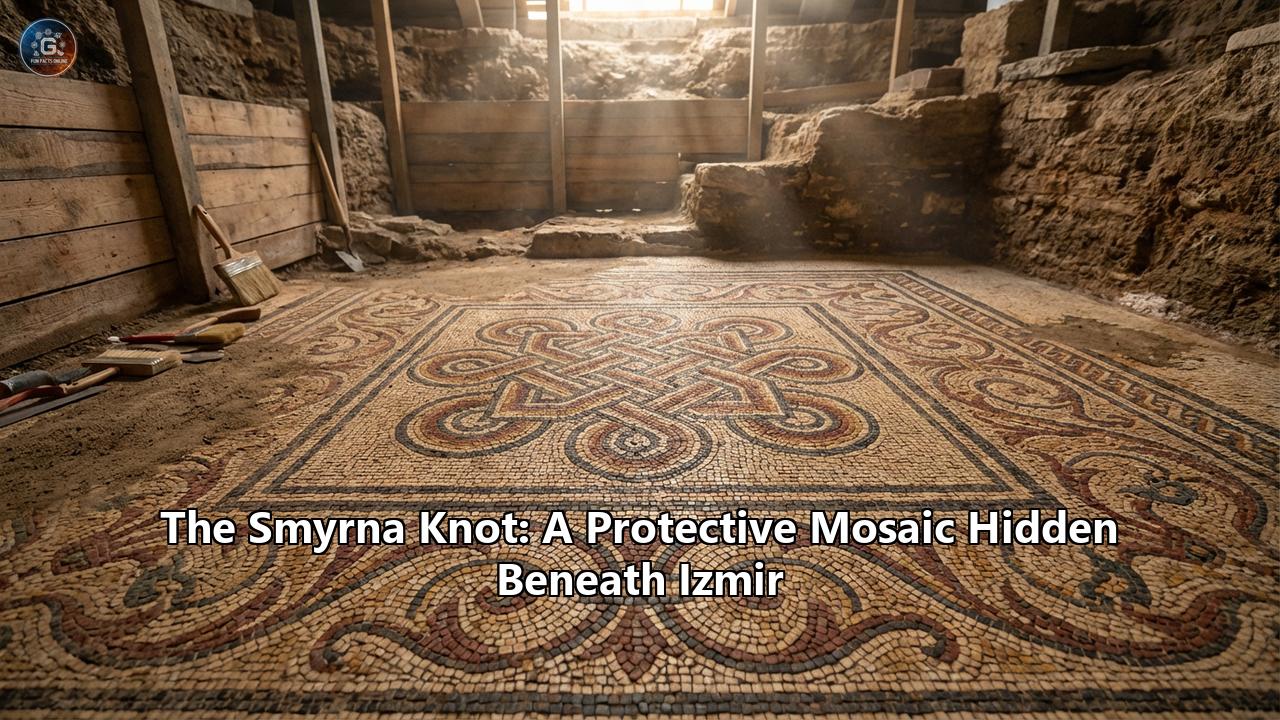
For decades, archaeologists have been peeling back the layers of this urban palimpsest, but their most recent discovery has sent a ripple of excitement through the world of classical studies. In the shadow of the Agora’s colonnades, along the ancient North Street, a team led by Professor Dr. Akın Ersoy has unearthed a rare and pristine mosaic floor. At its heart lies a symbol as old as it is mysterious: the Solomon’s Knot.
This is not merely a decorative floor; it is a shield in stone. It is a desperate, beautiful attempt by a Late Roman citizen to ward off the oldest enemy of the Mediterranean soul: the Evil Eye.
To understand why this discovery is so significant, and to truly grasp the story hidden within its tesserae, we must journey back to a time when Smyrna was a city of marble and magic, where the boundaries between the physical and the spiritual were as porous as the limestone hills that craddled it. This is the story of the Smyrna Knot.
Chapter 1: The Knot in the Stone
The discovery was made during the ongoing "Heritage for the Future" project, an ambitious initiative by the Turkish Ministry of Culture and Tourism to uncover and protect the archaeological wealth buried beneath the country's sprawling urban centers. The excavation team had been working along the North Street of the Smyrna Agora, a major thoroughfare that would have once thrummed with the footsteps of merchants, soldiers, and senators.
As the layers of soil were carefully brushed away, a pattern emerged. First, the borders: intricate geometric meanders and interlocking twelve-sided panels, executed in a palette of earthy reds, ochres, deep blacks, and creamy whites. Then, the center: a looped, endless design that seemingly has no beginning and no end.
The Solomon’s Knot (known in Latin as sigillum Salomonis) is not a true knot in the nautical sense. It is two closed loops, doubly interlinked in an alternating over-and-under pattern. In the Smyrna mosaic, it sits like a spider in its web, commanding the visual attention of anyone who would have entered the room.
The Architecture of Infinity
The room itself measures approximately 3 by 4 meters (roughly 10 by 13 feet). In the grand scale of Roman architecture, this is not a monumental basilica or a public bathhouse; it is an intimate space. This intimacy is our first clue. The mosaic was likely the centerpiece of a private reception room or a semi-public antechamber—a place where business was conducted, guests were welcomed, and social status was displayed.
The craftsmanship tells a story of a city that, even in the Late Antique period (4th to 6th centuries AD), still commanded immense artistic resources. The tesserae (the small stone cubes that make up the mosaic) are cut with precision, allowing for fluid lines that make the rigid stone appear to flow like rope.
Surrounding the central knot are smaller motifs: vegetal patterns representing abundance and fertility, and—crucially—small cross figures. These crosses are the timestamp of the mosaic. They whisper of a world in transition. By the 4th and 5th centuries, the Roman Empire was undergoing a seismic shift from paganism to Christianity. Yet, the old symbols did not simply vanish; they adapted. The Solomon’s Knot, ancient and pagan in origin, found a comfortable home in the new Christian aesthetic, representing the eternity of God and the infinite nature of the soul.
A Shield Against Envy
But why put a knot on the floor? To the modern eye, it is a pleasing geometric puzzle. To the ancient eye, it was a spiritual barrier.
In the Late Roman world, the air was thick with invisible dangers. The most feared of these was Invidia (Envy), manifested as the Evil Eye. It was believed that a glance of jealousy—whether from a neighbor, a rival merchant, or a stranger—could cause physical harm, financial ruin, or illness.
Apotropaic magic (from the Greek apotrepein, "to ward off") was the architectural antibiotic of the day. You didn't just build a house to keep out the rain; you built it to keep out the curse.
- The Labyrinthine Trap: Complex geometric patterns like the Solomon’s Knot were believed to confuse and trap evil spirits. A demon or a curse, entranced by the endless line, would be forced to follow the loop for eternity, never finding a way out to harm the inhabitants of the house.
- The Binding: The "knot" itself symbolizes binding. Just as a physical knot secures a rope, a symbolic knot "binds" the forces of chaos, preventing them from unraveling the order of the household.
This mosaic was not just a floor; it was a psychic security system, installed at the threshold of the home to filter the intentions of every guest who crossed it.
Chapter 2: The City of Ashes and Marble
To fully appreciate the mosaic, we must place it in its proper setting: the magnificent, turbulent city of Smyrna.
By the time this mosaic was laid, Smyrna was already ancient. It had been refounded by Alexander the Great, who, according to legend, fell asleep under a plane tree on Mount Pagus (modern Kadifekale) and was visited by the Nemeses, who told him to build a city there. It grew to become one of the wealthiest ports in the Mediterranean, a "crown of Ionia."
But Smyrna was a city familiar with destruction. The defining trauma of its Roman history occurred in 178 AD, when a catastrophic earthquake leveled the city. It was a disaster of biblical proportions. The earth roared, the marble columns snapped like twigs, and the city slid into ruin.
The Phoenix of Ionia
The rebuilding of Smyrna was a project of imperial importance. Emperor Marcus Aurelius, moved by the tears of the Smyrnaean aristocrat Aelius Aristides, poured state funds into the reconstruction. The Agora we see today—and the layer upon which our mosaic rests—is largely the result of this post-178 AD rebuilding effort.
The city that rose from the ash was a marvel of urban planning.
- The North Stoa: A massive basilica, 160 meters long, which served as a center for law and commerce. Its basement vaulted chambers, which survived the earthquake, are among the best-preserved crypto-porticoes in the world.
- The Water System: Smyrna was a city of water. Complex channels brought fresh spring water from Mount Pagus to the Agora, fueling fountains and nymphaea that cooled the air and provided a soothing soundtrack to the bustle of the market.
- The North Street: This is where our mosaic was found. It was a major artery, likely lined with high-status homes and shops. Imagine walking down this street in 400 AD: the pavement is shaded by colonnades, the air smells of roasting meat and incense, and beneath your sandals, the mosaics glitter in the dappled sunlight.
The "Mosaic Room" Context
The building containing the Solomon’s Knot was not an isolated structure. Excavations suggest it was part of a larger complex that remained in use for centuries. Interestingly, archaeologists found mortar from 19th-century walls directly on top of the Late Antique mosaic. This implies that the floor was either visible or just barely covered for over a thousand years, or that 19th-century builders (perhaps constructing the non-Muslim hospital that once stood there) encountered the Roman floor and decided to build their foundations right over it, unwittingly preserving it for us.
This layering of history—Roman, Byzantine, Ottoman, Modern—is the hallmark of Izmir. The protective knot, intended to save a Roman household, ultimately survived the collapse of empires, the arrival of the Turks, and the fires of the 20th century to emerge intact in 2026.
Chapter 3: Whispers on the Wall
The "Heritage for the Future" project didn't just find a floor; it contextualized a city of voices. While the mosaic speaks to us in the language of images, the nearby Basilica of the Agora speaks to us in words.
The Smyrna Agora possesses the richest collection of Greek graffiti in the ancient world. Preserved in the cool, dry basement of the basilica are hundreds of messages scratched or painted onto the plaster by bored merchants, waiting lovers, and gossiping locals.
These voices from the past provide the perfect psychological backdrop for the Solomon’s Knot. They reveal a society deeply concerned with fate, healing, and protection.
The Riddles and the Cures
Among the graffiti, scholars have found:
- Word Squares: Like the visual puzzle of the knot, the Romans loved verbal puzzles. Five-word palindromic squares (sator squares) were found, believed to have magical protective properties similar to the mosaic.
- Healing Prayers: "The gods healed my eyes," reads one inscription. "I dedicate an oil lamp to the gods." Eye health was a major obsession in Smyrna (perhaps due to dust or infection). This obsession with the "eye" links directly to the fear of the "Evil Eye." If your physical eyes were weak, you were perhaps more susceptible to, or unable to ward off, the malevolent gaze of others.
- Lovers' Laments: "I love a woman whose number is 1308," writes one shy suitor, using isopsephy (Greek numerology) to hide her name. Another writes, "I love someone who does not love me."
These graffiti reveal the anxieties of the people who walked the North Street. They were people who felt vulnerable—vulnerable to heartbreak, to sickness, to bad luck. In a world without modern medicine or insurance, you protected yourself however you could: with a prayer scratched on a wall, or a knot laid into the floor.
Chapter 4: The Evil Eye (Nazar)
The discovery of the Smyrna Knot is a powerful reminder that some human fears—and the symbols we use to combat them—are timeless.
Walk out of the archaeological site of the Smyrna Agora today, and go into any souvenir shop in Kemeraltı, or look at the rearview mirror of a taxi, or the lapel of a newborn baby. You will see a blue glass bead with an eye in the center: the Nazar Boncuğu.
The Blue Bead of Anatolia
The belief in the Nazar (Evil Eye) is the direct cultural descendant of the fear that inspired the Solomon’s Knot mosaic.
- The Concept: Just as in Roman times, the belief in Turkey today is that a person with "strong eyes" (often blue or light-colored, which were rare in the region and thus suspicious) can cause harm simply by looking at something with envy. A beautiful child, a new car, a successful business—all are targets.
- The Protection: The Nazar Boncuğu works on the same principle as the Roman apotropaic symbols. It is a decoy. It stares back. The logic is that the malicious gaze is drawn to the bead, which absorbs the negative energy and breaks, sparing the person or object it protects.
From Knot to Bead
The Solomon’s Knot functioned similarly. It was a "visual trap" designed to catch the eye. The transition from the complex geometric knots of the Roman period to the simple blue glass beads of the Ottoman and modern periods represents a democratization of magic.
- Roman Era: Only the wealthy could afford a mosaic floor to protect their home. The "magic" was architectural and permanent.
- Modern Era: The glass bead is cheap, portable, and universal. It is the apotropaic magic of the people.
The discovery of the Solomon’s Knot in Izmir is a beautiful closing of the circle. It proves that the "culture of protection" has been the beating heart of this city for 2,000 years. The method changes—from tesserae to glass—but the meaning remains: Keep us safe from the envy of others.
Chapter 5: A Room for the Ages
What exactly was this room where the mosaic was found? Based on similar finds in Anatolia, such as the massive 4th-century villa recently excavated in Kayseri (Caesarea) or the terrace houses of Ephesus, we can speculate.
It was likely a triclinium (dining room) or a tablinum (reception office).
In the Late Roman house, the dining room was the stage of social life. Guests would recline on couches arranged in a U-shape. The center of the floor—the "emblema"—was left visible for the guests to admire while they ate.
- The Dinner Party Defense: Imagine a wealthy merchant hosting a dinner for his trading partners. He wants to impress them with his wealth (hence the mosaic), but he also fears their jealousy. As they drink his wine and admire his home, their eyes are drawn to the floor. The Solomon’s Knot traps their envious glances, neutralizing their negativity before it can sour the wine or the deal.
The presence of the cross motifs suggests the owner was likely a Christian, or at least living in a Christianized society. Yet, he did not abandon the old ways. He hedged his bets. He had the Cross for his soul’s salvation, and the Knot for his house’s protection. This "belt and suspenders" approach to spiritual safety is deeply human.
Conclusion: The Legacy of Smyrna
The excavation of the Smyrna Knot is more than just a footnote in an archaeological report. It is a window into the psyche of a city that has survived everything history could throw at it.
Smyrna is a city that has been burned, shaken, and conquered, yet it has never been abandoned. It is a city of layers.
- Layer 1: The Hellenistic grid of Alexander.
- Layer 2: The Roman marble of Marcus Aurelius.
- Layer 3: The Byzantine churches.
- Layer 4: The Ottoman kervansarays.
- Layer 5: The modern Turkish metropolis.
The Solomon’s Knot mosaic sits at the intersection of these layers. It was walked upon by Romans, built over by Ottomans, and rediscovered by modern Turks. It is a symbol of continuity.
As Professor Ersoy and his team continue to brush away the dirt from the North Street, they are not just finding stones; they are finding the hopes and fears of the people who lived there. They are finding that the citizen of Smyrna in 400 AD—who worried about his health, loved someone who didn't love him back, and wanted to keep his home safe from envy—was not so different from the citizen of Izmir in 2026, who pins a blue bead on his baby’s shirt and hopes for the best.
The knot is endless. The city is eternal. And the protection still holds.
Reference:
- https://news.artnet.com/art-world/largest-known-4th-century-floor-mosaic-uncovered-in-turkey-2395605
- https://mymodernmet.com/roman-mosaic-keyseri-turkey/
- https://allthatsinteresting.com/roman-mosaic-floor-kayseri
- https://antiquitynow.org/2013/07/16/update-ancient-graffiti-from-pompeii-to-smyrna/
- https://turkeytravelplanner.com/details/NazarBonjuk/index.html
- http://gostudyinturkey.com/evil-eye-nazar-boncugu/
- https://healing-sounds.com/blogs/spirituality/evil-eye-in-turkey-meaning-guide
- https://www.lesartsturcs.com/history-of-turkish-and-anatolian-mosaics/
- https://helenmilesmosaics.org/mosaics-miscellaneous/similarities-between-ancient-mosaics/
- https://www.sci.news/archaeology/science-antique-mosaic-doliche-turkey-03406.html
- https://isaw.nyu.edu/publications/isaw-monographs/graffiti-smyrna