
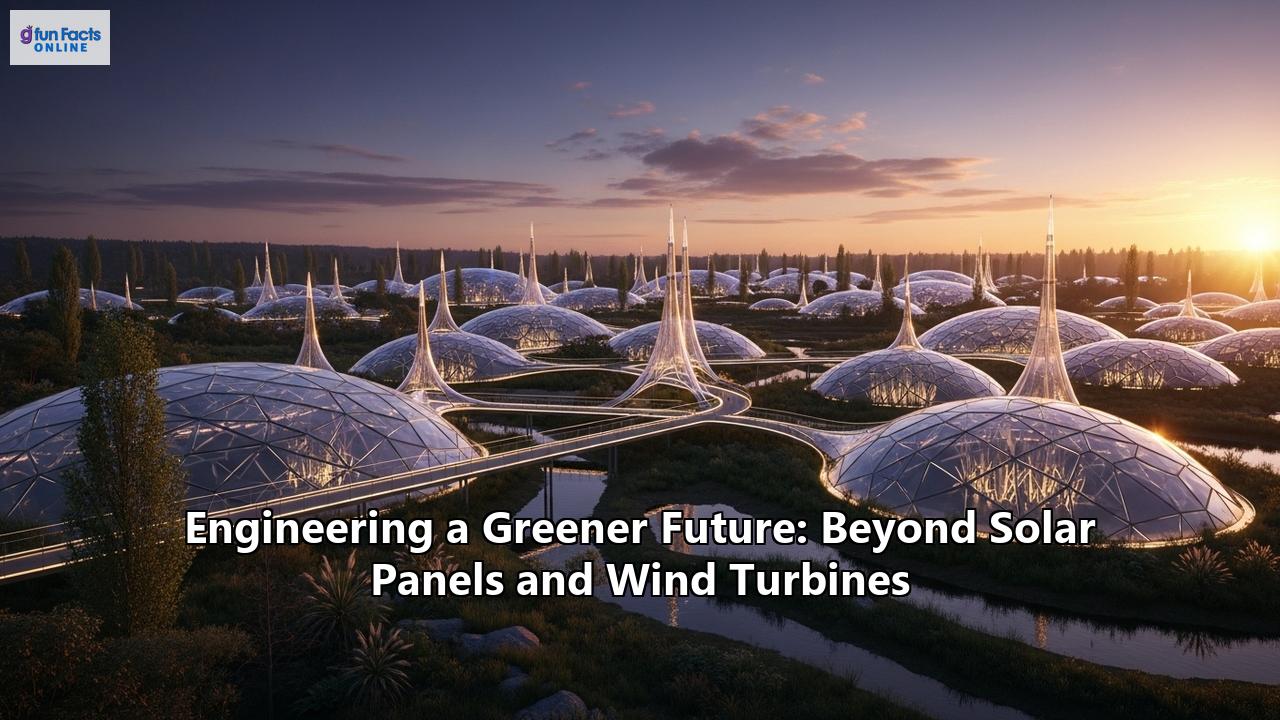
Engineering a Greener Future: A World Beyond Solar Panels and Wind Turbines
The global conversation about renewable energy has long been dominated by the iconic images of sprawling solar farms and majestic wind turbines. While these technologies are indispensable pillars in our transition to a sustainable future, the engineering landscape of green energy is vastly richer and more diverse. To truly achieve a resilient, reliable, and deeply decarbonized world, we must look beyond these familiar giants and explore the full spectrum of innovative solutions that engineers are developing.
From the Earth's molten core to the rhythmic power of the oceans, and from the biological potential of waste to the very air we breathe, the next generation of green technologies is poised to revolutionize our energy systems. This article delves into the exciting frontiers of sustainable engineering, exploring the powerful, and often unseen, forces being harnessed to build a cleaner, more resilient planet. We will journey through established but evolving technologies like hydropower and geothermal energy, investigate the promise of ocean power and bioenergy, and uncover the game-changing potential of green hydrogen, advanced nuclear reactors, and sophisticated carbon capture techniques.
Furthermore, a truly green future isn't just about clean energy generation; it's about creating a smarter, more efficient, and circular system. We will explore the critical role of advanced energy storage, the intelligence of smart grids, the paradigm shift of a circular economy, the life-sustaining innovations in water purification, and the transformative power of artificial intelligence in orchestrating it all.
Harnessing the Earth's Internal Fire: The Geothermal Revolution
Deep beneath our feet lies a vast and powerful source of clean energy: geothermal. This is the thermal energy generated and stored in the Earth's core, a consistent and reliable power source that is available 24/7, regardless of weather conditions. Engineers are developing increasingly sophisticated ways to tap into this subterranean furnace.
Traditional geothermal plants have typically been limited to areas with specific geological characteristics, such as hot springs or geysers. However, the advent of Enhanced Geothermal Systems (EGS) is set to unlock geothermal potential across the globe. EGS involves drilling deep into the earth's crust and creating artificial reservoirs by fracturing hot, dry rock. Water is then pumped down, heated by the rock, and brought back to the surface to drive turbines and generate electricity. This technology dramatically expands the geographical range for geothermal energy production.
Engineers are also pioneering closed-loop geothermal systems, which circulate a heat-transfer fluid through a deep underground loop without direct contact with the rock formations. This approach minimizes water usage and eliminates the risk of induced seismicity, addressing some of the environmental concerns associated with earlier geothermal projects. The continuous innovation in drilling technologies, materials science, and reservoir modeling is making geothermal energy an increasingly attractive and scalable option for a stable, baseload power supply in a renewable energy mix.
The Power of Water: Modernizing Hydropower
Hydropower is one of the oldest and largest sources of renewable energy, accounting for about 28.7% of renewable electricity generation in the United States. However, the era of building massive new dams is largely over in many parts of the world due to their environmental and social impacts. The future of hydropower lies in making existing facilities smarter, more flexible, and more environmentally friendly, as well as tapping into new, smaller-scale opportunities.
A key trend is the upgrading of existing hydropower plants with advanced turbine technology. New designs, such as variable-speed turbines, allow plants to operate efficiently over a wider range of water flows and to rapidly adjust their power output. This flexibility is crucial for stabilizing the grid as it accommodates the intermittent nature of solar and wind power. Digitalization is also playing a major role, with sensors and AI-driven analytics optimizing operations, predicting maintenance needs, and maximizing electricity generation from available water resources.
Furthermore, engineers are focusing on "fish-friendly" turbine designs, like the Alden turbine, and improved fish passage systems to mitigate the impact on local ecosystems. There is also a significant opportunity in electrifying non-powered dams, of which there are tens of thousands in the U.S. alone. Less than 3% of the more than 90,000 dams in the United States currently produce power. Adding power-generating infrastructure to these existing structures could significantly boost clean energy production without the need for new construction.
The Untapped Potential of the Oceans: Tidal and Wave Energy
The world's oceans are a massive, untapped reservoir of clean energy. The predictable rise and fall of tides and the relentless motion of waves contain vast amounts of kinetic and potential energy. Engineers are developing a range of innovative technologies to harness this power, though the field is still in its relatively early stages compared to solar and wind.
Tidal Energy comes in two main forms:- Tidal Barrages: These are essentially dams built across an estuary or bay. As the tide comes in, it fills the basin behind the barrage. At high tide, the gates are closed, and then the water is released through turbines to generate electricity as the tide goes out. While effective, large-scale barrages can have significant environmental impacts.
- Tidal Stream Generators: These devices work like underwater wind turbines, capturing the energy from fast-flowing tidal currents. They can be installed on the seabed or tethered in the water column and are considered to have a lower environmental impact than barrages.
- Point Absorbers: These are floating buoys that move up and down with the waves, driving a generator.
- Overtopping Devices: These are structures that collect water from incoming waves in a reservoir, which is then drained through a turbine.
- Oscillating Water Columns: These devices use the rise and fall of waves to compress and decompress air in a chamber, driving an air turbine.
The primary challenges for ocean energy are the harsh marine environment, which demands robust and low-maintenance designs, and the cost of deployment and grid connection. However, because water is much denser than air, ocean energy is a highly concentrated power source. Tidal power, in particular, is highly predictable, making it a valuable and reliable component of a future energy system.
From Waste to Watts: The Promise of Bioenergy
Bioenergy is a form of renewable energy derived from organic matter known as biomass, which can include agricultural crops and residues, forest products, and organic municipal solid waste. When this organic material is burned or converted into fuels, it releases the stored chemical energy. The key is to utilize these resources sustainably, often by converting waste streams into valuable energy.
Modern bioenergy technologies go far beyond simple combustion. Advanced processes include:
- Gasification: This process uses high temperatures and limited oxygen to convert biomass into a synthesis gas (syngas), which can then be used to generate electricity or be further processed into liquid fuels or hydrogen.
- Anaerobic Digestion: In the absence of oxygen, microorganisms break down organic waste (like food scraps, manure, and sewage sludge) to produce biogas, a mixture of methane and carbon dioxide. This biogas can be burned to produce heat and electricity or can be purified into renewable natural gas (RNG) and injected into existing gas pipelines.
- Pyrolysis: This involves heating biomass in the absence of oxygen to produce bio-oil, a liquid fuel that can be used in boilers or upgraded to transportation fuels.
A particularly exciting development is the use of algae as a biofuel feedstock. Algae can be grown in ponds or bioreactors on non-arable land and can have very high yields. They also consume carbon dioxide as they grow, offering the potential for a carbon-neutral or even carbon-negative fuel source. The engineering challenge lies in scaling up production and harvesting processes to be economically competitive.
The Swiss Army Knife of Clean Energy: Green Hydrogen
Green hydrogen is emerging as a versatile and powerful tool for decarbonizing sectors of the economy that are difficult to electrify, such as heavy industry (steel and cement production), long-haul transportation, and shipping. It is produced through a process called electrolysis, where electricity is used to split water into hydrogen and oxygen. When the electricity used for this process comes from renewable sources like solar, wind, or geothermal, the resulting hydrogen is considered "green."
The beauty of green hydrogen lies in its ability to act as an energy carrier and storage medium. It can be:
- Stored for long durations in tanks or underground caverns and then used to generate electricity in a fuel cell or turbine when renewable generation is low.
- Transported via pipelines or as a liquid (like liquefied natural gas) to where it is needed.
- Used as a clean fuel in vehicles, ships, and aircraft, producing only water as a byproduct.
- Utilized as a clean industrial feedstock to replace fossil fuels in processes like steel manufacturing and ammonia production.
Engineers are working to improve the efficiency and lower the cost of electrolyzers, as well as developing safe and cost-effective methods for hydrogen storage and transportation. As renewable energy generation continues to grow, green hydrogen offers a pathway to utilize surplus electricity and provide a clean, dispatchable energy source.
The Next Generation of Nuclear Power
While traditional large-scale nuclear power plants have faced challenges related to cost, construction timelines, and public perception, a new generation of nuclear technology is emerging that aims to address these issues. These advanced reactors are designed to be safer, more efficient, and more flexible than their predecessors.
Key innovations include:
- Small Modular Reactors (SMRs): These are reactors that are much smaller than conventional ones, typically producing less than 300 megawatts of electricity. Their modular design allows them to be factory-built and then transported to a site for assembly, which can significantly reduce construction costs and time. Their smaller size and inherent safety features, which often rely on passive systems that don't require external power or human intervention, make them suitable for a wider range of applications, including powering remote communities or industrial facilities.
- Advanced Reactor Designs: Researchers are exploring a variety of new reactor types that use different fuels and coolants, such as molten salt reactors and thorium-fueled reactors. These designs have the potential to produce less long-lived radioactive waste and can operate at higher temperatures, making them more efficient for electricity generation and suitable for providing high-temperature heat for industrial processes.
Advanced nuclear power offers the prospect of a carbon-free, high-capacity, and reliable energy source that can complement intermittent renewables and ensure a stable power grid.
Cleaning the Air: Carbon Capture, Utilization, and Storage (CCUS)
To meet ambitious climate goals, reducing emissions alone may not be enough. We will also need to remove existing carbon dioxide from the atmosphere. This is where Carbon Capture, Utilization, and Storage (CCUS) technologies come into play. CCUS is a suite of technologies that can capture CO2 emissions from industrial sources, such as cement plants and power stations, or even directly from the air, and then either store it permanently underground or use it to create valuable products.
The process involves three main steps:
- Capture: CO2 is separated from other gases. Post-combustion capture technologies, for example, use chemical solvents to "scrub" the CO2 from flue gases before they are released.
- Utilization: The captured CO2 can be used as a feedstock for a variety of products. For instance, it can be used in the production of carbonated beverages, to create synthetic fuels, or to cure concrete, effectively locking the carbon into building materials. One innovative example is AirCarbon, a plastic alternative made from carbon emissions that is fully biodegradable.
- Storage: For permanent removal, the captured CO2 is compressed and transported (usually by pipeline) to a suitable geological location, where it is injected deep underground into formations like depleted oil and gas reservoirs or saline aquifers.
A particularly exciting frontier in this field is Direct Air Capture (DAC). DAC technologies use large fans to pull in ambient air and pass it over materials that chemically bind with the CO2. The CO2 is then released and can be stored or utilized. While currently expensive and energy-intensive, DAC offers the potential to remove legacy emissions already in the atmosphere, making it a crucial tool for achieving net-zero or even net-negative emissions. The Intergovernmental Panel on Climate Change (IPCC) estimates that DAC could be required to remove up to 310 billion tonnes of CO2 from the atmosphere by 2100.
The Backbone of a Green Future: Enabling Technologies and Systems
The transition to a sustainable energy system is not just about inventing new ways to generate clean power. It also requires a fundamental re-engineering of the infrastructure and systems that deliver and consume that energy.
Advanced Energy Storage: Beyond the Battery
As we rely more on intermittent renewables like solar and wind, energy storage becomes paramount. While lithium-ion batteries are excellent for short-duration storage, we need cost-effective, long-duration solutions to ensure grid stability. Engineers are advancing several large-scale storage technologies:
- Pumped-Storage Hydropower (PSH): This is currently the most widespread form of utility-scale energy storage, accounting for about 96% of the capacity in the U.S. PSH systems use two reservoirs at different elevations. When electricity is cheap and plentiful, water is pumped from the lower reservoir to the upper one. When electricity is needed, the water is released back down through a turbine to generate power. Innovations in "closed-loop" systems, which don't require a connection to a river, and retrofitting existing dams for pumping capabilities are expanding the potential for PSH.
- Compressed Air Energy Storage (CAES): This technology uses surplus electricity to compress air and store it in underground caverns or man-made vessels. When power is needed, the compressed air is released and expanded through a turbine to generate electricity. Researchers are also exploring hybrid systems that combine PSH and CAES for improved efficiency and operational stability.
The Smart Grid: An Intelligent Energy Network
The traditional electrical grid was designed for a one-way flow of power from large, centralized power plants to consumers. A green energy future requires a "smart grid," which is a modernized electrical grid that uses digital communication technology to enable a two-way flow of electricity and information.
A smart grid can:
- Seamlessly integrate various types of distributed energy resources, including rooftop solar, electric vehicles, and utility-scale renewables.
- Improve efficiency and reduce waste by monitoring energy flows in real-time and rerouting power to avoid congestion and minimize losses.
- Enhance reliability by automatically detecting and responding to outages, often "self-healing" to restore power quickly.
- Empower consumers with real-time data on their energy use, allowing them to make more informed decisions and participate in demand-response programs that help balance the grid.
The Circular Economy: Designing Out Waste
A truly sustainable future requires us to rethink our entire approach to materials and products. The traditional linear model of "take, make, dispose" is inherently wasteful. The circular economy offers a new paradigm, focused on designing products and systems that eliminate waste and keep materials in use for as long as possible.
From an engineering perspective, this means:
- Design for Durability, Repair, and Reuse: Creating products that are built to last and can be easily repaired or upgraded.
- Design for Remanufacturing: Ensuring that at the end of a product's life, its components can be easily disassembled and used to manufacture new products.
- Design for Recycling: Choosing materials and assembly methods that make it easy to break down a product and recover its raw materials with high quality.
This approach requires a systems-level thinking, optimizing the entire lifecycle of a product, from raw material extraction to its end-of-life stage.
Innovations in Water Purification
Access to clean water is fundamental to human health and a sustainable society. As climate change strains freshwater resources, engineers are developing innovative and energy-efficient water purification and desalination technologies.
Key advancements include:
- Advanced Membrane Filtration: Nanotechnology is enabling the creation of highly efficient filters, such as those made from graphene, that can remove even the smallest contaminants like viruses and bacteria with less energy.
- Energy-Efficient Desalination: New processes are being developed to reduce the high energy cost of removing salt from seawater. For example, engineers have created carbon cloth electrodes that can remove boron from seawater without the need for expensive chemicals, potentially saving billions of dollars globally.
- Solar-Powered Purification: Low-cost, decentralized systems that use solar energy to disinfect water or power distillation processes are providing safe drinking water to remote communities.
- Biomimicry: Engineers are creating systems that mimic natural processes, such as artificial aquifers that use layers of sand, gravel, and carbon to filter water just as the Earth does.
The Role of Artificial Intelligence (AI)
Underpinning many of these advancements is the growing power of Artificial Intelligence. AI is a transformative tool that can help environmental engineers analyze vast datasets, optimize complex systems, and accelerate innovation.
In the context of a greener future, AI is being used to:
- Improve climate modeling and predict the impacts of climate change with greater accuracy.
- Optimize the operation of smart grids, balancing supply and demand in real-time to maximize the use of renewables.
- Enhance the efficiency of industrial processes and reduce their environmental footprint.
- Monitor deforestation, water pollution, and biodiversity loss using satellite imagery and sensor data.
- Accelerate the discovery of new materials for batteries, solar cells, and carbon capture.
By processing complex information far more quickly than traditional methods, AI is enabling faster, more intelligent decision-making in the quest for sustainability.
The Path Forward
The journey to a sustainable future is a complex and multifaceted engineering challenge. While solar panels and wind turbines will continue to be vital workhorses in this transition, they are only part of the story. The full tapestry of a green future is woven with threads of geothermal heat, the power of tides and waves, the potential of waste, the versatility of hydrogen, the reliability of advanced nuclear power, and the necessity of carbon removal.
This future is supported by an intelligent and resilient infrastructure of advanced energy storage and smart grids, all guided by the principles of a circular economy and the analytical power of artificial intelligence. Engineering this greener future requires not just technological innovation, but also a holistic vision, interdisciplinary collaboration, and a long-term commitment to creating systems that meet the needs of the present without compromising the ability of future generations to meet their own. The solutions are within our grasp, and engineers are leading the way in building a cleaner, more prosperous, and sustainable world for all.
Reference:
- https://eatlng.com/site/news-details?id=the-future-of-sustainable-engineering_1681378973
- https://morson-projects.co.uk/latest_news/sustainable-engineering-2025-renewable-energy-opportunities/
- https://www.numberanalytics.com/blog/future-sustainable-development-engineering
- https://www.energy.gov/eere/water/articles/advancing-hydropower-technologies-help-achieve-clean-energy-goals
- https://www.hydropower.org/blog/six-emerging-hydropower-technology-trends
- https://energyevolutionconference.com/hydropower-trends-2025/
- https://www.aiu.edu/blog/smart-grids-and-renewable-energy-integration-pioneering-the-energy-transition/
- http://www.eitc.org/research-opportunities/smart-city-technology/ai-in-environmental-engineering-and-ecology
- https://pdhonline.com/courses/e198/Modern%20Advances%20in%20Hydropower%20Technology.pdf
- https://d1meba.org/ocean-energy-engineering-the-capture-of-tidal-and-wave-power/
- https://www.pnnl.gov/explainer-articles/tidal-energy
- https://www.ebsco.com/research-starters/power-and-energy/ocean-and-tidal-energy-technologies
- https://www.bmt.org/industries/energy-and-resources/wave-and-tidal-energy/
- https://neg8carbon.com/what-is-direct-air-capture/
- https://climeworks.com/direct-air-capture
- https://www.elsevier.com/industry/guide-to-carbon-capture-utilization-and-storage
- https://ccushub.ogci.com/ccus-basics/understanding-ccus/
- https://www.youtube.com/watch?v=lgoqbs9Fdss
- https://www.britishengines.com/blog/sustainable-engineering/
- https://en.wikipedia.org/wiki/Direct_air_capture
- https://www.energy.gov/science/doe-explainsdirect-air-capture
- https://www.e-education.psu.edu/eme812/node/725
- https://woods.stanford.edu/sites/woods/files/media/file/innovative_and_advanced_hydropower_technology_can_improve_environmental_performance_generation_efficiency_and_grid_resilience.pdf
- https://www.pv-magazine.com/2024/05/08/integrating-pumped-hydro-with-compressed-air-energy-storage/
- https://figshare.utas.edu.au/articles/thesis/Development_of_a_combined_pumped_hydro_and_compressed_air_energy_storage_system/23252897
- https://www.mdpi.com/1996-1073/8/1/154
- https://www.zpnenergy.com/the-role-of-smart-grids-in-enhancing-renewable-energy-efficiency-how-zpn-energy-is-leading-the-way
- https://www.prysmian.com/en/insight/sustainability/what-is-a-smart-grid-and-how-does-it-work
- https://www.accuracy.com/energy-renewables-smart-grids/
- https://www.edx.org/learn/circular-economy/delft-university-of-technology-engineering-design-for-a-circular-economy
- https://www.eit.edu.au/circular-economy-and-how-engineers-can-achieve-it/
- https://energy.sustainability-directory.com/term/circular-economy-in-engineering/
- https://online-learning.tudelft.nl/courses/engineering-design-for-a-circular-economy/
- https://www.ediweekly.com/water-purification-innovations-can-environmental-engineering-solve-the-worlds-water-crisis/
- https://science.howstuffworks.com/environmental/green-tech/sustainable/10-innovations-water-purification.htm
- https://blog.emb.global/water-purification-and-desalination-technology/
- https://news.umich.edu/new-water-purification-technology-helps-turn-seawater-into-drinking-water-without-tons-of-chemicals/
- https://www.sciencedaily.com/releases/2025/01/250121130053.htm
- https://www.ai-infra-link.com/ai-and-machine-learning-in-environmental-engineering/
- https://www.jsr.org/hs/index.php/path/article/view/4804
- https://digitalcommons.odu.edu/management_fac_pubs/73/
- https://digitalcommons.odu.edu/cgi/viewcontent.cgi?article=1074&context=management_fac_pubs