
Picture a harsh, unforgiving Pleistocene landscape, somewhere in the Levant, half a million years ago. A hominin—a member of the incredibly successful species Homo erectus—sits in the dust, turning a raw nodule of flint over in their heavily calloused hands. To survive in this world, this individual needs a tool to butcher a scavenged elephant, to dig for tubers, or to strip bark from a branch. They raise a hammerstone and strike the flint. A flake shears off. They strike again, initiating a rhythmic, percussive song that has echoed across the globe for over a million years.
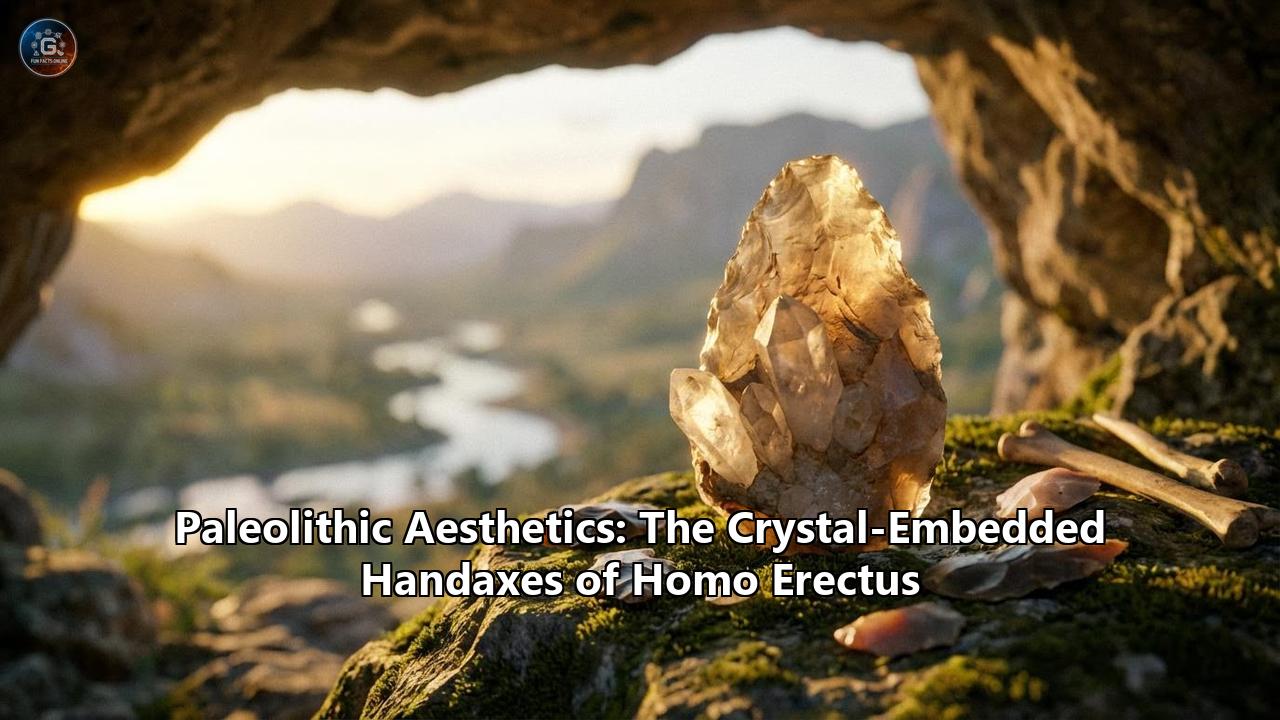
But then, something remarkable happens. As the rough outer cortex of the stone falls away, a secret hidden within the rock is revealed: a geode, a brain-like concretion bursting with sparkling, light-catching quartz crystals,.
Strict utility dictates that the knapper should either discard the flawed stone—crystals can cause unpredictable fractures—or simply chip right through it to achieve the sharpest possible edge. Instead, the hominin pauses. They alter their striking pattern. With deliberate, painstaking precision, they begin to shape the tool around the crystal, carefully framing the sparkling inclusion so that it sits dead center in the final product. They aren't just making a knife anymore. They are making a masterpiece.
For centuries, modern humans have suffered from a potent chronocentrism, an arrogant assumption that our species, Homo sapiens, holds a monopoly on complex thought, symbolic meaning, and the appreciation of beauty. We imagined our evolutionary ancestors as brutish ape-men, grunting their way through a brief, brutal existence. But a growing mountain of archaeological evidence is forcing a profound paradigm shift. From the fossil-framed flint axes of Europe to the diamond-like quartz crystal tools of Africa, the artifacts left behind by early hominins reveal a deep, undeniable, and hauntingly familiar trait: the dawn of Paleolithic aesthetics.
The Swiss Army Knife That Became a Canvas
To understand the magnitude of this artistic awakening, we must first understand the canvas: the Acheulean handaxe.
Emerging in the archaeological record in regions like Kenya and Ethiopia approximately 1.75 million years ago, the handaxe is the longest-used "designed" tool in human history,. Crafted primarily by Homo erectus and later by Homo heidelbergensis, these tools were utilized continuously for over 1.5 million years, spanning Africa, Europe, and Asia,,.
A typical handaxe is a biface, meaning it has been worked on both sides to create a symmetrical, teardrop or almond shape. It features a pointed end for piercing, cutting edges along its sides, and a rounded, ergonomic base meant to be gripped comfortably in the palm of the hand. It was the ultimate multi-tool of the ancient world. Palaeontologists often refer to the Acheulean handaxe as the "Swiss Army knife" of the Paleolithic era,. Wear-analysis on handaxes, such as those from the 480,000-year-old Boxgrove site in England, confirms they were primarily used for heavy-duty tasks like animal butchery and smashing bones to extract rich marrow,.
However, as hundreds of thousands of years rolled by, the handaxe began to transcend its utilitarian origins. Archaeologists began unearthing axes that were suspiciously perfect. These stones exhibited a degree of bilateral symmetry and refined thinness that offered no additional mechanical advantage for cutting meat or chopping wood. In fact, over-thinning a stone tool makes it more fragile and prone to snapping during heavy use.
Why would an ancient hominin expend precious time, energy, and cognitive focus to make a tool unnecessarily beautiful? The answer lies in the human brain's innate hunger for harmony, and it is most vibrantly displayed when early toolmakers encountered the deep past trapped in stone.
Framing the Ancient: The Fossil-Embedded Masterpieces
If the pursuit of symmetry was the first whisper of an aesthetic sense, the intentional framing of fossils was a triumphant shout. Across the globe, archaeologists have discovered a rare but undeniably deliberate class of handaxes where the knapper has purposefully incorporated natural anomalies into the tool's design.
Perhaps the most famous European example is the West Tofts handaxe, discovered in Norfolk, England. When the Homo heidelbergensis knapper was reducing this flint block, they encountered a perfectly preserved fossilized scallop shell (Spondylus spinosus). Rather than shattering the shell or discarding the rock, the knapper executed a series of highly skilled, delicate strikes to leave the shell entirely untouched, positioning it exactly at the visual center of the axe's face. Another striking example comes from the Middle Gravels of Swanscombe, Kent, where a meticulously crafted flint handaxe was found featuring a prominent fossilized echinoid (sea urchin) embedded within its surface.
These are not accidents of geology. To leave a fossil intact while shearing away the stone around it requires advanced foresight, master-level motor control, and a clear visualization of the final product—a process neuroaesthetics researchers link to long-term working memory.
The depth of this behavior was spectacularly underscored by a groundbreaking discovery announced in March 2026. In the Sakhnin Valley of Israel's Lower Galilee, self-taught nature enthusiast Muataz Shalata and Tel Aviv University archaeologist Prof. Ran Barkai identified an unprecedented concentration of late Lower Paleolithic handaxes dating back roughly 500,000 years,. Among the hundreds of tools found—used by groups of Homo erectus who likely followed the migration routes of elephants—researchers discovered a stunning subset of axes fashioned from flint nodules containing rare geological features.
These ancient knappers deliberately selected stones containing geodes and sparkling crystals, as well as fossil remains, and crafted their tools to preserve these natural wonders in prominent, centralized positions,. Because the Sakhnin Valley is unusually rich in these brain-like geological concretions, the hominins who lived there had unparalleled access to these visually striking materials.
But what did these fossils and crystals mean to a mind that predates modern humans by half a million years? According to Prof. Barkai, Homo erectus were intimately aware of their environment and likely recognized these embedded fossils and crystals as belonging to a distant, mysterious past. Barkai theorizes that early humans did not just view these tools functionally; rather, they possessed a symbolic belief system, and the framed crystals represented a tangible connection to "earlier entities or to the cosmos". To hold one of these axes was to hold a piece of the magic of the earth.
Paleolithic Bling: The Mastery of Quartz Crystal
While some hominins framed crystals, others decided to build the entire tool out of them. Handaxes made from solid rock crystal (quartz) represent one of the most astonishing technological and aesthetic achievements of the Lower Paleolithic,.
To fully appreciate a crystal handaxe, one must understand lithic technology. Flint and chert are the preferred canvases of the ancient toolmaker because they fracture cleanly and predictably (conchoidal fracture), allowing a skilled artisan to direct the force of their blows. Quartz crystal, on the other hand, is a knapper's nightmare. It is incredibly hard, structurally unforgiving, and prone to shattering into useless, jagged shards along hidden internal fault lines. It requires highly specialized techniques, such as bipolar percussion (striking the core while it rests on an anvil), to even attempt to shape it.
Despite these immense hurdles, primitive humans sought out this difficult material to create artifacts of breathtaking beauty. A striking example is a Lower Paleolithic handaxe discovered in Babati, Tanzania, dating between 800,000 and 1.5 million years ago. Crafted from scarce East African sparkling crystal quartz, the artifact appears, in strong light, as if it has been "dipped in diamonds". Because of the extreme difficulty of shaping crystalline quartz and the scarcity of the stone in the region, researchers conclude that this mesmerizing, sparkling tool was "without question... a prestige piece and highly prized for this sparkling effect".
Another extraordinary find from England, dating to approximately 300,000 BC, shows a different use of quartz. This Acheulean handaxe features two shallow cavities lined with micro-quartz crystals. The hominid maker deliberately centered these sparkling cavities on the face of the axe, giving the stone tool a symmetrical, anthropomorphic "mask-like" appearance. As the handaxe is turned, the crystal "eyes" catch the light and sparkle.
These crystal tools force us to ask a profound question: If a standard flint axe is easier to make, holds a sharp edge beautifully, and does the job perfectly well, why spend hours risking failure to carve a tool out of diamond-hard crystal?
The "Sexy Handaxe" Theory
Evolutionary psychologists and anthropologists have spent decades debating the purpose of these over-engineered, aesthetically flawless tools. The most provocative and widely discussed explanation is known as the "sexy hand-axe" theory.
First popularized by evolutionary psychologist Geoffrey Miller, the theory proposes that the highly symmetrical, elegantly crafted stone handaxes of the Acheulean period functioned as status-signalling devices—specifically designed to attract mates. In evolutionary biology, this is known as "costly signaling," a concept perfectly illustrated by the peacock's tail. A peacock's massive, iridescent tail makes it harder to fly and easier for predators to catch. However, by surviving despite this handicap, the peacock signals to females that it possesses vastly superior genetics.
A perfectly symmetrical, fossil-embedded, or crystal quartz handaxe may have served the exact same purpose for Homo erectus and Homo heidelbergensis. Creating a standard, ugly tool that cuts meat is easy. Creating a perfectly symmetrical, paper-thin, visually stunning crystal handaxe requires a massive investment of time, flawless hand-eye coordination, immense physical strength, deep planning, and cognitive mapping. Furthermore, it implies that the maker is such a successful hunter and gatherer that they have the leisure time to sit around making art.
Therefore, presenting a "sexy handaxe" to a potential mate was the Pleistocene equivalent of pulling up in a custom-built, luxury sports car. It was a physical manifestation of genetic fitness and cognitive brilliance.
This theory also helps explain the phenomenon of "giant" handaxes. At various archaeological sites around the world, researchers have unearthed beautifully shaped bifaces that are simply too massive and heavy to be wielded effectively by human hands for butchery or cutting,. While some researchers suggest these giants were used as stationary cutting planes wedged into the ground, evolutionary psychologists argue they were purely display items—exaggerated symbols of power and skill meant to be admired rather than utilized.
The Cognitive Leap: Mind of the Maker
Whether they were objects of spiritual veneration, tools of sexual selection, or simply an expression of pure, unadulterated artistic joy, these aesthetic handaxes offer a window into the minds of our ancient ancestors.
The application of neuroaesthetics to stone tools has shown that the visual processing and appraisal components of aesthetic cognition were alive and well 1.7 million years ago. The makers of these tools were not running on pure instinct. The production of a symmetrical handaxe requires the knapper to hold a mental template—an idealized image of the finished product—in their mind's eye while simultaneously executing a complex sequence of physical actions to bring that image into reality.
When a Homo heidelbergensis knapper struck the flint to expose the fossil scallop shell at West Tofts, they were making a series of conscious, value-based judgments. They recognized the fossil as "other." They judged it as visually pleasing. And they decided that preserving its beauty was more important than the immediate, effortless completion of the tool. That exact sequence of cognitive events is what occurs when a modern sculptor chips away marble to reveal the figure hiding within.
This cognitive leap blurs the line between "tool" and "art." It suggests that long before Homo sapiens painted the magnificent beasts of Lascaux or carved the Venus of Willendorf, the fundamental architecture of the artistic mind was already constructed.
The Enduring Legacy of the First Aesthetes
In the year 1800, a British antiquarian named John Frere published a paper featuring drawings of flint handaxes he had discovered in Suffolk. At the time, the idea that these stones were crafted by ancient, pre-human hands was revolutionary; popular folklore held that they were "thunderstones," magical objects that fell from the sky during violent storms or were forged by lightning strikes.
Today, we know the truth is far more magnificent than the myth. These stones did not fall from the heavens. They were pulled from the earth, weighed in the hands of beings who were navigating a brutal, prehistoric world, and shaped by minds that were just beginning to wake up to the wonders of the universe.
The crystal-embedded, fossil-framed, perfectly symmetrical handaxes of the Lower Paleolithic stand as the ultimate testament to the humanity of Homo erectus and their descendants. They remind us that the drive to create beauty, to elevate the mundane into the magical, and to leave a permanent, sparkling mark upon the world is not a modern invention. It is an ancient, ancestral inheritance, carved in stone, half a million years ago.
Reference:
- https://www.timesofisrael.com/paleolithic-chic-500000-years-ago-israels-ancient-toolmakers-had-a-taste-for-sparkle/
- https://www.miragenews.com/major-discovery-in-israel-unveils-early-human-1641591/
- https://stonetoolsmuseum.com/artefact/africa/acheulean-handaxe-4/1141/
- https://en.wikipedia.org/wiki/Hand_axe
- https://www.donsmaps.com/tools.html
- https://www.reddit.com/r/todayilearned/comments/1iv85tx/til_about_the_sexy_handaxe_theory_in_evolutionary/
- https://www.mediastorehouse.com/science-photo-library/flint-handaxe-fossil-echinoid-c016-6004-9239479.html
- https://www.researchgate.net/publication/333322263_The_Handaxe_Aesthetic
- https://timevaultgallery.com/tanzania-early-man-tool-prehistoric-artifact-stone-handaxe-hand-axe-ach275/
- https://www.mbabram.com/tribal-ethnographic-design/p/lower-paleolithic-handaxe-with-quartz-micro-crystals