
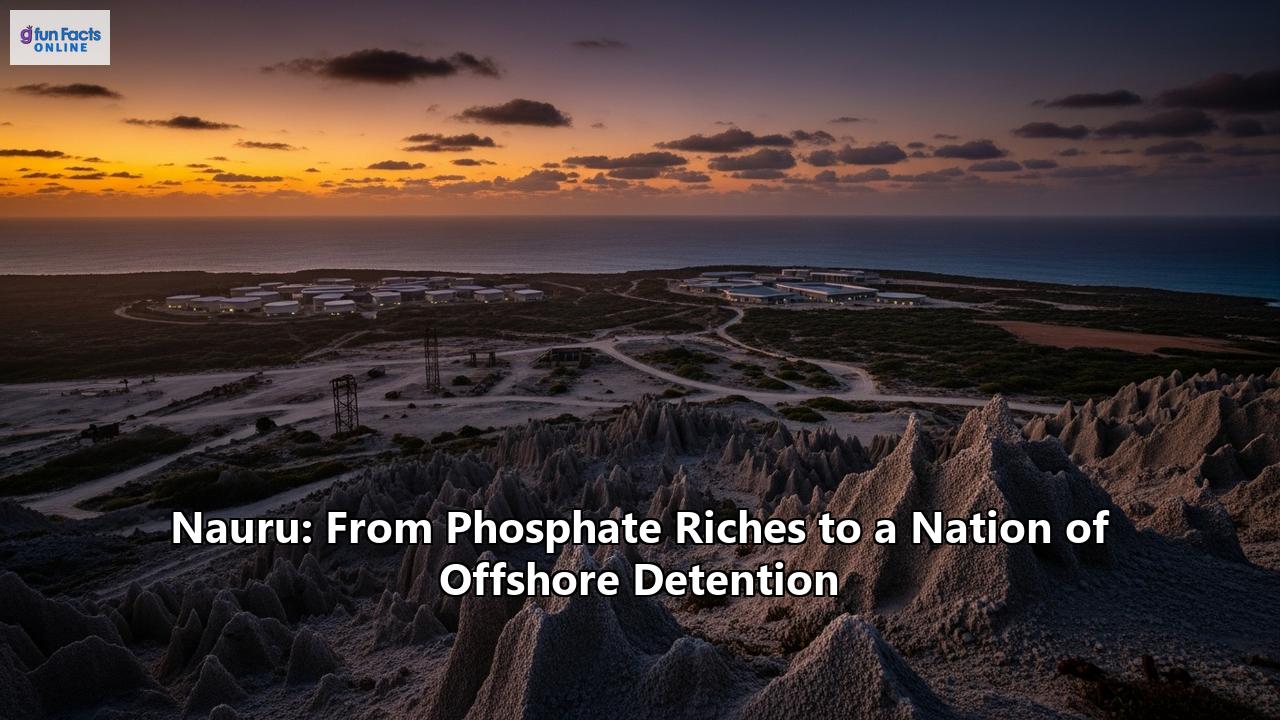
A Tale of Two Fortunes: Nauru's Journey from Phosphate Riches to a Land of Offshore Detention
Nauru, a speck of an island in the vast Pacific Ocean, holds a story of dizzying heights and devastating lows. Once boasting the highest per capita GDP in the world, a nation so wealthy its citizens paid no taxes and enjoyed lavish government services, it is now a landscape scarred by its past and economically beholden to a controversial and morally fraught industry: offshore detention. This is the story of how a paradise, blessed by a geological quirk, became a case study in the "resource curse" and a key player in Australia's hardline immigration policy.
The White Gold Rush: A Century of Phosphate Extraction
For millennia, the island, known to its first European visitors as "Pleasant Island," was a lush tropical oasis inhabited by twelve clans. Its fate was irrevocably altered in 1900 with the discovery of vast, high-quality phosphate deposits, the result of centuries of bird droppings, or guano, mineralizing. This "white gold" was a key ingredient in fertilizer, a commodity in high demand by agricultural nations like Australia and New Zealand.
What followed was a century of intensive mining. Colonial powers, first Germany and then a consortium of Australia, New Zealand, and the United Kingdom, strip-mined the island's interior, leaving a haunting legacy. The British Phosphate Commission (BPC), established after World War I, managed the extraction, with the vast majority of the profits flowing to the colonial administrators. The Nauruan people received only a pittance in royalties for the systematic destruction of their homeland.
Upon gaining independence in 1968, Nauru took control of its phosphate resources, purchasing the assets of the BPC. This ushered in an era of unprecedented wealth. With revenues soaring to between A$100-120 million annually, Nauru's small population became, on paper, some of the richest people on Earth. The government established a comprehensive welfare state, providing free healthcare, education, and housing. Tales of extravagance became legendary, with stories of Nauruans purchasing sports cars for an island with barely any paved roads.
The Resource Curse: A Dream Squandered
In anticipation of the day the phosphate would run out, the Nauruan government established the Nauru Phosphate Royalties Trust (NPRT) in 1968. This sovereign wealth fund, which peaked at an estimated A$1.3 billion in 1991, was intended to secure the nation's future for generations to come. However, a combination of spectacular mismanagement, ill-advised investments, and corruption led to its downfall.
The NPRT's portfolio included a series of disastrous ventures. Perhaps the most infamous was the funding of a London West End musical, "Leonardo the Musical: A Portrait of Love," which was a critical and commercial flop, losing millions. The trust also invested in luxury hotels and properties, including Nauru House in Melbourne, which were later sold off to cover mounting debts. By the early 2000s, the trust had all but collapsed, leaving the nation on the brink of bankruptcy.
Nauru's story is a textbook example of the "resource curse," a phenomenon where countries rich in natural resources often experience stunted economic growth and development. The massive influx of phosphate revenue led to an over-reliance on a single industry, while other sectors of the economy were neglected. With the public sector being the primary employer, there was little incentive for private enterprise to flourish. This economic vulnerability was laid bare when the primary phosphate reserves were exhausted in the late 20th and early 21st centuries.
A Faustian Bargain: The Detention Economy
Facing economic collapse and international blacklisting for a brief and unsuccessful stint as a tax haven and a hub for money laundering, Nauru turned to a new, and highly controversial, source of income. In 2001, it signed an agreement with Australia to host an offshore processing center for asylum seekers who had attempted to reach Australia by boat. This arrangement, known as the "Pacific Solution," saw Nauru exchange its sovereignty for significant financial aid.
The detention center has since become the cornerstone of Nauru's economy. The revenue generated from the facility, including visa fees and direct payments from Australia, has at times accounted for a significant portion of the Nauruan government's income. In the 2019-20 fiscal year, for instance, revenue from the Regional Processing Centre (RPC) made up 58% of the government's total revenue, amounting to approximately A$150 million. The center is also a major source of employment for Nauruans, with many working as guards and support staff.
This economic lifeline, however, has come at a profound moral and human cost.
An Island of Despair: The Human Cost of Offshore Detention
The conditions within the Nauruan detention center have been widely and repeatedly condemned by international human rights organizations, the United Nations, and medical professionals. Reports from Amnesty International and Human Rights Watch have detailed a litany of abuses, including severe neglect, inhumane treatment, and a deliberate policy of cruelty designed to deter other asylum seekers.
A Mental Health Crisis:The prolonged and indefinite nature of the detention has had a devastating impact on the mental health of the men, women, and children held there. Medical experts have described the detainees as among the most traumatized people they have ever seen, with rates of post-traumatic stress disorder (PTSD), depression, and suicidal ideation soaring. Children have been reported to suffer from traumatic withdrawal syndrome, with some becoming catatonic and attempting self-harm. The despair is so profound that self-harm and suicide attempts have become tragically frequent occurrences.
Inadequate Medical Care and Inhumane Conditions:The physical conditions in the centers have also been criticized, with reports of overcrowding, insufficient sanitation, and extreme heat. Access to adequate medical care has been a persistent issue, with refugees and asylum seekers facing long delays and at times, denial of treatment for even life-threatening conditions.
A Climate of Fear and Violence:Refugees and asylum seekers have also reported frequent and unpunished assaults, including sexual assault, by some members of the local Nauruan population and even by guards at the center. A climate of fear often prevents individuals from leaving their accommodations, particularly at night.
The Australian government has maintained that it does not have jurisdiction over the abuses that occur in Nauru, a claim that has been rejected by the UN Human Rights Committee, which has ruled that Australia remains responsible for the asylum seekers it transfers there.
The Social Fabric of Nauru: A Complicated Coexistence
For the people of Nauru, the detention center presents a complex and often contradictory reality. On one hand, it is an undeniable economic necessity, providing jobs and revenue in a country with few other options. Many local business owners have seen a revival in their fortunes due to the influx of money associated with the center.
On the other hand, the presence of the detention facility has created social tensions. While some Nauruans are employed by the center, there have been numerous reports of hostility and violence directed at the refugees by some locals. For the refugees who are eventually granted some freedom of movement within the Nauruan community, life remains a struggle. They often face poverty, with a meager allowance that is insufficient to cover the high cost of living on the island, and report difficulties accessing adequate food and basic necessities.
An Uncertain Future: Beyond the Wire
The long-term sustainability of Nauru's detention-based economy is precarious. The number of detainees has fluctuated over the years, and with it, the revenue Nauru receives. The center was even briefly empty in 2023 before new arrivals were transferred. While Australia has committed to an "enduring" offshore processing capability on the island, the policy remains subject to the political winds in Canberra.
Nauru's government has expressed a commitment to economic diversification, with potential avenues including the development of a fishing industry and the rehabilitation of mined-out lands. However, the challenges are immense. The environmental devastation from phosphate mining has left up to 80% of the island's interior a barren moonscape of limestone pinnacles, unsuitable for agriculture or development. Tourism is a distant prospect given the island's remote location and lack of infrastructure.
The nation's future seems inextricably linked to its powerful neighbor, Australia. The relationship is one of co-dependency, with Nauru reliant on Australian aid and Australia dependent on Nauru to maintain its controversial immigration policies. This raises profound questions about Nauru's sovereignty and its ability to forge an independent and sustainable path forward.
From the heights of unimaginable wealth to the depths of economic and environmental ruin, Nauru's story serves as a stark and tragic cautionary tale. It is a testament to the destructive power of the resource curse and a somber reflection of the human cost of political expediency. As the world grapples with forced migration and climate change, the future of this tiny island nation remains a poignant and unresolved question.
Reference:
- https://www.cainz.org/13222/
- https://www.unsw.edu.au/newsroom/news/2016/08/how-the-entire-nation-of-nauru-almost-moved-to-queensland
- https://journals.openedition.org/jso/7055
- https://en.wikipedia.org/wiki/Nauru
- https://www.theguardian.com/world/2018/sep/04/corruption-incompetence-and-a-musical-naurus-riches-to-rags-tale
- https://islandtimes.org/new-economic-prospects-needed-for-chameleon-nauru/
- https://en.wikipedia.org/wiki/Phosphate_mining_in_Banaba_and_Nauru
- https://thereader.mitpress.mit.edu/dark-history-nauru/
- https://en.wikipedia.org/wiki/Nauru_Phosphate_Royalties_Trust
- https://machinocene.substack.com/p/the-cautionary-tale-of-nauru
- https://openresearch-repository.anu.edu.au/server/api/core/bitstreams/e4c7edda-aa4e-4275-ad35-c900748911fd/content
- https://www.researchgate.net/publication/248959457_Nauru_The_First_Failed_Pacific_State
- https://en.wikipedia.org/wiki/Economy_of_Nauru
- https://en.wikipedia.org/wiki/Australia%E2%80%93Nauru_relations
- https://www.theguardian.com/world/2016/aug/10/a-short-history-of-nauru-australias-dumping-ground-for-refugees
- https://www.lowyinstitute.org/the-interpreter/what-s-next-nauru
- https://www.rnz.co.nz/international/pacific-news/440663/nauru-s-thriving-again
- https://www.hrlc.org.au/explainers/timeline-offshore-detention/
- https://www.unhcr.org/asia/news/press-releases/un-ruling-australia-s-responsibility-people-transferred-nauru
- https://www.amnesty.nl/actueel/australia-appalling-abuse-neglect-of-refugees-on-nauru
- https://www.hrw.org/news/2016/08/02/australia-appalling-abuse-neglect-refugees-nauru
- https://asrc.org.au/wp-content/uploads/2023/07/ASRC23-Finish-This-Crisis.pdf
- https://asrc.org.au/2024/07/19/11-years-of-costly-cruelty-offshore/
- https://www.theguardian.com/australia-news/2024/nov/12/asylum-seekers-in-australian-offshore-detention-at-20-times-greater-ptsd-risk-than-someone-not-detained-study-finds
- https://www.theguardian.com/australia-news/2016/aug/03/refugees-attacked-on-a-daily-basis-on-nauru-says-amnesty-report
- https://www.ohchr.org/en/press-releases/2025/01/australia-responsible-arbitrary-detention-asylum-seekers-offshore-facilities
- https://www.sbs.com.au/news/article/nauru-fears-detention-exit-economic-hit/dm40zcy1r
- https://asrc.org.au/2024/10/17/people-held-on-nauru-moved-into-community-and-face-further-challenges/
- https://www.theguardian.com/world/2022/feb/12/nauru-detention-centre-operator-makes-101m-profit-at-least-500000-for-each-detainee
- https://minio.uninfo.org/uninfo-production-main/f4a8c115-7b2c-480e-a9d9-e6fedac4d635_NAUCCA2024.pdf