
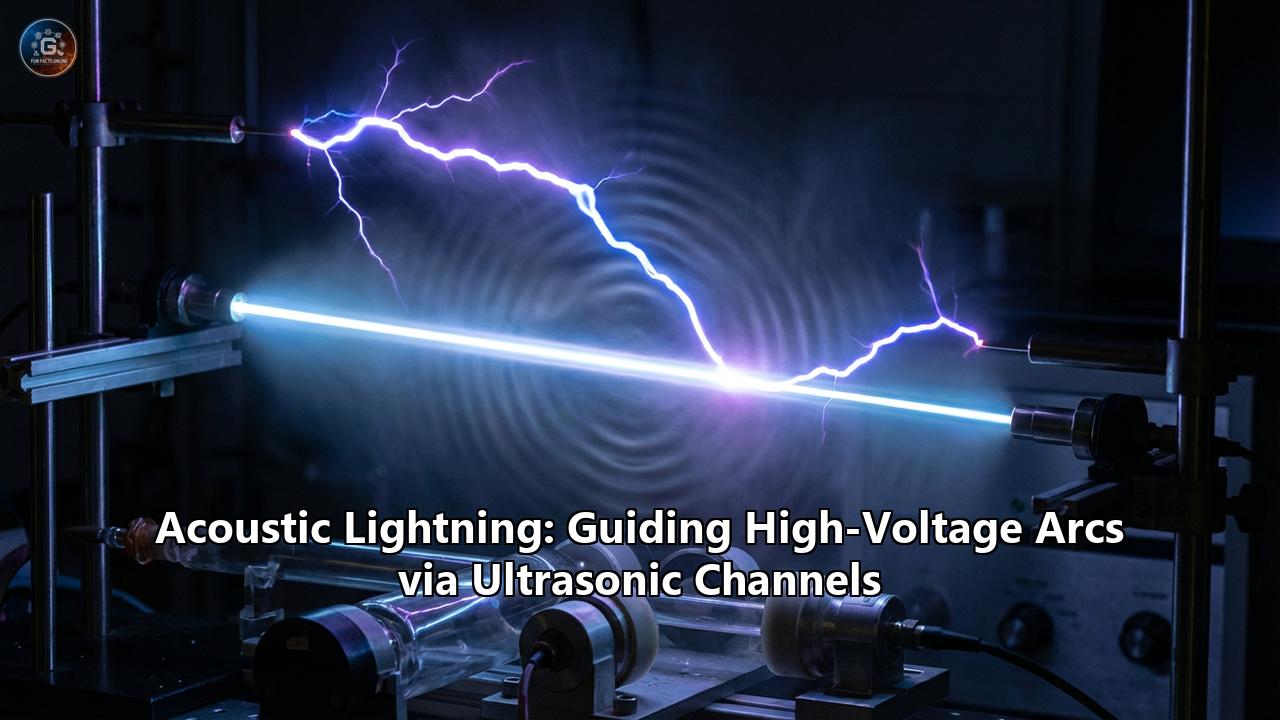
Since the dawn of human consciousness, lightning has commanded a primal mixture of fear and reverence. It was the weapon of Zeus, the hammer of Thor, a divine and unpredictable force that split the heavens and struck the earth with capricious fury. For millennia, humanity’s relationship with atmospheric electricity was entirely passive; we huddled in caves, built temples to appease storm gods, and later, constructed lightning rods to humbly suggest a path of least destruction. Benjamin Franklin’s kite experiment in 1752 was a watershed moment—not because it tamed the bolt, but because it dared to touch it. It was the first step in a long journey from fear to understanding, from superstition to science.
Yet, for nearly three centuries after Franklin, our control over high-voltage electrical discharges remained crude. We could attract them with metal spikes, conductive wires, and grounded masts, but we could not truly guide them. An electric arc, whether a jagged bolt from a thunderhead or a snap of static from a doorknob, is inherently chaotic. It is a stochastic process, a frantic search by electrons for the path of least resistance through an insulating medium. This path is dictated by microscopic fluctuations in air density, humidity, and particulate matter, making the trajectory of a spark a jagged, unpredictable fractal.
In the late 20th century, a new contender for control emerged: the laser. Scientists discovered that ultra-short, high-intensity laser pulses could ionize the air, creating a filament of plasma—a conductive wire made of light—that could shepherd lightning. It was a brute-force solution, effective but fraught with danger and complexity. It required terawatt-class lasers, massive power supplies, and strict safety protocols to prevent blinding pilots or bystanders. It was a "Hammer of Thor" approach—powerful, linear, and rigid.
But in the quiet corners of acoustic physics laboratories, a subtler, more elegant revolution has been brewing. It is a technology that does not force the air into submission with blinding light, but rather coaxes it with invisible sound. This is the era of Acoustic Lightning. By harnessing the physics of ultrasonic standing waves, vortex beams, and acoustic radiation pressure, scientists have unlocked the ability to steer high-voltage arcs through the air with the precision of a conductor’s baton. We can now make electricity bend around obstacles, travel in predetermined curves, and strike targets with millimeter accuracy, all without a single laser beam or physical wire.
This article explores the deep physics, the experimental triumphs, and the future implications of guiding high-voltage arcs via ultrasonic channels. It is a story of how sound—the vibration of matter—can become the master of electricity—the flow of charge.
II. The Anatomy of the Arc: Why Electricity is Wild
To understand the magnitude of the achievement that is acoustic guiding, one must first appreciate the unruly nature of the electric arc itself. An electrical discharge in a gas, such as air, is a dramatic phase transition. Under normal conditions, air is an excellent insulator. Its molecules (mostly nitrogen and oxygen) hold onto their electrons tightly. For a current to flow, this insulation must be broken down.
The process begins when a high voltage creates an intense electric field. When this field exceeds the dielectric strength of air—approximately 30 kilovolts per centimeter (kV/cm)—it imparts enough kinetic energy to free electrons to smash into neutral atoms, knocking their electrons loose. This triggers an avalanche effect known as impact ionization. A conductive channel of plasma, a soup of ions and free electrons, begins to form.
However, the air is not a uniform medium. It is a turbulent fluid, teeming with thermal fluctuations, dust particles, and humidity gradients. As the ionization front—called a "streamer"—advances, it constantly seeks the easiest route. If a pocket of slightly warmer (and thus less dense) air lies to the left, the streamer will jag left. If a dust particle offers a stepping stone to the right, it will fork right. This sensitivity to initial conditions is what makes lightning jagged. It is a search algorithm running at a fraction of the speed of light, solving for the path of least resistance in real-time.
Traditional methods of controlling this path rely on pre-empting the search. A copper wire offers a path of resistance so low that the arc has no "choice" but to follow it. But a physical wire is static; it cannot be moved in milliseconds, nor can it be deployed instantly across a room. This is where the concept of a "virtual wire" becomes the Holy Grail of high-voltage physics.
III. The Laser Interlude: A Path of LightBefore sound took the stage, light was the primary candidate for creating these virtual wires. The technology, known as Laser-Induced Plasma Channeling (LIPC), works on the principle of multiphoton ionization. When a femtosecond laser pulse (lasting one quadrillionth of a second) is fired through the air, its intensity is so high that it rips electrons from air molecules directly.
As the laser pulse propagates, it undergoes a phenomenon called filamentation. The laser creates a plasma core that acts as a defocusing lens, while the surrounding air acts as a focusing lens (the Kerr effect). These two effects balance each other out, trapping the laser beam in a long, thin filament that can extend for hundreds of meters. This filament is a conductive plasma wire. If a high-voltage source acts while this filament is present, the electricity will happily ride down the laser beam.
In 2023, a European consortium successfully guided actual atmospheric lightning using a high-repetition-rate terawatt laser atop Mt. Säntis in Switzerland. It was a monumental achievement. However, the laser approach has fundamental limitations. First, the plasma filaments are generally straight. You cannot easily curve a laser beam around a corner to guide a spark to a hidden target. Second, the energy requirements are astronomical. Third, firing terawatt lasers into the open air presents significant safety hazards to eyes and optical sensors.
The scientific community began to ask: Is there a safer, more flexible way to create a path of least resistance?
IV. The Acoustic Channel: Sound as a SculptorThe answer lay in the thermodynamics of the arc itself. The key variable that determines the breakdown voltage of air is its density. According to Paschen’s Law, the voltage required to spark across a gap is roughly proportional to the product of pressure (density) and gap distance. Lower the density of the air, and you lower the electrical resistance.
This is where sound comes in. Sound waves are, fundamentally, pressure waves—oscillations of high and low density traveling through a medium. If one could use sound to manipulate the density of air in a specific pattern, one could theoretically create a "low-density tunnel" that electricity would prefer to travel through.
However, the density variations in a standard sound wave (even a loud one) are too small and transient to guide a high-speed spark on their own. The breakthrough came when researchers, most notably Dr. Asier Marzo and his team at the Public University of Navarre, realized they didn't need the sound to create the vacuum channel from scratch. They could use the sound to guide the hot air created by the spark itself.
The Thermal-Acoustic Feedback LoopWhen an electric spark occurs, it is a violent thermal event. The air in the spark channel is heated to thousands of degrees in microseconds. This hot air expands explosively (creating the shockwave we hear as thunder/snap). Hot air is significantly less dense than cold air. Therefore, the residual heat from a previous spark creates a lingering path of low resistance for the next spark.
In a rapid sequence of sparks (like the output of a Tesla coil), each spark tends to follow the path of the previous one, creating a stable arc. But without guidance, this hot channel floats upward due to buoyancy (convection) and twists chaotically due to turbulence.
The acoustic guiding system intervenes in this thermal evolution. By using an array of ultrasonic transducers (speakers emitting sound above the range of human hearing, typically 40 kHz), scientists can create a structured sound field, such as a standing wave.
In a standing wave, there are nodes (points of minimum pressure fluctuation) and antinodes (points of maximum pressure fluctuation). Crucially, there is a force associated with these sound fields called the Acoustic Radiation Force. This non-linear force acts on particles and fluids with different acoustic impedances than the surrounding medium.
Hot air has a lower acoustic impedance than cold ambient air. Consequently, the acoustic radiation force pushes the hot gas channel toward specific regions of the sound field. In a typical standing wave setup, the hot, low-density air is trapped at the pressure nodes (or antinodes, depending on the specific geometry and particle interplay, but effectively "trapped" in a stable column).
This creates a self-reinforcing cycle:
- Spark Initiation: A spark jumps, heating a thin channel of air.
- Expansion: The air expands and becomes less dense.
- Acoustic Trapping: The ultrasonic field "grabs" this hot, light air and holds it in a straight line (or a curve), preventing it from floating away or twisting.
- Guidance: The next spark, seeking the path of least resistance, travels down this artificially stabilized tube of hot air.
The result is a "virtual wire" made of nothing but organized sound and heat. To the naked eye, the jagged, chaotic spark suddenly snaps into a perfectly straight line, or a smooth arc, following the invisible acoustic beam.
V. The Machinery of the Invisible WireThe apparatus required to achieve this is surprisingly accessible compared to the million-dollar laser systems. The core component is the Phased Array Transducer (PAT).
1. The TransducersStandard piezoelectric transducers, similar to those used in car parking sensors, are arranged in a grid or a specific geometric pattern (like a ring). These transducers vibrate at ultrasonic frequencies (commonly 40 kHz). By carefully controlling the phase delay of the signal sent to each transducer, the emitted waves can be made to interfere constructively at specific points in space.
2. Beamforming and HolographyThis is where the "sculpting" happens. By adjusting the phases, the array can generate various types of acoustic beams:
- Bessel Beams: These are "non-diffracting" beams that maintain a tight focus over a long distance. They consist of a central high-intensity core surrounded by concentric rings. They are excellent for creating long, straight channels for sparks.
- Vortex Beams: By spiraling the phase of the transducers (e.g., the first transducer is at 0°, the next at 45°, the next at 90°, etc.), the array creates a tornado-like sound field. These beams carry orbital angular momentum (OAM). They have a "quiet" core surrounded by a high-intensity ring. Acoustic vortex beams are particularly intriguing for stabilizing thicker plasma channels or potentially creating rotating plasma structures.
- Curved Beams (Airy Beams): Through complex phase holography, sound can be made to travel in a curved trajectory (within the limits of diffraction). This allows the spark to be guided around a solid obstacle—a feat impossible for a line-of-sight laser.
The acoustic field does not create the electricity; it only guides it. The setup requires a high-voltage source, typically a transformer or a Tesla coil, capable of generating sparks at a high repetition rate. The "guidance" works best with high-frequency discharges (kHz range) because the time between sparks must be short enough that the hot air channel doesn't cool down or dissipate before the acoustic trap can act on it.
VI. Breaking the Linearity: Bending and Splitting ArcsOne of the most visually and scientifically stunning aspects of acoustic guiding is the ability to break the linearity of the discharge. In experiments, researchers have placed a solid plastic obstacle between the high-voltage electrode and the ground target.
With a standard arc, the electricity would either strike the obstacle (damaging it) or jump unpredictably around it. With a laser, the beam would be blocked by the obstacle, severing the connection.
But with ultrasound, the researchers can generate a curved acoustic field that circumvents the object. The hot air channel is steered around the plastic barrier, and the electric arc dutifully follows the curve, glowing like a neon tube bent in mid-air, but with no glass to contain it.
Furthermore, by using multiple focal points, the acoustic field can split the arc. A single discharge leaving the electrode can be bifurcated into two separate branches, striking two different targets simultaneously. This "Y-shaped" discharge is stable and controllable, effectively functioning as a gas-phase electrical switch.
VII. The Physics of the Interaction: A Deeper DiveTo fully appreciate the complexity, we must look at the forces involved. The acoustic radiation force ($F_{rad}$) on a small inclusion of fluid (the hot spark channel) in a standing wave is given by the gradient of the acoustic potential $U$.
$$F_{rad} = -\nabla U$$
The potential $U$ depends on the contrast in compressibility and density between the inclusion (hot air) and the host medium (ambient air). Since the spark channel is extremely hot (often >1000 K), its density is a fraction of the ambient air ($\rho_{hot} \ll \rho_{cold}$). This density contrast is enormous compared to typical acoustic manipulation targets (like styrofoam beads).
The acoustic field essentially acts as a "density trap." The hot gas is pushed towards the pressure nodes of the standing wave. As long as the acoustic pressure is strong enough to overcome the buoyant force ($F_{buoyancy}$) of the hot gas rising, the channel remains trapped.
$$F_{rad} > F_{buoyancy}$$
This inequality defines the limits of the technology. If the spark is too hot (creating too much lift) or the sound is too weak, the guidance fails. This is why current experiments use powerful transducer arrays (creating sound pressure levels exceeding 140 dB, well beyond the threshold of pain, though inaudible) and work with spark gaps of several centimeters to tens of centimeters.
VIII. Applications: More Than Just a Light ShowWhile the visual of a bending lightning bolt is spectacular, the applications of Acoustic Lightning are grounded in practical utility.
1. Non-Contact Switches and ConnectorsIn high-voltage environments, physical switches are prone to mechanical failure and arcing damage. An acoustically guided arc can act as a "virtual switch." By changing the acoustic pattern, the arc can be redirected from Terminal A to Terminal B in milliseconds, without any moving parts. This could be revolutionary for reconfigurable high-voltage circuits or testing equipment.
2. Electronic Manufacturing and Micro-MachiningElectric Discharge Machining (EDM) is a common manufacturing process that uses sparks to cut hard metals. However, it usually requires a liquid dielectric and a stimulating electrode very close to the workpiece. Acoustic guiding could allow for "air-based EDM" where sparks are drilled into a surface from a distance, with the acoustic beam ensuring the spark hits the exact same micron-scale spot every time, or traces a specific pattern on the surface for engraving.
3. Plasma Medicine and SterilizationCold atmospheric plasmas are used in medicine to sterilize wounds and treat skin conditions. However, applying high voltage to the human body is risky. Acoustic guiding allows the plasma generation to happen at a safe distance, with the active species (the plasma stream) guided precisely to the treatment area without the risk of a stray arc striking healthy tissue.
4. Material Science and Aero-AcousticsStudying how these arcs interact with sound fields provides unique data on plasma dynamics, aero-thermodynamics, and the behavior of ionized gases. It is a new playground for fluid physicists.
5. Entertainment and Holographic DisplaysImagine a display made not of LEDs, but of actual floating fire. Acoustic guiding allows for the creation of persistence-of-vision displays using electric arcs. By rapidly moving the acoustic focal point, a single spark can be made to trace out shapes, letters, or animations in mid-air. It is the ultimate "dangerous" display technology, visceral and bright.
IX. The Limitations: Why We Can't Guide Thunderstorms (Yet)The term "Acoustic Lightning" naturally begs the question: Can we use this to protect airports from actual storm lightning?
Currently, the answer is no, for several reasons relating to the physics of sound vs. light.
1. AttenuationSound waves are rapidly absorbed by the air, especially at high frequencies. A 40 kHz ultrasonic wave loses half its energy every few meters. To guide a lightning bolt from a cloud 1 km high, one would need incredibly low frequencies (infrasound) which are hard to focus, or impossibly loud ultrasonic sources that would heat the air themselves. Lasers, by contrast, can propagate for kilometers.
2. Wind and TurbulenceReal atmospheric conditions are windy. Sound carries with the wind. A 20 mph crosswind would blow the acoustic channel off course, breaking the "virtual wire." Light is unaffected by wind (except for minor refractive index changes).
3. Scale of EnergyThe laboratory sparks are mere centimeters long. A lightning bolt is kilometers long and carries gigajoules of energy. The acoustic pressure required to confine the massive, explosively expanding channel of a return stroke would be astronomical—likely impossible to generate.
However, "impossible" is a moving target. Research is looking into hybrid systems. perhaps a laser initiates the channel, and a high-intensity acoustic array stabilizes the attachment point on the ground, ensuring the strike hits the lightning rod rather than the sensitive antenna next to it.
X. Comparison: Acoustic vs. Laser Guiding| Feature | Laser Guiding (Filamentation) | Acoustic Guiding (Ultrasonic) |
| :--- | :--- | :--- |
| Mechanism | Ionization (Plasma Filaments) | Density Modulation (Hot Air Channeling) |
| Speed | Speed of light | Speed of sound (initially), then electric speed |
| Range | Kilometers (Potential for clouds) | Centimeters to Meters (Lab/Industrial) |
| Trajectory | Line-of-sight (Straight) | Flexible (Curved, Splitting, Obstacle avoidance) |
| Safety | Hazardous (Blindness, High Energy) | Safe (Inaudible, Low Power, No coherent light) |
| Cost | Extremely High ($$$$) | Low ($) |
| Energy Efficiency | Low (Terawatts required) | High (Watts required) |
XI. The Future of the Silent GuideThe field of acoustically guided electricity is in its infancy. We are currently at the "Franklin Kite" stage—we have proven it works, but we are just beginning to understand the full scope of the physics.
Future research is targeting Acoustic Vortex Beams more aggressively. These twisting beams could impart rotation to the plasma channel, potentially stabilizing it against the "kink instability" (the tendency of magnetic fields to twist a plasma column). This could allow for longer, more stable arcs.
There is also interest in Acousto-Optical Hybrids. Using a low-power laser to heat the air slightly, and then an acoustic lens to shape that heated air into a guide, could offer the best of both worlds: the range of optics with the flexibility of acoustics.
XII. Conclusion"Acoustic Lightning" represents a paradigm shift in how we manipulate energy. For a century, we believed that to control the fury of electricity, we needed heavy metals, thick insulation, or blinding lasers. We fought force with force.
The acoustic approach teaches us a different lesson: that the most chaotic forces can be tamed by shaping the environment they inhabit. By whispering to the air with ultrasound, we create a path of least resistance, and the lightning follows, not because it is forced, but because it is the easiest way forward.
In the hum of the ultrasonic array, we find a new kind of conductor—one that wields an invisible baton to direct the most volatile section of nature’s orchestra. The arc, once a symbol of chaos, becomes a brushstroke of light, guided by the silent, steady hand of sound.
Detailed Technical Addendum: The Physics of the "Vacuum Tunnel"
For the scientifically inclined reader, the mechanism warrants a closer look at the interaction between the Paschen curve and Bernoulli principles.
Paschen's Law and DensityPaschen's law states that the breakdown voltage $V_b$ is a function of the product of gas pressure $p$ and gap distance $d$:
$$V_b = \frac{B \cdot p \cdot d}{\ln(A \cdot p \cdot d) - \ln(\ln(1 + 1/\gamma))}$$
Where $A$ and $B$ are constants for the gas, and $\gamma$ is the secondary electron emission coefficient. Crucially, for a fixed distance $d$, reducing the pressure $p$ (or density $\rho$, since $p \propto \rho T$) reduces the breakdown voltage (down to a minimum point, the Paschen minimum).
The Acoustic RoleIn a standing wave, the acoustic pressure $P_{ac}$ varies sinusoidally:
$$P_{ac}(x, t) = P_0 \cos(kx) \sin(\omega t)$$
However, the time-averaged force on a particle or fluid element is determined by the Acoustic Radiation Pressure, which relates to the square of the pressure amplitude.
The spark creates a filament of hot gas with temperature $T_{hot} \approx 3000 K$, while ambient is $T_{amb} \approx 300 K$. This creates a density ratio $\rho_{hot}/\rho_{amb} \approx 0.1$.
Because of this contrast, the acoustic field creates a potential well. The hot gas flows towards the velocity antinodes (pressure nodes) of the standing wave to minimize the acoustic potential energy.
Once the hot gas is confined, it acts as a "wire" of density $\rho_{hot}$. The breakdown voltage along this wire is significantly lower than in the surrounding cold air.
$$V_b(\rho_{hot}) \ll V_b(\rho_{amb})$$
When the high voltage source pulses again, the electric field effectively "sees" a tunnel of low resistance and discharges through it. The current heats the tunnel further, reinforcing the low density, while the acoustic field fights the convective buoyancy to keep the tunnel straight.
This delicate balance of thermodynamics, acoustics, and electrodynamics is what makes "Acoustic Lightning" not just a cool trick, but a masterpiece of modern physics.
Reference:
- https://www.researchgate.net/publication/349614085_Acoustic_Hole-Hologram_for_Ultrasonic_Focusing_With_High_Sensitivity
- https://acousticalsociety.org/wp-content/uploads/2018/02/Jacksonville_Wednesday.pdf
- https://www.scribd.com/document/502077231/4-1-Project-Report
- https://www.researchgate.net/profile/Asier-Marzo