
anthropus was as widespread and versatile as Homo and was not necessarily outcompeted by Homo, the scientists said". Both lineages represented highly successful, albeit profoundly different, evolutionary strategies for navigating the climatic instability of the Plio-Pleistocene boundary.
The Deep Time Laboratory: Implications for Human Evolution
The unearthing of Paranthropus in the Afar Depression serves as a profound reminder of how much remains unknown about the branching events that gave rise to our own genus. The period between 3.0 and 2.5 million years ago represents one of the most critical, yet enigmatic, intervals in the entire hominin fossil record. It is the evolutionary crucible from which the morphological blueprints of both the robust australopithecines and early humans were forged.
“If we are to understand our own evolutionary trajectory as a genus and species, we need to understand the environmental, ecological, and competitive factors that shaped our evolution,” Dr. Alemseged stated. “We strive to understand who we are and how we became to be human, and that has implications for how we behave and how we are going to impact the environment around us, and how that, in turn, is going to impact us”.
By pushing the geographic and temporal boundaries of Paranthropus deeper into the ancient past, the Mille-Logya jawbone fundamentally reconfigures the map of early human origins. It suggests that the evolutionary divergence that split our ancestors from the robust lineages was not a localized event isolated to one specific region of Africa, but a pan-African phenomenon, occurring across a mosaic of changing habitats.
Furthermore, the discovery invites a radical re-evaluation of fossil collections currently housed in museums around the world. As researchers turn their gaze to other understudied geological formations in the Horn of Africa, they do so with a renewed understanding: the absence of a species in the fossil record is not a reliable metric of its historical footprint. The apparent boundaries of a species' range are merely the limits of our current discoveries.
Conclusion: The Silent Testimony of Stone and Bone
Paleoanthropology is a science built upon fragments—shards of enamel and splinters of bone that somehow survived the ravages of time, scavenging hyenas, and tectonic upheaval. Through the meticulous application of modern geology, micro-CT imaging, and ecological reconstruction, these silent fragments are coaxed into telling the epic story of our origins.
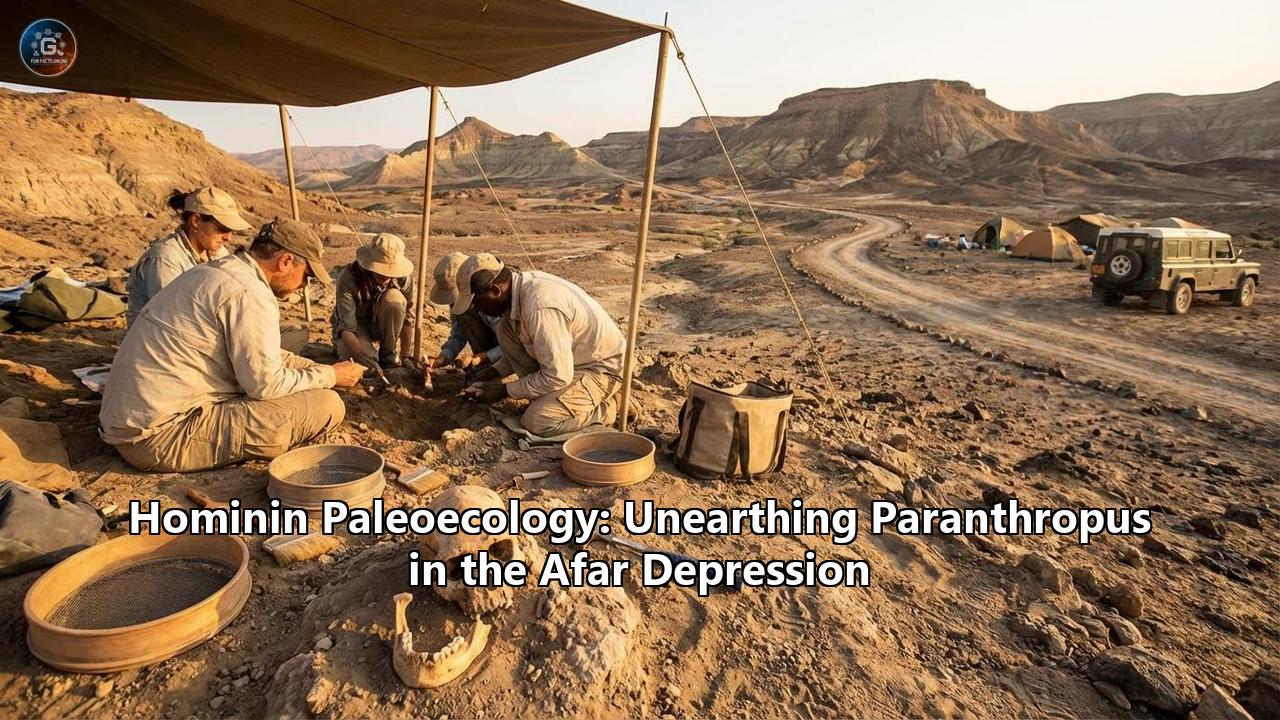
The 2.6-million-year-old jawbone from the Mille-Logya research area is a testament to the enduring power of field exploration. By confirming the presence of Paranthropus in the Afar Depression, researchers have closed a glaring geographical gap, dismantled the myth of the rigid dietary specialist, and illuminated a vibrant, fiercely competitive chapter of the human past.
In the baking heat of the Ethiopian badlands, the Earth has once again yielded a secret that rewrites the textbooks. It reveals a diverse family tree whose branches did not simply snap under the pressure of climate change, but instead bent, adapted, and flourished across the vast and shifting landscapes of prehistoric Africa. As the search for our origins continues, the Afar Depression remains what it has always been: the ultimate theater of human evolution, a place where the dust of the present still conceals the infinite mysteries of the past.
Reference:
- https://news.uchicago.edu/story/scientists-unearth-26-million-year-old-hominin-fossil-ethiopia
- https://www.ena.et/web/eng/w/eng_8161721
- http://www.ipa-assoc.com/news/news/rh/202601/t20260128_822204.html
- https://scitechdaily.com/scientists-found-an-ancient-human-relative-where-none-was-expected/
- https://columbian.gwu.edu/new-26-million-year-old-paranthropus-fossil-reshapes-understanding-early-hominins
- https://pubmed.ncbi.nlm.nih.gov/41565809/?utm_source=FeedFetcher&utm_medium=rss&utm_campaign=None&utm_content=1TqPT7y834vuZbR07ks06oxele76dkTDZ03ehfXCkT-iGFVks&fc=None&ff=20260303021713&v=2.19.0.post6+133c1fe
- https://www.sci.news/othersciences/anthropology/afar-paranthropus-fossil-14499.html
- https://www.discovermagazine.com/a-2-6-million-year-old-jaw-uncovers-a-missing-hominin-from-the-afar-region-48568
- https://bioengineer.org/afar-fossil-reveals-paranthropus-wide-range/