
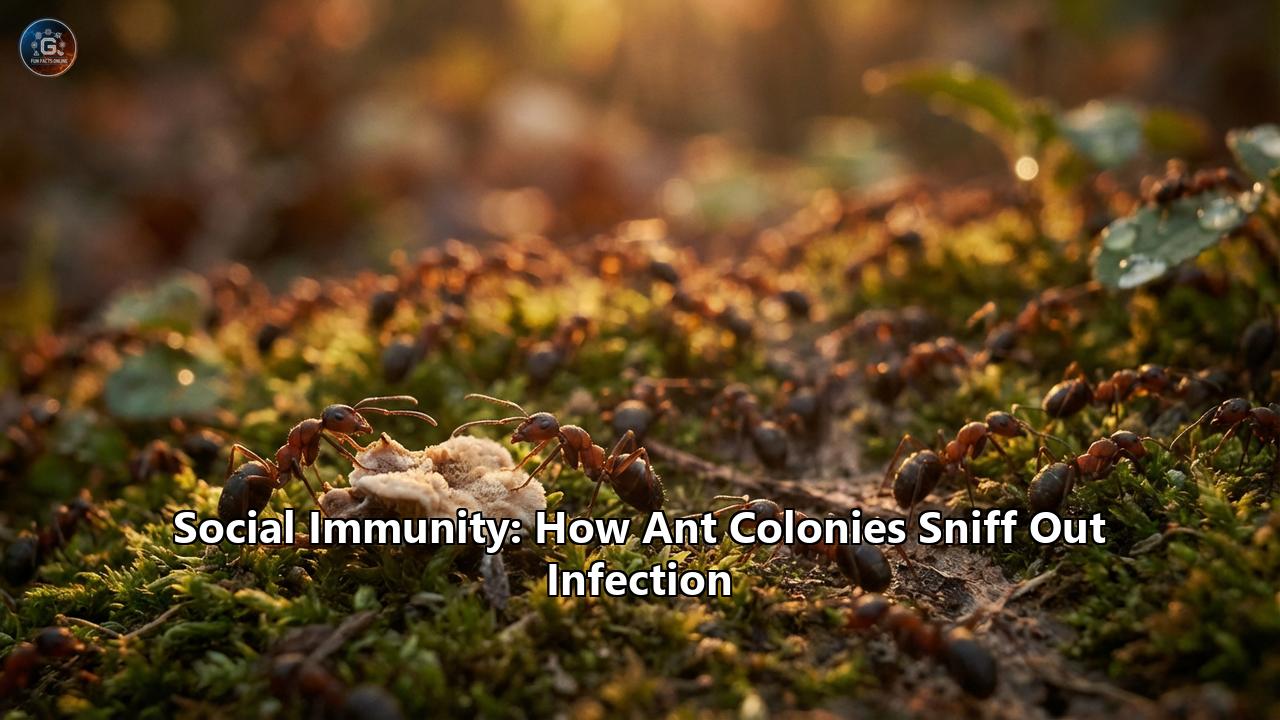
Introduction: The Paradox of the Crowded City
Imagine a city with millions of inhabitants, living in cramped, dark, humid tunnels, constantly touching one another, sharing food mouth-to-mouth, and walking over each other's waste. In human terms, this is a recipe for a catastrophic plague. Yet, in the world of ants, this is daily life.
Ant colonies are marvels of biological engineering, not just for their architecture, but for their epidemiological resilience. Despite living in conditions that should theoretically make them easy targets for bacteria, fungi, and viruses, ant colonies rarely succumb to mass infection. They have evolved a sophisticated, multi-layered defense system known as Social Immunity.
Unlike individual immunity, which relies on white blood cells and antibodies within a single body, social immunity relies on the collective behaviors of thousands of individuals acting in concert. It is a decentralized, emergent healthcare system where every worker is a doctor, a nurse, and, when necessary, a hazmat disposal unit.
1. The Superorganism Concept: The Colony as a Body
To truly understand how ants fight disease, one must stop viewing them as individual insects and start viewing the colony as a single animal—a Superorganism. In this analogy:
- The Queen is the reproductive organ (ovaries).
- The Workers are the somatic cells (muscle, tissue, and gut).
- The Foragers are the circulatory system, bringing nutrients in.
- Social Immunity is the immune system.
Just as your body will sacrifice a single infected cell via apoptosis (programmed cell death) to save the tissue, an ant colony will sacrifice an individual worker to save the colony. This ruthlessly efficient logic drives every aspect of their hygiene behavior.
The Evolution of Collective Defense
Evolutionary biologists have long puzzled over why social insects are so successful despite the high disease risks of group living. The answer lies in the "dilution effect" and "social prophylaxis." By pooling their resources, ants can mount defenses that are impossible for a solitary insect. A lone beetle must rely entirely on its own immune system; an ant has 10,000 sisters ready to groom off a fungal spore before it even penetrates her cuticle.
Recent research from 2024 and 2025 has highlighted that this system is not static. It is a dynamic, learning network that can "remember" past infections and even physically restructure the nest to stop a pandemic—a biological version of the lockdowns and social distancing humans employ.
2. The First Line of Defense: Hygiene and Prophylaxis
Long before a pathogen enters an ant’s body, it must bypass the colony’s external defenses. This "border control" is rigorous and multifaceted.
Allogrooming: The Social Shower
The most visible form of social immunity is allogrooming—the act of one ant cleaning another. This is not merely a social bonding ritual; it is a medical procedure.
- Mechanism: When a forager returns to the nest, she is often covered in dust, pollen, and potentially deadly fungal spores (like Metarhizium or Beauveria). Nestmates immediately inspect her, using their sensitive antennae to detect foreign particles.
- The Infrabuccal Pocket: Ants do not just brush off the dirt; they lick it up. The debris and spores are stored in a specialized pouch in their mouth called the infrabuccal pocket. Here, the material is compacted into a solid pellet. Crucially, this pocket prevents the pathogens from entering the ant's gut and infecting her.
- Sterilization: While the pellet is in the pocket, the ant secretes antimicrobial compounds that kill or neutralize the spores. Once sterilized, the ant spits out the pellet in a designated waste area.
Necrophoresis: The Undertakers
Death is inevitable in a colony of thousands. If a corpse is left to rot, it becomes a breeding ground for disease. Ants have evolved a specialized behavior called necrophoresis (literally "carrying the dead").
- The Scent of Death: When an ant dies, its body chemistry changes. Historically, scientists believed ants reacted to the breakdown products like oleic acid (the smell of rot). However, newer research suggests that ants are actually detecting the absence of "life signs" (specific cuticular hydrocarbons that constantly evaporate from live ants) coupled with the onset of death cues.
- The Disposal Squad: Specialized "undertaker" ants pick up the corpse and carry it to a dedicated refuse pile or graveyard located far from the brood chambers. These undertakers often remain at the periphery of the colony, acting as a quarantine caste to prevent bringing pathogens back into the heart of the nest.
Waste Management and "Kitchen" Hygiene
Leafcutter ants (Atta and Acromyrmex) are famous farmers who grow a specialized fungus for food. Their survival depends on keeping this garden sterile.
- The Waste Management Division: Leafcutters have a specific caste of older workers whose sole job is to manage the waste heaps. These heaps are hazardous, filled with the aggressive parasitic fungus Escovopsis.
- One-Way Traffic: To prevent cross-contamination, waste workers are rarely allowed to re-enter the fungus gardens. They live and die in the dump, effectively sacrificing their remaining days to keep the "clean zones" safe.
3. Chemical Warfare: The Ant Pharmacy
Ants were mastering chemistry millions of years before humans discovered penicillin. They produce, collect, and cultivate a stunning array of pharmaceutical compounds.
The Metapleural Gland: An Ancient Antibiotic Factory
Unique to ants, the metapleural gland (located on the thorax) is the cornerstone of their chemical defense.
- The Cocktail: This gland secretes a potent mixture of acidic compounds, including phenylacetic acid and various phenols. These chemicals are broad-spectrum antibiotics and antifungals.
- Application: Ants rub their legs over the gland and then smear the secretion over their bodies and the bodies of nestmates, effectively coating themselves in a prophylactic antiseptic gel. In leafcutter ants, this secretion is vital for weeding out alien fungi from their food gardens.
Venom as Disinfectant
We typically think of ant venom (like the sting of a fire ant) as a weapon against predators. However, for many species, it is primarily a cleaning product.
- Formic Acid: Species like the wood ant (Formica) and black garden ant (Lasius) lack a stinger but possess a specialized nozzle (acidopore) to spray formic acid. They spray this acid on their brood and nest surfaces to sterilize them.
- Solenopsins: The fire ant (Solenopsis invicta) uses its venom alkaloids (solenopsins) not just to burn your skin, but to fumigate its nest. These alkaloids have powerful antibacterial properties.
The External Pharmacy: Resin Collection
Some ants, particularly the wood ants (Formica paralugubris), have learned to outsource their medicine.
- Tree Resin: These ants actively forage for solidified resin from coniferous trees (pine and spruce). This resin is rich in terpenes, compounds that trees use to protect themselves from rot.
- Synergy: The ants bring chunks of resin into the nest and place them near the vulnerable brood. In a remarkable display of chemistry, they often spray their own formic acid onto the resin. Recent studies have shown that this mixture creates a synergistic effect, producing a combined antimicrobial agent that is far more potent than either substance alone.
4. The "Eat-Me" Signal: Altruism in the Brood
One of the most chilling yet evolutionarily efficient discoveries in recent years is the "Eat-Me" signal found in ant pupae. This mechanism was elucidated in breakthrough studies (2023-2025) led by researchers looking at invasive garden ants.
The Problem of Immobile Brood
Adult ants can leave the nest if they feel sick (social isolation). But pupae—the developing young encased in cocoons—are trapped. If a pupa gets infected with a fungus, it becomes a ticking time bomb that could sporulate and wipe out the nearby nursery.
The Chemical Alarm
When a pupa is terminally infected, its cuticular hydrocarbon profile (the waxy layer on its skin) changes. It begins to emit a specific chemical signature—a "death scent."
- Detection: Nurse workers sniffing the brood pile detect this specific alteration in scent. Crucially, this signal is honest; it only appears when the pupa is beyond saving.
- Destructive Disinfection: Upon detecting the signal, the nurses do not try to cure the pupa. Instead, they unwrap it from its cocoon, bite a hole in its cuticle, and spray lethal doses of formic acid inside. This kills the pupa and the fungus simultaneously.
- The "Find-Me" Analogy: This is functionally identical to how a viral-infected cell in a human body signals the immune system to destroy it (cytotoxic T-cell response). The pupa sacrifices its future to ensure the safety of its genetic siblings.
5. Architectural Immunity: Engineering Against Epidemics
Until very recently, it was believed that ants fought disease primarily through behavior and chemistry. However, a landmark study released in late 2024/early 2025 has proven that ants also use Architecture as an immune defense.
*The Study: Lasius niger Digging Patterns
Researchers from the University of Bristol exposed black garden ant colonies to pathogens and observed how they dug their nests compared to healthy colonies. The results were groundbreaking.
Modularity and Spacing
Infected colonies dug nests that were fundamentally different:
- Increased Spacing: The tunnels were wider, and the chambers were spaced further apart.
- Reduced Connectivity: Instead of a highly interconnected "small-world" network (where every room is easily accessible), the ants built a modular nest with fewer connecting tunnels.
- The Result: This "socially distanced" architecture physically slowed the transmission of fungal spores. If one chamber collapsed due to infection, the lack of direct connections prevented the spread to the rest of the colony. This is the structural equivalent of a hospital building quarantine wards.
6. Evolutionary Arms Race: When Social Immunity Fails
No defense is perfect. The existence of such robust social immunity has driven parasites to evolve terrifyingly clever countermeasures.
The Zombie Ant Fungus (Ophiocordyceps)
This famous fungal parasite has evolved to bypass social immunity entirely.
- The Hack: It infects the ant's brain (or rather, the muscles controlling the body) and forces the ant to leave the nest.
- Why Leave? By forcing the ant to climb a plant and die outside the colony, the fungus avoids the efficient waste-disposal teams inside the nest. If the ant died inside, it would be dismantled and sterilized before the mushroom stalk could ever grow. The "zombie" behavior is an adaptation specifically designed to escape the colony's hygiene protocols.
The Social Hackers: Maculinea Butterflies
The Alcon Blue butterfly (Maculinea alcon or rebeli) is a "social parasite" that infiltrates Myrmica ant colonies.
- Chemical Mimicry: The butterfly larva secretes chemicals that are nearly identical to the ant's own brood pheromones. It smells so much like an ant larva that the workers pick it up and carry it into the nursery.
- Acoustic Mimicry: Once inside, the caterpillar takes the deception a step further. It makes clicking sounds that mimic the acoustics of the Queen ant. Hearing this, the worker ants treat the parasite like royalty, feeding it the best food—even feeding it their own young—while the colony starves.
7. Human Applications: Biomimetics and Future Medicine
The war between ants and microbes has been raging for 100 million years. Humans, who have been fighting bacteria with antibiotics for less than a century, have much to learn.
Formicamycins: The New Antibiotics
In the search for drugs to fight superbugs like MRSA (Methicillin-resistant Staphylococcus aureus), scientists turned to the African plant-ant Tetraponera penzigi. These ants host symbiotic bacteria (Streptomyces formicae*) on their bodies.
- Discovery: These symbionts produce unique antibiotic compounds called Formicamycins.
- Potential: Early tests show that Formicamycins can kill bacteria that are resistant to all known human antibiotics. Because these compounds evolved in a high-stakes evolutionary environment, they are incredibly potent and stable.
Pandemic Algorithms
Computer scientists and epidemiologists are now modeling human pandemic responses on ant behavior.
- Localized Lockdowns: Ants do not shut down the whole colony when infection hits; they isolate specific chambers (architectural immunity) and alter the foraging networks of specific subgroups.
- Robotics: Swarm robotics engineers are designing "nurse bots" that use simple, local rules (like ants) to detect and isolate faulty units in a swarm without a central controller.
Conclusion
The study of social immunity in ants reveals a profound truth about nature: cooperation is the ultimate survival strategy. Through a combination of chemical ingenuity, architectural adaptation, and altruistic self-sacrifice, ant colonies have conquered the globe.
As humans face rising challenges from antibiotic resistance and global pandemics, the lowly ant offers a blueprint for survival. They teach us that in a crowded, connected world, the health of the individual is inextricably linked to the behavior of the collective. We just have to be willing to look down at the pavement to find the answers.
Reference:
- https://scienceblog.com/wildscience/2025/12/02/sick-ants-flash-a-chemical-alarm-then-workers-finish-the-job/
- https://scitechdaily.com/ants-smell-deadly-infection-before-it-spreads/
- https://www.loe.org/shows/segments.html?programID=12-P13-00019&segmentID=4
- https://www.miragenews.com/ants-self-sacrifice-to-signal-deadly-infection-1581795/
- https://bookcafe.yuntsg.com/ueditor/jsp/upload/file/20251024/1761285763892042987.pdf
- https://www.the-scientist.com/sick-immobile-young-ants-send-kill-me-signal-to-colony-workers-73801
- https://www.iflscience.com/fungus-turns-hosts-zombies-manipulates-ants-die-colony-doorstep-25400
- https://www.miragenews.com/severely-ill-ants-sound-alarm-and-are-killed-1581808/
- https://idw-online.de/en/news862320
- https://www.earth.com/news/ants-redesign-their-nests-to-stop-disease-outbreaks/
- https://www.researchgate.net/publication/8560414_A_butterfly's_chemical_key_to_various_ant_forts_Intersection-odour_or_aggregate-odour_multi-host_mimicry
- https://pmc.ncbi.nlm.nih.gov/articles/PMC1690087/
- https://www.jic.ac.uk/news/new-antibiotic-from-bacteria-found-on-an-ant-could-beat-mrsa/