
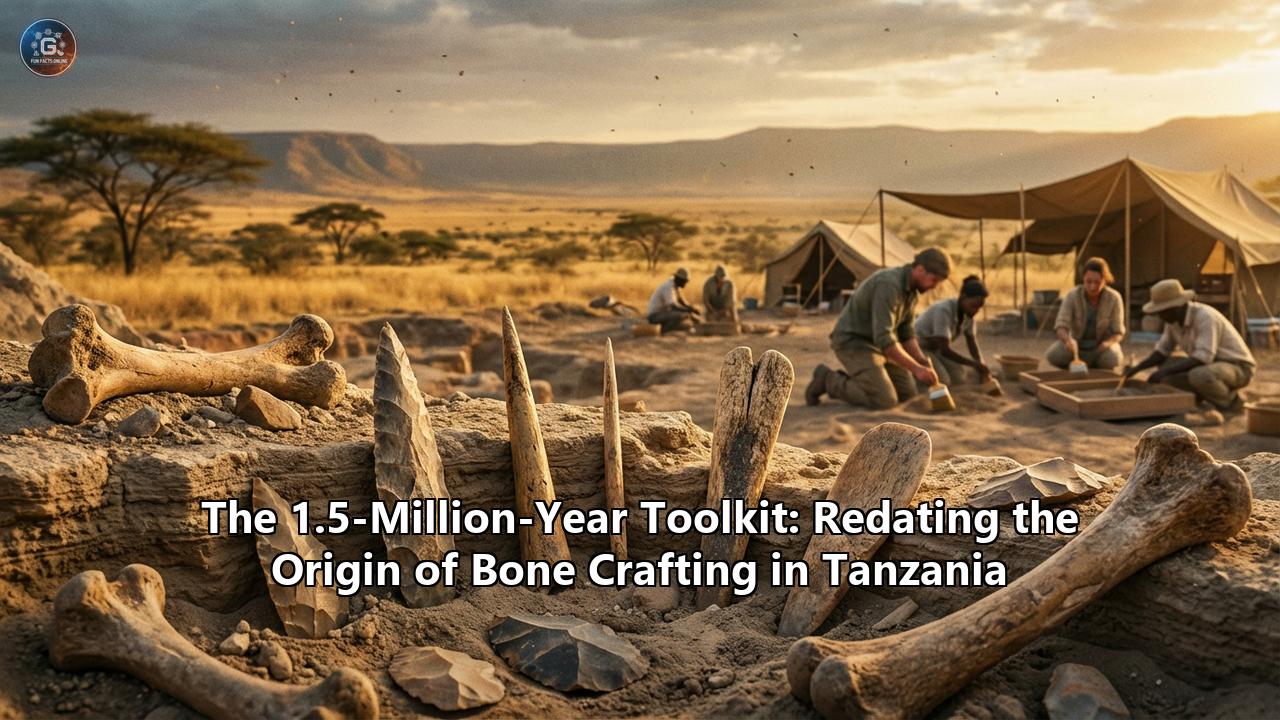
The sun beats down on the scrubland of northern Tanzania, baking the earth into a palette of rust and ochre. Here, in the Great Rift Valley, the wind whispers secrets that have been kept for eons. It is a landscape that looks deceptively barren to the untrained eye, yet it is the greatest library of human history on our planet. This is Olduvai Gorge—the "Grand Canyon of Evolution"—and it has just surrendered a secret that completely rewrites the biography of our species.
For decades, the story of human technological evolution was written in stone. We believed that for millions of years, our ancestors were masters of rock, chipping away at quartzite and basalt to create the sharp edges necessary for survival. Bone, we thought, was a much later addition to the toolkit—a sophistication that arrived only with the larger brains of later humans, perhaps around 500,000 years ago.
That story is now obsolete.
In a groundbreaking revelation that has sent shockwaves through the scientific community, archaeologists have unearthed a cache of bone tools at Olduvai Gorge dating back a staggering 1.5 million years. This discovery, centered on the excavation site known as the T69 Complex, pushes the timeline of systematic bone crafting back by a million years. It suggests that the inhabitants of the Pleistocene—likely Homo erectus or their robust cousin Paranthropus boisei—were far more innovative, adaptable, and cognitively advanced than we ever dared to imagine.
This is the story of the 1.5-million-year toolkit, a discovery that bridges the gap between animal instinct and human ingenuity, and forces us to look at our ancient ancestors with new eyes.
Part I: The Cradle of Innovation
To understand the magnitude of this discovery, one must first understand the stage upon which it was set. Olduvai Gorge is not merely a ravine; it is a time machine. Carved by erosion over millennia, its steep slopes expose layers of volcanic ash and sedimentary rock that serve as pages in a geological history book.
Since the pioneering work of Louis and Mary Leakey in the mid-20th century, Olduvai has been synonymous with the origins of humanity. It was here that Zinjanthropus (now Paranthropus boisei) was found; here that the first fossils of Homo habilis—the "Handy Man"—were identified. For generations, paleoanthropologists have sifted through these sands, mostly finding stone tools. The "Oldowan" and "Acheulean" stone tool industries were defined here, marking the slow, grinding progress of technological capability.
But stone has a survival bias. It is indestructible. It persists through floods, fires, and the crushing weight of overlaying sediment. Organic materials, like wood and bone, usually rot away, leaving a hole in the archaeological record. We have long suspected that early humans used perishable materials—after all, modern chimpanzees use sticks to fish for termites—but proving it has been the holy grail of Pleistocene archaeology.
The excavations at the T69 Complex, led by a multi-institutional team including researchers from the Spanish National Research Council (CSIC) and Tanzanian experts, were not explicitly looking to rewrite the history of bone. They were investigating the transition from the simple Oldowan stone choppers to the complex Acheulean hand axes. They were looking for stones.
What they found instead was a workshop of bone.
Buried within a specific geological horizon, preserved by a serendipitous mix of soil chemistry and rapid sedimentation, were 27 bone fragments. To the casual observer, they might have looked like the refuse of a hyena's dinner. But under the microscopic scrutiny of the experts, these bones told a different story. They hadn't been gnawed; they had been knapped.
Part II: The Toolkit of Giants
The assemblage found at T69 is remarkable not just for its age, but for its deliberate nature. These were not random splinters picked up and used once. These were manufactured items, the result of a standardized production process.
The raw materials were impressive. The ancient inhabitants of Olduvai did not trifle with the bones of gazelles or small antelopes for their tools. They sought out the titans of the savanna. The toolkit is crafted primarily from the limb bones of elephants and hippopotamuses—massive, dense skeletal elements that require immense force to fracture.
The "Hand Axes" of BoneAmong the 27 artifacts, several stand out for their striking resemblance to the famous stone hand axes of the Acheulean period. They are pear-shaped, with a rounded bottom for gripping and a tapered, sharp end for cutting or smashing.
Creating such a tool from an elephant's humerus is a feat of engineering. Unlike stone, which has a crystalline structure that fractures in predictable conchoidal waves, bone is fibrous and elastic. To "knap" bone—to strike it with a hammerstone and flake off pieces to shape it—requires a distinct set of physical mechanics. You have to hit it harder, and at different angles, than you would a piece of flint.
The study revealed that these early hominins had mastered this physics. They were applying the same reduction techniques used on stone to organic material. They were selecting specific bones, likely debarking the periosteum (the fibrous membrane covering the bone), and then methodically chipping away flakes to create a sharp, durable edge.
The Logic of SelectionThe choice of material speaks volumes about the cognitive planning of these toolmakers. Elephant bone is incredibly dense. Once shaped, it holds an edge that is different from stone—less brittle, more durable for prying or heavy-duty butchery.
"This wasn't an accident," notes Dr. Ignacio de la Torre, one of the lead authors of the study. "They knew that stone had limitations. Stone can shatter. But a tool made from the femur of a hippo? That is a tool meant to last. It suggests they were categorizing materials based on their properties—hard vs. tough, brittle vs. elastic. That is abstract thinking."
The size of the tools also offers a glimpse into the physical power of their makers. Some of the elephant bone implements measure up to 38 centimeters (15 inches) in length. Wielding a solid bone shard of that size as a precision cutting instrument or a heavy chopper requires significant hand strength and coordination.
Part III: The Mystery of the Makers
The burning question, of course, is: Who did this?
The sediments at Olduvai Gorge 1.5 million years ago were trodden by two very different distinct lineages of hominins.
*Suspect A: Homo erectus---
The most likely candidate is Homo erectus. By 1.5 million years ago, this species was well-established in East Africa. They were tall, athletic, and possessed brains significantly larger than their predecessors. Homo erectus is traditionally credited with the invention of the Acheulean hand axe—the "Swiss Army knife" of the Stone Age.
If Homo erectus was already shaping stone into teardrop symmetries, it is a logical step that they would apply the same mental template to bone. This discovery would bolster the view of Homo erectus as the true "technological breakthrough" species—the one that left Africa and conquered the Old World.
*Suspect B: Paranthropus boisei---
But we cannot rule out the underdog. Paranthropus boisei, often called "Nutcracker Man," was living alongside Homo erectus. For decades, Paranthropus was dismissed as an evolutionary dead-end—a specialized vegetarian with massive jaws for grinding roots and tubers, destined for extinction because they couldn't adapt.
However, recent years have rehabilitated the reputation of Paranthropus. We now know their hands were capable of the precision grip needed for tool use. If Paranthropus was the bone-crafter, it would overturn our entire understanding of human evolution, suggesting that "advanced" technology was not the exclusive province of the Homo lineage.
While no hominin fossils were found in direct association with the bone tools at T69, the sophistication of the knapping technique leans toward the makers of the stone hand axes found in the same era. This points the finger at Homo erectus, but the mystery remains a tantalizing "whodunit" of the Pleistocene.
Part IV: A Cognitive Leap
The phrase "transfer of technology" sounds modern, something we associate with software porting or industrial manufacturing. Yet, this is exactly what happened 1.5 million years ago.
The most profound implication of the Olduvai bone tools is what they tell us about the brain. To make a stone tool, you learn a specific motor sequence: strike, rotate, strike. To make a bone tool using the same technique requires a cognitive leap. It requires the maker to generalize a concept.
The thought process would have been something like: "I use this technique to make sharp stone. This bone is hard like stone. Therefore, if I use this technique on the bone, I will get sharp bone."
This is analogical reasoning. It is a high-level cognitive function that allows organisms to solve new problems using old solutions. It suggests that these ancestors were not just mimicking behaviors, but understanding the mechanics behind them.
Furthermore, the sourcing of the material implies planning depth. You cannot just stumble upon a fresh elephant bone. You have to scavenge a dangerous kill site, or perhaps hunt (though hunting megafauna 1.5 million years ago is debated). You have to transport this heavy raw material back to a safe location (the T69 site), process it, and shape it. This behavior—transport, anticipation, and curation of tools—indicates a mental landscape that is increasingly recognizable to us.
Part V: The Environmental Context
Why switch to bone? Why bother with the difficult task of fracturing an elephant's leg when volcanic rock was available?
The answer may lie in the environment. 1.5 million years ago, the climate of East Africa was fluctuating. The landscape of Olduvai was a mosaic of open savanna, wetlands, and lake margins. In the T69 complex, evidence suggests a landscape rich in game but perhaps variable in the quality of available stone.
If good quality stone was scarce in a particular locale, or if the specific task—such as disarticulating a massive carcass—required a tool that wouldn't snap, bone became a valuable alternative.
The bone tools found were heavily associated with butchery. The sharp edges of a bone knife are excellent for slicing through meat and hide. The heavier bone choppers could shatter the marrow cavities of other bones. It was a self-sustaining cycle: use a tool to get food, use the remains of the food to make more tools.
This resourcefulness marks the beginning of a key human trait: the ability to see "tool potential" in everything around us. It is the precursor to using wood for spears, hides for clothing, and eventually, silicon for chips.
Part VI: Rewriting the History Books
Before this discovery, the timeline of bone technology was fragmented. There were isolated reports—a potential bone point from Swartkrans in South Africa, a contested piece from Drimolen—but nothing systematic. The general consensus was that while early hominins might have used a broken bone as a makeshift pick, the manufacture of bone tools (shaping them) didn't appear until the Middle Pleistocene, associated with archaic Homo sapiens or Neanderthals.
The Olduvai find destroys that timeline. It places systematic bone knapping squarely in the Early Pleistocene.
This has a domino effect on how we view other archaeological sites. It forces researchers to go back to their museum collections, to the boxes of "faunal remains" stored in basements, and look again. How many "bone fragments" dismissed as food waste were actually tools?
"We've been looking for the wrong thing," admits Dr. Njau, a co-author of the study. "We were looking for polished bone points or needles, the kind of things modern humans make. We weren't looking for 'bone hand axes.' We missed a million years of technology because we didn't know what to look for."
Part VII: The Future of the Past
As we stand in 2026, nearly a year after this discovery was published, the field of paleoanthropology is in a state of energetic revision. New excavations are being planned with "bone eyes," utilizing microscopic analysis on faunal assemblages from the start.
The 1.5-million-year toolkit of Tanzania is more than just a collection of old bones. It is a testament to the resilience and creativity of our ancestors. It tells us that long before we painted caves, before we invented the wheel, and before we spoke in complex sentences, we were already innovators. We were looking at the world not just as it was, but as it could be shaped.
In the dusty strata of Olduvai Gorge, the ghosts of Homo erectus reach out across the eons, holding a piece of shaped elephant bone. It is a handshake from the deep past, a reminder that the spark of human genius was lit far earlier than we ever dreamed.
Deep Dive: The Anatomy of the Discovery
To truly appreciate the significance of the T69 find, we must delve into the specifics of the archaeology. The study, titled "Systematic bone tool production at 1.5 million years ago", provided a masterclass in modern forensic archaeology.
The T69 ComplexThe site is located in the Frida Leakey Korongo (FLK) West gully of Olduvai. This area has historically been overshadowed by the famous "Zinj" site (FLK Zinj), but T69 has proven to be a treasure trove. The geological layer is dated using argon-argon dating of volcanic tuffs, providing a very precise window of time.
The 27 ArtifactsThe researchers identified 27 specific bone specimens that showed unequivocal signs of modification. These signs included:
- Impact Notches: Points where a hammerstone struck the bone to detach a flake.
- Negative Scars: The concave depressions left behind after a flake is removed.
- Bulbs of Percussion: A specific ripple feature that only occurs when a material is struck with high-velocity force, characteristic of knapping.
- Use-Wear Analysis: Microscopic scratches and polish on the edges indicating the tools were used to cut soft material (meat) and perhaps scrape wood or hide.
The researchers classified the tools into types similar to stone tools:
- Bone Hand Axes: Large, bifacially worked tools.
- Bone Scrapers: Smaller fragments with retouched edges used for cleaning hides.
- Bone Choppers: Heavy, blocky pieces used for smashing.
This typology confirms that the "Acheulean" was not just a stone industry; it was a concept that could be applied to any suitable material.
The Cognitive Implications: A Brain on Fire
The brain of Homo erectus averaged about 900 cubic centimeters—roughly 60-70% the size of a modern human brain. Yet, this discovery proves that raw brain size isn't the only metric of intelligence.
The ability to switch raw materials suggests Executive Function. This is the brain's management system, responsible for flexibility, planning, and switching tasks. If H. erectus encounters a dead elephant, the executive function assesses the situation: "I need a knife. There are no rocks nearby. This leg bone is hard. I can make a knife from the leg bone."
This adaptability is arguably the defining trait of the genus Homo. We are not the strongest or the fastest animals, but we are the most chemically and physically adaptable. The 1.5-million-year toolkit is the first hard evidence that this adaptability extended to material science at such an early date.
Global Connections
While Olduvai takes the spotlight, this discovery illuminates other obscure finds around the world.
- Sangiran, Indonesia: Homo erectus sites here have yielded clam shell tools. This mirrors the Olduvai find—using what is available (shells) and applying stone-tool principles.
- Bilzingsleben, Germany: Much later sites show bone use, but the Olduvai find connects the dots, showing a continuous, albeit invisible, lineage of organic tool use.
It suggests that wherever early humans went, they carried not just their stone tools, but a "mental toolkit"—a set of algorithms for survival that could be run on whatever hardware the local environment provided.
Conclusion: The unbroken chain
The 1.5-million-year toolkit is a humbling reminder of our origins. We often think of technology as a ladder, a straight climb from primitive to modern. But the reality is a branching tree, full of experiments, adaptations, and lateral moves.
The bone crafters of Olduvai were not "primitive" in the pejorative sense. They were masters of their environment. They understood the hidden properties of the natural world. When they picked up an elephant bone and struck it with a stone, they were performing an act of transformation that reverberates to this day. They were engineering their world.
As we look at these ancient artifacts, we are looking at the dawn of the Anthropocene—the moment when biology began to bend to the will of the mind. And it started not with a computer chip, or a bronze sword, or even a flint arrowhead, but with a shattered piece of bone on the hot savannah of Tanzania, 1.5 million years ago.
Reference:
- https://www.sci.news/archaeology/olduvai-gorge-bone-tool-factory-13724.html
- https://www.sciencealert.com/discovery-of-1-5-million-year-old-bone-tools-rewrites-early-human-history
- https://leakeyfoundation.org/1-5-million-year-old-bone-tools-shed-new-light-on-human-evolution/
- https://archaeologymag.com/2025/03/1-5-million-year-old-bone-tools-tanzania/
- https://www.livescience.com/archaeology/1-5-million-year-old-bone-tools-crafted-by-human-ancestors-in-tanzania-are-oldest-of-their-kind
- https://scitechdaily.com/rewriting-history-bone-tools-from-1-5-million-years-ago-shake-up-human-origins/
- https://www.uab.cat/web/newsroom/news-detail/new-discoveries-reveal-systematic-production-of-bone-tools-1-5-million-years-ago-1345830290613.html?detid=1345948015438
- https://archaeology.org/news/2025/03/07/bone-tool-production-revealed-in-olduvai-gorge/
- https://www.sciencenews.org/article/human-ancestors-oldest-bone-tools
- https://apnews.com/article/early-humans-bone-tools-tanzania-olduvai-gorge-aac84e0b46e0ad6537d5bdcd48088574
- https://www.humanbiologyjournal.com/1-5-million-year-old-bone-tools-discovered-in-tanzania/
- https://www.downtoearth.org.in/science-technology/rewriting-history-study-finds-early-humans-were-crafting-bone-tools-15-million-years-ago