
The invisible war is escalating, and the battlefield is microscopic. For nearly a century, antibiotics have been the bedrock of modern medicine, a seemingly invincible shield against bacterial pathogens. Today, that shield is fracturing. Through relentless evolutionary pressure, bacteria have mutated, adapting to survive the very drugs designed to destroy them. These "superbugs" deploy a staggering arsenal of defense mechanisms—ejecting drugs through efflux pumps, dismantling antibiotic molecules with specialized enzymes like beta-lactamases, and barricading themselves within impenetrable biofilms.
The consequences of this microscopic arms race are devastating. According to the World Health Organization’s 2025 Global Antibiotic Resistance Surveillance System (GLASS) report, which analyzed over 23 million laboratory-confirmed bacterial infections across more than 100 countries, the sheer scale of Antimicrobial Resistance (AMR) is terrifying. Globally, one in six common bacterial infections is now resistant to standard antibiotic treatments. In regions with weaker healthcare infrastructure, the numbers are even more alarming; one in three infections in Southeast Asia and the Eastern Mediterranean, and one in five in Africa, are currently drug-resistant. With drug resistance contributing to nearly 4.71 million deaths annually out of 7.7 million global bacterial infection fatalities, we are teetering on the precipice of a post-antibiotic era—a time when routine surgeries, cancer chemotherapy, and minor scratches could once again carry a lethal risk.
At the heart of this crisis lies a critical, mechanical failure in our healthcare system: the bottleneck of time.
The Bottleneck of Time: Why Traditional Diagnostics Fuel the AMR Fire
When a critically ill patient is rushed into an Intensive Care Unit (ICU) with suspected sepsis, the clock starts ticking. Every hour without effective antibiotic therapy increases the risk of mortality. Yet, the traditional gold standard for identifying a pathogen and determining its antibiotic susceptibility has barely changed since the days of Alexander Fleming.
Historically, clinical microbiology has relied on centralized laboratories. A blood, urine, or sputum sample is collected, transported to a lab, streaked onto agar plates, and incubated. It takes 24 to 48 hours just to grow enough bacteria to identify the species. Determining which antibiotics will actually kill the bug—a process known as Antimicrobial Susceptibility Testing (AST)—takes another 24 to 48 hours. In the modern clinical environment, waiting three days for an answer is not just inefficient; it is a matter of life and death.
Trapped by this diagnostic lag, physicians are forced to prescribe empiric therapy: broad-spectrum antibiotics deployed like cluster bombs, hoping to carpet-bomb the unknown pathogen before it kills the patient. If the bacteria happen to be resistant to the chosen drug, the patient deteriorates. Furthermore, this indiscriminate use of broad-spectrum antibiotics slaughters the patient's beneficial microbiome and exerts immense evolutionary pressure on surviving bacteria, directly fueling the genesis of new superbugs.
To save the antibiotics we have left, we must shift the paradigm from reactive, empiric prescribing to proactive, targeted therapy. We need to know the identity of the enemy and its weaknesses during the very first patient encounter. This is where the intersection of biology, nanotechnology, and engineering comes into play: the rapid evolution of Point-of-Care Diagnostics (POCD).
Engineering the Micro-Battlefield: Microfluidics and Lab-on-a-Chip
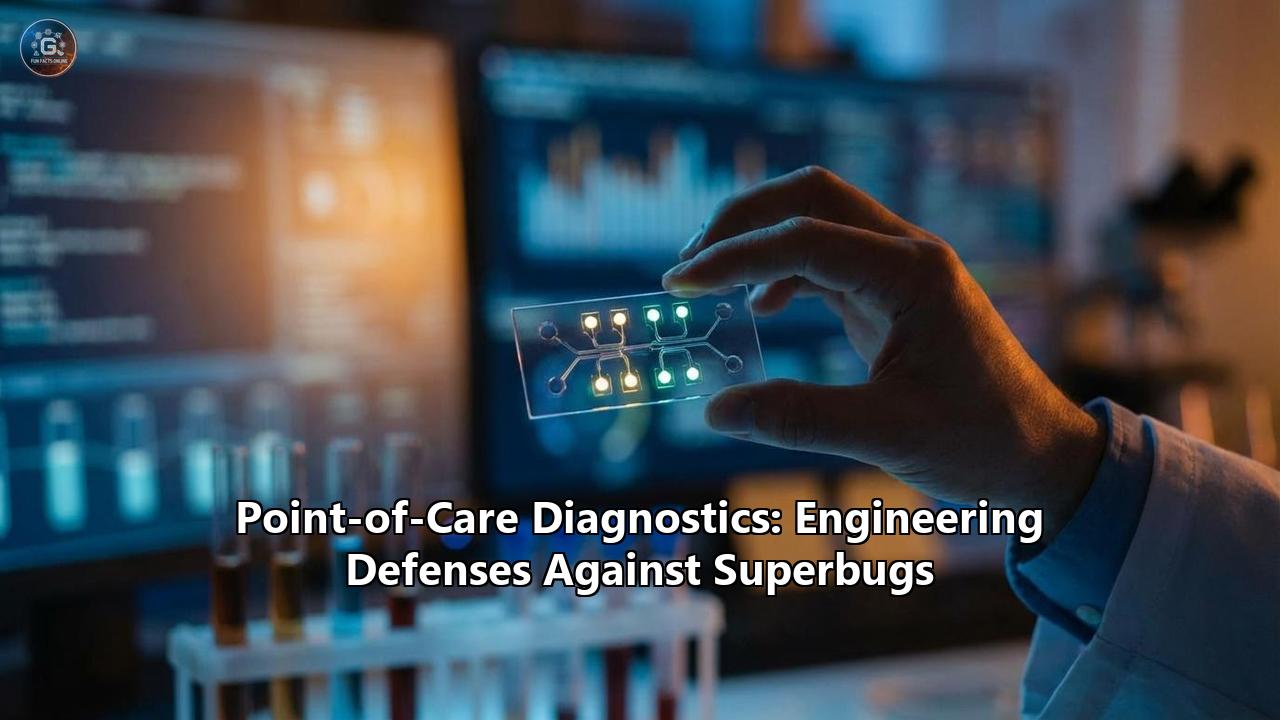
The foundational engineering challenge of point-of-care diagnostics is miniaturization. How do you take a room full of automated lab equipment, centrifuges, and incubators and shrink it into a device that fits in the palm of a doctor's hand? The answer lies in microfluidics—the science of manipulating fluids at the sub-millimeter scale.
Lab-on-a-Chip (LOC) technologies have revolutionized POC diagnostics. By utilizing etched microchannels, microvalves, and micropumps, these devices can precisely control the flow of incredibly small sample volumes (nanoliters or picoliters). When a drop of whole blood or urine is introduced into a microfluidic chip, the fluid dynamics change entirely. At this micro-scale, fluids behave predictably and laminarly, allowing engineers to design chips that automatically separate red blood cells from plasma, lyse bacterial cell walls to extract DNA, and mix reagents with extraordinary precision.
Recent advancements in droplet-based microfluidics allow for the isolation of individual bacterial cells within millions of distinct, microscopic water-in-oil droplets. These highly controlled microenvironments act as millions of individualized test tubes. If a superbug is present, its genetic material or secreted proteins can be detected rapidly without the need for days of bulk culturing.
Coupled with functional nanomaterials, these devices become exquisitely sensitive. Engineers are deploying gold nanoparticles, carbon nanotubes, and graphene oxide within these microfluidic channels to act as biosensors. When a target biomarker binds to these nanomaterials, it triggers a measurable change—be it an electrical shift in an electrochemical sensor or a change in light absorbance in a plasmonic sensor. These nanomaterial-enabled biosensors can detect specific superbugs at incredibly low concentrations, right at the patient's bedside.
Furthermore, POC diagnostics are addressing one of the most common causes of antibiotic misuse: differentiating between bacterial and viral infections. Many patients presenting with respiratory tract infections receive antibiotics, even though the vast majority of these infections are viral (and thus impervious to antibiotics). Engineers have developed multiplexed POC devices that analyze host-response biomarkers. By simultaneously measuring biomarkers like C-reactive protein (CRP), which spikes during bacterial infections, and Myxovirus resistance protein A (MxA), which elevates during viral infections, these devices can definitively tell a doctor within 15 minutes whether an antibiotic is actually warranted.
The CRISPR Diagnostic Revolution: SHERLOCK and DETECTR
While microfluidics provides the hardware for point-of-care diagnostics, the gene-editing tool CRISPR is providing a revolutionary new software. Best known for its ability to edit genomes, the CRISPR-Cas system—originally a bacterial immune system used to fight off bacteriophage viruses—has been ingeniously repurposed by bioengineers into a highly sensitive, ultra-fast diagnostic search engine.
Genotypic testing looks for the specific DNA or RNA sequences that encode resistance (such as the mecA gene in MRSA or the blaKPC gene in carbapenem-resistant Klebsiella pneumoniae). Traditional Polymerase Chain Reaction (PCR) is highly accurate for this, but it requires bulky thermal cyclers to rapidly heat and cool the sample, making it difficult to deploy in low-resource settings. CRISPR diagnostics bypass this limitation entirely by operating at a constant temperature (isothermal amplification).
The two pioneering CRISPR diagnostic platforms are SHERLOCK (Specific High-sensitivity Enzymatic Reporter unlocking) and DETECTR (DNA Endonuclease-Targeted CRISPR Trans Reporter).
SHERLOCK utilizes the Cas13 enzyme, which specifically targets RNA. Bioengineers design a "guide RNA" that matches the exact genetic signature of a superbug or a specific antibiotic resistance gene. When the guide RNA locates its target in the patient sample, the Cas13 enzyme binds to it. However, once activated by its target, Cas13 exhibits a bizarre and highly useful behavior: "collateral cleavage". It goes into a frenzy, indiscriminately slicing up any nearby RNA. Engineers exploit this by flooding the test mixture with "reporter" RNA molecules tagged with a fluorescent dye. When the target superbug gene is found, Cas13 activates, slashes the reporter molecules, and unleashes a bright fluorescent glow.
DETECTR operates on a similar principle but utilizes the Cas12 enzyme, which targets and collateral-cleaves DNA instead of RNA. Both systems are blindingly fast, capable of delivering results in under an hour. Because they do not require heavy, energy-intensive thermocyclers, CRISPR diagnostic kits can be formatted onto simple paper strips, much like a pregnancy test. A color change on the strip instantly alerts the clinician to the presence of a superbug and its specific resistance profile.
By bringing high-fidelity molecular diagnostics to the bedside, SHERLOCK and DETECTR democratize infectious disease testing, offering a lifeline to low- and middle-income countries (LMICs) that bear the heaviest burden of the AMR crisis but lack centralized lab infrastructure.
The Holy Grail: Rapid Phenotypic Antimicrobial Susceptibility Testing (AST)
As powerful as genotypic tools like CRISPR and multiplex PCR are, they have a critical blind spot: they can only detect the resistance genes we already know about. If a bacteria has mutated a novel way to survive an antibiotic, genotypic tests will miss it, falsely reporting the bug as susceptible. Furthermore, the mere presence of a resistance gene does not always guarantee that the bacteria will survive the drug in the human body.
For definitive proof, clinicians need phenotypic Antimicrobial Susceptibility Testing (AST). Phenotypic testing answers a simple, pragmatic question: if we expose these living bacteria to this specific antibiotic, do they die, or do they keep growing?
Historically, phenotypic AST has been the primary cause of the 48-to-72-hour delay. You cannot visually see a few bacteria growing on an agar plate; you have to wait for them to multiply into colonies of millions. Engineering a way to accelerate this process—rapid AST (rAST)—is considered the Holy Grail of clinical microbiology.
A new vanguard of bioengineering companies is finally cracking this code, developing ultra-rapid phenotypic AST systems that can deliver results in a single 8-hour shift, and in some cases, in under three hours. To achieve this, engineers have abandoned the naked eye and embraced advanced optics, biophysics, and machine learning.
Instead of waiting for visible colonies, modern rapid AST systems analyze how individual bacterial cells behave when assaulted by antibiotics. For example, emerging technologies utilize lens-free holographic microscopy and microfluidic channels to monitor the real-time morphological responses of bacteria. When exposed to an effective antibiotic like a beta-lactam, susceptible bacteria will physically swell, elongate, and eventually lyse (burst) long before they stop dividing.
Systems like the UKCA-certified iFAST ONE extract bacteria directly from a positive blood culture, expose them to various antibiotics, and use advanced electrical or optical readers to scan thousands of individual bacteria. Within minutes to hours of incubation, these devices can definitively classify the pathogen as resistant or susceptible. Other platforms, such as the ASTar and QuickMIC systems, utilize sophisticated broth microdilution arrays and real-time imaging to provide Minimum Inhibitory Concentration (MIC) data in a fraction of the traditional time.
By slashing the turnaround time for phenotypic AST from days to hours, these engineered systems allow doctors to pivot from broad-spectrum guesswork to precision strikes. If a patient is septic, the physician can rapidly de-escalate therapy to the narrowest, most effective antibiotic, drastically improving patient survival while preserving our most vital last-resort drugs.
AI and the Digital Frontier of Diagnostics
The physical engineering of point-of-care devices is only half the battle; the sheer volume of data these devices generate necessitates the integration of Artificial Intelligence (AI) and Machine Learning (ML).
In rapid AST, AI algorithms process the complex, real-time optical and biophysical data streaming from microfluidic chips. An algorithm can detect the subtle, microscopic swelling of a bacterial cell wall or the slight shift in a bacteria's metabolic rate long before a human technician could identify a change. Machine learning models are trained on millions of data points to accurately predict the trajectory of bacterial growth, interpolating within an hour whether a culture will eventually succumb to an antibiotic or resist it.
Moreover, AI is transforming AMR surveillance. The 2025 WHO GLASS report highlights that the threat of gram-negative bacteria, such as Klebsiella pneumoniae and Escherichia coli, is escalating globally, with over 40% of E. coli and 55% of K. pneumoniae strains now resistant to third-generation cephalosporins. Dealing with localized outbreaks of these superbugs requires real-time intelligence. Modern point-of-care devices are being designed with Internet of Things (IoT) connectivity. When a rapid AST or CRISPR-based device identifies a carbapenem-resistant strain in a rural clinic or a busy urban ICU, that data is instantly anonymized and uploaded to a cloud-based surveillance network. AI systems can map these outbreaks globally, predicting the spread of resistance patterns and guiding public health interventions before a localized outbreak becomes a regional epidemic.
The Global Impact and the LMIC Challenge
The engineering triumphs of rapid AST and CRISPR diagnostics must be evaluated through the lens of global equity. The WHO report explicitly notes that the highest prevalence of superbugs is occurring in Low- and Middle-Income Countries (LMICs), specifically in the African, Southeast Asian, and Eastern Mediterranean regions. In these regions, the absence of centralized laboratory infrastructure, frequent power grid failures, and the high cost of automated diagnostics severely cripple the ability to fight AMR.
Therefore, the ultimate test of engineering in this field is accessibility. A sophisticated microfluidic device that costs $100,000 and requires a climate-controlled laboratory will not alter the trajectory of global AMR.
This is why the development of paper-based diagnostics, isothermal CRISPR assays, and smartphone-integrated readouts is so critical. Engineers are focusing on "frugal innovation"—designing diagnostic tools that are robust, require no cold-chain storage for reagents, operate on battery or solar power, and cost less than a few dollars per test. For instance, smartphone cameras are now powerful enough to act as optical readers for colorimetric or fluorescent microfluidic assays. By transforming the ubiquitous smartphone into a mobile diagnostic laboratory, engineers can deploy advanced superbug detection to the most remote corners of the globe, providing front-line health workers with the precision tools previously reserved for elite research hospitals.
The Road to 2030 and Beyond
As we move toward the UN target year of 2030 for sweeping AMR intervention, the landscape of infectious disease management is poised for a radical transformation. The convergence of microfluidics, nanotechnology, CRISPR-Cas gene editing, and Artificial Intelligence is forging a new standard of care.
We are entering an era of true precision medicine for infectious diseases. In the very near future, empiric prescribing will be viewed as an archaic practice. A patient arriving at an emergency department with a suspected infection will undergo an immediate point-of-care test. Within minutes, a CRISPR or biosensor assay will differentiate between a virus and a bacterium, halting the unnecessary prescription of antibiotics. If the infection is bacterial, rapid phenotypic AST integrated into a portable lab-on-a-chip will analyze the pathogen's vulnerabilities in real time. Before the patient even leaves the waiting room or ICU intake, the physician will receive a digital report dictating the exact, targeted antibiotic required to neutralize the threat.
The fight against superbugs is not just a biological war; it is an engineering challenge. Bacteria will never stop mutating, and evolution will never cease. However, by continually miniaturizing our laboratories, accelerating our detection methods, and democratizing access to point-of-care diagnostics, we can strip superbugs of their greatest advantage: the element of surprise. Through relentless innovation, we can safeguard the miracle of antibiotics for generations to come.
Reference:
- https://www.who.int/publications/i/item/9789240116337
- https://www.who.int/news/item/13-10-2025-who-warns-of-widespread-resistance-to-common-antibiotics-worldwide
- https://www.cidrap.umn.edu/antimicrobial-stewardship/who-antimicrobial-resistance-widespread-globally-and-increasing
- https://www.theguardian.com/world/2025/oct/13/sharp-global-rise-in-antibiotic-resistant-infections-in-hospitals-who-finds
- https://pmc.ncbi.nlm.nih.gov/articles/PMC6686868/
- https://www.biomerieux.com/content/dam/biomerieux-com/medical-affairs/microbiology/new-ast/biomerieux-AST-BOOKLET-2024-FINAL.pdf
- https://ifastdiagnostics.com/
- https://pmc.ncbi.nlm.nih.gov/articles/PMC8756393/
- https://www.roche.com/stories/fighting-antimicrobial-resistance-in-infectious-diseases
- https://www.frontiersin.org/journals/cellular-and-infection-microbiology/articles/10.3389/fcimb.2026.1769679/full
- https://haiweb.org/storage/2023/01/Diagnostics-to-address-antimicrobial-resistance.pdf
- https://www.news-medical.net/health/CRISPR-Based-Diagnostics-The-Future-of-Disease-Detection.aspx
- https://adamjones.me/blog/crispr-diagnostics-intro/
- https://www.mdpi.com/2075-4418/15/17/2244
- https://pmc.ncbi.nlm.nih.gov/articles/PMC8106734/
- https://medium.com/@harvardmicrosociety/crispr-cas-revolution-how-sherlock-and-detectr-technologies-are-bringing-rapid-diagnostics-to-the-dac457c6aa08
- https://medium.com/@rameslamichhane1/crispr-diagnostics-detecting-superbugs-in-minutes-sherlock-and-detectr-a18c3b0cdef3
- https://journals.asm.org/doi/10.1128/jcm.00674-25
- https://gradientech.se/learn/rapid-ast-to-advance-antimicrobial-stewardship/