
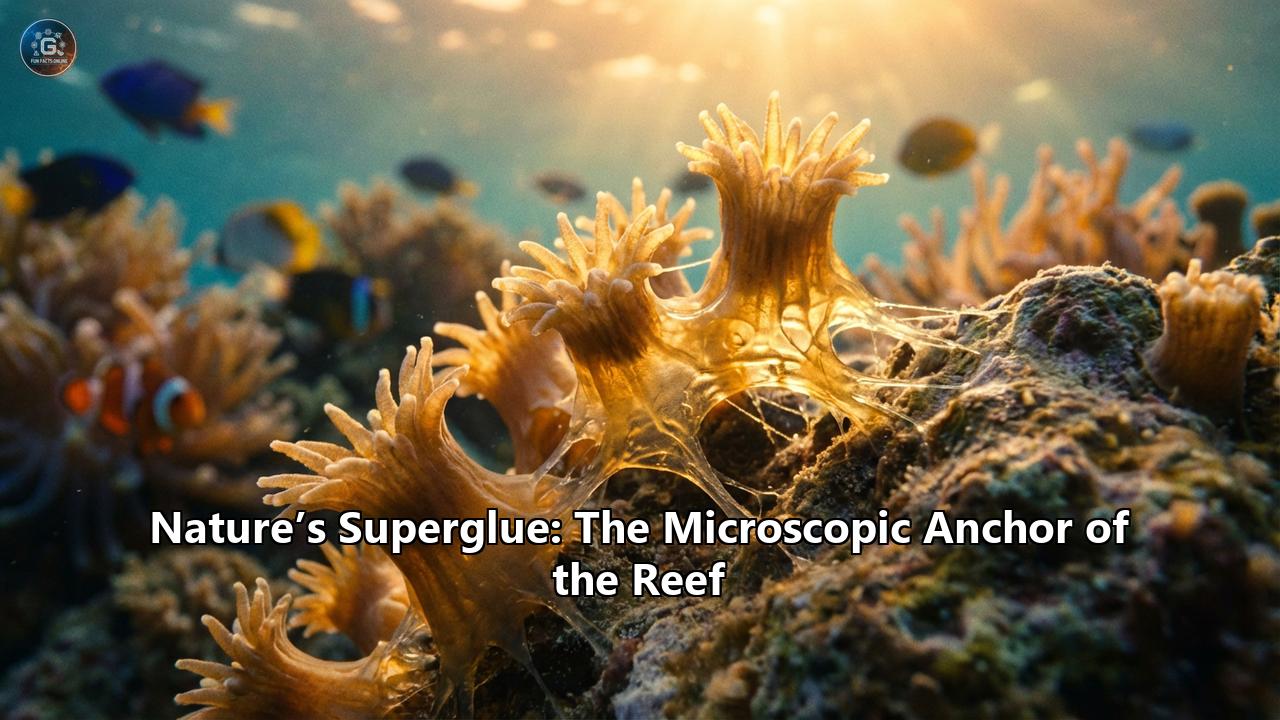
The roar of a breaking wave exerts a force that can shatter bone. On the windward face of a coral reef, this hydraulic hammer strikes thousands of times a day, delivering impact pressures that would strip a human city to its foundations in weeks. Yet, amidst this chaotic bombardment, life not only survives but builds the largest biological structures on Earth.
The secret to this defiance is not just bulk or weight, but a microscopic marvel of chemistry and engineering—a suite of biological adhesives so sophisticated that they defy the dissolving power of water, the sheer force of tides, and the eroding march of time. This is the story of nature’s "superglue," the invisible anchor that holds the reef together.
Part I: The Invisible War
To understand the magnitude of the problem, one must first appreciate the environment. Seawater is the universal solvent. It hydrates surfaces, creating a barrier of water molecules that prevents most chemical bonds from forming. In the human world, gluing two wet surfaces together is a nightmare; water wicks into the interface, pushing the adhesive away before it can grip. Underwater, this problem is compounded by salt, which corrodes and interferes with electrostatic attraction, and by the relentless motion of the ocean itself.
Yet, a single mussel, clinging to a pylon in a storm, holds fast. A barnacle, cemented to the hull of a ship, requires a chisel to remove. A coral polyp, soft as a jellyfish, lays down a limestone foundation that eventually becomes a mountain. These organisms have waged a billion-year war against the physics of water, and they have won. Their victory lies in a mastery of protein chemistry that human science is only just beginning to unravel.
Part II: The Architects of Adhesion
The reef is a multi-species construction site, and different organisms have evolved distinct strategies to solve the same problem: how to stay put.
1. The Flexible Tether: The Mussel’s Byssus
The Blue Mussel (Mytilus edulis) is perhaps the most studied master of wet adhesion. Its strategy is not to glue its entire body to the rock, but to engineer a shock-absorbing suspension system.
When a mussel finds a suitable spot, its foot—a tongue-like muscular organ—emerges from its shell. It probes the surface, cleaning away debris and sensing the texture. Inside the foot, a biological injection-molding process begins. A cocktail of liquid proteins is secreted into a groove running down the foot. Within minutes, these proteins solidify into a thread—a byssal thread. The foot retracts, leaving behind a golden, hair-like tether anchored by a small, adhesive plaque.
The genius of the byssus lies in its chemical gradients. The thread is not uniform; it is a composite material. The proximal end, attached to the mussel, is stretchy and elastic, allowing the animal to move slightly and absorb the shock of waves. The distal end, near the rock, is stiff and tough. But the true marvel is the plaque itself, a tiny disc of glue that bonds to wet stone.
The secret ingredient is DOPA (3,4-dihydroxyphenylalanine). DOPA is an amino acid modification that acts as a molecular grappling hook. It has a unique chemical structure (a catechol group) that loves to bind to metals and oxides found in rocks. It can displace water molecules from the surface, essentially "drying" the microscopic contact point to allow a bond to form. Furthermore, the mussel utilizes iron ions from the seawater to create cross-links between these protein chains, curing the glue into a hardened solid. It is a self-healing, impact-resistant, underwater epoxy that sets in minutes.
2. The Permanent Cement: The Barnacle
While the mussel uses a tether, the barnacle commits to a "forever home." Once a barnacle larva (the cyprid) settles, it never moves again. Its survival depends on a cement that is arguably the strongest natural glue known to man.
Barnacle cement is a multi-protein complex that defies degradation. Unlike the mussel’s thread, which can be severed if necessary, the barnacle’s bond is designed for permanence. The cement glands secrete a fluid that spreads between the barnacle’s base plate and the substrate. This fluid contains a mix of proteins, some hydrophobic (water-repelling) and some hydrophilic (water-loving).
Recent research has identified specific proteins, such as cp19k and cp20k, which self-assemble into amyloid-like nanofibers. These fibers form a mesh so dense and entangled that bacteria cannot biodegrade it, and strong acids cannot dissolve it. The cement cures without shrinking, a vital property because shrinking would pull the glue away from the rock.
The sheer strength of this bond is staggering. Tensile strength tests show that barnacle cement can withstand pull-off forces of over 2 megapascals (MPa)—equivalent to a small car hanging from a square inch of glue. In shear tests (sliding force), it is even stronger. This is why scraping barnacles off a boat hull often results in damaging the hull before the glue gives way.
3. The Living Masonry: Coral and Algae
The coral polyp is the architect of the reef, but it is also a master of adhesion. When a coral larva (planula) settles, it undergoes a dramatic metamorphosis. It flattens against the rock and begins to calcify. But before it builds its limestone skeleton, it must stick.
The polyp secretes a "proto-skeleton," an organic matrix of proteins and sugars that acts as a template. This matrix bonds to the rock and then guides the crystallization of calcium carbonate (aragonite) directly onto the surface. It is a form of biomineralization where the glue becomes the rock.
However, the corals do not work alone. The unsung hero of reef stability is Crustose Coralline Algae (CCA). To the naked eye, CCA looks like pink paint splattered over the reef. In reality, it is a rock-hard, calcifying algae. It grows over loose rubble, dead coral skeletons, and sand, secreting calcium carbonate that binds everything together.
If corals are the bricks of the reef, CCA is the mortar. Without this algal "superglue," the reef would be nothing more than a pile of loose bones, easily scattered by the first typhoon. The CCA provides a continuous, solid pavement that seals the reef structure, protecting it from erosion and providing a clean, chemical-cued landing strip for new coral larvae to settle.
Part III: The Chemistry of the Bond
The molecular mechanisms at play here are a masterclass in chemistry. The central challenge of underwater adhesion is interfacial water. On any submerged surface, a layer of water molecules is tightly ordered, acting like a force field that prevents other chemicals from touching the surface.
DOPA is nature's solution to this. The catechol side chain of DOPA has a high affinity for surface oxides. It can "punch through" the hydration layer, forming hydrogen bonds and coordination bonds with the surface atoms.But sticking is only half the battle; the glue must also be cohesive (it must hold itself together). This is where metal coordination comes in. Mussels and sandcastle worms (which build tubes out of sand grains) use metals like iron, calcium, and magnesium to bridge their protein chains. A single iron ion can grab three DOPA molecules, locking them together in a rigid complex.
Interestingly, this chemistry is pH-dependent. Inside the animal's gland, the glue is kept acidic (low pH), which keeps the proteins liquid and prevents them from cross-linking prematurely. When secreted into the seawater (typically pH 8.1), the sudden shift to alkalinity triggers the cross-linking reaction. The glue cures instantly upon contact with the ocean. It is a "smart" material that responds to its environment.
Part IV: Evolution’s Timeline
These adhesive strategies are not recent inventions. They are the product of hundreds of millions of years of evolutionary pressure. The Cambrian Explosion (approx. 541 million years ago) saw the rise of hard-shelled organisms, and with them, the need to attach.
As predators evolved—crushing jaws, prying claws, and drilling tongues—the pressure to stay anchored increased. The intertidal zone, the area between high and low tide, became a refugium for species that could withstand the exposure and the waves. Here, adhesion became a survival prerequisite.
Evolutionary convergence is rampant in this field. Mussels, barnacles, and tube worms are not closely related, yet they all evolved protein-based glues. The specific proteins differ, but the physical principles—displacing water, cross-linking with metals, and using nanofiber reinforcement—are strikingly similar. It seems there are only a few ways to solve the physics of wet adhesion, and nature has found them all.
Part V: The Human Imitation
For centuries, human engineers have envied the barnacle. Our best glues—epoxies, cyanoacrylates (Super Glue), polyurethanes—fail miserably in wet environments. They are toxic, brittle, and require dry surfaces.
The field of biomimetics is now changing that. By reverse-engineering the mussel’s byssus, scientists have created new classes of medical adhesives.
- Fetal Surgery: A "mussel-inspired" glue is currently being tested for prenatal surgery. It can seal ruptures in the amniotic sac, a procedure that was previously impossible because no glue could stick to wet, living tissue without poisoning the fetus.
- Dental Adhesives: New dental primers use DOPA-like chemistry to bond fillings to wet teeth more effectively, reducing the need for drilling and etching.
- Underwater Construction: Industrial adhesives are being developed that cure underwater, allowing for the repair of oil pipelines, ship hulls, and bridge pylons without the need for dry-docking.
- Surgical Sealants: Products like "B-Seal" and "Tough Adhesives" mimic the energy-dissipating structure of the mussel thread. They are hydrogels that can stretch with the skin or heart muscle but hold a wound closed with the strength of a suture.
Part VI: The Acid Test
However, this story has a darker chapter. The chemistry that makes these glues work is delicately balanced, and human activity is upsetting that balance.
The ocean is absorbing massive amounts of carbon dioxide, leading to ocean acidification. This drop in pH is catastrophic for bioadhesion. Remember that the curing of mussel glue relies on the shift from acidic to alkaline conditions. As the ocean becomes more acidic, this shift becomes less pronounced.
Recent studies have shown that mussels reared in acidified water produce byssal threads that are 40% to 60% weaker. The critical iron-DOPA cross-links fail to form properly. In extreme cases, the glue simply doesn't set, and the mussels fall off the rocks, to be eaten by predators or smashed by waves.
Barnacles are also suffering. Their calcified base plates become thinner, and the protein cement, while still sticky, struggles to anchor to the eroding shell. For corals, the double whammy is severe: the acidification slows their skeleton building, while simultaneously dissolving the "mortar" of crustose coralline algae. The chemical cues that guide larvae to settle on the algae are disrupted, leading to "recruitment failure"—the babies simply don't attach.
Conclusion: The Fragile Anchor
The reef is often viewed as a biological entity—a community of fish and coral. But fundamentally, it is a geological structure held together by a microscopic layer of glue. This "superglue" is the unsung hero of the marine world. It allows soft, squishy life to stand against the might of the ocean.
From the molecular grappling hooks of the mussel to the nanofiber cement of the barnacle, these adaptations are triumphs of evolution. They are inspiring a revolution in human materials science, promising a future where our broken bones and broken bridges are mended with the same elegance as a reef.
But as we marvel at this microscopic engineering, we must also recognize its vulnerability. The chemistry of adhesion is the chemistry of the ocean itself. By altering the ocean’s pH, we risk dissolving the very bonds that hold these ecosystems together. If the glue fails, the reef falls. And in the silence of the deep, the anchor is already beginning to slip.