
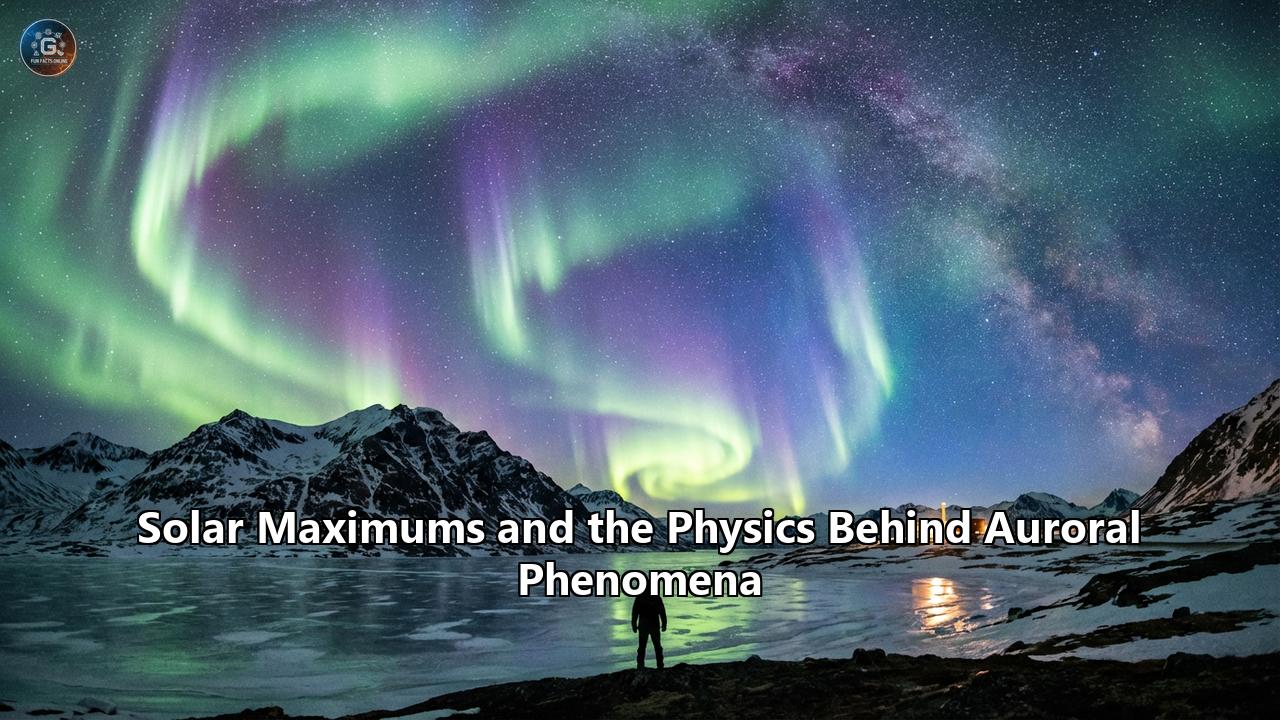
The night sky is not a static canvas. Over the last two years, it has become a theater of celestial violence and breathtaking beauty, a vivid reminder that our planet is intimately tethered to a churning, magnetic star. Throughout 2024, 2025, and into the early months of 2026, humanity has been treated to some of the most spectacular displays of the Aurora Borealis and Aurora Australis in modern history. The Northern and Southern Lights have spilled far beyond their usual polar confines, painting the skies over Greece, Mexico, India, and the southern United States in vibrant shades of crimson, emerald, and amethyst.
But these lights are not merely atmospheric decorations. They are the visible footprint of a massive transfer of energy across 93 million miles of space. They are the glowing exhaust of invisible magnetic collisions. To understand the aurora is to understand the physics of the Sun, the architecture of Earth's magnetic shield, and the rhythmic, 11-year heartbeat of the solar system known as the Solar Maximum.
As we navigate the lingering peak of Solar Cycle 25, the physics behind these auroral phenomena has never been more relevant, nor more awe-inspiring.
The Heartbeat of the Solar System: The 11-Year Solar Cycle
The Sun is not a solid body; it is a roiling sphere of superheated plasma—a state of matter where electrons are stripped from their atomic nuclei, creating a fluid of freely moving electrical charges. Because the Sun is a fluid, it does not rotate uniformly. Its equator spins faster than its poles, a phenomenon known as differential rotation.
Over the course of years, this differential rotation twists and stretches the Sun's magnetic field lines, winding them tighter and tighter like a rubber band. This immense magnetic tension generates a cyclical rise and fall in solar activity. Every 11 years, the Sun undergoes a dramatic transformation from a quiet, nearly featureless sphere (Solar Minimum) to a chaotic, storm-battered state (Solar Maximum). At the peak of this cycle, the Sun's magnetic field becomes so tangled and unstable that it completely flips—the magnetic north becomes magnetic south, and vice versa.
The visual markers of this magnetic tension are sunspots. Sunspots appear as dark blemishes on the photosphere (the Sun's visible surface). They appear dark because they are cooler than the surrounding plasma. While the average surface temperature of the Sun is around 5,500 degrees Celsius, sunspots can be thousands of degrees cooler. This cooling occurs because the intensely concentrated magnetic fields in these regions act like a plug, suppressing the convective upward flow of heat from the Sun's interior.
However, sunspots are anything but tranquil. They are the launchpads for the most explosive events in the solar system.
Solar Cycle 25: The Storm We Underestimated
When Solar Cycle 25 officially began in December 2019, consensus among forecasting panels like those from NASA and the National Oceanic and Atmospheric Administration (NOAA) predicted a relatively mild cycle. Early models suggested a peak sunspot number of around 115, comparable to the subdued Solar Cycle 24.
The Sun, however, had other plans.
By 2023, it became abundantly clear that Solar Cycle 25 was overperforming. Sunspot numbers skyrocketed past 200, nearly double the initial forecasts. Scientists now believe that the actual peak of the smoothed sunspot number occurred around October 2024, but the chaotic energy of the Solar Maximum does not simply shut off overnight. We are currently experiencing a prolonged, highly active plateau—sometimes referred to as a "double peak". This extended maximum phase has kept solar activity remarkably elevated through 2025 and into 2026, producing an unrelenting barrage of solar flares and geomagnetic storms.
The consequences of this miscalculation have been visually stunning. In May 2024, an extreme G5 geomagnetic storm—the strongest category on NOAA's scale—slammed into Earth, triggering global auroras that were seen by millions of people who had never before witnessed the phenomenon. Similar severe (G4) storms followed in October 2024 and November 2025, constantly pushing the auroral oval far toward the equator.
The Arsenal of the Sun: Solar Wind, Flares, and CMEs
To understand how a twisted magnetic field on the Sun results in glowing skies on Earth, we must break down the three primary components of space weather: the solar wind, solar flares, and coronal mass ejections (CMEs).
The Solar Wind
Even on a quiet day, the Sun is constantly boiling off its outer atmosphere (the corona). This continuous stream of protons, electrons, and alpha particles is known as the solar wind. Traveling at speeds between 250 and 500 miles per second (400 to 800 kilometers per second), the solar wind carries the Sun's magnetic field—known as the Interplanetary Magnetic Field (IMF)—outward to the very edges of the solar system.
Solar Flares
When the tangled magnetic field lines above a sunspot become too strained, they can undergo a process called magnetic reconnection. The field lines suddenly snap and realign into a simpler, lower-energy configuration, releasing a catastrophic amount of energy in the process. This results in a solar flare: a brilliant flash of electromagnetic radiation spanning the entire spectrum, from radio waves to X-rays and gamma rays.
Because flares are made of light, their energy reaches Earth in just eight minutes. They are categorized by intensity into A, B, C, M, and X classes, with X-class flares being the most powerful. In November 2025, the Sun unleashed a massive X5.1 flare, and 2024 alone saw over 50 X-class events. While flares cause immediate radio blackouts by ionizing Earth's upper atmosphere, they do not directly cause auroras. For that, we need mass.
Coronal Mass Ejections (CMEs)
Often accompanying a major solar flare is a Coronal Mass Ejection. If a flare is the muzzle flash of a cosmic cannon, the CME is the cannonball. A CME is a billion-ton cloud of magnetized plasma violently hurled into space. Unlike the speed-of-light flash of a flare, CMEs travel much slower, typically taking anywhere from 18 hours to several days to cross the gulf between the Sun and Earth.
When a CME is Earth-directed, it acts like a snowplow, sweeping up the ambient solar wind and creating a massive shockwave. It is the collision of this magnetized plasma cloud with Earth's own magnetic field that triggers the aurora.
Earth's Invisible Shield: The Magnetosphere
If Earth did not possess a magnetic field, the solar wind and CMEs would eventually strip away our ozone layer and atmosphere, leaving our planet as barren as Mars. Fortunately, deep within the Earth, a churning ocean of liquid iron and nickel acts as a geodynamo. The convection of these molten metals, driven by the heat of the inner core and the rotation of the Earth, generates a massive magnetic shield called the magnetosphere.
On the sunward side, the magnetosphere is compressed by the pressure of the solar wind, forming a blunt boundary called the bow shock, much like the water piling up at the bow of a moving ship. On the night side, the solar wind drags the magnetosphere out into a long, teardrop-shaped tail known as the magnetotail, which extends hundreds of thousands of miles into the darkness of space.
Most of the time, the magnetosphere elegantly deflects the solar wind. But when a Coronal Mass Ejection arrives, a complex physical interaction occurs.
The Physics of Magnetic Reconnection
The key to a spectacular aurora lies in a specific orientation of the Interplanetary Magnetic Field (IMF) carried by the CME. Magnetic fields have a directional component. Earth's magnetic field points north at the equator. If the magnetic field of the incoming CME is also pointing north, it essentially bounces off Earth's shield, resulting in a minor disturbance and weak auroras.
However, if the magnetic field of the CME is pointing south (known as a southward Bz), a dramatic phenomenon occurs. The southward-pointing solar magnetic lines press against the northward-pointing Earth magnetic lines. Because opposites attract, the two fields physically merge—or "reconnect".
This magnetic reconnection peels open Earth's sunward magnetic shield, allowing solar plasma to pour inside. The solar wind drags these reconnected field lines all the way back into the magnetotail. As more and more field lines pile up in the magnetotail, the tension becomes unbearable. Eventually, they snap back together in a secondary magnetic reconnection event, operating much like a slingshot.
This snapping action violently accelerates electrons and protons—both from the solar wind and from Earth's own ionosphere—catapulting them down the magnetic field lines straight toward Earth's polar regions.
The Quantum Mechanics of the Aurora
As these high-energy electrons plunge toward the poles, they enter the thermosphere and ionosphere, roughly 60 to 400 miles above the Earth's surface. Here, the near-vacuum of space gives way to a tenuous soup of oxygen and nitrogen atoms and molecules.
When a high-speed electron slams into an oxygen or nitrogen atom, it transfers a portion of its kinetic energy to the atom. This energy kicks one of the atom's orbiting electrons into a higher, unstable energy state. In quantum mechanics, an atom cannot remain in this "excited" state for long. Within a fraction of a second to a few minutes, the atom's electron drops back down to its original ground state.
To obey the law of conservation of energy, the atom must release the extra energy it absorbed. It does this by emitting a single particle of light: a photon.
When billions of trillions of atoms undergo this excitation and emission process simultaneously, the sky erupts in a glowing, undulating river of light. This is the aurora.
The Colors of the Cosmic Spectrum
The specific color of the aurora is dictated by two factors: the type of gas being struck, and the altitude of the collision. Because different elements have different atomic structures, they emit photons at very specific wavelengths when they relax.
Brilliant Green (Oxygen, 60 to 200 miles high):This is the most common auroral color. It is produced by atomic oxygen at moderate altitudes. When oxygen is excited, it takes about three-quarters of a second to emit a green photon (at a wavelength of 557.7 nanometers). Because the atmosphere is relatively sparse at this altitude, the oxygen atoms have time to emit their light before colliding with another molecule, which would otherwise steal the energy without producing light.
Blood Red (Oxygen, 150 to 400 miles high):At the highest reaches of the atmosphere, atomic oxygen undergoes a different transition that produces a deep red light (at 630 nanometers). However, this is a "forbidden" quantum transition, meaning it takes a very long time—up to two minutes—for the oxygen atom to release the red photon. At lower altitudes, the atom would collide with something else before the two minutes were up, extinguishing the light. Only at extreme altitudes, where the gas is so incredibly thin that collisions are rare, can the red aurora bloom. These high-altitude red auroras are often the first thing seen when a geomagnetic storm pushes the lights toward the equator.
Pink, Purple, and Blue (Nitrogen, below 60 miles high):Molecular nitrogen is heavier and much harder to excite than oxygen. It requires extremely energetic electrons—typically propelled by massive CMEs during Solar Maximums—to penetrate deep into the atmosphere (around 60 miles up) and strike the nitrogen. When excited, molecular nitrogen emits blue and purple light. Furthermore, when ionized nitrogen (nitrogen that has had an electron completely stripped away) regains an electron, it emits a vibrant pink/crimson glow. Because nitrogen exists at the lowest visible fringe of the aurora, it often paints a spectacular magenta fringe along the bottom of green auroral arcs.
The March 2026 Equinox: The Russell-McPherron Effect
As we navigate through the spring of 2026, aurora watchers and space weather physicists are highly focused on the month of March. Historically, the weeks surrounding the vernal (spring) and autumnal (fall) equinoxes produce the most intense and frequent geomagnetic storms, a phenomenon known as the equinoctial effect.
For decades, the mechanism behind this seasonal surge was a mystery. Why would the Sun care what season it is on Earth?
The answer was formalized in 1973 by geophysicists Christopher Russell and Robert McPherron, and is now famously known as the Russell-McPherron effect. It is entirely a matter of cosmic geometry.
The Sun's equator, from which the solar wind flows radially outward, is tilted relative to Earth's orbital plane. Meanwhile, Earth's magnetic dipole axis is tilted by about 11 degrees from its geographic rotational axis. Because of this complex, three-dimensional geometry, the alignment between the Interplanetary Magnetic Field (the solar wind's magnetic field) and Earth's magnetic field changes throughout the year.
Around the equinoxes in March and September, Earth's magnetic poles are oriented at a right angle to the flow of the solar wind. This specific tilt maximizes the geometric coupling between the Earth and the Sun. It essentially forces the southward component of the solar wind's magnetic field to perfectly oppose Earth's northward magnetic field.
Because of the Russell-McPherron effect, even a modest breeze of solar wind—or a glancing blow from a minor CME—can easily pry open "cracks" in Earth's magnetosphere during the equinox. Now, in March 2026, combining the maximized geometrical vulnerability of the equinox with the lingering, highly charged output of the Solar Maximum, we are sitting in the ultimate golden window for auroral phenomena.
Anomalies in the Sky: STEVE and the Picket Fence
While traditional auroras follow the physics of particle precipitation and atomic excitation, the heightened scrutiny of the night sky during recent Solar Maximums has brought another, stranger phenomenon into the limelight.
Often appearing equator-ward of the main auroral oval is a stark, narrow ribbon of purple-white light. For years, Canadian citizen scientists and amateur photographers documented this streak, affectionately naming it "Steve". In 2018, atmospheric physicists finally classified the anomaly, turning the name into a backronym: Strong Thermal Emission Velocity Enhancement (STEVE).
STEVE is not a regular aurora. When researchers attached spectrographs to cameras to analyze STEVE's light, they found a shocking difference. A normal aurora produces distinct emission lines—specific spikes of green, red, or blue corresponding to oxygen and nitrogen, much like a neon sign. STEVE's spectrum, however, is a continuous, broadband wash of light. It looks less like a neon sign and more like the glow of an incandescent lightbulb or a hot electric stove coil.
Physics reveals that STEVE is caused by a Subauroral Ion Drift (SAID). During severe geomagnetic storms, supersonic rivers of plasma flow westward through Earth's upper atmosphere. At altitudes of around 280 miles (450 km), this plasma flows at a staggering speed of 4 miles per second (6 km/s), generating immense friction. The friction heats the atmospheric gases to an astonishing 5,400 degrees Fahrenheit (3,000 degrees Celsius).
STEVE, therefore, is not caused by electrons falling from space and exciting atoms. It is simply the thermal glow of a river of gas burning with atmospheric friction—a hyper-fast, super-heated ribbon of plasma native to our own atmosphere.
Often accompanying the purple arc of STEVE is a series of vertical green stripes known as the "Picket Fence". Unlike the purple arc, spectrographic analysis shows that the Picket Fence is a true aurora (particle precipitation), but how it forms at such unusually low latitudes simultaneously with the thermal heating of STEVE remains one of the most exciting, actively researched mysteries in magnetospheric physics today.
The Hidden Cost: Space Weather and Modern Hazards
It is easy to become entirely captivated by the aesthetics of the Solar Maximum, but the physics that light up the sky are the exact same physics that threaten modern civilization. A severe geomagnetic storm is a kinetic and electromagnetic assault on Earth's infrastructure.
When a massive CME compresses the magnetosphere, the rapidly fluctuating magnetic fields induce electrical currents in the ground, known as Geomagnetically Induced Currents (GICs). Because the Earth is a poor conductor of electricity, these massive, low-frequency currents seek the path of least resistance: human-built infrastructure. They travel up the grounding wires of high-voltage power grids, overwhelming transformers.
We have seen the consequences before. In 1859, the infamous Carrington Event induced currents so strong they caused telegraph machines to spontaneously catch fire. In October 2003, the "Halloween Storms" caused power outages in Sweden and destroyed transformers in South Africa.
During Solar Cycle 25, the hazards have evolved. In January 2026, Earth was battered by an unusually rapid S4 solar radiation storm. Unlike CMEs, which take days to arrive, this event saw an intense surge of high-energy protons accelerated from the Sun to Earth in under 24 hours. NOAA issued immediate warnings to airlines to divert transpolar flights due to lethal radiation exposure limits, while astronauts aboard the International Space Station were forced to take shelter in heavily shielded modules.
Furthermore, the heat dumped into the upper atmosphere by geomagnetic storms causes the thermosphere to expand outward. Satellites orbiting in Low Earth Orbit (LEO) suddenly find themselves plowing through a thicker atmosphere. This atmospheric drag slows them down, degrading their orbits. In 2022, a relatively minor geomagnetic storm caused up to 40 newly launched Starlink satellites to prematurely burn up in the atmosphere. As we navigate the tail-end of the current Solar Maximum, satellite operators must constantly burn precious fuel to keep their multi-billion-dollar constellations from falling out of the sky.
A Cosmic Conclusion
As we stand under the canopy of the 2026 night sky, bathed in the glow of the Russell-McPherron equinox effect, we are witnessing the grand mechanics of the universe at play. The Aurora Borealis and Aurora Australis are not just beautiful anomalies; they are the physical manifestation of a protective shield doing its job.
Every shimmering green ribbon, every blood-red corona, and every purple-white streak of STEVE represents a violent collision of solar plasma and atmospheric gas. They are the echoes of explosions that happened 93 million miles away.
Solar Cycle 25 has proven that our local star is deeply unpredictable. While scientists expect solar activity to gradually decline as we push toward 2030, the declining phase of a Solar Maximum is historically when some of the largest, most complex sunspots—and therefore the most powerful Coronal Mass Ejections—occur.
The Sun is slowly going back to sleep, but it will not do so quietly. For those willing to brave the dark, cold nights, the sky remains alive—a glowing, crackling testament to the magnificent, terrifying physics of our solar system. Look up; the show isn't over yet.
Reference:
- https://www.iflscience.com/russell-mcpherron-effect-why-cracks-in-earths-magnetic-field-mean-we-get-peak-auroras-at-equinox-78459
- https://lasp.colorado.edu/2021/12/12/mysterious-steve-light-emissions-emanate-from-earths-magnetosphere/
- https://earthsky.org/sun/aurora-season-auroras-equinox-connection/
- https://www.hurtigruten.com/en-gb/explore-norway/northern-lights/science
- https://nordnorge.com/en/artikkel/the-aurora-leaves-the-night-sky-stage-in-a-grand-finale/
- https://pmc.ncbi.nlm.nih.gov/articles/PMC7837507/
- https://www.space.com/what-is-steve
- https://en.wikipedia.org/wiki/STEVE
- https://www.gi.alaska.edu/news/its-not-aurora-its-steve