
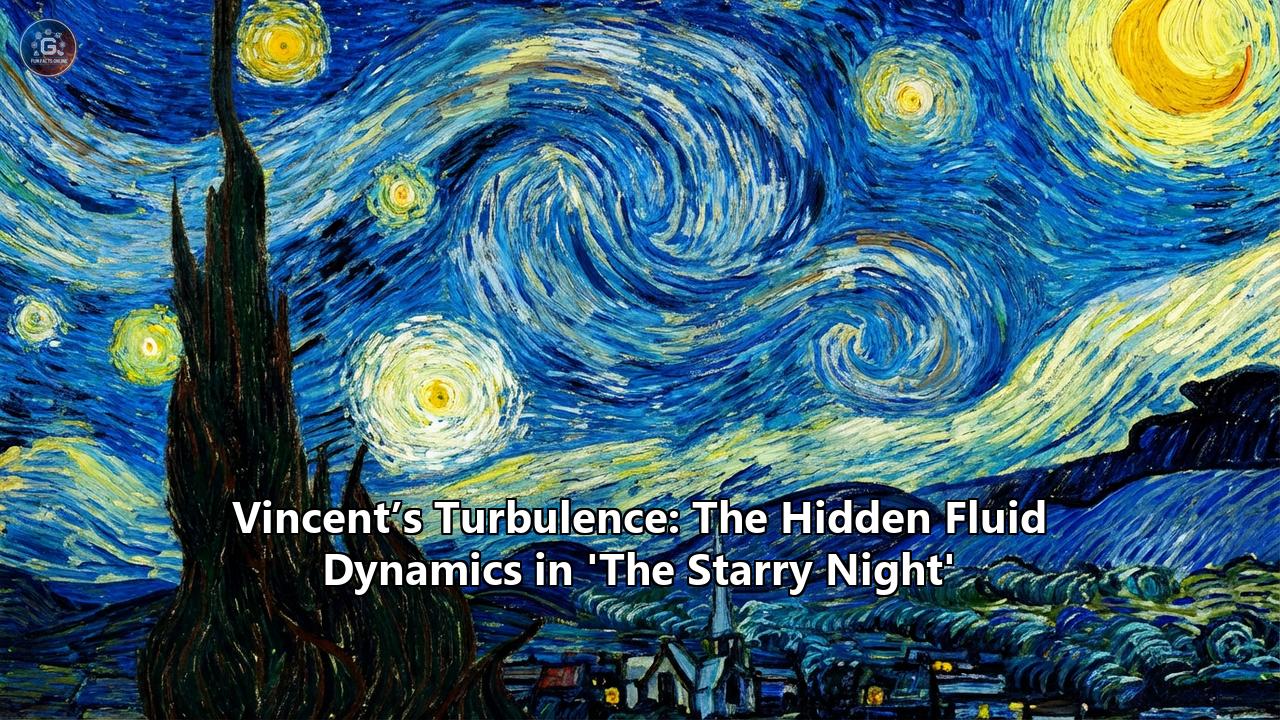
The night sky over Saint-Rémy-de-Provence is not silent. In the mind of Vincent van Gogh, and upon the canvas that would become his magnum opus, it is a roaring, churning ocean of energy. To the casual viewer, The Starry Night is a masterpiece of Post-Impressionist emotion—a dreamscape of rolling blue hills, a flaming cypress tree, and a village that never quite existed in that form. But to a physicist, it is something far more startling. It is a data set.
Hidden within the thick, impasto swirls of cobalt and indian yellow lies a mathematical fingerprint so precise, so complex, and so scientifically accurate that it predates the theories describing it by nearly sixty years. This is the story of how a man, locked away in an asylum and fighting the terrors of his own mind, intuitively captured one of the most elusive concepts in physics: the chaotic perfection of turbulent flow.
Part I: The Chaos in the Canvas
To understand the magnitude of what Van Gogh achieved in June 1889, we must first step away from art history and into the realm of fluid dynamics. The concept of "turbulence" is one of the hardest problems in classical physics. It is the chaotic motion of fluid—whether that fluid is water rushing over a rock, smoke rising from a cigarette, or the atmospheric gas of a nebula—characterized by chaotic changes in pressure and flow velocity.
For centuries, scientists struggled to describe this chaos mathematically. It wasn’t until 1941, fifty-one years after Van Gogh’s death, that the Soviet mathematician Andrey Kolmogorov formulated a statistical theory that could quantify it. Kolmogorov proposed that energy in a turbulent fluid moves down a "cascade." It starts in large eddies—big swirls of energy—which become unstable and break down into smaller eddies, which in turn break down into even smaller ones, transferring energy all the way down until it dissipates as heat (viscosity).
Kolmogorov found that this energy transfer follows a specific mathematical scaling law. If you were to measure the energy of these eddies against their size, you would find a mathematical relationship known as the "-5/3 power law." It is a precise, universal signature of turbulence.
In 2004, a team of scientists led by José Luis Aragón from the National Autonomous University of Mexico decided to analyze The Starry Night. They digitized the painting and measured the luminance (brightness) of the pixels as a proxy for the velocity of the fluid. Their findings sent shockwaves through both the art and science worlds. The probability distribution of the distance between two pixels of similar brightness in Van Gogh's sky didn't just resemble turbulence; it matched Kolmogorov’s scaling law with uncanny precision.
The large, rolling swirls in the center of the sky? They are the energy injection scale. The smaller, frantic brushstrokes? They are the inertial sub-range, transferring that energy down. Van Gogh had not just painted a "swirly sky"; he had painted a scientifically accurate model of the atmosphere’s fluid dynamics.
But the discovery didn't end there. In 2024, a new study published in Physics of Fluids by Yongxiang Huang and his team took the analysis a step further. They treated the individual brushstrokes as if they were "leaves swirling in the wind." They found that not only did the large-scale swirls fit Kolmogorov's law, but the microscopic paint mixing within the brushstrokes themselves followed a completely different, yet equally significant law: Batchelor’s scaling.
George Batchelor, an Australian mathematician, described in 1959 how "passive scalars" (like dye in water, or pigment in oil) mix at scales smaller than the turbulence itself. This follows a "-1 power law." The 2024 study confirmed that The Starry Night exhibits both: the Kolmogorov cascade in the composition of the sky, and the Batchelor scaling in the minute diffusion of the paint. Van Gogh had captured the physics of the atmosphere and the physics of the paint simultaneously, creating a multi-scale representation of nature that is technically impossible for a human eye to "see" in the traditional sense.
Part II: The Asylum and the Morning Star
How did he do it? Was it a coincidence, or a moment of transcendent observation? To answer this, we must look at the man himself in the summer of 1889.
Vincent van Gogh checked himself into the Saint-Paul-de-Mausole asylum on May 8, 1889, following a severe breakdown in Arles that resulted in the mutilation of his own ear. He was terrified of his own mind, seeking refuge in structure and supervision. The asylum was a former monastery, quiet and austere. Vincent was given a second-story bedroom with a window facing east, overlooking a wheat field and the Alpilles mountains.
It was from this window that he saw the sky that would define his legacy. In a letter to his brother Theo, dated around June 2, 1889, he wrote:
"This morning I saw the countryside from my window a long time before sunrise, with nothing but the morning star, which looked very big."That "morning star" was Venus, shining with exceptional brightness that spring. But Vincent wasn't just seeing a star; he was seeing the medium in which it hung. The Provençal sky is dominated by the Mistral, a fierce, cold wind that blows down from the Alps. It is relentless, capable of driving people to madness with its ceaseless howling. In June 1889, the Mistral was blowing.
While other Impressionists were obsessed with light—Monet with the fleeting sun on a haystack, Renoir with the dappled light on a dress—Van Gogh was becoming obsessed with movement. He wrote to Émile Bernard about the "funereal cypresses" and the "agitated" sky. He wasn't painting a snapshot; he was painting a duration. He was trying to capture the act of the wind blowing, not just the result.
The connection between his mental state and his art is often romanticized, but here the science offers a darker, more fascinating correlation. The 2004 study by Aragón analyzed several of Van Gogh’s paintings. They found that the Kolmogorov turbulence signature was present in The Starry Night (1889), Road with Cypress and Star (1890), and Wheatfield with Crows (1890)—all painted during periods of intense psychotic agitation.
Crucially, when they analyzed his Self-Portrait with Bandaged Ear and Pipe (1889), painted immediately after his breakdown but during a period he described as one of "absolute calm" and heavy sedation with potassium bromide, the turbulence was gone. The mathematical scaling vanished. The "flow" was no longer turbulent.
This suggests a profound link between Van Gogh’s "turbulent" mind and his ability to perceive, or at least express, the turbulent flow of nature. During his psychotic episodes, his sensory gating—the brain's ability to filter out irrelevant stimuli—may have failed. He might have been experiencing a sensory overload where the motion of the wind, the flickering of the starlight, and the overwhelming energy of the cosmos became a tangible, vibrating force that he felt compelled to document. He wasn't hallucinating the swirls; he was hypersensitized to the very real physics of motion that the rest of us ignore.
Part III: The Neuroscience of the "Moving" Sky
If the physics explains what he painted, neuroscience explains why we see it the way we do. Even to a viewer who knows nothing of fluid dynamics, The Starry Night appears to move. The stars seem to twinkle; the blue river of the sky seems to flow. This is not magic; it is biology.
Our vision system is split into two distinct pathways: the "What" system (the parvo pathway) and the "Where" system (the magno pathway).
- The "What" system is evolutionarily newer. It sees color, high resolution, and fine detail. It allows us to recognize faces and read text.
- The "Where" system is ancient. It is colorblind, low resolution, and sensitive only to luminance (light and dark) and motion. Its job is to tell us where something is and if it’s moving (so we can catch it or run away from it).
Margaret Livingstone, a neurobiologist at Harvard Medical School, has extensively studied The Starry Night. She points out that Van Gogh used a technique called "equiluminance." If you look at the yellow moon and the blue sky surrounding it, they are vividly different colors. But if you strip away the color and look only at the brightness (the grayscale value), the yellow and the blue are almost identical in luminance.
This confuses the brain. The "What" system sees a strong contrast between yellow and blue and says, "There are clear objects here." But the "Where" system, which is colorblind, sees two areas of equal brightness and cannot distinguish the edges clearly. It can’t lock the position of the stars. As a result, the "Where" system interprets this positional uncertainty as jitter or motion.
Furthermore, the brushstrokes in the sky create a phenomenon known as "illusory motion." The repetitive, directional strokes activate motion-sensitive neurons in the visual cortex (area V5/MT). When we scan our eyes across the painting, the high-contrast edges of the swirls stimulate these motion detectors, making the static image appear to churn.
This effect is amplified by our peripheral vision. The central part of our retina (the fovea) is packed with cones (color). The periphery is packed with rods (light/motion). Rods are far more sensitive to the "Where" system’s signals. If you look directly at a star in the painting, it might look relatively still. But look at the church steeple, and out of the corner of your eye, the sky above will start to swirl more violently. This mimics the actual experience of looking at the night sky, where faint stars are often clearer in averted vision than in direct gaze. Van Gogh, painting in the dim pre-dawn light, would have been relying heavily on his rod vision, perhaps unconsciously transferring that rod-dominated, motion-heavy perception onto the canvas.
Part IV: Van Gogh vs. The World
To truly appreciate the uniqueness of The Starry Night, we must compare it to other "turbulent" works of art. Van Gogh was not the only artist to depict storms or anxiety, but he is the only one who got the math right.
Take Edvard Munch’s The Scream. Painted just four years after The Starry Night, it is often cited as the other great Expressionist masterpiece of anxiety. The sky in The Scream is blood-red and wavy, a depiction of a "scream passing through nature." Many have hypothesized that Munch’s sky also depicts turbulence. However, when scientists applied the same pixel-luminance analysis to The Scream, the result was negative. The swirls in Munch’s sky do not follow the -5/3 Kolmogorov scaling. They are aesthetic, symbolic waves, not physical ones. They represent internal psychological horror, not external physical fluid dynamics.
Consider also The Great Wave off Kanagawa by Hokusai. This famous woodblock print depicts a towering, claw-like wave. It is a masterpiece of hydrodynamics in its own right, capturing the fractal nature of a breaking wave (self-similarity, where the small foam claws look like the big wave). It likely depicts a "plunging breaker" or even a rogue wave. However, it captures a different physical phenomenon—linear direction focusing and breaking—rather than the atmospheric turbulence of the Kolmogorov cascade. Hokusai froze a moment of structural mechanics; Van Gogh captured a continuous flow of energy.
Leonardo da Vinci, the original scientist-artist, filled notebooks with sketches of water flowing into pools, obsessively studying the "eddies" and "whirlpools." He famously noted that water has a "curling motion" like hair. Yet, even Da Vinci’s deliberate, analytical sketches do not perfectly align with the Kolmogorov spectrum in the way Van Gogh’s impassioned, manic brushstrokes do. Da Vinci was trying to draw the math; Van Gogh felt it.
Part V: The Myth and the Miracle
Is it possible that this is all just a coincidence? A "popular myth" as some skeptics argue?
Critics, such as fluid dynamics experts Mohamed Gad-el-Hak and James J. Riley, have pointed out the limitations of these studies. A painting is a 2D static object; it has no Reynolds number (the ratio of inertial forces to viscous forces), no temperature, and no pressure. They argue that applying fluid dynamics equations to a dry canvas is a category error. The "flow" is an illusion created by the orientation of brushstrokes, not real fluid.
This is technically true. The Starry Night is not a simulation. But the counter-argument, bolstered by the 2024 study, is that the statistics of the pattern match the statistics of nature. It is not that Van Gogh calculated the Reynolds number of the air; it is that his brain had internalized the statistical probability of how energy moves through a fluid.
Think of it like a musician with perfect pitch. A composer like Beethoven could "hear" the mathematical intervals of harmony without needing to calculate the frequency ratios of the sound waves. Van Gogh had "perfect pitch" for motion. He had spent thousands of hours observing the wind rippling through wheat fields, the smoke rising from pipes, and the clouds churning in the Mistral. His brain had built a predictive model of how turbulence looks. When he stood before his easel in the asylum, painting not what he saw in that exact moment (for he painted the village from memory and the sky from a composite of nights), he outputted that predictive model onto the canvas.
The "coincidence" theory becomes harder to sustain when you consider the Batchelor scaling. It is one thing to accidentally paint big swirls that look like big eddies. It is entirely another to paint microscopic mixing patterns in the brushstrokes that match the diffusion of scalar pigments in a turbulent fluid. That level of multi-scale fidelity suggests a deep, intuitive coupling between the artist's hand and the laws of physics.
Conclusion: The Universe in a Brushstroke
Vincent van Gogh died by suicide in July 1890, just a year after painting The Starry Night. He died believing himself a failure, his mind "broken" by an illness he couldn't control. He never knew that he had solved a problem that would stump physicists for another half-century.
The Starry Night is more than a painting. It is a bridge between the subjective experience of human suffering and the objective reality of the physical universe. It reminds us that the "chaos" of nature—and perhaps the chaos of the mind—is not random. It follows a law. There is a hidden order in the storm.When we look at The Starry Night today, we are not just seeing a pretty picture. We are seeing the universe as it truly is: a place of ceaseless, violent, beautiful energy, cascading from the birth of stars down to the mixing of atoms, captured by a man who felt it all too intensely. We are seeing the turbulence of the cosmos reflected in the turbulence of the soul, and finding that, mathematically, they are one and the same.
Reference:
- http://vangoghschair.blogspot.com/2010/01/painting-wind.html
- https://www.researchgate.net/publication/337531690_The_Batchelor_spectrum_of_passive_scalar_turbulence_in_stochastic_fluid_mechanics
- https://www.researchgate.net/publication/263140455_The_Batchelor_Spectrum_for_Mixing_of_Passive_Scalars_in_Isotropic_Turbulence_Submitted_for_the_Special_Issue_Dedicated_to_S_B_Pope
- https://www.webexhibits.org/vangogh/letter/20/593.htm
- https://en.wikipedia.org/wiki/The_Scream
- https://www.mcgawgraphics.com/blogs/news/edvard-munchs-the-scream-may-have-a-scientific-explanation
- https://www.youtube.com/watch?v=Tu6jP7naub0
- https://www.munch.no/en/our-collection/5-things-you-should-know-about-the-scream/
- https://www.youtube.com/watch?v=NZ4OI7EptEU
- https://www.vangoghstudio.com/did-the-mistral-wind-bother-van-gogh/
- https://vangoghletters.org/vg/letters/let783/letter.html#translation