
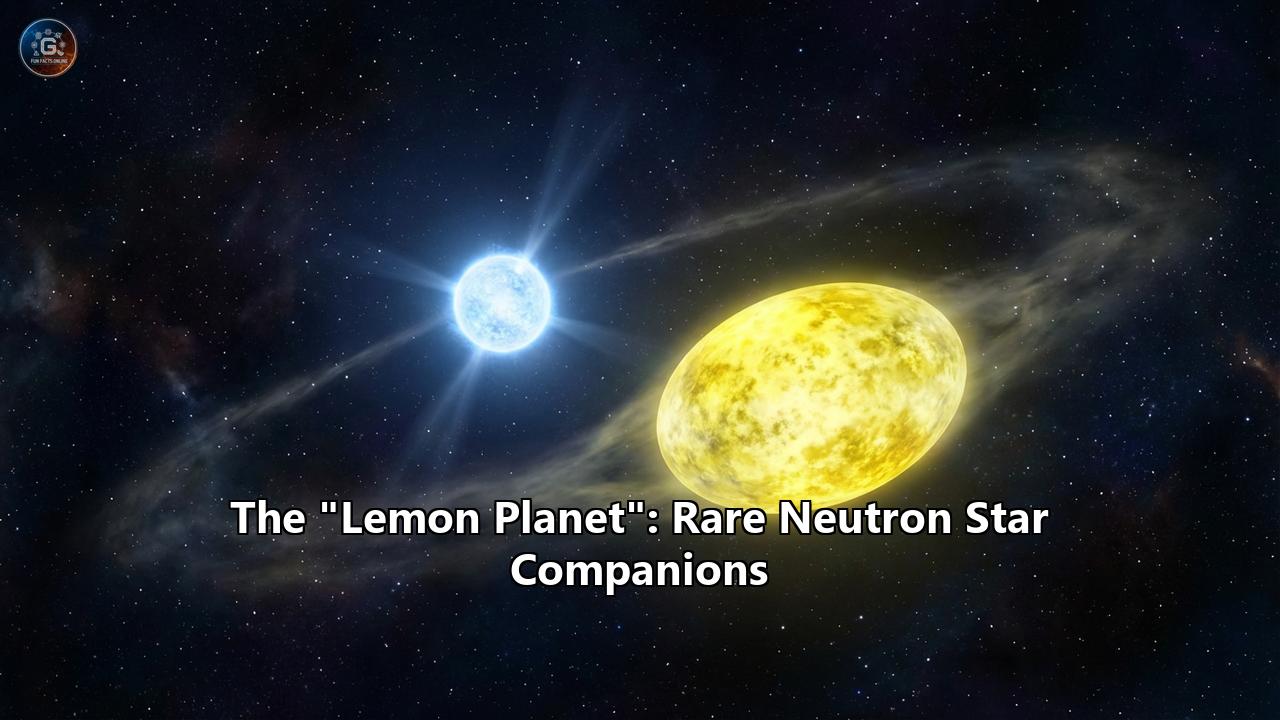
In the grand, terrifying, and often whimsical gallery of the cosmos, astronomers have recently hung a new portrait that defies both expectation and easy explanation. It is a world that should not exist, orbiting a star that is essentially a zombie, in a system that screams of violence and cataclysm. They call it the "Lemon Planet."
Technically, it is known as PSR J2322-2650b, a designation that sounds more like a barcode than a destination. But to the team of astrophysicists who unveiled its existence to the world in late December 2025, and to the public that has since been captivated by the artist’s impressions, it is the Lemon Planet—a Jupiter-mass world stretched by the rack of gravity into a distinct, prolate spheroid. It looks less like a marble and more like an American football or a bright yellow citrus fruit, tumbling through the void.
But the shape is merely the opening hook of a story that encompasses the most extreme physics in the universe. This is a tale of stellar cannibalism, of diamond rain, of timekeeping so precise it rivals atomic clocks, and of a planet that is actually the flayed corpse of a star. To understand the Lemon Planet, one must journey into the heart of a "Black Widow" system, where a millisecond pulsar spins at dizzying speeds, slowly devouring its companion in a gravitational dance of death.
Part I: The Discovery of the Impossible
The story of the Lemon Planet begins not with an image, but with a rhythm. The universe is filled with noise—radio waves, X-rays, gamma rays—but few signals are as distinct as those from a pulsar. Pulsars are neutron stars, the ultra-dense remnants of massive stars that have gone supernova. They are the lighthouses of the galaxy, beaming radiation from their magnetic poles. As they spin, these beams sweep across the cosmos. If Earth happens to lie in the path of the beam, we see a pulse. Tick. Tick. Tick.
For most pulsars, this ticking is steady but relatively slow, occurring perhaps once every second or so. But there exists a rare breed of "millisecond pulsars" (MSPs) that spin hundreds of times per second. These are nature's most precise clocks. PSR J2322-2650 is one such object, located roughly 2,000 light-years away in the constellation Sculptor. It spins so fast that its surface moves at a significant fraction of the speed of light.
In early 2025, astronomers using the Square Kilometre Array (SKA) and existing data from the Parkes Observatory noticed a tiny, periodic irregularity in the pulses from J2322. The pulses were arriving slightly early, then slightly late, in a repeating pattern every 7.8 hours. This is the telltale signature of the Doppler effect caused by an orbiting body. Something was tugging on the pulsar, causing it to wobble back and forth in space.
Calculations revealed the mass of the intruder: roughly that of Jupiter. At first glance, this seemed like a standard exoplanet discovery. We have found thousands of planets, some even orbiting pulsars. But when the James Webb Space Telescope (JWST) was turned toward the system to capture infrared data and analyze the "planet's" potential heat signature, the data that came back was baffling.
The light curve—the way the brightness of the object changed as it orbited—did not fit the model of a spherical planet reflecting starlight or emitting its own heat evenly. The brightness fluctuated wildly, suggesting the object changed its cross-sectional area as it moved. It wasn't a sphere. It was elongated.
Detailed modeling of the tidal forces confirmed the observation. PSR J2322-2650b is orbiting so close to its host—a mere million miles, or roughly four times the distance between Earth and the Moon—that the pulsar’s immense gravity is physically stretching the planet. It is filling its "Roche lobe," the tear-drop-shaped region of space where the planet's gravity can hold onto its own material. The planet is being pulled into a 3:2 ratio ellipsoid. It is, effectively, a cosmic lemon.
Part II: The Monster in the Middle
To appreciate the plight of the Lemon Planet, one must first confront the monster it orbits. PSR J2322-2650 is not a normal star. It is a city-sized sphere of neutrons, packing the mass of our Sun (and then some) into a ball only about 12 miles (20 kilometers) across.
The density of such an object is beyond human comprehension. A teaspoon of neutron star material would weigh roughly a billion tons—equivalent to the weight of every human being on Earth appearing in that teaspoon. If you were to drop a marshmallow onto the surface of a neutron star, it would impact with the force of a nuclear warhead, simply due to the acceleration of gravity, which is billions of times stronger than Earth’s.
But J2322 is not just a neutron star; it is a recycled pulsar. Born from a supernova millions of years ago, it likely started its life as a slower-spinning, lonely object. However, it was not truly alone. It had a companion star—a normal, main-sequence star like our Sun. Over eons, the binary pair spiraled closer together. As the companion star aged and expanded, its outer layers were siphoned off by the neutron star's intense gravity.
This infalling matter did two things. First, it formed an accretion disk, a swirling hula-hoop of superheated gas spiraling into the neutron star. Second, it transferred angular momentum. Just as a figure skater spins faster when pulling their arms in, the neutron star spun up as it consumed its partner’s mass. It became a millisecond pulsar, a dynamo spinning hundreds of times a second.
This process is known as "recycling," and it creates a specific class of binary systems. If the companion star is reduced to a very low mass (less than 0.1 solar masses), the system is called a "Black Widow," named after the spider that eats its mate. If the companion is heavier (around 0.2 to 0.4 solar masses), it is called a "Redback."
PSR J2322-2650b, the Lemon Planet, sits in a strange purgatory between these definitions. Its mass is roughly that of Jupiter (0.001 solar masses), which classifies it as a planet by weight. Yet, its history is almost certainly stellar. It is likely the crystalline core of the star that once fed the pulsar. It is a "zombie planet"—the withered, diamond-hard remains of a white dwarf or a helium star, now demoted to planetary status and locked in a frantic, 7.8-hour orbit around the corpse that killed it.
Part III: The Physics of the Lemon Shape
Why a lemon? Why not a pancake or a cigar?
The shape of any celestial body is determined by the battle between its internal gravity (which wants to pull everything into a sphere) and external forces (like rotation or tidal pull from a neighbor). Earth is an "oblate spheroid"—slightly wider at the equator—because its rotation pushes the equator outward.
For the Lemon Planet, the dominant force is the tidal pull of the pulsar. Because the planet is so close to the neutron star, the gravitational pull on the side facing the pulsar is significantly stronger than the pull on the far side. This "differential gravity" stretches the planet along the line connecting the two centers.
However, the planet is not just being stretched; it is also being compressed. The gravity of the pulsar squeezes the planet's "waist" (the axis perpendicular to the orbit). The result is a prolate spheroid—an object that is longer than it is wide.
This distortion is extreme. While the Earth's tidal bulge (caused by the Moon) raises the oceans by a few meters, the tidal bulge on the Lemon Planet distorts the entire solid and gaseous body by thousands of kilometers. The planet is literally pointed at the star.
This shape is stable only because the planet is "tidally locked." Just as the Moon always shows the same face to Earth, the Lemon Planet rotates exactly once for every orbit it completes. If it rotated faster or slower relative to its position, the tidal bulge would have to travel across the planet's surface, kneading the interior with friction so intense it would likely melt the entire world and tear it apart. The lock is a survival mechanism. The "point" of the lemon is permanently fixed toward the pulsar, frozen in a gravitational salute.
Scientists call this shape "Roche-filling." The Roche lobe is the theoretical boundary around a star within which an orbiting object is gravitationally bound. The Lemon Planet has expanded (or been stretched) to the very edge of this boundary. It is living on the precipice. If it were to expand slightly, or get slightly closer, its material would spill over the Roche lobe and stream onto the pulsar. It is a world on the brink of dissolution.
Part IV: An Atmosphere of Diamonds and Soot
The shape was the headline, but the chemistry is the mystery. When the JWST analyzed the infrared spectrum of the Lemon Planet’s atmosphere, astronomers expected to see the standard signature of a gas giant: hydrogen, maybe some methane, water vapor, or ammonia.
Instead, they found a spectral fingerprint that Peter Gao of the Carnegie Earth and Planets Laboratory described as "absolute madness." The atmosphere is almost entirely devoid of hydrogen. Instead, it is dominated by helium and strange, heavy molecules of carbon—specifically diatomic carbon (C2) and triatomic carbon (C3), forms usually found only in the hot atmospheres of carbon stars or in soot flames on Earth.
This composition is the smoking gun of the planet’s origin. Planets formed from the protoplanetary disk of a young star are made mostly of hydrogen (75%) and helium (24%), matching the primordial mix of the universe. To find a world made of helium and carbon means the hydrogen is missing.
Where did it go? The pulsar ate it.
In the "Black Widow" scenario, the pulsar strips the outer layers of the companion star first. Stars burn hydrogen in their outer shells, but their cores are where heavier elements like helium and carbon are synthesized. Over millions of years, the pulsar peeled away the hydrogen envelope of its companion, leaving behind the processed, helium-rich core.
The Lemon Planet is this exposed core. It is a "helium planet" with a crust and atmosphere enriched by the carbon "ash" of ancient nuclear fusion.
The conditions within this atmosphere are hellish. The side facing the pulsar is blasted by high-energy radiation (X-rays and Gamma rays) and a "pulsar wind" of relativistic particles. This superheats the upper atmosphere to thousands of degrees. However, unlike a normal star, the pulsar emits very little visible or infrared light; its energy is mostly in the high-frequency spectrum. This means the heating is non-uniform and penetrates deep into the gas.
The carbon in the atmosphere behaves in fascinating ways. In the upper, cooler layers on the "night side" (or the terminator line), the carbon vapor condenses. On Earth, carbon condenses into soot. On the Lemon Planet, the pressure is so high that as this soot falls deeper into the interior, it likely undergoes a phase transition.
Models suggest that at a certain depth, the soot clouds crystallize. It rains diamonds.
This is not the romanticized diamond rain of Neptune or Uranus, which occurs deep in the slushy mantles. On the Lemon Planet, carbon is a primary constituent, not a trace element. The "rain" could be heavy hail of diamond dust and larger crystals, falling through a helium sky, eventually settling into a liquid carbon-metal ocean surrounding a degenerate core.
Part V: A Visit to the Lemon World
What would it be like to stand on the surface of PSR J2322-2650b?
First, "surface" is a relative term. Like Jupiter, this is likely a fluid world with no hard ground until you reach the incredibly dense core. But let us imagine a platform floating in the upper atmosphere on the day side, the side permanently facing the pulsar.
The sky would not be blue. With an atmosphere full of carbon soot and helium, the scattering of light would create an eerie, yellowish-gray haze, darkening to black directly overhead. Dominating the sky would be the pulsar. It wouldn't look like a sun. It is too small—a tiny pinprick of light, no larger than a distant star to the naked eye. But it is brilliantly, blindingly energetic. The radiation it emits would be lethal instantly without shielding.
However, the most terrifying aspect of the pulsar would be its magnetic field lines. If you could see in the radio or gamma spectrum, the sky would be alive with auroras of unimaginable power, swirling and crashing as the pulsar's wind slams into the planet's magnetic field (if it retains one).
Gravity on this platform would be disorienting. Because of the lemon shape and the rapid rotation (once every 7.8 hours), the "down" direction would feel different depending on where you were. At the "poles" of the lemon (the tips pointing to and away from the star), the net gravity would be weaker because the centrifugal force of the orbit and the tidal pull of the star counteract the planet's mass. You would feel lighter here. At the "equator" (the waist of the lemon), you would feel crushing gravity.
The weather would be apocalyptic. The heat differential between the day side (blasted by the pulsar) and the night side would drive supersonic winds. These winds would carry the carbon soot clouds around the planet, creating banding patterns similar to Jupiter’s but monochrome—shades of charcoal, grey, and dirty yellow.
And then there is the sound. The pulsar spins hundreds of times a second. If the planet has a magnetic field that interacts with the pulsar's wind, the radio waves could be converted into plasma waves in the ionosphere, creating a constant, screaming hum—a 300+ Hertz drone that permeates the entire world. It is a planet that literally hums with the frequency of its master.
Part VI: The Black Widow’s Kiss
The discovery of the Lemon Planet has provided a crucial missing link in the study of binary evolution. For decades, astronomers have observed "Black Widow" pulsars with no companions, and others with companions that are mere whisps of gas. They hypothesized that the pulsars eventually completely consume or blast away their partners.
PSR J2322-2650b represents an intermediate stage. It is a companion that has been whittled down to planetary mass but has not yet been destroyed. It is "metastable."
The fact that it exists at all is a puzzle. Usually, when a companion star loses so much mass that it becomes a planet-sized object, it puffs up. As mass decreases, the gravity holding the object together weakens, and it expands (counter-intuitively, degenerate matter gets larger as it gets lighter, up to a point). If it expands too much, it gets ripped apart.
The Lemon Planet, however, seems to have found a "sweet spot" of density. It is likely composed of electron-degenerate matter—the same stuff that makes up white dwarves. This material is incompressible. Even as it loses mass, it remains dense enough to hold itself together against the tidal forces, at least for now.
But its days are numbered. The pulsar is constantly blasting the planet with a wind of particles that "ablates" (erodes) the atmosphere. The planet is leaving a tail of helium and carbon gas behind it, like a comet. This material is slowly spiraling onto the pulsar. In a few million years—a blink of an eye in cosmic time—the Lemon Planet may be reduced to nothing more than a ring of diamond dust, and eventually, it will be gone entirely, leaving the pulsar alone to spin in the dark.
Part VII: Implications for Exoplanetary Science
Why does the "Lemon Planet" matter to us?
First, it challenges our definition of a planet. The International Astronomical Union (IAU) defines a planet largely by its orbit around a star and its ability to clear its neighborhood. But the definition implicitly assumes a formation history: planets form from dust in a disk.
PSR J2322-2650b did not form like a planet. It formed like a star. It underwent fusion. It shone with its own light for billions of years. Now, it is a cold, dark rock orbiting another corpse. Is it a planet? Or is it a stellar remnant? It has the mass of Jupiter, the radius of Jupiter, and an atmosphere. Functionally, it is a planet. Historically, it is a star. It blurs the line, forcing astronomers to categorize objects by what they are now, rather than how they were born.
Second, it serves as a laboratory for extreme matter. We cannot create the pressures of a carbon-helium degenerate core in labs on Earth. By studying how the Lemon Planet deforms (its "Love number," a measure of rigidity), scientists can infer the internal structure of this exotic matter. It helps us understand how materials behave under pressures that would crush atoms into paste.
Third, it aids in the detection of Gravitational Waves. Millisecond pulsars are used in "Pulsar Timing Arrays" to detect the background hum of gravitational waves from colliding supermassive black holes. To use them effectively, we need to account for every wobble and tick. Understanding companions like the Lemon Planet—how they drag on the pulsar and distort the signal—is vital for calibrating these galactic-scale detectors.
Part VIII: The Gallery of Weirdness
The Lemon Planet is not the first pulsar planet discovered, but it is the most visually and chemically distinct. The first exoplanets ever confirmed were found in 1992 orbiting the pulsar PSR B1257+12. These worlds, named Draugr, Poltergeist, and Phobetor, are rocky, irradiated hellscapes. They likely formed from the debris of the supernova itself—a "second generation" of planets rising from the ashes.
In contrast, the Lemon Planet is a survivor of the original system. It witnessed the supernova of its partner. It survived the explosion that created the neutron star. It endured the phase where the neutron star blasted it with X-rays. It is a cosmic veteran.
There is also the "Diamond Planet" discovered years ago, 55 Cancri e (though it orbits a normal star) and PSR J1719-1438 b, another pulsar companion that is thought to be pure crystallized carbon. PSR J1719-1438 b is often cited as a close cousin to the Lemon Planet, but the new discovery of J2322-2650b offers much more detailed atmospheric data thanks to the JWST, allowing us to see the "soot" and the shape in unprecedented detail.
Part IX: Conclusion – A Universe of Infinite Variety
The Lemon Planet, PSR J2322-2650b, serves as a humbling reminder of the universe’s capacity for the bizarre. In our own solar system, we are used to the orderly progression of rock, gas, and ice. We see planets as stable, spherical oases.
But out in the dark, in the graveyards of the stars, nature is sculpting monstrosities. It takes the cores of dead stars, squeezes them into diamonds, drapes them in soot, stretches them into fruit shapes, and sets them spinning around city-sized nuclear magnets.
The Lemon Planet is a place where it rains diamonds, where the sky is yellow, where the "sun" is a strobing pinprick of doom, and where the ground itself is being pulled apart by the tides of gravity. It is a world that illustrates the violent, dynamic, and beautiful life cycle of the cosmos—where destruction breeds creation, and where even a dead star can have a second life as a lemon-shaped wonder of the galaxy.
As the James Webb Space Telescope continues its mission and the Square Kilometre Array comes fully online, we can expect to find more of these rare companions. Perhaps we will find a planet shaped like a pear, or a contact binary shaped like a peanut. But for now, the Lemon Planet stands alone as the strangest fruit in the cosmic garden.
Deep Dive: The Science of "Roche Lobe Filling"
To truly understand the "Lemon" shape, one must delve into the mechanics of the Roche Lobe. Named after the French astronomer Édouard Roche, this concept defines the region around a star in a binary system within which orbiting material is gravitationally bound to that star.
Imagine two gravity wells: the deep, steep well of the neutron star, and the shallower well of the planet. There is a point between them, the Lagrange point (L1), where the gravity of both cancels out. The Roche lobe is the volume of space around the planet that extends up to this L1 point.
For most planets, like Earth, the physical planet is much, much smaller than its Roche lobe. We are safe, spherical, and comfortably far from the boundaries of our gravitational influence.
For PSR J2322-2650b, the planet has physically expanded to fill this volume. The "nose" of the lemon is touching the L1 point. This is why the shape is a tear-drop or lemon: the equipotential surface (the zone of equal gravity) is pointed towards the host.
If the planet were to swell even slightly—perhaps due to heating from the pulsar—material at the nose would be pushed through the L1 doorway. Once it crosses that threshold, it falls down the steep gravity well of the neutron star. This is the mechanism of accretion.
The Lemon Planet is currently in a state of "Roche-lobe filling." This is common for stars in binary systems (contact binaries), but observing it in a planetary-mass object is exceptionally rare. It implies a delicate balance. If the mass transfer were too fast, the planet would have disintegrated already. If it were too slow, the planet wouldn't be distorted to this degree. We are catching this system in a fleeting, critical moment of its evolution.
The Role of Carbon in Planetary Atmospheres
The discovery of Diatomic Carbon (C2) and Triatomic Carbon (C3) in the atmosphere is significant. On Earth, carbon is locked up in rocks (carbonates), life (biomass), or gases like CO2 and Methane (CH4). We rarely see pure carbon chains in the atmosphere because oxygen destroys them (forming CO2) or hydrogen bonds with them (forming hydrocarbons).
The presence of C2 and C3 signals an environment that is:
- Hydrogen-poor: There isn't enough hydrogen to turn all the carbon into methane.
- Oxygen-poor: There isn't enough oxygen to turn it into CO2.
- Hot: These molecules typically form in high-energy environments.
This "sooty" atmosphere changes the opacity of the planet. Carbon soot is incredibly effective at absorbing light. This means the upper atmosphere absorbs the pulsar’s radiation very efficiently, creating a "stratosphere" that is hotter than the layers below it (a temperature inversion). This trapped heat drives the violent winds that circulate the energy to the night side, preventing the atmosphere from freezing out completely on the dark side.
Future Research: The Search for the "Diamond Core"
How do we know there are diamonds? We can't drill into the planet. However, the density provides a clue.
By measuring the Doppler wobble of the pulsar, we get the planet's mass. By analyzing the transit (the dip in light as the planet passes in front of the pulsar, or the modulation of the relativistic wind), we get the radius and shape.
Mass divided by Volume equals Density. The Lemon Planet is incredibly dense for its size—much denser than Jupiter. A planet made of pure hydrogen/helium would be fluffier. A planet made of rock would be smaller. The density fits the profile of a "carbon-oxygen white dwarf" material that has expanded slightly due to the removal of overlying weight.
High-pressure physics tells us that carbon, under these pressures (megabars), forms a crystalline lattice. It is not just a theory; it is a necessity of the phase diagram of carbon. The core of this world is almost certainly a diamond the size of Earth, buried under an ocean of liquid metal and a sky of soot.
The "Lemon Planet" is a jewel in the rough, a testament to the transformative power of gravity, and a beacon guiding us toward a deeper understanding of the stellar graveyard.
Reference:
- https://www.cbsnews.com/chicago/news/scientists-uchicago-discover-bizarre-lemon-shaped-planet-orbiting-neutron-star/
- https://www.sciencealert.com/ludicrous-lemon-shaped-world-is-like-nothing-weve-ever-seen
- https://centralnews.co.za/scientists-discover-unusually-stretched-planet-orbiting-fast-spinning-star-cosmic-oddity-astronomers-find-planet-stretched-into-extreme-shape/
- https://www.good.is/new-lemon-planet-discovered
- https://www.youtube.com/watch?v=wEOWgNKySLY
- https://cosmoscience.in/nasas-nicer-telescope-discovers-lemon-shaped-neutron-star/
- https://www.astronomy.com/science/jwst-discovers-a-strange-exoplanet-that-orbits-a-pulsar/
- https://timesofindia.indiatimes.com/life-style/spotlight/nasas-james-webb-telescope-reveals-a-truly-extraordinary-exoplanet/articleshow/126251642.cms
- https://www.forbes.com/sites/jamiecartereurope/2025/12/19/bizarre-lemon-shaped-exoplanet-found-by-webb-telescope/
- https://www.youtube.com/watch?v=JHQUAwD8qeo