
The Baltic Sea is a graveyard of ships, a repository of chemical weapons, and a quiet archive of wars fought in living memory. But far beneath the cold, brackish waves, below the layers of modern silt and the rusting hulks of the 20th century, lies a secret that predates the pyramids, the written word, and the very existence of the sea itself. It is a line of stones, silent and unassuming, stretching for nearly a kilometer across the twilight of the seafloor. It should not be there.
For thousands of years, the "Blinkerwall" waited in the darkness of the Bay of Mecklenburg, hidden by twenty-one meters of water, untouched by the currents of history that reshaped the continent above. Its discovery was not the result of a fevered treasure hunt or a decades-long archaeological quest. It was found by accident, a ghostly echo on a sonar screen that caught the eye of a scientist teaching a class. This structure, a Stone Age megastructure of unparalleled significance, has since shattered our understanding of the prehistoric people who once roamed the frozen tundra of Northern Europe. It is a time machine made of granite, pulling us back 11,000 years to a moment when the Baltic was a dry, green valley and the survival of humanity hung on the migration of the reindeer.
Part I: The Ghost on the Screen
The story of the Blinkerwall begins in the autumn of 2021, on a routine training cruise aboard the research vessel Alkor. Jacob Geersen, a marine geophysicist from the Leibniz Institute for Baltic Sea Research Warnemünde (IOW), was not looking for lost civilizations. He was teaching a group of students the technical, often tedious art of seafloor mapping using multibeam sonar. The Bay of Mecklenburg, located roughly 10 kilometers off the coast of Rerik, Germany, is a well-trafficked stretch of water, presumed to be geologically unremarkable.
As the Alkor trawled back and forth, painting the seabed with sound waves, the monitor displayed the usual chaotic tapestry of the ocean floor: ripples of sand, scattered erratic boulders left by retreating glaciers, and the flat monotony of mud. But then, something anomalous appeared in the data. It was a ridge, which in itself was not unusual, but running along this ridge was a feature that defied the chaotic randomness of geology.
It was a line. A distinct, continuous linear structure stretching for nearly a kilometer.
"Nature rarely builds in straight lines," is a maxim often cited in geology. While glacial moraines and eskers can create linear features, they tend to be messy, organic, and massive. This was different. It was precise. It was composed of distinct points—large boulders connected by stretches of smaller stones. To the untrained eye, it might have been a trick of the resolution or a data artifact. But to Geersen and his colleagues, it sparked an immediate, electrifying curiosity.
The team returned to port with a mystery. Over the next year, they launched a dedicated investigation, deploying everything modern marine science could offer: autonomous underwater vehicles (AUVs) equipped with high-resolution cameras, multibeam echo sounders, and eventually, human divers.
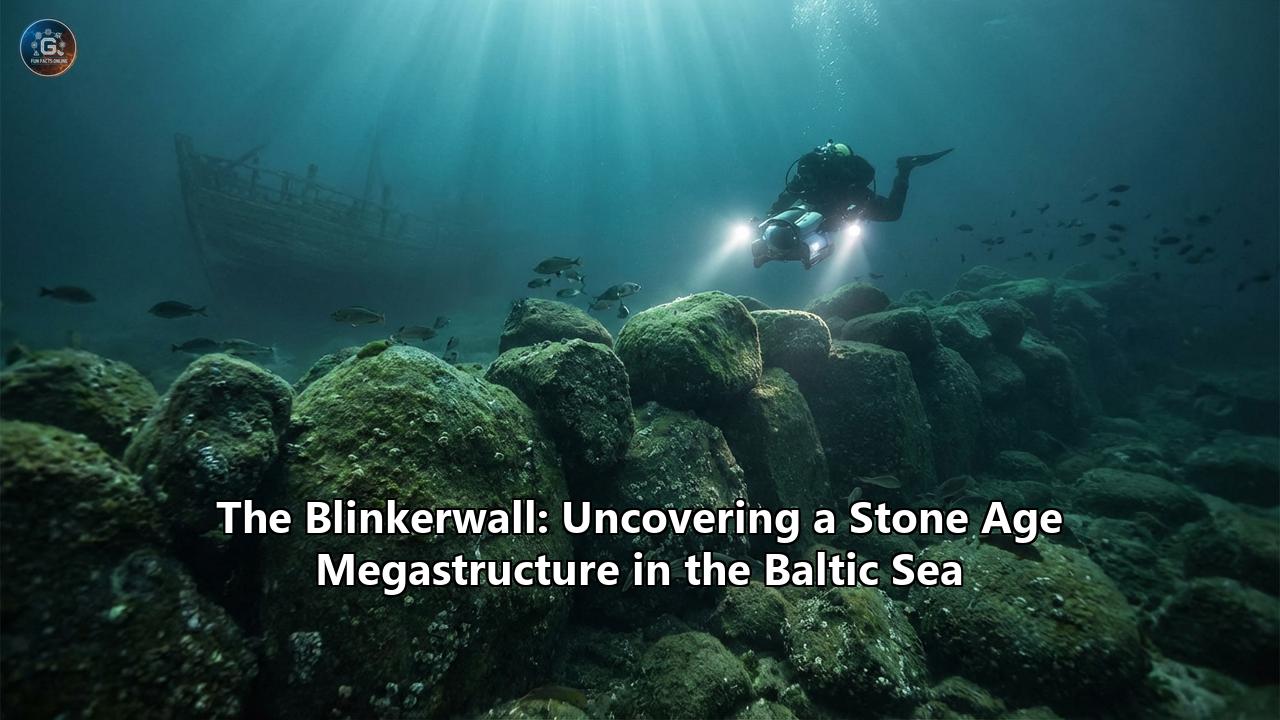
What the cameras revealed in the gloom of the Baltic was breathtaking. The "ridge" was not just a pile of rocks. It was a wall.
The structure, now christened the "Blinkerwall" after a nearby submerged shoal known as Blinker Hill, is a masterpiece of prehistoric engineering. It runs for 971 meters (nearly two-thirds of a mile). It is composed of 1,673 individual stones. The layout is methodical, almost rhythmic: roughly 300 large boulders, some weighing tons, act as anchor points. Between these heavy monoliths, the builders had meticulously piled over 1,400 smaller stones to form a continuous barrier.
The wall is not high—most of it stands less than a meter tall—but it is undeniably artificial. The smaller connecting stones are not scattered randomly; they are piled to connect the larger boulders, creating a barrier that would have been visually and physically distinct on the landscape. The total weight of the stones moved to create this structure is estimated at over 142 tons.
This was not a natural formation. It was not a remnant of a WWII anti-submarine net, nor was it debris from a cable-laying operation (interpretations that were quickly ruled out). It was a hunting architecture, built by human hands at a time when the seabed was dry land.
Part II: The Drowned World
To understand the Blinkerwall, one must strip away the sea. We must travel back in time, past the modern era, past the Roman Empire, past the Bronze Age, to the transition between the Paleolithic (Old Stone Age) and the Mesolithic (Middle Stone Age).
11,000 years ago, the geography of Europe was radically different. The massive Weichselian Ice Sheet, which had smothered Scandinavia and the Baltic basin for millennia, was retreating. As the ice melted, the weight was lifted from the crust, and the global sea levels were still significantly lower than they are today—up to 60 or 70 meters lower.
The Bay of Mecklenburg did not exist. Instead, it was a sweeping, low-lying landscape, likely a tundra or steppe-tundra environment, dotted with birch and pine forests that were slowly reclaiming the land from the ice. It was a cold, harsh, but vibrant world. Rivers meandered through the valleys, and large freshwater lakes filled the depressions left by the glaciers.
The Blinkerwall was built on the flank of a till ridge, running parallel to the shoreline of one of these ancient lakes. The location was chosen with strategic brilliance. To the south lay the lake; to the north, the rising slope of the ridge. The wall created a corridor—an artificial bottleneck.
This was the world of the "Reindeer People."
The builders of the Blinkerwall were likely members of the Ahrensburg culture or a similar late-glacial hunter-gatherer society. These were not the primitive, knuckle-dragging cavemen of popular cartoon imagination. They were anatomically modern humans, identical to us in intelligence and capacity. They were skilled survivors, expert navigators of a changing world, and master craftsmen of flint and bone.
But their world was dying, or rather, it was changing faster than perhaps any human generation had experienced before. The climate was warming. The great ice sheets were bleeding meltwater into the oceans. The sea was coming.
However, for the generations that built and used the Blinkerwall, the threat was not the ocean, but the hunger of winter. Their survival depended entirely on the harvest of the great migratory herds, specifically the Eurasian reindeer (Rangifer tarandus).
Part III: The Engineering of Death
Why build a kilometer-long wall of stone in the middle of nowhere?
The answer lies in the psychology of the reindeer. Reindeer are creatures of habit and instinct. When they migrate, they follow lines in the landscape—rivers, ridges, and forest edges. They are also herd animals that react predictably to obstacles. When faced with a linear barrier, like a low wall or a line of brush, reindeer will not typically jump over it if they can walk alongside it. They will flow like water along the path of least resistance.
The Blinkerwall was a "drive lane." It was a tool for managing the movement of living creatures on a massive scale.
Imagine the scene: It is autumn. The reindeer herds are moving across the landscape, fattening up for the coming winter. They number in the hundreds, perhaps thousands. The hunters know the migration routes; they have watched them for generations.
The wall is positioned to intercept the herd. As the animals approach, the wall gently guides them. It doesn't block them abruptly; it subtly alters their trajectory. The 300 large boulders, which were likely already present on the landscape (glacial erratics), served as the foundation. The hunters gathered smaller stones from the surrounding area to fill the gaps, creating a continuous visual line.
The wall runs parallel to the ancient lake shore. As the reindeer move along the wall, the corridor between the stones and the water narrows. The animals are funneled into a "kill zone."
This was likely a communal effort. It would have required dozens, perhaps hundreds of people to coordinate the hunt. Some would be "beaters," driving the animals toward the wall. Others would be waiting in the kill zone, perhaps hiding behind the wall itself or in blinds, armed with bows and spears tipped with flint.
The height of the wall—under a meter—might seem insufficient to stop a reindeer, but it didn't need to be a fortress. It only needed to be a psychological barrier. Once the herd was moving fast, panicked by the drivers, they would veer away from the anomaly of the stone line, pressing closer and closer to the hunters or the water.
Some archaeologists theorize the wall might have been used to drive the reindeer into the lake. Reindeer are strong swimmers, but they are slow and vulnerable in the water. Hunters in skin boats could have paddled out to easily dispatch the swimming animals with spears.
This method of hunting—using drive lanes—is known from other parts of the world. In the Middle East, the famous "desert kites" are massive stone funnels used to trap gazelles. In North America, indigenous peoples built "inuksuit" and stone lines to drive caribou (the same species as reindeer) into lakes or ambushes beneath the surface of the Great Lakes (like the discoveries at the Alpena-Amberley Ridge).
But the Blinkerwall is unique in Europe. It is the oldest megastructure of its kind ever found on the continent. It proves that the Stone Age hunters of the Baltic were not just opportunistic wanderers. They were landscape architects. They had the social organization to plan, build, and maintain a massive public work project that required moving 140 tons of rock. They had a concept of territory, of future planning, and of engineering the environment to suit their needs.
Part IV: The Great Flood
The Blinkerwall likely functioned for centuries, perhaps longer. It was a fixed point in a changing world, a place where scattered bands of hunters would congregate for the annual harvest. It was a place of feasting, of trade, of ritual.
But the end was inevitable. The climate warming that made the region habitable also doomed it. The glaciers continued to melt. The global sea level rose.
Around 8,500 years ago, a geological event known as the Littorina Transgression occurred. The connection between the North Sea and the Baltic basin opened up. Salt water poured into the freshwater lakes. The valleys flooded. The forests drowned. The "Atlantis" of the Stone Age—a vast area archaeologists call "Doggerland" further west, and the coastal plains of the Baltic—vanished beneath the waves.
The Blinkerwall was submerged.
Ironically, this catastrophe was the key to its preservation. Had the wall remained on dry land, it would have been destroyed long ago. The stones would have been harvested by later farmers to build houses or clear fields. The landscape would have been plowed, paved, and reshaped by ten thousand years of civilization.
But the sea is a preservative. The rising waters covered the wall in a protective blanket of low-oxygen sediment and peat. The currents in the Bay of Mecklenburg at this depth are relatively weak, sparing the structure from the erosion that tears apart shallow coastal wrecks. For 8,500 years, the wall sat in the cold, dark silence, perfectly preserved, while above it, humanity moved from stone tools to bronze, to iron, to silicon.
Part V: The Science of the Deep
The discovery of the Blinkerwall highlights a revolution in archaeology. For centuries, archaeology was a dirt-based discipline. You dug holes in the ground. But the most exciting frontier in archaeology today is underwater.
Submerged landscape archaeology is difficult, dangerous, and expensive. It requires ships, sonar, remotely operated vehicles (ROVs), and highly trained technical divers. But it is essential. Because humans have always loved the coast. During the Ice Age, the "coasts" were hundreds of miles further out than they are today. The vast majority of human prehistory—the settlements, the camps, the migration routes—is currently underwater.
Geersen’s team used a combination of multibeam echosounder data (which uses sound to create a 3D topographic map of the seafloor) and visual inspection. The acoustic data gave them the "big picture"—the line of the wall against the chaotic background. The divers and AUVs provided the "ground truthing."
When the divers descended to the site, they found the stones covered in marine growth, but the arrangement was unmistakable. They documented the size and position of the boulders. They looked for the tell-tale signs of glacial transport and found none. Glaciers drop stones randomly; they don't sort them by size and arrange them in a line connecting a ridge to a lake.
One of the most critical pieces of evidence came not from the stones themselves, but from the mud nearby. The team took sediment cores from the area south of the wall—the site of the ancient lake. By analyzing the pollen and diatoms (microscopic algae) in the mud, they could reconstruct the ancient environment. They confirmed that a freshwater lake existed there roughly 9,100 to 10,000 years ago.
Radiocarbon dating of a piece of wood found in the peat near the wall provided a "terminus ante quem"—a date before which the wall must have been built. The wood dated to around 9,000 years ago. Since the wall was built on dry land, it had to be older than the flooding event that deposited the marine sediment. This places the construction squarely in the late Paleolithic or very early Mesolithic.
Part VI: Rewriting the History Books
The Blinkerwall challenges the "primitive" narrative of Stone Age Europe.
Until recently, the prevailing view of hunter-gatherers in this region was that they were highly mobile, living in small, flexible bands with few permanent possessions and certainly no monumental architecture. Building a kilometer-long wall implies something different.
It implies territoriality. If you build a wall, you intend to stay, or at least to return. You are claiming that specific piece of land.
It implies large-scale cooperation. A single family could not build the Blinkerwall in a season. It required the coordinated effort of many groups. This suggests that the dispersed bands of the Baltic united for these massive construction projects, likely timed with the seasonal aggregations for the reindeer hunt.
It implies demographic density. There may have been more people in Stone Age Europe than we previously thought. To maintain and operate such a drive lane suggests a population robust enough to support specialized labor.
The Blinkerwall also connects prehistoric Europe to a global tradition of hunting architecture. It shows that humans, regardless of where they were—be it the deserts of Jordan, the plains of North America, or the tundra of Germany—developed similar sophisticated solutions to the problem of survival. They understood animal behavior, and they used the landscape itself as a weapon.
Part VII: The Unanswered Questions
The discovery of the Blinkerwall is just the beginning. The structure itself is a massive clue, but it is also a signpost pointing to other treasures.
If hundreds of people gathered here to hunt, they must have camped nearby. Somewhere in the sediment around the wall, buried under meters of mud, are the remains of their lives. There will be flint knapping sites where they sharpened their spears. There will be hearths where they cooked the reindeer meat. There might be butchery sites, filled with the processed bones of the animals.
The research team, led by the University of Kiel and the IOW, is currently planning the next phase of exploration. They will use sub-bottom profilers (sonar that penetrates the mud) to look for anomalies that might be buried campsites. They will send divers to excavate test pits, sifting the sand for microscopic flakes of flint or charcoal.
They are also looking for the "Second Wall." Drive lanes often work best as funnels. While the lake shore acted as one side of the funnel, it is possible there is a second, undiscovered stone wall buried deeper in the sediment, creating a V-shape leading to the kill zone.
The clock is ticking, in a way. While the wall is stable, the very act of discovering it brings attention. And the Baltic Sea is a busy place. Offshore wind farms, pipelines, and cables are constantly being developed. The discovery of the Blinkerwall has already led to calls for the area to be designated a protected archaeological zone, safeguarding it from modern industrial development.
Conclusion: A Message in Stone
We often look to the stars for signs of intelligent life, or to the grand ruins of Rome and Athens for our heritage. But the Blinkerwall reminds us that the history of human ingenuity goes back much further, into the deep time of the Ice Age.
11,000 years ago, a group of people stood on a cold, windy ridge in Northern Europe. They looked at the landscape and saw not just what was, but what could be. They moved rocks, one by one, sweating and straining, to build a machine made of stone that would ensure the survival of their children.
They could not have known that the sea would rise and swallow their world. They could not have known that ten millennia later, their descendants—people who fly in the air and speak to machines—would find their handiwork using sound waves.
The Blinkerwall is more than just a pile of rocks. It is a testament to the resilience and brilliance of the human spirit. It is a handshake across ten thousand years, a reminder that even in the deepest, darkest waters, the past is never truly gone. It is just waiting for the right light to blink back.
Reference:
- https://www.sciencealert.com/mysterious-ancient-megastructure-discovered-lurking-beneath-the-baltic-sea
- https://www.smithsonianmag.com/smart-news/stone-age-wall-discovered-beneath-the-baltic-sea-helped-early-hunters-trap-reindeer-180983783/
- https://www.dagens.com/news/ancient-stone-wall-discovered-in-the-baltic-sea-could-rewrite-prehistoric-history
- https://www.reddit.com/r/StrangeEarth/comments/1aq8blb/10000_year_old_megastructure_found_beneath_the/
- https://www.anthropology.net/p/the-blinkerwall-a-stone-age-megastructure
- https://dailygalaxy.com/2024/12/discovery-ancient-wall-in-the-baltic-sea/
- https://www.pnas.org/doi/10.1073/pnas.2312008121
- https://www.sci.news/archaeology/stone-age-hunting-megastructure-baltic-sea-12687.html
- https://archaeology.org/news/2024/02/13/240214-baltic-sea-blinkerwall/
- https://www.popsci.com/science/europe-oldest-megastructure-bottom-of-the-sea/
- https://archaeology.org/issues/january-february-2025/collection/reindeer-hunters-wall/top-10-discoveries-of-2024/
- https://www.theguardian.com/science/2024/feb/12/stone-age-wall-found-at-bottom-of-baltic-sea-may-be-europes-oldest-megastructure
- https://medium.com/@katrinapaulson/archeologists-discover-stone-wall-made-and-used-by-palaeolithic-hunters-bc829f9b7941