
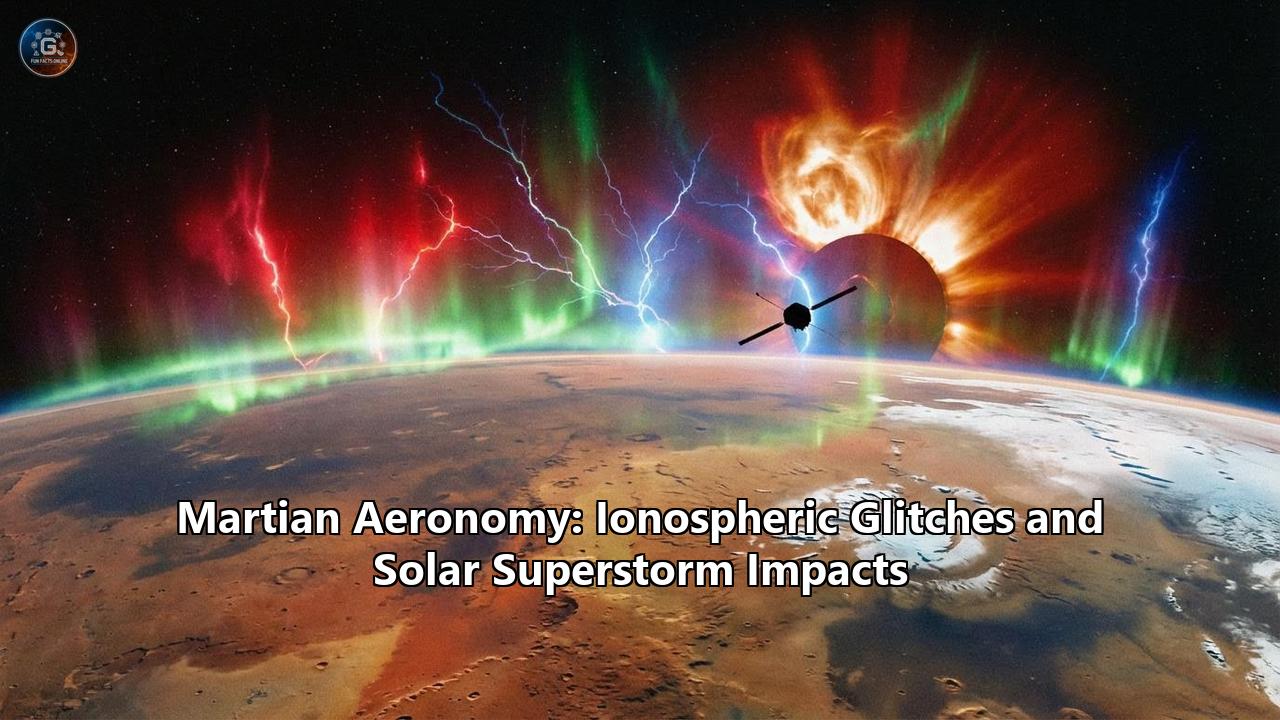
When we envision the Red Planet, the mind conjures a static, frozen desert—a world locked in geological stasis, characterized by silent canyons, rolling dunes of rust, and skies tinted the color of bruised peach. But this quiet tableau is a profound illusion. Above the dusty surface, in the tenuous, invisible realm of the upper atmosphere, Mars is a dynamic, violent, and electrically charged battlefield. Here, a relentless war is waged between the fragile remnants of a planetary atmosphere and the unbridled fury of our local star.
Welcome to the cutting edge of Martian aeronomy—the study of the upper atmospheric regions, including the ionosphere, thermosphere, and exosphere, where the chemistry and physics of a planet are dictated not by weather from below, but by space weather from above.
In recent years, humanity’s robotic emissaries have fundamentally rewritten our understanding of Martian space weather. Aided by the peak of the Sun’s 11-year activity cycle, known as solar maximum, our spacecraft have recorded unprecedented phenomena. Among these are staggering ionospheric glitches, widespread radar blackouts, and the spectacular impacts of solar superstorms. The recent data—culminating in breathtaking observations from May 2024 and deeply analyzed in subsequent landmark studies published in 2026—paints a vivid picture of a planet that, lacking the magnetic armor of Earth, is entirely at the mercy of the Sun.
To understand the sheer magnitude of these celestial collisions, we must first understand the anatomy of the weapons the Sun wields, the fragile nature of the Martian sky, and the profound implications these interactions hold for the future of human exploration.
The Anatomy of a Solar Siege
The Sun is not a gentle provider of light; it is a roiling, magnetic nuclear furnace. During solar maximum, the complex, twisting magnetic fields on the solar surface frequently snap and realign in a process known as magnetic reconnection. When this happens, the Sun unleashes a triad of destructive forces into the solar system: solar flares, Solar Energetic Particles (SEPs), and Coronal Mass Ejections (CMEs).
When a major event occurs, it initiates a staggered assault on any planet in its crosshairs.
- The Flash (Solar Flares): Traveling at the speed of light, an intense burst of X-rays and extreme ultraviolet (EUV) radiation is the first to arrive. It hits the planet in mere minutes. This high-energy light violently strips electrons from neutral atoms and molecules in the upper atmosphere, causing rapid ionization.
- The Shrapnel (Solar Energetic Particles): Trailing slightly behind the light are protons and electrons accelerated to a significant fraction of the speed of light. These SEPs arrive within tens of minutes to a few hours, penetrating deep into the atmosphere and even reaching the surface, functioning as a hazardous shower of ionizing radiation.
- The Battering Ram (Coronal Mass Ejection): Finally, days later, the CME arrives. This is a billion-ton cloud of magnetized plasma. When it slams into a planet’s atmospheric boundary, it drives massive electrical currents, triggers auroral displays, and physically strips away the upper atmosphere, casting it out into the void of deep space.
On Earth, we are largely protected from the brunt of this assault by a robust, globally generated magnetic field—the magnetosphere. Our magnetic bubble deflects the CME plasma and funnels the charged particles toward the poles, resulting in localized, harmless, and beautiful auroras. The ionosphere may suffer temporary disruptions, causing high-frequency radio blackouts, but life on the surface remains entirely oblivious.
Mars, however, is a very different world. Billions of years ago, its internal dynamo cooled and died, shutting down its global magnetic field. Today, Mars only possesses weak, localized "crustal" magnetic fields—paleomagnetic remnants frozen into the rocks of its southern hemisphere. Without a global shield, a solar superstorm strikes the Martian atmosphere broadside. The consequences of this direct impact are nothing short of cataclysmic for the planet's atmospheric chemistry and any robotic or future human inhabitants caught in the crossfire.
The May 2024 Superstorm: A Benchmark in Martian Aeronomy
In May 2024, the Sun unleashed a sequence of eruptions so powerful they made headlines across the globe. While Earth was treated to its most spectacular auroral displays in more than two decades—with the northern lights visible as far south as Mexico—the same hyperactive sunspot regions also took aim at Mars.
The event was a "triple act" of solar devastation. It began with a massive X-class solar flare—specifically recorded as an X12 flare by some observational instruments and associated with an X2.9 flare from a hyperactive region. Moving at the speed of light, the soft X-ray photons slammed into the dayside of Mars. Because X-rays carry immense energy, they began wholesale stripping of electrons from carbon dioxide molecules in the upper atmosphere.
Trailing closely behind the light was a punishing wave of Solar Energetic Particles (SEPs). This proton storm peppered the upper atmosphere, pushing ionization deeper than the X-rays alone could manage. Finally, the interplanetary Coronal Mass Ejection (CME) that had erupted days earlier crossed the millions of miles of empty space and smashed into the Red Planet, enveloping it in a turbulent, magnetized plasma cloud.
Because Mars hosts an international armada of scientific spacecraft, humanity had a front-row seat to this cosmic bombardment. The data retrieved from these orbiters and rovers provided scientists with a "science bonanza," revealing the mechanics of Martian aeronomy with unprecedented clarity.
A Flood of Electrons: Orbiter-to-Orbiter Revelations
The most profound revelations regarding the upper atmosphere's response came from a study published in Nature Communications in March 2026, led by Jacob Parrott, a research fellow at the European Space Agency (ESA). The study detailed how the May 2024 superstorm triggered the most dramatic electron flood ever recorded in the Martian ionosphere.
The Martian ionosphere is primarily composed of two distinct layers: the M1 layer, situated at an altitude of roughly 110 kilometers, and the M2 layer, floating higher up at about 130 kilometers. To measure the unseen electrical chaos unfolding in these layers, ESA scientists utilized a highly sophisticated, pioneering technique known as orbiter-to-orbiter radio occultation.
Instead of relying solely on signals beamed from a spacecraft back to Earth, ESA's Mars Express orbiter beamed a radio signal directly to the ExoMars Trace Gas Orbiter (TGO). As Mars Express slipped behind the curvature of the planet relative to TGO, the radio signal had to pass through the Martian atmosphere. The atmosphere acted like a lens, bending—or refracting—the radio waves. The degree of this refraction allowed scientists to calculate the exact density of electrons the signal was passing through.
The results were staggering. Parrott and his team found that the M1 layer had ballooned to an astonishing 278% of its typical electron density. The higher M2 layer also swelled, experiencing a 45% increase. The sheer influx of energy from the storm was so intense that it actually physically lifted both atmospheric layers upward by approximately 6.5 kilometers.
"The impact was remarkable: Mars's upper atmosphere was flooded by electrons," Parrott noted, confirming it was the largest response to a solar storm ever observed at the Red Planet.
Interestingly, NASA’s MAVEN (Mars Atmosphere and Volatile EvolutioN) spacecraft, which was also observing the event, initially measured only about a threefold increase directly around its instruments. This discrepancy led scientists to a fascinating discovery regarding the physics of ionospheric glitches: secondary ionizations.
When a solar flare is powerful enough, it "hardens" the X-ray spectrum, shifting the light toward intensely high energies. When these highly energetic photons strike an atom, the electron that gets knocked loose (a photoelectron) flies away with immense kinetic energy. This lone photoelectron is moving so fast that it becomes a microscopic projectile, violently colliding with other neutral atmospheric molecules on its way down. These collisions trigger a cascade of additional ionisations—a domino effect that amplifies the original solar flare's impact. This cascading phenomenon explains the localized ballooning of the M1 layer, fundamentally altering our models of how solar energy is deposited into the atmospheres of terrestrial planets.
Glitches in the Machine: Radar Blackouts and Spacecraft Anomalies
When the ionosphere becomes supercharged with electrons, it fundamentally changes how electromagnetic waves behave. On Earth, the sudden influx of X-rays from a solar flare severely thickens the D-layer of the ionosphere. High-frequency (HF) radio waves, which normally bounce off the upper ionosphere to allow for over-the-horizon communication, instead become trapped and absorbed in this dense, electrically chaotic D-layer. The result is a sudden radio blackout. Entire continents can lose radio contact for the duration of the flare.
A nearly identical process occurs on Mars during a solar superstorm. The hyper-dense, electron-flooded upper atmosphere becomes an impenetrable wall to certain frequencies of electromagnetic radiation. For scientists, this presents a massive hurdle. Orbiters around Mars use ground-penetrating radar to search for subsurface liquid water and map the geological strata hidden beneath the dust. Instruments like MARSIS on Mars Express and SHARAD on the Mars Reconnaissance Orbiter rely on firing low-frequency radar pulses at the planet.
However, during the May 2024 superstorm, the 278% increase in electron density in the M1 layer effectively created a radar blackout. The thickened ionosphere absorbed and scattered the radar signals, temporarily blinding the orbiters to the Martian subsurface. If human explorers were on the surface attempting to communicate with an orbiter or an over-the-horizon outpost using HF radio bands, they would have found their radios entirely dead, greeted only by the static of an angry star.
The technological disruption extended beyond just radio waves. Spacecraft computers operate in a delicate balance, relying on microprocessors that process data in binary states—ones and zeros represented by tiny electrical charges. When the high-energy Solar Energetic Particles (SEPs) arrived, they slammed into the silicon brains of the Martian orbiters. These particles have enough energy to flip a bit from a zero to a one, causing what engineers call a Single Event Upset (SEU).
During the peak of the storm, both the Mars Express and ExoMars TGO suffered computer errors and glitches. Similarly, NASA's 2001 Mars Odyssey orbiter experienced a temporary blackout of its orientation star camera—an instrument essential for the spacecraft to know which way it is pointing. Fortunately, modern spacecraft are designed with radiation-hardened components and built-in fault-detection systems that quickly correct these errors. But the glitches serve as a stark reminder: the environment around Mars during a superstorm is profoundly hostile to digital life.
Auroras that Wrap a World
While the orbiters wrestled with computer glitches and a flooded ionosphere, NASA’s MAVEN spacecraft turned its Imaging Ultraviolet Spectrograph (IUVS) toward the planet to witness one of the most mesmerizing consequences of the storm: global auroras.
Because Mars lacks a global magnetic dipole, there are no magnetic poles to funnel the incoming solar plasma. When the CME and solar particles struck the planet, they plunged directly into the atmosphere across the entire globe. As the charged particles collided with the gases in the Martian atmosphere, they excited the atoms, causing them to emit light as they returned to a lower energy state.
On Earth, auroras primarily glow green and red due to the excitation of oxygen and nitrogen in our thick atmosphere. On Mars, the atmospheric composition is heavily dominated by carbon dioxide, with traces of nitrogen and argon. Furthermore, MAVEN observes the planet in the ultraviolet spectrum, which is invisible to the naked human eye. If we had ultraviolet vision, we would have seen the entire nightside of Mars bathed in an eerie, pulsing purple glow. MAVEN tracked this global auroral event for an entire week in May 2024, noting that the brighter the purple glow in their data processing, the more intense the auroral activity.
Christina Lee, the Space Weather Lead for the MAVEN mission at the University of California, Berkeley’s Space Sciences Laboratory, highlighted the sheer scale of the bombardment. "This was the largest solar energetic particle event that MAVEN has ever seen," she stated. "There have been several solar events in past weeks, so we were seeing wave after wave of particles hitting Mars".
These auroras are not just pretty light shows; they are visual representations of atmospheric loss. Every time a CME strikes and induces global auroras, energy is injected into the upper atmosphere, heating it. As the gases heat up, they expand outward, escaping the planet's weak gravitational pull. This process, known as ion sputtering and photochemical escape, is the very mechanism that has, over billions of years, slowly bled Mars dry of its ancient, thick atmosphere, transforming it from a potentially habitable world of lakes and rivers into the desiccated wasteland we see today. The study of Martian aeronomy is, in essence, an autopsy of the planet’s climate.
Boots on the Ground: Curiosity's Front-Row Seat
While MAVEN and the European orbiters watched from the heavens, NASA's Curiosity rover experienced the storm from the bottom of Gale Crater, providing a crucial "ground truth" to the orbital data.
Curiosity, a nuclear-powered mobile laboratory about the size of an SUV, has been exploring Mars since 2012. It routinely uses its navigation cameras (Navcams) to monitor the crater floor for dust devils and wind activity. On May 20, 2024, it happened to be recording a video of a wind gust sweeping up Martian dust just as the solar storm’s charged particles reached the surface.
When the video was beamed back to Earth, scientists noticed something incredible. The footage was not just grainy due to standard processing; it was violently speckled with visual artifacts—streaks and bright, snow-like dots flashing rapidly across the frames. These artifacts were not dust. They were the physical impacts of high-energy protons from the solar storm smashing directly into the camera's image sensor. It was a visual manifestation of a radiation shower hitting the surface of another planet.
Simultaneously, Curiosity’s Radiation Assessment Detector (RAD) began screaming. The RAD instrument acts as a synthetic astronaut, measuring the types and amounts of radiation that punch through the thin Martian atmosphere to reach the surface. During the May 20 event, RAD recorded a colossal surge in radiation—the highest dose the instrument had ever measured in its 12 years of continuous operation on Mars.
The numbers were sobering. The radiation monitor on the ExoMars TGO in orbit picked up a dose equivalent to 200 "normal" days of background radiation condensed into just 64 hours. Down on the surface, beneath the meager shielding of the thin atmosphere, Curiosity's RAD measured a radiation dose of 8,100 micrograys.
To put that into perspective: if an astronaut had been standing next to Curiosity during that storm, working outside their shielded habitat in a standard Extravehicular Activity (EVA) suit, they would have been dosed with the radiation equivalent of receiving 30 chest X-rays all at once.
While 8,100 micrograys is not a localized lethal dose—an acute lethal dose of radiation sickness generally begins at around 1 to 2 million micrograys (1 to 2 grays)—it is a massive spike for a single event. Radiation exposure is cumulative. If an astronaut on a multi-year mission to Mars were repeatedly subjected to these types of unshielded solar superstorms, the DNA damage would rapidly compound, significantly elevating their lifetime risk of severe cancers, acute radiation sickness, and degenerative diseases.
Preparing for the Future: Humanity's Next Steps
The May 2024 superstorm, and the intense analysis it spawned in the years following, has fundamentally shifted how space agencies view crewed missions to the Red Planet. The "science bonanza" provided by MAVEN, Curiosity, Mars Express, and TGO has offered an unprecedented opportunity to understand how deep-space weather unfolds and the precise radiation limits human explorers will face.
This data is already being synthesized by groups like the Moon to Mars Space Weather Analysis Office at NASA's Goddard Space Flight Center. Their goal is to develop predictive space weather models specifically tailored for Mars. Because Mars is tens of millions of miles away, and on a different orbital track, a CME that misses Earth entirely could be a direct hit for Mars. Therefore, humanity cannot rely solely on Earth-centric space weather forecasts. We must build a dedicated, interplanetary meteorological network.
When humans finally set foot on the Martian regolith, survival will depend on this network. Habitat design will require heavily shielded "safe rooms"—likely buried under several meters of Martian regolith or utilizing water-lined walls—where astronauts can retreat when an X-class flare is detected. Because solar light (the flare) arrives slightly before the most dangerous particles (the SEPs and the CME), astronauts might have a golden window of perhaps ten to thirty minutes to abandon their surface EVAs, drop their tools, and secure themselves in radiation bunkers before the invisible storm of protons begins peppering their suits.
Furthermore, surface operations will need to account for the ionospheric glitches. Astronauts operating autonomous drones, navigating far from the base using ground-based radar systems, or relying on HF radio to speak with a base camp over the horizon will have to prepare for spontaneous communication blackouts. The realization that the Martian ionosphere can swell by nearly 300% and actively block radar and radio frequencies means that mission planners must design redundant, hardwired, or line-of-sight communication relays that do not rely on bouncing signals off the upper atmosphere.
The Living Machine of Martian Aeronomy
The story of the May 2024 solar superstorm is a testament to the fact that Mars is not a dead world. It may lack the lush forests, swirling oceans, and magnetic shields of Earth, but it possesses a dynamic, living atmosphere that reacts violently and beautifully to the whims of the cosmos.
Through the lens of Martian aeronomy, we see a planetary system in constant flux. We see X-ray photons creating cascades of secondary electrons. We see the sky glowing in ultraviolet purples as the ghost of the planet's water is slowly carried away on the solar wind. We see spacecraft computers glitching under the strain of cosmic radiation, and we see the dust of Gale Crater being whipped up in the very same moment that a radioactive rain of solar particles hits a rover's camera lens.
As we escalate toward an era where human boots will leave imprints in that very same dust, our understanding of these ionospheric glitches and superstorm impacts moves from the realm of pure academic curiosity to a matter of life and death. The Sun is a relentless adversary, and the thin Martian sky is a poor shield. Yet, armed with the knowledge gathered by an armada of robotic pioneers, humanity is slowly learning to read the weather of the deep solar system, ensuring that when we do finally step out onto the rust-colored plains, we will be ready to weather the storm.
Reference:
- https://en.wikipedia.org/wiki/Ionosphere
- https://www.swpc.noaa.gov/phenomena/solar-flares-radio-blackouts
- https://scienceblog.com/esa/2026/03/05/solar-superstorm-triggered-the-biggest-electron-flood-ever-recorded-at-mars/
- https://www.thebrighterside.news/post/esa-orbiter-reveals-strange-behavior-within-mars-upper-atmosphere-during-a-solar-superstorm/
- https://earthsky.org/space/what-happened-when-a-solar-superstorm-hit-mars/
- https://www.notebookcheck.net/Scientists-witness-the-most-intense-solar-superstorm-ever-recorded-on-Mars.1245174.0.html
- https://www.forbes.com/sites/amandakooser/2024/06/11/this-is-what-an-epic-solar-storm-looked-like-on-mars/
- https://www.nasa.gov/missions/nasas-maven-observes-martian-light-show-caused-by-major-solar-storm/
- https://www.sciencealert.com/a-solar-flare-just-knocked-out-radio-across-the-us-and-more-are-on-the-way
- https://www.skyatnightmagazine.com/news/mars-solar-storm-20-may-2024
- https://www.newsweek.com/solar-storm-radio-blackouts-space-weather-1869939
- https://www.youtube.com/watch?v=Jpd8xJMf3mk
- https://www.universetoday.com/articles/a-recent-solar-storm-even-had-an-impact-on-mars
- https://science.nasa.gov/photojournal/curiosity-sees-specks-caused-by-2024-solar-storm-while-recording-a-wind-gust-on-mars/
- https://www.youtube.com/watch?v=VZRNQxrMUe0