
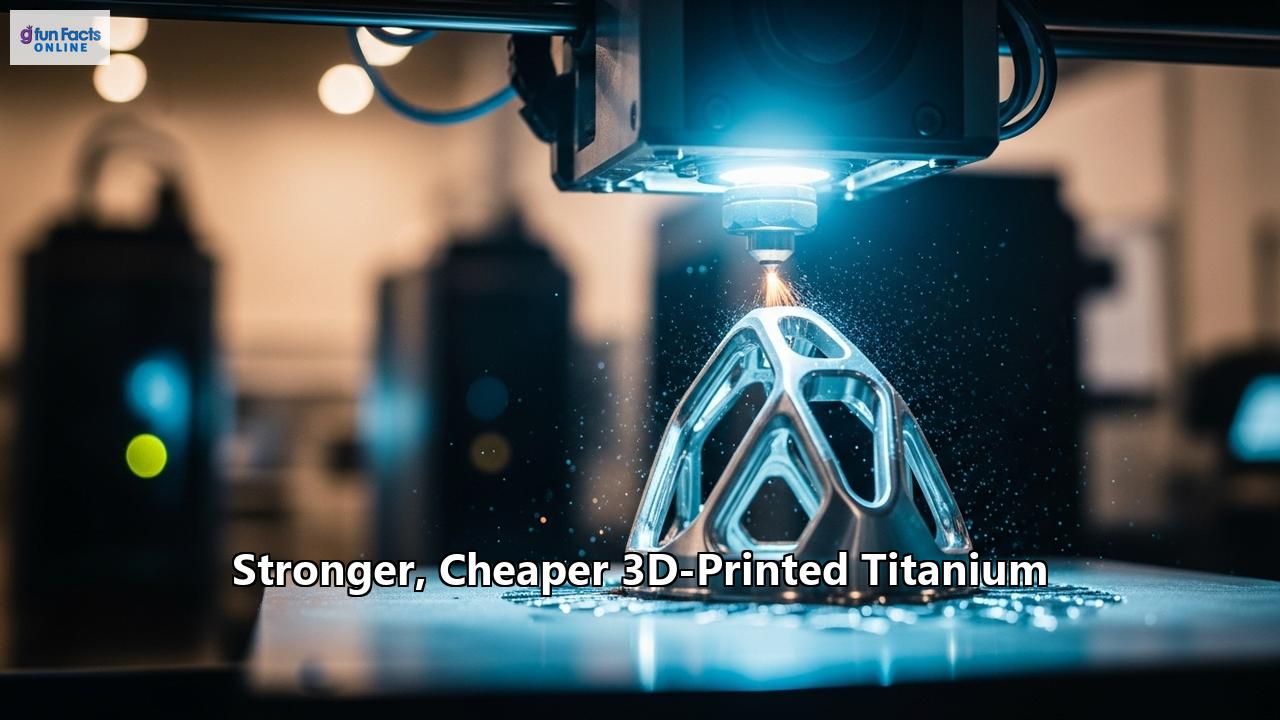
A New Era for Titanium: How 3D Printing is Forging Stronger, Cheaper Components
Titanium, the titan of the metals world, has long been the material of choice for applications where strength, low weight, and corrosion resistance are paramount. From the high-performance demands of aerospace and defense to the life-changing requirements of medical implants, its properties are unparalleled. Yet, this high performance has always come at a high price, not just in raw material cost but also in the complex and wasteful processes required to shape it. Traditional manufacturing, such as forging and machining, can result in up to 90% of the initial expensive material being cut away and discarded. This "buy-to-fly" ratio, which can be as high as 25:1 for some aerospace parts, has confined titanium's use to the most critical, cost-is-no-object applications.
Now, a revolution is underway, driven by the transformative power of additive manufacturing (AM), more commonly known as 3D printing. This technology is not just changing how titanium parts are made; it's fundamentally altering the composition of the metal itself, unlocking possibilities for alloys that are not only significantly cheaper but also stronger and more reliable than their traditionally manufactured counterparts. A recent breakthrough from researchers at RMIT University in Australia has sent shockwaves through the industry: a new 3D-printable titanium alloy that is just as strong, if not stronger, than the conventional material but costs around 30% less to produce. This development is more than an incremental improvement; it signals a paradigm shift, promising to democratize high-performance titanium and expand its reach into new industries and applications, heralding a new age of lightweight, high-strength, and economically viable manufacturing.
This article delves into the multifaceted world of stronger, cheaper 3D-printed titanium. We will explore the foundational challenges that have limited titanium's use, dissect the cutting-edge 3D printing technologies that are rewriting the rules of manufacturing, and unpack the metallurgical science that makes these new alloys possible. Through detailed case studies in aerospace, medicine, and automotive sectors, we will see the real-world impact of this revolution, and finally, we will look to the horizon, exploring the future of a technology that is building the world, one layer at a time.
The Tyranny of Tradition: Why Titanium is Ripe for Disruption
For decades, the undisputed workhorse of the high-performance titanium world has been Titanium-6 Aluminum-4 Vanadium (Ti-6Al-4V), also known as Grade 5 titanium. This alpha-beta alloy is a marvel of material science, offering a superb balance of strength, low density, and corrosion resistance. However, its strengths in traditional applications become significant hurdles when translated to the world of additive manufacturing.
The Cost Conundrum
The primary barrier to the widespread use of titanium is its staggering cost. This expense is a multi-stage problem:
- Raw Material: Producing the fine, spherical, high-purity titanium powder required for most 3D printing processes is a sophisticated and energy-intensive endeavor. The price for this powder typically ranges from $300 to $600 per kilogram, making it one of the most expensive feedstocks in additive manufacturing.
- Machinery: The 3D printers capable of handling this demanding material are themselves million-dollar investments. Machines for processes like Direct Metal Laser Sintering (DMLS) or Electron Beam Melting (EBM) can cost anywhere from $500,000 to over $1 million. These are not desktop printers; they are complex industrial instruments requiring controlled environments, high power, and specialized personnel.
- The Process: Printing with titanium is slow and expensive. Service providers often charge between $35 to $50 per cubic centimeter of printed material. To put that in perspective, a solid 10cm cube could cost between $35,000 and $50,000 to print. The process requires a tightly controlled inert gas environment (typically argon) to prevent the highly reactive titanium from becoming contaminated with oxygen at high temperatures, which would lead to embrittlement and part failure. This adds further operational cost and complexity.
- Wasteful by Nature: Traditional subtractive manufacturing, where a part is carved from a solid block (or billet) of titanium, is incredibly wasteful. The buy-to-fly ratio—the weight of the raw material purchased compared to the weight of the final part—can be as high as 25:1. While 3D printing drastically improves this ratio to between 3:1 and 12:1, the high cost of the initial powder means every gram counts.
The Metallurgical Challenge: Anisotropic Nightmares
Beyond cost, the very physics of melting and solidifying Ti-6Al-4V layer by layer poses a fundamental problem. The rapid heating and cooling cycles inherent in additive manufacturing processes create extreme thermal gradients. This environment causes the metal's crystals, or grains, to grow in an undesirable way.
In titanium, the arrangement of these grains dictates the part's mechanical properties. The ideal structure consists of fine, uniform, "equiaxed" grains, which look like tightly packed, multi-sided crystals. This structure provides isotropic properties, meaning the part is equally strong in all directions.
However, when 3D printing Ti-6Al-4V, the alloy has a strong tendency to form long, "columnar" grains that grow upwards, parallel to the build direction. This columnar growth results in anisotropy, a critical flaw where the part's mechanical properties are directionally dependent. A part might be incredibly strong along the length of these grains but significantly weaker and more prone to cracking across them. This unpredictable performance is unacceptable for critical applications like a jet engine component or a spinal implant. This fundamental issue has been a major barrier to the qualification and widespread adoption of 3D-printed titanium parts.
Researchers have been forced to rely on extensive and costly post-processing techniques, such as Hot Isostatic Pressing (HIP), to try and break down these columnar structures and homogenize the material's properties. The reliance on legacy alloys like Ti-6Al-4V, which were designed for forging and not for 3D printing, has been a case of fitting a square peg in a round hole. As one researcher from RMIT University aptly put it, "It's like we've created an airplane and are still just driving it around the streets." The full potential of additive manufacturing was being held back by a material that wasn't designed for it.
The Additive Revolution: A Layer-by-Layer Look at Titanium 3D Printing
Additive manufacturing technologies are at the heart of the revolution in titanium component production. Unlike subtractive methods that cut material away, AM builds parts layer by layer directly from a 3D model. This approach not only minimizes waste but also unlocks unprecedented design freedom, allowing for the creation of complex, lightweight structures that are impossible to make with traditional methods. For titanium, three primary powder-based technologies dominate the industrial landscape: Laser Powder Bed Fusion, Electron Beam Melting, and Directed Energy Deposition.
Laser Powder Bed Fusion (L-PBF)
Laser Powder Bed Fusion is the most widely adopted method for 3D printing high-resolution titanium parts. It is known by several trademarked names, including Direct Metal Laser Sintering (DMLS) and Selective Laser Melting (SLM), but the underlying process is the same.
How it Works:- Preparation: The process begins inside a build chamber, which is sealed and filled with a high-purity inert gas like argon to prevent oxygen contamination of the reactive titanium powder. A thin, uniform layer of fine titanium alloy powder, typically just 20 to 60 microns thick, is spread across a build platform.
- Melting: A high-power laser, often a ytterbium fiber laser with hundreds of watts of power, is directed by a series of mirrors (galvanometers). Following the cross-sectional data from a CAD file, the laser selectively scans the powder bed, melting and fusing the particles together to form the first solid layer of the object.
- Layering: Once a layer is complete, the build platform lowers by the thickness of a single layer. A recoater arm or blade then sweeps across the surface, depositing a fresh layer of powder.
- Repetition: The melting and layering process is repeated thousands of times, with each new layer fusing to the one below it, until the final 3D part is fully formed within the surrounding powder bed.
- Post-Processing: After the build is complete and has cooled, the part is excavated from the powder bed. The unused powder can be collected, sieved, and recycled for future builds. The part is then typically removed from the build plate, has its support structures detached, and undergoes heat treatment or other finishing steps.
- Pros: L-PBF offers the highest resolution and best surface finish of the main titanium AM processes, making it ideal for intricate and complex parts.
- Cons: The process generates significant internal stresses due to rapid heating and cooling, often requiring extensive support structures and post-process heat treatment.
Electron Beam Melting (EBM)
Developed and commercialized primarily by Arcam (now part of Colibrium Additive), Electron Beam Melting is another powder bed fusion technique that offers distinct advantages, particularly for reactive materials like titanium.
How it Works:- Vacuum Environment: Unlike L-PBF's inert gas, EBM operates in a high-vacuum environment. This virtually eliminates the risk of contamination and makes it exceptionally well-suited for processing titanium alloys.
- Preheating: Before melting, the electron beam performs a high-speed, low-power pass over the powder bed, preheating it to an elevated temperature (often several hundred degrees Celsius). This critical step sinters the powder particles together lightly, which helps to mitigate electrostatic charging and dramatically reduces thermal gradients, minimizing internal stresses in the final part.
- Melting: A powerful electron beam, guided by electromagnetic coils rather than physical mirrors, selectively melts the powder according to the part's geometry. The absence of moving mechanical parts allows the beam to move at very high speeds, enabling it to maintain multiple melt pools simultaneously and build parts faster than L-PBF systems.
- Layering and Repetition: Similar to L-PBF, the build platform lowers after each layer is completed, a recoater applies fresh powder, and the process repeats until the part is finished.
- Post-Processing: The finished parts are left to cool in the powder cake. Because of the preheating step, EBM parts have very low residual stress and often require less extensive post-processing heat treatment compared to L-PBF parts.
- Pros: High build speed, low residual stress, and excellent material properties due to the vacuum environment. Ideal for orthopedic implants and aerospace components.
- Cons: Generally produces parts with a rougher surface finish and lower resolution than L-PBF. The process is also limited to conductive materials.
Directed Energy Deposition (DED)
Directed Energy Deposition operates on a fundamentally different principle from powder bed methods. Instead of building a part within a bed of powder, DED actively deposits and melts material at the same time, making it ideal for repairing existing parts or adding features to them, as well as for creating large structures. This process is also known by various names such as Laser Engineered Net Shaping (LENS) or Direct Metal Deposition (DMD).
How it Works:- Feedstock Delivery: A multi-axis nozzle, often mounted on a robotic arm, delivers either metal powder or wire feedstock directly into the path of a focused energy source.
- Melting and Deposition: A powerful laser or electron beam creates a small molten pool on the surface of the substrate or the previously deposited layer. The feedstock is injected directly into this melt pool, where it melts and fuses to the surface.
- Building the Part: The nozzle moves along a programmed path, building the part up track by track and layer by layer. This process is not confined to a build box, allowing for the creation of very large parts or the repair of existing components.
- Controlled Environment: Like L-PBF, DED processes involving reactive metals like titanium are conducted in a hermetically sealed chamber filled with inert gas to prevent oxidation.
- Pros: High deposition rates allow for very fast builds of large parts. Ability to repair high-value components and create functionally graded materials by changing the feedstock mid-process.
- Cons: Produces parts with lower resolution and a rougher surface finish compared to powder bed methods, often requiring significant post-process machining.
These three technologies form the vanguard of the titanium AM revolution. By enabling engineers to move beyond the constraints of traditional manufacturing, they have paved the way for the next great leap forward: the design of new alloys created specifically to harness the unique physics of the 3D printing process.
The Alchemist's Dream: Redesigning Titanium at the Atomic Level
The true revolution in 3D-printed titanium lies not just in the printers, but in the material itself. For years, engineers were constrained by legacy alloys like Ti-6Al-4V, which were never optimized for the unique thermal conditions of additive manufacturing. Now, armed with a deeper understanding of metallurgy and computational tools, scientists are designing new alloys from the ground up, atom by atom, to be stronger, more ductile, and significantly cheaper.
The Breakthrough: Solving the Grain Structure Problem
The core of this innovation is the ability to control the microscopic grain structure of the metal as it solidifies. The nemesis of 3D-printed titanium has always been the formation of large, columnar grains that lead to weak, anisotropic parts. The holy grail is a fine, uniform, equiaxed grain structure, which gives the material consistent and superior mechanical properties.
Recent research, most notably from a team at RMIT University, has cracked this code by leveraging a metallurgical principle known as constitutional supercooling.
- Understanding the Phases of Titanium: Pure titanium is allotropic, meaning it exists in two different crystal structures depending on the temperature. At room temperature, it has a hexagonal close-packed (hcp) structure called the alpha (α) phase. Above the beta transus temperature (around 882°C for pure titanium, but higher for alloys like Ti-6Al-4V), it transforms into a body-centered cubic (bcc) structure called the beta (β) phase. Alloying elements are added to stabilize one phase or the other. Aluminum is an alpha stabilizer, while vanadium is a beta stabilizer.
- The Problem with Rapid Cooling: In AM processes, the metal is rapidly melted into the beta phase and then cools extremely quickly. This rapid quench doesn't give the beta phase enough time to transform into a stable alpha structure in an orderly way. Instead, it forces a diffusionless transformation into a brittle, needle-like structure known as acicular α' martensite. It is the arrangement of this martensite within large, columnar prior-beta grains that causes the poor ductility and anisotropy of as-built Ti-6Al-4V parts.
- The Solution with Constitutional Supercooling: The RMIT team developed a new framework for alloy design that promotes constitutional supercooling at the solidification front (the boundary between the liquid and solid metal). By carefully selecting specific alloying elements, they can create a condition where the liquid ahead of the solidifying interface is cooler than its own freezing point. This unstable condition triggers the nucleation of new, independent equiaxed grains ahead of the advancing solidification front, effectively disrupting the formation of long, columnar grains.
Cheaper, More Abundant Elements
Crucially, the RMIT team discovered that expensive and increasingly scarce beta-stabilizing elements like vanadium could be replaced with much cheaper and more common elements, such as copper and iron. These elements are highly effective at promoting the constitutional supercooling needed to achieve a fine, equiaxed grain structure.
This two-pronged innovation—a new design methodology combined with the use of low-cost alloying elements—has resulted in a new class of titanium alloys with remarkable properties:
- Cost Reduction: By eliminating the need for expensive vanadium, the new alloy is reported to be 29% to 33% cheaper to produce than traditional Ti-6Al-4V.
- Superior Strength and Ductility: Without the large, weak columnar grains, the new alloy exhibits superior mechanical properties. It is not only stronger but also more ductile, meaning it can deform more without fracturing—a critical property for safety and reliability.
- In-Situ Alloying: Some AM processes, particularly DED, allow for the creation of these new alloys in-situ. Different metal powders can be fed and mixed in the melt pool during the printing process, opening the door for creating functionally graded materials where the alloy composition changes within a single part.
The Role of AI and Machine Learning
Finding the perfect combination of alloy composition and AM process parameters (like laser power, scan speed, and layer thickness) has traditionally involved extensive, time-consuming, and expensive trial-and-error. Artificial intelligence and machine learning are rapidly accelerating this process.
Researchers are now using AI-driven models to simulate and predict how a material will behave under thousands of different processing conditions. These models can identify previously unexplored processing windows that lead to optimal part density, microstructure, and mechanical properties, all while increasing production speed. This data-driven approach dramatically reduces the development cycle for new alloys and processes, allowing for the rapid qualification of materials that are perfectly tuned for additive manufacturing.
Real-World Impact: Case Studies in Transformation
The advent of stronger, cheaper 3D-printed titanium is not a futuristic concept; it is actively transforming key industries today. The ability to create lightweight, topologically optimized, and cost-effective components is enabling breakthroughs in performance, efficiency, and patient care.
Aerospace: Lighter, Faster, and More Efficient Flight
The aerospace industry, where every gram of weight saved translates into fuel efficiency and increased payload capacity, is the primary beneficiary of this technology.
Case Study: The GE Aviation LEAP Engine NozzlePerhaps the most famous example of 3D printing's impact on aerospace is the fuel nozzle tip for the LEAP jet engine, developed by CFM International (a joint venture between GE Aviation and Safran Aircraft Engines).
- The Challenge: The original nozzle was a complex assembly of approximately 18-20 individual parts, which had to be painstakingly machined and welded together. This process was time-consuming, labor-intensive, and generated significant material waste.
- The AM Solution: Using Direct Metal Laser Sintering (DMLS), GE engineers were able to consolidate the entire nozzle assembly into a single, monolithic component. This redesigned part, printed from a high-performance cobalt-chromium alloy (though the principles are directly applicable to new titanium alloys), featured intricate internal cooling channels and support structures that were impossible to create with traditional manufacturing.
- The Results: The 3D-printed nozzle is 25% lighter and estimated to be five times more durable than its predecessor. The consolidation of parts eliminated numerous failure points, drastically simplifying the supply chain and assembly process. The LEAP engine, with its 3D-printed nozzles, is now a commercial success, powering aircraft like the Airbus A320neo and Boeing 737 MAX and delivering a 15% improvement in fuel efficiency. This success story has become the blueprint for how AM can revolutionize the production of critical aerospace components.
Additive manufacturing is also being used to produce structural components for aircraft like the Boeing 787 and Airbus A350, including brackets, wing components, and other high-strength parts where the improved buy-to-fly ratio offers significant cost savings. Norsk Titanium, using its high-speed Rapid Plasma Deposition® (RPD®) process, is an FAA-approved producer of structural titanium components for major OEMs.
Medical: Personalized Implants and Enhanced Healing
In the medical field, the unique capabilities of 3D-printed titanium are leading to a new generation of patient-specific implants that improve surgical outcomes and quality of life. Titanium's excellent biocompatibility means it is not harmful or toxic to living tissue, making it the gold standard for orthopedic and dental implants.
Case Study: Porous Titanium Implants for Osseointegration- The Challenge: A major issue with traditional solid metal implants is "stress shielding." Natural bone is not a solid mass; it is a porous structure that flexes and remodels itself in response to load. A solid, overly stiff implant carries too much of the load, "shielding" the surrounding bone from the stress it needs to remain healthy. This can lead to bone density loss and eventual implant loosening.
- The AM Solution: 3D printing allows for the precise fabrication of implants with complex, porous lattice structures that mimic the architecture of natural trabecular bone. Engineers can control the pore size, shape, and overall porosity of the implant to match the patient's own bone density. Pore sizes in the range of 500-800 micrometers with 70-90% porosity have been shown to be optimal for bone regeneration.
- The Results: These porous structures serve two critical functions. First, they dramatically lower the stiffness of the implant, reducing stress shielding and allowing the surrounding bone to experience more natural mechanical loading. Second, the interconnected pores create a scaffold for osseointegration, where the patient's own bone cells can grow into and through the implant, creating a strong, stable biological fixation. Companies like Amnovis have received FDA clearance for their 3D printing processes to create custom titanium spinal and orthopedic implants, simplifying the regulatory pathway for medical device manufacturers. This level of customization and biological integration is simply unattainable with traditional manufacturing.
Automotive & Motorsports: The Competitive Edge
While high costs have largely kept titanium out of mass-market automobiles, the high-stakes world of motorsports has become a key proving ground for 3D-printed titanium parts.
Case Study: Lightweighting in Formula 1 and Performance Racing- The Challenge: In racing, performance is a direct function of weight and strength. Every component is scrutinized for potential weight savings without compromising safety or durability.
- The AM Solution: Racing teams like Alfa Romeo F1 Team ORLEN and the Delta Racing team from Germany use 3D printing to produce a wide range of titanium components, including suspension uprights, rocker arms, and gearbox inserts. Using topology optimization software, engineers define the loads a part must withstand, and the software generates the most efficient, lightweight design to meet those requirements. These organic, skeletal-looking parts often can only be manufactured via AM.
- The Results: The Delta Racing team used 3D-printed titanium alloy to create suspension components that were over 60% lighter than their machined predecessors, reducing the part's weight from 240 grams to just 91 grams. For IndyCar, the mandatory "top frame" safety component, which protects the driver's head, is 3D printed in titanium, a choice made to meet a rapid development timeline and achieve the necessary strength and lightweighting for the 2024 racing season. For these teams, the cost of titanium is offset by the immense competitive advantage gained from reduced vehicle mass, leading to faster acceleration and better handling.
Overcoming the Hurdles: The Path to Widespread Adoption
Despite the immense promise and proven successes, the journey of stronger, cheaper 3D-printed titanium from a niche technology to a mainstream manufacturing method is not without its challenges. Overcoming these hurdles in cost, standardization, and regulation is the final frontier for its widespread adoption.
The Economic Gauntlet: Driving Down Costs
While new alloys that eliminate expensive elements like vanadium are a giant leap forward, the total cost of additive manufacturing remains a significant barrier. The high price of specialized powder, the multi-million-dollar cost of industrial printers, and the expenses associated with energy, inert gases, and labor all contribute to the premium price of printed parts.
However, several trends are working to drive these costs down:
- Powder Production Innovation: Companies are actively developing more efficient methods for producing high-quality metal powders, with some forecasts predicting cost reductions of up to 17% in the near future. The ability of new alloys to use recycled industrial waste and lower-grade materials as feedstock will also have a major impact.
- Increased Machine Productivity: Newer L-PBF and EBM machines are being equipped with multiple lasers or electron beams, allowing them to build parts much faster and increase throughput.
- Process Optimization: As AI and in-situ monitoring become more common, printing processes will become more reliable, reducing the rate of failed builds and the need for costly post-processing.
The Post-Processing Imperative: From Print to Part
A 3D-printed part is rarely ready for use right out of the machine. A series of critical post-processing steps are required to ensure the component meets the stringent requirements of its application.
- Stress Relief and Heat Treatment: As-built parts, particularly from L-PBF, contain significant internal stresses that must be relieved through carefully controlled heat treatment cycles in a furnace. This process also serves to refine the microstructure, for instance by decomposing the brittle martensite phase into a more stable and ductile alpha+beta structure.
- Hot Isostatic Pressing (HIP): For critical, fatigue-sensitive applications, HIP is a vital step. The process subjects parts to high temperatures (just below the melting point) and high-pressure inert gas (up to 30,000 PSI) in a sealed vessel. This combination of heat and pressure effectively collapses and fuses any internal micro-porosity that may have formed during printing, densifying the part to nearly 100% of its theoretical density and dramatically improving its fatigue life and mechanical properties.
- Support Removal and Surface Finishing: Removing the support structures required during the build process can be labor-intensive. Furthermore, the as-built surface of a printed part is often rough and must be machined, ground, or polished to meet the final dimensional tolerances and surface finish requirements.
The Regulatory Maze: Certification and Qualification
For safety-critical industries like aerospace and medicine, you can't simply print a part and install it. A rigorous and often lengthy certification and qualification process is required to prove that the part is safe, reliable, and performs as expected.
- Establishing Standards: The development of industry-wide standards is paramount. Organizations like ASTM International have been crucial in this effort. For example, the ASTM F3001 standard provides a detailed specification for additively manufactured Ti-6Al-4V ELI (Extra Low Interstitial) using powder bed fusion, covering feedstock requirements, manufacturing plans, chemical and mechanical properties, and quality control. These standards provide a common framework for producers, purchasers, and regulatory bodies.
- FAA and FDA Approval: In the United States, the Federal Aviation Administration (FAA) and the Food and Drug Administration (FDA) are the ultimate arbiters for aerospace and medical components, respectively. Securing clearance from these agencies is a complex undertaking. The FDA, for instance, does not approve materials in isolation but rather the entire process used to create a finished medical device for a specific intended use. Manufacturers must provide extensive data validating their entire workflow, including process controls, material reuse protocols, manufacturing residuals (like leftover powder), and extensive testing to prove the device is safe and effective. Companies are helping to streamline this by submitting FDA Master Files that pre-validate their printing processes, making it easier for medical device OEMs to gain clearance for their products. This meticulous validation is essential for building trust and ensuring patient safety.
The Horizon: A Future Forged in Titanium
The confluence of material science, advanced manufacturing, and artificial intelligence is pushing 3D-printed titanium toward a tipping point. The journey from an expensive, niche technology to a cornerstone of modern manufacturing is accelerating, with a future that promises even greater innovation and accessibility.
Developing Alloys for AM: The RMIT breakthrough is just the beginning. Researchers worldwide are designing a new generation of "designer" titanium alloys created specifically for additive manufacturing. These new formulations, which include novel eutectoid and beta-Ti alloys, are being engineered not only for lower cost and superior strength but also for improved printability—possessing characteristics that naturally resist cracking and form ideal microstructures under the rapid solidification conditions of AM. The Rise of the Digital Twin: The future of quality control lies in the digital realm. The integration of AI and in-situ monitoring will lead to a "digital twin"—a virtual replica of a physical part that is updated in real-time with data from sensors monitoring the melt pool, thermal conditions, and layer geometry during the build. This will allow the printing system to make autonomous corrections on the fly, ensuring perfect quality and dramatically reducing the need for post-build inspection and qualification. The ultimate goal is to create parts that are "born qualified." Democratization and Expansion: As the costs of powders and machines continue to fall and the processes become more standardized and reliable, high-performance titanium will break free from the exclusive domains of aerospace and high-end medicine. We can anticipate its expanded use in performance sports equipment, luxury automotive components, marine applications, and even in the energy sector for advanced nuclear and renewable energy systems. The ability to produce strong, corrosion-resistant, and lightweight parts on-demand will revolutionize maintenance, repair, and overhaul (MRO) operations across countless industries.The narrative of 3D-printed titanium is a story of overcoming limits. It's about transforming a notoriously difficult and expensive material into an accessible, versatile, and superior one. The innovations in creating stronger, cheaper alloys are not merely incremental improvements; they represent a fundamental shift in how we think about materials and manufacturing. This technology is forging a future where the high-performance components that power our jets, heal our bodies, and push the boundaries of human achievement are not only better, but available to all. The age of democratized titanium is dawning, built one layer at a time.
Reference:
- https://www.diva-portal.org/smash/get/diva2:991369/FULLTEXT01.pdf
- https://standards.iteh.ai/catalog/standards/astm/eb518018-bb00-4c91-a8e5-0c3c5ce66918/astm-f3001-142021
- https://newatlas.com/materials/3d-printed-titanium-alloy-additive-manufacturing/
- https://www.mdpi.com/2075-4701/13/5/842
- https://www.mdpi.com/2079-6412/14/3/253
- https://www.researchgate.net/publication/377933599_Recent_Innovations_in_Laser_Additive_Manufacturing_of_Titanium_Alloys
- https://core.ac.uk/download/pdf/189992287.pdf
- https://www.researchgate.net/publication/346193983_Directed_Energy_Deposition_DED_Technology
- https://usa-titanium.com/basic-titanium-metallurgy/
- https://store.astm.org/f3001-14r21.html
- https://www.metal-am.com/articles/hot-isostatic-pressing-improving-quality-and-performance-in-3d-printing/
- https://pubmed.ncbi.nlm.nih.gov/40067074/
- https://heegermaterials.com/blog/45_What-can-post-processing-through-hot-isostati.html
- https://www.twi-global.com/technical-knowledge/faqs/directed-energy-deposition
- https://engineeringproductdesign.com/knowledge-base/direct-energy-deposition/
- https://am-material.com/news/hot-isostatic-pressinghip-3d-printing/
- https://pmc.ncbi.nlm.nih.gov/articles/PMC7048629/
- https://ideas.repec.org/a/spr/joinma/v33y2022i6d10.1007_s10845-021-01773-4.html
- https://met3dp.com/directed-energy-deposition-202403211/
- https://www.mdpi.com/2076-3417/7/9/883
- https://universemagazine.com/en/new-3d-titanium-for-rockets-and-satellites-cheaper-faster-more-reliable/
- https://dl.asminternational.org/technical-books/monograph/145/chapter/2456425/Understanding-the-Metallurgy-of-Titanium
- https://thermalprocessing.com/microstructural-evolution-its-effect-on-ti6al4v-alloy/
- https://www.mdpi.com/2075-4701/14/9/1028
- https://www.mdpi.com/2075-4701/11/3/481
- https://pmc.ncbi.nlm.nih.gov/articles/PMC5706207/
- https://www.researchgate.net/publication/325985628_The_Challenges_Associated_with_the_Formation_of_Equiaxed_Grains_during_Additive_Manufacturing_of_Titanium_Alloys
- https://www.osti.gov/pages/biblio/2530840
- https://www.researchgate.net/publication/350932350_Machine_learning-based_optimization_of_process_parameters_in_selective_laser_melting_for_biomedical_applications
- https://www.atlantis-press.com/article/126006916.pdf
- https://pureportal.coventry.ac.uk/files/30395800/Silbernagel_MachineLearning.pdf
- https://img.antpedia.com/standard/files/pdfs_ora/20230612/astm/F/F%203001%20-%2014%20(2021).pdf.pdf)
- https://www.mdpi.com/1996-1944/18/3/612
- https://www.lastingtitanium.com/titanium-alloy-additive-manufacturing-an-in-depth-exploration.html
- https://bonezonepub.com/2024/07/30/what-you-need-to-know-to-secure-fda-clearance-of-3d-printed-devices/
- https://www.frontiersin.org/journals/mechanical-engineering/articles/10.3389/fmech.2021.830126/full
- https://3dprintingindustry.com/news/amnovis-fda-master-file-simplifies-regulatory-submission-process-for-3d-printed-titanium-medical-implants-223416/
- https://www.fda.gov/apology_objects/abuse-detection-apology.html
- https://www.researchgate.net/publication/392937505_Accelerated_martensite_decomposition_in_additively_manufactured_TA15_titanium_alloy_under_thermal_cycling
- https://www.tandfonline.com/doi/abs/10.1080/10255842.2023.2199901
- https://www.sciencedaily.com/releases/2023/05/230531150128.htm
- https://www.researchgate.net/figure/Metallography-of-Alpha-light-and-Beta-dark-and-Alpha-Beta-microstructure-types-on_fig4_256446663
- https://arxiv.org/abs/2404.09806
- https://www.tandfonline.com/doi/abs/10.1080/10255842.2023.2199901?tab=permissions&scroll=top&role=tab&aria-labelledby=reprints-perm
- https://www.astm.org/news/extra-low-interstitials-so13
- https://www.fiercebiotech.com/medtech/fda-seeks-input-regulating-3d-printed-implants-devices-made-at-point-care