
Unsheathing the Past: How New Discoveries and Forensic Science are Rewriting the Story of Trojan War-Era Warriors
The glint of bronze, the clash of swords, the roar of chariots—the epic tales of the Trojan War, immortalized by Homer, have captivated imaginations for millennia. For centuries, these stories were relegated to the realm of myth. But today, a revolution is underway in the field of archaeology. Armed with cutting-edge forensic techniques, 3D scanners, and a willingness to put ancient theories to the ultimate test, researchers are peeling back layers of legend to reveal the stunning reality of the Late Bronze Age warrior. From a startlingly recent find of Trojan War-era armor in the heart of Europe to exhaustive real-world trials of a 3,500-year-old Mycenaean panoply, new revelations are painting a vivid, visceral, and astonishingly accurate picture of the soldiers who fought and died in the age of heroes.Recent discoveries are forcing a complete re-evaluation of the technology, tactics, and sheer physical prowess of these ancient armies. Experimental archaeology, where replicas of ancient gear are tested under real-world conditions, is transforming our understanding of what was possible on a Bronze Age battlefield. This is not just about dusty artifacts; it is about the forensics of warfare—analyzing skeletal trauma to see how soldiers were wounded, studying the wear and tear on weapons to understand how they were used, and even recreating the diet that fueled these elite fighters. We are now able to step into the greaves of a Mycenaean soldier, feel the heft of their shield, and understand the world through their helmet's visor in a way that was previously unimaginable.
A Glimpse of Homeric Splendor: The Czech Armor and a Pan-European Warrior Class
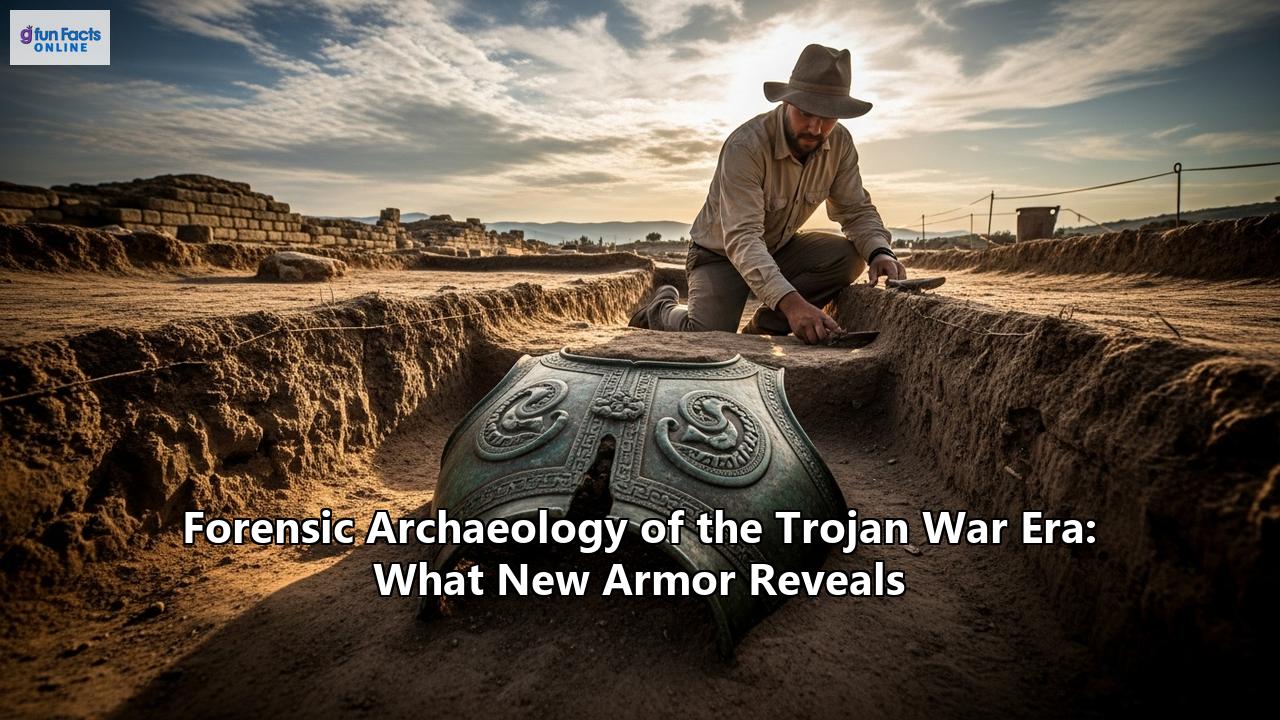
In a stunning development in July 2025, archaeologists from the Brno City Museum announced a discovery that sent ripples across the world of Bronze Age studies. Unearthed in South Moravia in the Czech Republic, a crumpled, unassuming sheet of metal was revealed to be a fragment of a 3,200-year-old bronze breastplate. This find is exceptionally rare, being only the second specimen of its kind ever found in the country. It dates to approximately 1200 BCE, placing it squarely within the timeframe traditionally associated with the Trojan War.
Found in a hoard alongside a spearhead, a sickle, and other bronze items, the armor appears to have been deliberately damaged and buried, suggesting a ritual offering to the gods—a common practice in prehistoric Europe. The archaeologists, led by Aleš Navrátil, employed advanced 3D scanning technology to digitally "unfold" the bent and fragile artifact. This non-invasive forensic technique allowed them to reconstruct its original form without causing further damage, revealing intricate decorative patterns, including embossed waves and a punched solar motif around the chest.
While not Mycenaean in origin, the armor's craftsmanship and its discovery within the context of the widespread European Urnfield culture highlight a crucial point: the world of the Trojan War was not an isolated Aegean affair. The Urnfield culture, known for its distinctive burial customs and advanced metalworking, stretched across Central Europe and shared a sophisticated warrior tradition. This tradition included heavily armored warriors with bronze cuirasses, helmets, and slashing swords, an idea likely borrowed from or shared with Mycenaean Greece. The Czech armor, therefore, is not just a local curiosity; it's a tangible link in a vast network of Bronze Age warrior elites who shared technology, ideology, and a profound reverence for the implements of war. It demonstrates that the gleaming bronze armor described by Homer was not a poetic fantasy confined to the shores of Greece, but a real-world technology employed by a high-ranking warrior class across a wide swathe of the continent.
The Dendra Panoply: Testing an Ancient War Machine
For decades, one of the most iconic and debated artifacts of the Mycenaean era has been the Dendra panoply. Discovered in a tomb near the Greek village of Dendra in 1960, this nearly complete suit of bronze armor, dating to the 15th century BCE, is a breathtaking sight. Comprised of fifteen separate bronze plates held together with leather thongs, it encases the wearer from neck to knees and includes a formidable cuirass, large shoulder guards, a deep neck guard, and plates to protect the groin and thighs.
Yet, its sheer bulk and seemingly cumbersome design led many scholars to question its practicality. Was it purely ceremonial, a status symbol for a king or chieftain to wear in parades but never in the heat of battle? This question has profound implications for our understanding of Mycenaean warfare. Did they possess the technology for true heavy infantry, or was combat a more mobile, lightly-armored affair?
To answer this once and for all, an international team of researchers, led by Professor Andreas Flouris of the University of Thessaly, embarked on a landmark project in the field of experimental archaeology, published in 2024. They took a meticulously crafted replica of the Dendra armor—made in the 1980s and matching the original's weight and dimensions—and gave it to those best suited to test it: elite marines of the Hellenic Armed Forces.
Over an exhaustive 11-hour combat simulation, these modern warriors put the ancient armor through its paces. The protocol was not arbitrary; it was developed through a painstaking analysis of Homer's Iliad, which, despite its poetic nature, provides the most detailed descriptions of Late Bronze Age combat. The simulation mimicked the estimated duration, timing, and energy cost of a day of battle as described in the epic, from the morning meal to the final skirmishes.
The results were nothing short of revolutionary. The study, a new frontier of "archeo-physiology," found that the Dendra armor was not only battle-worthy but extraordinarily effective. Far from being restrictive, the articulated design allowed for a full range of motion. The modern marines could run, jump, and execute complex combat maneuvers with surprising ease.
Crucially, the physiological strain on the wearers was well within tolerable limits for fit, trained soldiers, even over an 11-hour period. Researchers monitored everything from heart rate and oxygen consumption to core temperature and fluid loss, concluding that the armor, while heavy at 23 kilograms (51 pounds), did not cause excessive stress. This suggests that a Mycenaean warrior could have fought in this panoply for an entire day, day after day.
To add another layer of authenticity, the participants consumed a "Homeric diet" designed to replicate the nutritional intake of an ancient warrior, providing an estimated 4,443 calories. Based on descriptions in the Iliad and bioarchaeological data, this diet included bread, beef, goat cheese, green olives, onions, and red wine.
The conclusion was unequivocal: the Dendra panoply was a highly effective piece of military technology that would have given its wearer a decisive advantage on the battlefield. Protected from most blows, a warrior in this armor would have been a veritable walking tank, a terrifying and almost unstoppable force against lighter-armed opponents. This single experiment overturned decades of debate and proved that the Mycenaeans possessed the means to field true heavy infantry, a fact that fundamentally alters our understanding of their military power and their impact across the Eastern Mediterranean.
Forensic Files: Reading the Scars of Battle on Bone and Bronze
The Dendra experiment tells us what the armor could do, but forensic archaeology tells us what actually happened. By examining the skeletal remains of Bronze Age individuals and the surviving weapons themselves, a grim but fascinating story of combat emerges.
Studies of Minoan and Mycenaean burials have revealed a range of military-related traumas. One of the most compelling aspects is how the evidence on bone corroborates the use of armor. While injuries are found on various parts of the body, there's a notable pattern. For example, analysis of skeletons from a cemetery in Athens shows healed fractures on ribs and evidence of wounds to the ulna (one of the forearm bones). An injury to the ulna, often called a "parry fracture," is a classic defensive wound sustained when raising an arm to block a blow. The presence of such injuries suggests that while armor like the Dendra panoply covered the torso, the limbs were still vulnerable and actively used in defense.
The extreme pressure of wielding the heavy Mycenaean "tower" or "figure-eight" shields could also have caused stress injuries to the arm bones, providing another line of evidence for how this equipment was used. Skull traumas are particularly revealing. While fatal blows were often aimed at the torso, the head was a frequent target. The existence of numerous boar's tusk and bronze helmets speaks to this reality, and the cranial injuries found on skeletons from sites like Hagios Charalambos in Crete confirm it.
The study of the weapons themselves provides another forensic layer. Use-wear analysis, which examines the microscopic scratches, chips, and damage on the edges of swords and spearheads, can reveal whether a weapon was used in combat, what it struck (bone, flesh, or other metal), and the angle of attack. Experiments to identify the specific "cut marks" left by different types of blades on bone are helping archaeologists to reconstruct battles with greater accuracy. For instance, the heavy chopping marks of a sword are distinct from the finer cuts of a knife. When a weapon is found in a grave, its condition can also be telling; many swords from the Mycenae Shaft Graves were found broken or damaged, suggesting they had seen actual combat before being interred with their owners.
However, the forensic record also has its limitations. As one study notes, most effective sword attacks would have targeted soft tissue like the neck and abdomen, leaving no trace on the skeleton. Therefore, the skeletal evidence likely represents only a fraction of the injuries sustained. What it does show, however, is a consistent picture of brutal, close-quarters combat where armor was essential for survival.
The Complete Warrior: From Boar's Tusk Helmet to Bronze-Tipped Spear
The Dendra panoply was the pinnacle of protection, but it was just one part of a complex and sophisticated military kit. The appearance of the Trojan War-era warrior was a product of centuries of technological development and battlefield experience.
Helmets: The Mark of a HunterPerhaps no piece of equipment bridges the gap between the archaeological record and Homeric poetry better than the boar's tusk helmet. The Iliad gives a meticulous description of such a helmet given to Odysseus: a leather cap lined with felt, with rows of white tusks from a wild boar expertly stitched to the outside. For a long time, this was considered a poetic flourish until archaeology proved it stunningly accurate.
Fragments of these helmets, and in some cases nearly complete examples, have been found at numerous Mycenaean sites, including Dendra, Mycenae, and Knossos. They were constructed exactly as Homer described: a leather or felt cap formed the base, and slivers of tusk from dozens of boars were sewn on in rows to create a hard, protective outer layer. Hunting the ferocious wild boar was a dangerous and prestigious activity for the Mycenaean elite, so wearing such a helmet was not only practical but also a potent symbol of strength, bravery, and status. It was estimated that up to forty or fifty boars would need to be killed to create a single helmet, making it a truly elite item. While not as strong as a solid bronze helmet, the overlapping tusks would have been remarkably effective at deflecting blows and dispersing impact, much like a modern flak jacket.
Shields: The Moving WallBefore the development of full-body plate armor, the primary defense of a Mycenaean warrior was his shield. Early in the period, warriors wielded enormous body shields, known from vivid depictions in art like the famous Lion Hunt Dagger from Mycenae. There were two main types: the rectangular "tower shield," which Homer attributes to the hero Ajax, and the distinctive "figure-eight" shield.
These were not simple, flat shields. Made of a wicker or wooden frame covered with multiple layers of tough ox-hide, they were large enough to cover the entire body. The three-dimensional curve of the figure-eight shield would have almost enclosed the bearer, offering immense protection. So large and heavy were they that they were carried on a strap (a telamon) slung over the shoulder and across the chest, freeing the warrior's hands to wield a long, two-handed thrusting spear.
As warfare evolved and full plate armor like the Dendra panoply became more common, these massive shields were gradually replaced. By the later Mycenaean period, smaller, lighter, and often round shields held by a central handgrip became more prevalent. This shift is famously depicted on the "Warrior Vase," a krater from Mycenae dating to around 1200 BCE. The soldiers on the vase carry smaller, crescent-shaped shields, wear lighter armor, and are armed with shorter spears. This reflects a fundamental change in tactics, away from the heavily armored, static individual warrior toward more mobile, uniform bodies of troops.
Greaves, Swords, and Spears: The Tools of the TradeThe Achaeans are famously called "well-greaved" (euknemides) in the Iliad, and archaeology bears this out. Greaves, or shin guards, were essential for protecting the lower legs, a vulnerable target in close combat. Examples made of bronze have been found at sites like Dendra and Kallithea, and they were often worn over linen padding for comfort.
Mycenaean swords also evolved significantly over time. Early swords were long, slender, and designed primarily for thrusting, meant to be used in conjunction with the large body shields. As tactics changed, swords became shorter, sturdier, and better suited for both cutting and thrusting, a more versatile weapon for a more fluid battlefield. The development of stronger hilts, cast as one piece with the blade, made them more reliable in the chaos of battle.
The spear, however, remained the king of the battlefield. The early Mycenaeans used long, heavy lances in combination with their tower shields, but later warriors, like those on the Warrior Vase, carried shorter, more versatile spears that could be used for both thrusting and throwing.
The Mycenaean War Machine: Tactics, Chariots, and the Bureaucracy of Battle
This sophisticated armor and weaponry did not exist in a vacuum. It was the product of a highly organized, militaristic society, the workings of which are revealed to us through the administrative records of the palaces: the Linear B tablets.
Written on clay and preserved when the palaces burned, these tablets are primarily economic inventories. But their meticulous lists of military equipment, personnel, and production offer an unparalleled glimpse into the Mycenaean war machine. Tablets from Pylos and Knossos record hundreds of chariots, thousands of arrowheads, and inventories of armor—listed with the ideogram to-ra-ke—that correspond to panoplies like the one from Dendra.
These records reveal a complex military hierarchy. At the top was the wanax (king), followed by the lawagetas (a high-ranking leader, perhaps of the army), and a class of elite officers or companions known as the heqetai. The tablets from Pylos famously detail the disposition of coastal watch units, recording the commanders, officers, and soldiers assigned to defend against a seaborne attack, a chilling premonition of the chaos that would eventually engulf their world.
One of the most debated aspects of Mycenaean warfare is the role of the chariot. Unlike their Near Eastern counterparts who often used chariots as mobile archery platforms, the Mycenaean use is less clear. The Iliad predominantly describes heroes using them as "battlefield taxis"—riding to a hot spot in the fighting, dismounting to engage in single combat, and then having their charioteer wait nearby to extract them if necessary.
The archaeological evidence is ambiguous. Some early depictions show chariots seemingly charging into battle, while later frescoes and the Linear B tablets, which list chariots alongside armor but often without bows, seem to support the "battlefield transport" theory. It's likely their role evolved, with early, heavier "box chariots" being used as fighting platforms, while later, lighter "rail chariots" served to convey elite, heavily armored warriors like the owner of the Dendra panoply to the front lines.
Echoes of the Collapse: The End of the Bronze Age Warrior
The late 13th and 12th centuries BCE were a time of great upheaval across the Mediterranean, an era known as the Late Bronze Age Collapse. Palaces were burned, trade routes were severed, and entire civilizations, including the mighty Hittite Empire and the Mycenaean kingdoms, fell. The sophisticated military system that had produced the Dendra panoply was swept away.
The reasons for the collapse are complex and much debated, but the nature of warfare itself was changing. The era of the heavily armored, chariot-riding champion was giving way to a new kind of fighting. The iconic Warrior Vase, created during this period of turmoil, is a key piece of forensic evidence for this transition.
The soldiers it depicts are marching in a disciplined, uniform fashion. They are more lightly and uniformly equipped than the heroes of earlier art, carrying smaller shields and shorter spears. Their knapsacks suggest they are part of a mobile force capable of traveling long distances. This is not the depiction of an aristocratic duel; it is the image of an army on the move, a potential harbinger of the raiding and mass migrations that characterized the age of the "Sea Peoples" who wreaked havoc on Egypt and the Levant.
The very technology that defined the Bronze Age warrior—bronze itself—was also on the verge of being superseded. The difficulty of producing large, homogenous iron plates meant that full plate armor disappeared for centuries, only to re-emerge in medieval Europe. Early iron swords were often inferior to their bronze counterparts, but iron ore was far more plentiful than the copper and tin needed for bronze, allowing for the equipping of larger, if less spectacularly armored, armies.
The world of the Trojan War hero, clad in gleaming bronze from head to toe, a champion driven to battle in a magnificent chariot, was coming to an end. But through the painstaking work of archaeologists and the innovative application of forensic science, their world is no longer lost to the mists of time. By analyzing the armor they wore, the wounds they suffered, and the weapons they wielded, we can now appreciate the profound technological sophistication and raw physical power of these Bronze Age warriors. The epic tales may still sound like myths, but the evidence, etched in bronze and bone, proves that behind the legends stood very real, and very formidable, men of war.
Reference:
- https://www.ancientworldmagazine.com/articles/mycenaean-warfare/
- https://en.wikipedia.org/wiki/Warrior_Vase
- https://www.researchgate.net/publication/222528038_Identifying_Sword_Marks_on_Bone_Criteria_for_Distinguishing_Between_Cut_Marks_Made_by_Different_Classes_of_Bladed_Weapons
- https://www.livescience.com/archaeology/ancient-mycenaean-armor-is-so-good-it-protected-users-in-an-11-hour-battle-simulation-inspired-by-the-trojan-war
- https://brewminate.com/the-warrior-krater-and-a-period-of-increased-warfare-in-ancient-mycenae/
- https://www.birmingham.ac.uk/news/2024/3500-year-old-mycenaean-armour-was-suitable-for-extended-battle-study
- https://discoveringancienthistory.wordpress.com/2016/12/02/from-warriors-to-raiders-the-evolution-of-mycenaean-weapons-armament-tactics/
- https://www.google.com/search?q=time+in+Peloponnisos,+GR
- https://en.wikipedia.org/wiki/Dendra_panoply
- https://www.hellenicarmors.gr/en/armor/dendra-armor/
- https://historygreek.org/artifacts/mycenaean-warrior-vase
- https://elearncollege.com/arts-and-humanities/dendra-panoply-unveiling-mycenaean-warfare/
- https://brocku.ca/blogs/brock-odyssey-2017/2017/06/17/mycenaean-warrior-vase-12th-century-bce/
- https://www.classicult.it/en/the-dendra-panoply-an-ancient-mycenaean-armour-has-been-tested-by-marines-and-pronounced-suitable-for-extended-combat/
- https://bioarchaeologyofviolence.wordpress.com/wp-content/uploads/2018/05/lewis2008.pdf
- https://journals.plos.org/plosone/article?id=10.1371/journal.pone.0301494
- https://pure-oai.bham.ac.uk/ws/portalfiles/portal/227259496/FlourisA2024Analysis.pdf
- https://pmc.ncbi.nlm.nih.gov/articles/PMC11111059/
- https://www.quora.com/How-were-swords-made-in-the-Mycenaean-era
- https://www.reddit.com/r/ArmsandArmor/comments/xrnblf/the_dendra_panoply/