
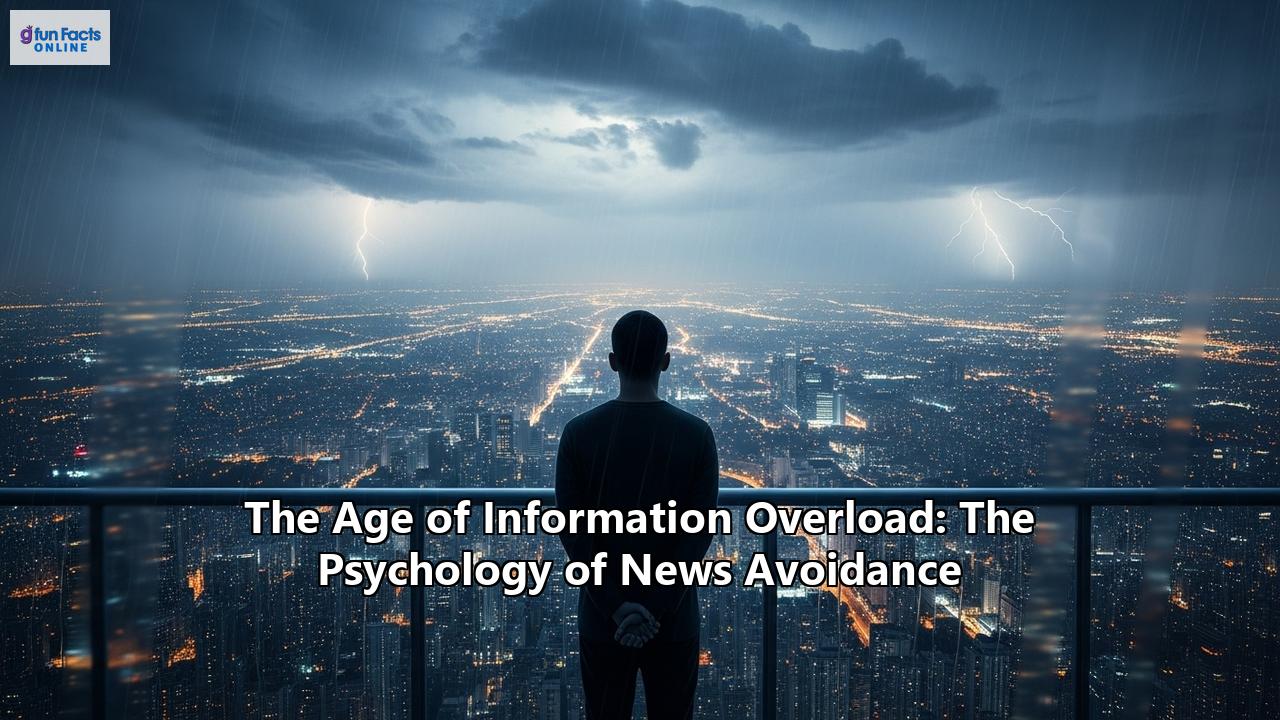
In an age where information is more abundant and accessible than ever before, a curious paradox has emerged: a growing number of people are actively choosing to turn away from the news. This phenomenon, known as news avoidance, is not merely a matter of personal preference but a complex psychological response to an environment saturated with data, fraught with negativity, and designed to capture our attention at any cost. This deep dive explores the multifaceted world of information overload and the intricate psychology behind our collective retreat from the headlines.
The Unseen Burden: Understanding Information Overload
Information overload, sometimes called "infobesity" or "information anxiety," describes the difficulty a person has in understanding an issue and making decisions when they have too much information about it. The term was first popularized by Alvin Toffler in his 1970 book Future Shock, where he predicted that the rapid increase in information would cause people to feel overwhelmed, leading to depression and a withdrawal from society. Decades later, with the advent of the internet and 24/7 connectivity, Toffler's predictions seem prescient.
Today, the sources of information are virtually endless: push notifications from news apps, endless social media feeds, relentless cable news cycles, and a constant stream of emails and messages. This digital deluge has tangible cognitive and emotional consequences. It can lead to distraction, indecision, and heightened stress levels. The constant multitasking required to keep up with this flow of information can split our focus and lead to mental exhaustion. Researchers have found that this state of overload makes it difficult to process and retain information effectively, ultimately diminishing our attention spans and productivity.
A 2020 survey by the Pew Research Center found that two-thirds of American adults felt "worn out" by the amount of news they were consuming. This feeling of being overwhelmed is a primary driver for people to disengage. When our cognitive and emotional bandwidth feels scarce, simply turning off the firehose of information can feel like a necessary act of self-preservation.
A Historical Echo: Information Anxiety Through the Ages
While it may feel like a uniquely modern affliction, the anxiety of having "too much to know" has a long history. Concerns about information overload have been documented throughout periods of technological advancement that increased the production of information.
As far back as the 3rd or 4th century BCE, the writer of Ecclesiastes lamented, "of making many books there is no end." In the 1st century AD, Seneca the Elder commented that "the abundance of books is a distraction." These early complaints highlight a long-standing human struggle with managing knowledge.
The invention of the printing press by Johannes Gutenberg around 1453 marked a significant turning point. The ability to mass-produce printed materials led to an "information revolution," making books and pamphlets accessible to a much wider audience. This explosion of texts was met with both enthusiasm and dread. While it fueled the Renaissance and the Scientific Revolution, it also created new anxieties. Scholars of the era complained about the "confusing and harmful" overabundance of data and the "frailty of human resources for mastering them." They developed new methods to cope, such as note-taking systems and reference books, in an attempt to manage the deluge.
In the 18th and 19th centuries, similar concerns arose with the proliferation of newspapers, novels, and pamphlets. U.C. Riverside professor Susan Zieger notes that "all the same questions we now pose about information addiction and overload, the superficiality of social media, and the spread of misinformation were first asked then." These historical parallels reveal that our current struggle is not entirely new but rather the latest chapter in a long story of humanity grappling with its own creations. The key difference today lies in the unprecedented scale, speed, and pervasive nature of the information flow.
The Psychological Drivers of News Avoidance
The decision to avoid the news is often rooted in a complex interplay of psychological factors. It is more than just a simple desire to be uninformed; it is a protective mechanism against a range of negative emotional and cognitive states.
Emotional and Compassion Fatigue
One of the most significant drivers of news avoidance is the sheer negativity of the news cycle. The old journalistic adage "if it bleeds, it leads" is supported by research showing that negative news headlines increase user engagement. However, this constant exposure to stories of tragedy, conflict, and suffering comes at a high psychological cost.
This can lead to compassion fatigue, a state of emotional and physical exhaustion resulting from repeated exposure to the suffering of others. Originally identified in healthcare professionals, this "cost of caring" is now recognized as a broader societal issue in the digital age. When we are constantly bombarded with heartbreaking stories and images, our capacity for empathy can become overwhelmed, leading to emotional numbness and withdrawal as a self-protective measure. Many people report avoiding the news simply to preserve their well-being and stop the cycle of dread.
Vicarious Traumatization
In more extreme cases, exposure to graphic and distressing news can lead to vicarious traumatization. This occurs when an individual develops trauma-like symptoms after indirect exposure to a traumatic event through media. Symptoms can include anxiety, flashbacks, hypervigilance, and feelings of helplessness, mirroring those of post-traumatic stress disorder (PTSD). Research has shown a direct link between the frequency of media exposure to traumatic events, such as mass shootings or natural disasters, and the development of these symptoms. The constant availability of graphic content on social media, often without warning, has exacerbated this risk.
Cognitive Dissonance and Confirmation Bias
Our minds naturally seek harmony and consistency. Cognitive dissonance, a theory developed by Leon Festinger, describes the mental discomfort we experience when holding conflicting beliefs or when new information challenges our existing views. To resolve this discomfort, we are motivated to either change our beliefs, justify our actions, or, most commonly, avoid the conflicting information altogether.
News avoidance can be an extreme form of managing cognitive dissonance. For example, a person who holds strong political beliefs may avoid news outlets that present opposing viewpoints to prevent the psychological stress of having their convictions challenged.
Closely related to this is confirmation bias, the tendency to seek out, interpret, and remember information that confirms our pre-existing beliefs. In the modern high-choice media environment, it is easier than ever to curate a news diet that consists solely of information that validates our worldview. Social media algorithms often amplify this effect by creating "filter bubbles" or "echo chambers" that shield us from dissenting opinions. This selective exposure helps reduce cognitive dissonance but also contributes to a more polarized and less informed public.
The Role of the Modern Media Landscape
The psychological pull to avoid the news is amplified by the structure and incentives of the current media environment.
The 24/7 News Cycle and "Headline Anxiety"
The advent of 24-hour news channels and the internet created a media landscape that is "always on." This constant stream of breaking news, alerts, and updates can trigger what has been termed "headline anxiety" or "headline stress." The relentless pace and often sensationalized nature of reporting can activate our body's fight-or-flight response, leading to chronic stress and anxiety. This is especially true when news is consumed passively, such as having a cable news channel on in the background, which can still have a negative effect on our psyche.
Social Media as a News Source
An increasing number of people, particularly younger audiences, get their news from social media. However, these platforms are not primarily designed for the dissemination of high-quality, balanced information. Their algorithms are built to maximize engagement, which often means prioritizing emotionally charged, sensational, or extreme content. This can create a distorted and overwhelmingly negative perception of the world.
Furthermore, the context collapse on social media—where news from credible sources is presented alongside misinformation, personal updates, and advertisements—can make it difficult for users to evaluate the credibility of what they are seeing. This environment can foster distrust and further encourage disengagement from the news altogether.
Societal Consequences of Widespread News Avoidance
When large segments of the population turn away from the news, the implications extend beyond the individual, affecting the health of democratic societies.
Erosion of Civic and Democratic Engagement
A well-informed citizenry is often considered a cornerstone of a functioning democracy. News consumption has historically been linked to higher levels of political knowledge and civic participation. When people avoid the news, they may miss out on crucial information about elections, policy debates, and community issues.
Research indicates that lower levels of news use are generally associated with less political engagement. This creates a troubling cycle: people who are less interested in politics are more likely to avoid the news, and this avoidance further decreases their engagement and knowledge. This can lead to a less representative democracy, where the voices of those who are disengaged are not heard.
Increased Political Polarization
While it may seem that disengaging from the news would lead to less political strife, the opposite may be true. The mechanisms of selective exposure and confirmation bias mean that those who do remain engaged with the news are often consuming it from highly partisan sources that reinforce their existing views. This creates "echo chambers" where differing perspectives are not encountered, leading to a more entrenched and polarized populace.
This "identity journalism" can weaponize the differences between political and social groups, making compromise and consensus-building more difficult. The decline of a shared, common set of facts and information, which a more unified news environment once provided, makes it harder to have productive public discourse.
Charting a New Course: Strategies for a Healthier Information Diet
Given the psychological toll and societal risks of both overconsumption and complete avoidance of news, finding a balanced approach is crucial. A number of strategies and movements have emerged to help individuals and the news industry navigate this new reality.
For Individuals: Cultivating Mindful Consumption
- Set Boundaries: One of the most effective strategies is to be intentional about when and how you consume news. This can include setting specific time limits for news consumption, such as 15-30 minutes in the morning and evening, and creating media-free times or zones, like during meals or before bed.
- Turn Off Notifications: Constant push alerts from news and social media apps are a primary driver of information overload. Turning these off allows you to seek out information on your own terms rather than being constantly interrupted.
- Curate Your Sources: Actively choose a few trusted, high-quality news sources that provide factual, balanced reporting rather than sensationalism. Consider adding an international news source to gain a broader perspective.
- Practice Mindfulness: Engaging in mindfulness practices like meditation can enhance your ability to process information and reduce the stress associated with negative news.
- Take Action: One of the feelings that drives news avoidance is helplessness. Counteracting this by taking small, tangible actions—donating to a cause, volunteering, or signing a petition—can restore a sense of agency.
For the News Industry: Rebuilding Trust and Engagement
The news industry itself is beginning to recognize its role in the rise of news avoidance and is exploring new models of journalism.
- Solutions Journalism: This approach to reporting focuses not just on problems, but on the responses to them. By rigorously investigating how individuals and institutions are attempting to solve social issues, solutions journalism provides a more complete and often more hopeful picture. Studies have shown that solutions-oriented stories can increase reader engagement, leave audiences feeling more optimistic, and can even help rebuild trust in the media.
- Slow Journalism: As a direct response to the frantic pace of the 24/7 news cycle, the "slow journalism" or "slow news" movement advocates for taking the time to produce well-researched, in-depth, and narrative-driven stories. By prioritizing quality over quantity and context over clicks, slow journalism aims to provide a more meaningful and less overwhelming experience for the reader.
- Increased Transparency and Listening: To combat widespread distrust, news organizations can be more transparent about their reporting processes. Furthermore, actively listening to what audiences want and need—and understanding why they disengage—can help newsrooms create content that feels more relevant and less alienating.
The Role of Media Literacy
In an era of information abundance and misinformation, media literacy has become an essential skill. It is the ability to access, analyze, evaluate, and create media in various forms. Media literacy education equips individuals with the critical thinking skills needed to discern credible information from falsehoods, recognize bias, and understand the persuasive techniques used in media messages. By fostering a more critical and discerning audience, media literacy can empower people to navigate the complex information environment without feeling the need to completely disengage.
Conclusion: Reclaiming Our Attention and Our Well-Being
The age of information overload has presented us with a profound challenge: how to stay informed without becoming overwhelmed. The psychology of news avoidance reveals that tuning out is often a rational, if unconscious, strategy for protecting our mental and emotional health in an environment that feels increasingly toxic and demanding.
However, the consequences of a society that disengages from the news are dire for democratic health and social cohesion. The path forward does not lie in a return to a bygone media era, but in forging a new relationship with information. For individuals, this means cultivating mindful consumption habits and demanding better from our information sources. For the news industry, it requires a fundamental rethinking of its values, moving away from a model that prioritizes clicks and outrage towards one that values context, solutions, and the well-being of its audience. By embracing strategies like solutions journalism, slow media, and robust media literacy, we can begin to navigate the currents of the information age, staying engaged with the world without losing ourselves in the process.
Reference:
- https://www.pmaward.org/solutions-journalism-how-to-cover-problems-through-the-lens-of-responses/
- https://en.wikipedia.org/wiki/Information_overload
- https://medium.com/truth-love-and-light/rediscovering-slow-journalism-46a2e7334e4f
- https://www.ebsco.com/research-starters/library-and-information-science/information-overload
- https://reutersinstitute.politics.ox.ac.uk/news/news-avoidance-varies-greatly-country-country-why
- https://medium.com/@goboldfish/information-overload-in-our-digital-age-90cbe93bb530
- https://www.internationalhu.com/research/projects/news-avoidance-and-its-effect-on-the-informed-citizen-in-a-democratic-society
- https://www.ikmz.uzh.ch/en/research/divisions/political-communication/projects/news-avoidance-and-participation.html
- https://news.harvard.edu/gazette/story/2010/12/ye-old-information-overload/
- https://dancohen.org/2013/12/22/information-overload-past-and-present/
- https://reutersinstitute.politics.ox.ac.uk/news/people-are-turning-away-news-heres-why-it-may-be-happening
- https://rarecachebroadcast.wordpress.com/2015/01/20/the-printing-press-and-the-information-revolution/
- https://analyzehistory.com/how-did-the-printing-press-impact-the-renaissance/
- https://www.rand.org/pubs/papers/P8014.html
- https://slate.com/technology/2010/02/a-history-of-media-technology-scares-from-the-printing-press-to-facebook.html
- https://www.universityofcalifornia.edu/news/information-overload-has-been-around-1800s
- https://news.ucr.edu/articles/2018/07/20/information-overload-has-been-around-1800s
- https://en.wikipedia.org/wiki/Slow_journalism
- https://constructiveinstitute.org/how/contributions/solutions-to-news-avoidance/
- https://www.vev.design/blog/slow-journalism/
- https://fastercapital.com/topics/the-role-of-media-literacy-in-managing-information-overload.html/1
- https://www.chronicle.com/article/information-overload-then-and-now/
- https://www.solutionsjournalism.org/impact/how-solutions-journalism-rebalances-news
- https://en.wikipedia.org/wiki/Solutions_journalism
- https://www.usethenews.nl/wp-content/uploads/2024/02/10.1515_commun-2021-0099.pdf
- https://fastercapital.com/topics/media-literacy-and-coping-with-information-overload.html/1
- https://prnews.io/blog/slow-journalism.html
- https://www.theguardian.com/society/ng-interactive/2025/sep/01/news-avoidance-high-anxiety
- https://sites.bu.edu/pardeeatlas/research-and-policy/back2school/how-the-american-media-landscape-is-polarizing-the-country/
- https://www.mediaupdate.co.za/media/150953/whats-the-deal-with-slow-journalism
- https://www.researchgate.net/publication/321811757_Solutions_Journalism_The_effects_of_including_solution_information_in_news_stories_about_social_problems
- https://cpdonline.co.uk/knowledge-base/business/all-about-media-literacy/
- https://gmec.online/media-literacy-in-the-age-of-information-overload/
- https://ssir.org/articles/entry/strengthen_media_literacy_to_win_the_fight_against_misinformation