
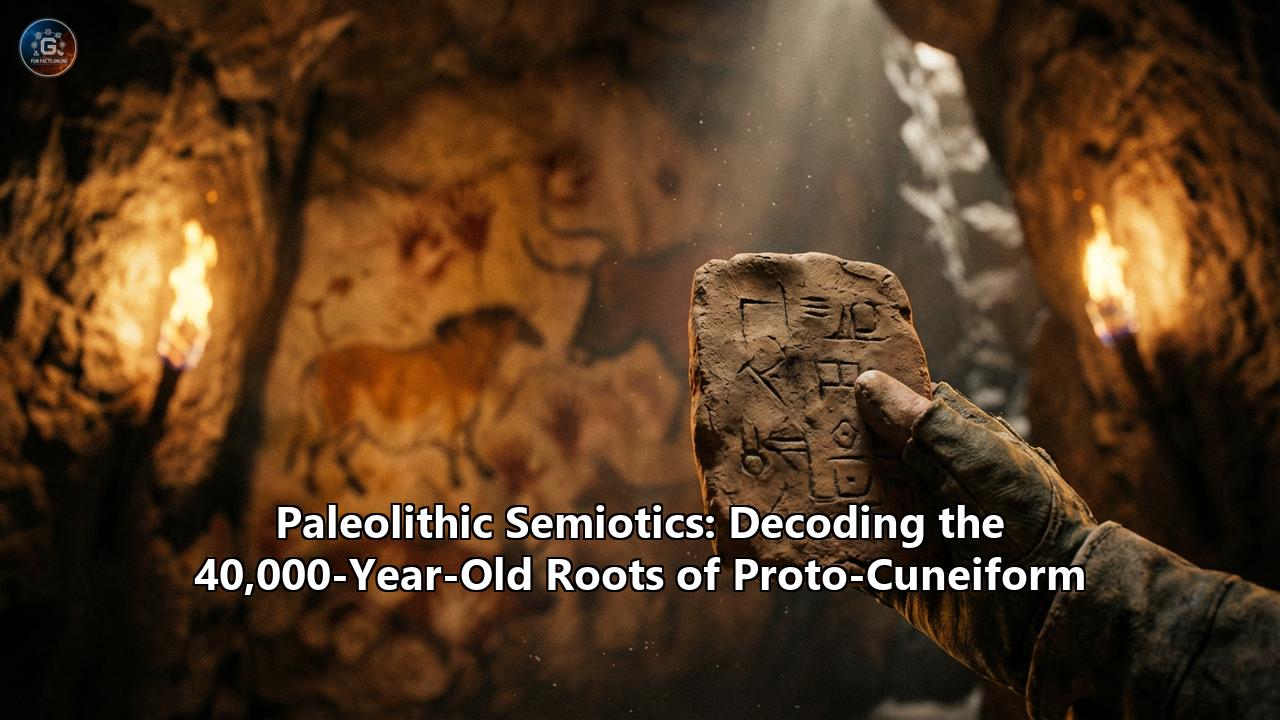
Deep within the subterranean darkness of Europe’s limestone caves, far beyond the reach of natural sunlight, early humans stood in the flickering glow of animal-fat lamps and did something extraordinary. They reached out to the rough rock walls and left marks. For centuries, modern archaeologists and art historians have been captivated by the spectacular Ice Age paintings of stampeding horses, charging bison, and graceful stags found in places like Lascaux and Chauvet. Yet, scattered around these breathtaking animal forms, often relegated to the margins and ignored as mere "decorations" or abstract doodles, lies something arguably much more profound: geometric signs.
Lines, dots, crosses, zigzags, and penniform (feather-shaped) marks accompany the grand beasts. For a long time, the orthodox narrative of human history dictated that the story of written communication began much later, in the sun-drenched river valleys of Mesopotamia around 3200 BCE, with the administrative ledgers of the Sumerians. But groundbreaking research in paleolithic semiotics is dismantling that timeline. By applying modern computational linguistics, statistical analysis, and exhaustive archaeological cataloging, researchers are decoding a 40,000-year-old lineage of symbols.
We are now discovering that the cognitive architecture required for proto-cuneiform was not born in the early cities of the Near East. Instead, it was forged tens of thousands of years earlier by hunter-gatherers navigating the harsh landscapes of Ice Age Europe. This is the story of how human beings first learned to store information outside their own bodies, mapping the grand journey from Paleolithic cave signs to the clay accounting tokens of the Neolithic, and finally, to the dawn of recorded history.
The 32 Keys to the Paleolithic Mind
To understand the roots of graphic communication, we must first look to the pioneering work of paleoanthropologist Genevieve von Petzinger. Prior to her extensive research, there was no comprehensive database of the geometric signs scattered across European cave networks. The animals drew the funding and the awe, while the abstract marks were treated as esoteric mysteries.
By compiling a massive relational database of signs from 146 painted caves in France and expanding across Europe, von Petzinger uncovered a startling reality: across a span of 30,000 years and the entire continent of Europe, Ice Age humans used a highly restricted vocabulary of just 32 distinct geometric sign types.
If these marks were random scribbles or meaningless decorations, one would expect infinite variations. Instead, a staggering 65 percent of these signs remained in continuous use throughout the entire Upper Paleolithic period. Some signs had restricted regional distributions—like the divided rectangles found only in northern Spain—while others, such as simple lines, ovals, and triangles, crossed thousands of kilometers.
This incredible continuity points to one undeniable conclusion: intentionality. Our ancient ancestors possessed a shared system of graphic communication. While we may never know the precise spoken words attached to these symbols, the signs were clearly meant to transmit information. This was an epochal cognitive leap. Before this moment, human knowledge was entirely ephemeral, bound to the spoken word and the biological limits of memory. By externalizing information—by carving a sign into a cave wall that would outlast the person who drew it—Paleolithic humans invented the concept of permanent data storage.
However, the story gets even deeper when we move from the stationary cave walls to portable objects.
The Swabian Jura and the Math of the Ice Age
In 2026, the scientific community was rocked by a landmark study published in the Proceedings of the National Academy of Sciences (PNAS) by linguist Christian Bentz and archaeologist Ewa Dutkiewicz. While von Petzinger had proven the spatial and temporal continuity of cave signs, Bentz and Dutkiewicz sought to measure their statistical structure.
Focusing on the Aurignacian culture—the era between 43,000 and 34,000 years ago when some of the earliest anatomically modern humans arrived in Europe and encountered Neanderthals—the researchers analyzed a corpus of over 200 mobile objects. Found largely in the cave systems of the Swabian Jura in southwestern Germany, these artifacts included small, meticulously carved figurines of mammoths, lions, and humans, as well as functional bone and antler tools.
Adorning these objects were several thousand intentionally engraved geometric signs: rows of dots, crosses, and notches. Bentz and Dutkiewicz didn't just catalog these marks; they subjected them to rigorous computational classification and statistical modeling, specifically measuring their "entropy" (a statistical estimate of how much information a sequence can carry).
The results were paradigm-shifting. Modern writing systems, which encode spoken language, exhibit high entropy because spoken language is highly variable and unpredictable. The Aurignacian sequences, on the other hand, displayed lower entropy characterized by high rates of repetition (e.g., cross, cross, cross; line, line, line). But when the researchers compared the statistical fingerprint of these 40,000-year-old marks to the earliest known proto-cuneiform tablets from Mesopotamia (dating to approximately 3500–3000 BCE), the overlap was practically perfect.
Structurally and statistically, the sign sequences of Paleolithic hunter-gatherers share the exact same information density and complexity as the early proto-cuneiform administrative ledgers.
Furthermore, the Aurignacian people were highly deliberate in how they applied these symbols. The researchers discovered that signs were systematically applied to yield higher information density on certain types of objects. Ivory figurines, for example, contained sequences with 15 percent higher information density than basic tools. There were distinct syntactic rules at play: crosses were almost exclusively associated with animal figurines like mammoths and horses, while dots were strongly associated with humans and lions.
This is vividly demonstrated by the famous "Adorant" figurine—an ivory carving of a human-lion hybrid marked with specific rows of dots. The dots likely related to attributes of the lion, symbolically applied to a human form.
These findings fundamentally reshape our understanding of human cognition. The architects of the Aurignacian culture had proven that they possessed the exact cognitive capacity required to bootstrap a genuine writing system. They already had a conventional, structured system of intentional signs 35,000 years before the Sumerians. So, why didn't they invent a fully realized script?
The answer lies in necessity. Hunter-gatherer societies, while culturally and spiritually complex, operate on a different socioeconomic scale than urban empires. They had no need to record tax yields, ration distributions, or complex agricultural debts. Their semiotic system was perfectly adapted to their environment—stable, effective, and continuous for 10,000 years. To push graphic communication from repeated symbolic sequences into a phonetic script that mapped directly to spoken language, humanity needed a catalyst. It needed agriculture, economics, and the city.
The Token System: The Bridge to Uruk
To trace how the latent human capacity for semiotics evolved into proto-cuneiform, we must fast forward through the millennia and travel from the glacial landscapes of Ice Age Europe to the fertile crescent of the Near East. Here, we encounter the monumental work of archaeologist Denise Schmandt-Besserat, who revolutionized our understanding of the direct origins of writing.
Around 9000 BCE, humanity underwent its next great metamorphosis: the Neolithic Revolution. People began to settle down, domesticate animals, and cultivate crops. With the advent of communal silos, granaries, and livestock herds, a new cognitive challenge emerged: how do you keep track of what belongs to whom? The survival of these early farming communities depended on a strict economy of redistribution.
The solution was a system of small, geometrically shaped clay tokens. For over 5,000 years, from the Neolithic down to the Early Bronze Age, these tokens served as the bedrock of Near Eastern accounting. The genius of the token system lay in its conceptual simplicity. A small cone-shaped token represented a small measure of barley; a larger sphere stood for a larger measure of barley; a flat disc represented a sheep.
This was a system of one-to-one correspondence. If a farmer owed three measures of barley to the temple, three clay cones were placed in a ledger. Unlike the abstract, ritually charged signs of the Paleolithic, these tokens were purely mundane and administrative. Yet, they represent a critical bridge in human semiotics: the tangible, three-dimensional representation of discrete abstract quantities.
For thousands of years, these "plain tokens" remained unchanged. But as villages swelled into the first sprawling urban centers like Uruk (in modern-day Iraq) around 3500 BCE, society became radically more complex. The economy diversified. People were no longer just trading raw grain and sheep; they were dealing in manufactured goods like textiles, oils, garments, and crafted tools. Consequently, the token system evolved into "complex tokens," featuring intricate incisions and a wider variety of shapes to represent these specific commodities.
The Birth of the Envelope and the Flattening of Thought
As trade networks expanded, the tokens had to be transported. If a merchant sent a courier with a flock of 20 sheep and a pouch of 20 tokens to verify the transaction, how could the recipient trust that the courier hadn't sold three sheep and thrown away three tokens on the journey?
The Mesopotamian accountants devised a brilliant security measure: the bulla, or clay envelope. They took the tokens, wrapped them in a hollow ball of wet clay, and sealed it with their personal cylinder seal. Once the clay dried, the tokens were locked inside. If the recipient wanted to verify the contents, they had to break open the envelope.
But this created a new problem. How could a temple administrator know what was inside the unbroken envelope without destroying it?
The solution to this problem is widely considered the very moment that writing as we know it began to materialize. Before sealing the wet clay envelope, the accountant would take the tokens and press them into the soft exterior of the bulla, leaving a two-dimensional indented footprint of the three-dimensional token inside. A cone token left a wedge-shaped impression; a sphere left a circular mark.
This was a monumental conceptual leap. Denise Schmandt-Besserat notes that the realization that a three-dimensional physical object could be abstracted into a two-dimensional graphic sign on a clay surface changed the course of human history. Eventually, accountants realized that the physical tokens inside the envelope were completely redundant. The two-dimensional impressed marks on a flat clay tablet were entirely sufficient to convey the information.
Proto-Cuneiform: The Administrative Machine
By 3350 BCE, in the Uruk III and Uruk IV periods, the system of impressed shapes evolved into proto-cuneiform. Accountants began using a sharpened reed stylus to incise lines and draw pictographs alongside the numerical impressions.
Proto-cuneiform was not yet a representation of human speech; it was a highly structured, visual-administrative code. If an administrator needed to record the issuance of bread rations, they would draw a pictograph of a human head next to a bowl, alongside the numerical signs. Like the Paleolithic signs 35,000 years prior, proto-cuneiform was characterized by high repetition and rigid structural sequences.
However, there was a crucial difference in the trajectory of the two systems. The Aurignacian hunter-gatherer system remained stable for 10,000 years because their social environment didn't necessitate phonetic writing. In Mesopotamia, however, the relentless pressure of urban administration, state bureaucracy, and ultimately, human mortality, forced the system to evolve further.
While proto-cuneiform was perfect for counting sheep and grain, it was terrible for recording the nuance of human identity. As Schmandt-Besserat observes, the final push from accounting into true phonetic writing was likely driven by the Mesopotamian belief in the afterlife. To secure eternal life, a Mesopotamian believed their name had to be continuously spoken after death. To achieve this, early urbanites repurposed the economic pictographs to spell out phonetic sounds.
Using the "rebus principle"—similar to drawing an "eye," a "sea," and an "apple" to sound out the English phrase "I see an apple"—they began to piece together signs to represent the syllables of human names. Once an individual's name could be inscribed on a funerary offering, the floodgates were open. The script rapidly expanded from logging debts to recording impassioned supplications to the gods, and eventually, the Epic of Gilgamesh. Within five centuries, the transition from accounting tokens to the classical cuneiform syllabary was complete.
The Enduring Legacy of the Human Mark
When we string these two monumental eras of human history together—the Paleolithic caves of Europe and the bustling administrative centers of Mesopotamia—a profound new narrative emerges.
For generations, we viewed the invention of writing as a sudden, brilliant spark of genius that occurred in the Near East roughly 5,000 years ago. But the mathematical realities uncovered by Christian Bentz, Ewa Dutkiewicz, and Genevieve von Petzinger demonstrate that the roots of proto-cuneiform plunge 40,000 years deep into our ancestral past.
The anatomically modern humans of the Ice Age who carved grids into mammoth ivory and painted red ochre crosses on limestone walls were not primitive minds stumbling in the dark. They possessed the identical cognitive hardware, the same semiotic capabilities, and the same drive to externalize information as the temple scribes of Uruk. Their 32 geometric signs were the first triumph of human data storage.
The journey from a carved cross on an Aurignacian mammoth figurine to a wedge-shaped impression on a Sumerian clay tablet is not a story of sudden invention, but of gradual repurposing. We took a neurological capacity honed in the ice-swept valleys of prehistoric Europe and applied it to the agricultural surpluses of the Neolithic.
The symbols changed, the mediums shifted from stone and ivory to clay and reed, but the foundational impulse remained exactly the same: the uniquely human desire to say, I was here, this is what I know, and I will leave this mark so that it outlives me. Whether encoding the mystical attributes of a cave lion or the mundane reality of a barley debt, paleolithic semiotics built the invisible scaffolding upon which the entire edifice of human history, literature, and civilization currently rests.
Reference:
- https://www.nationalgeographic.com/history/article/cave-art-ice-age-paleolithic-writing-first-signs
- https://www.youtube.com/watch?v=hJnEQCMA5Sg
- https://en.wikipedia.org/wiki/Proto-cuneiform
- https://www.ancient-origins.net/news-history-archaeology/paleolithic-proto-writing-00102537
- https://www.pnas.org/doi/10.1073/pnas.2520385123
- https://www.hominides.com/articles/the-geometric-signs-an-introduction/
- https://www.sciencealert.com/these-40000-year-old-marks-may-be-a-precursor-to-writing
- https://www.youtube.com/watch?v=u4elgYqS_FQ
- https://www.discovermagazine.com/40-000-year-old-stone-age-symbols-may-be-a-precursor-to-written-language-48726
- https://www.iflscience.com/these-hunter-gatherers-developed-a-system-of-written-signs-thousands-of-years-before-writing-was-invented-82644
- https://sites.utexas.edu/dsb/tokens/the-invention-of-tokens/
- https://sites.utexas.edu/dsb/tokens/from-accounting-to-writing/
- https://www.journals.uchicago.edu/doi/10.1086/727776