
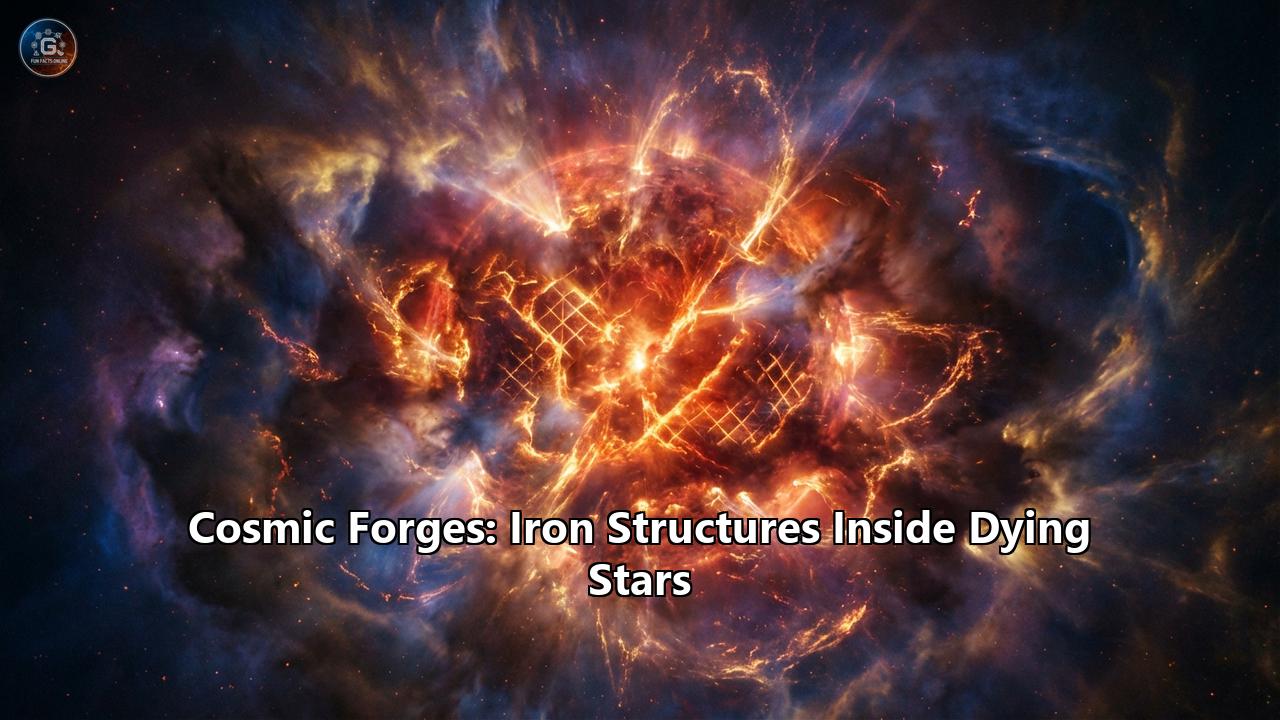
The cosmos is not a silent void, but a symphony of matter and energy, conducted by the fundamental forces of physics. Among the most dramatic movements in this celestial opera are the final moments of massive stars—titanic entities that spend their lives fighting a war against their own gravity. In the deep, crushing dark of their interiors, these stars act as cosmic forges, transmuting the simplest elements into the building blocks of the universe. But for every massive star, there comes a moment when the forging stops, when the fuel runs dry, and the structure that held up the sky for millions of years gives way. This is the story of that final, fatal architecture: the iron structures inside dying stars.
Part I: The Stellar Engine
To understand the end, we must understand the beginning. A star is, in essence, a balancing act. Gravity pulls inward, seeking to crush the star into a singularity. Opposing this is the outward pressure generated by nuclear fusion in the core. For the vast majority of a star’s life, it fuses hydrogen into helium. This process, the proton-proton chain or the CNO cycle in more massive stars, releases tremendous amounts of energy, creating the thermal pressure necessary to hold gravity at bay.
But massive stars—those with more than eight times the mass of our Sun—are voracious. They burn through their hydrogen fuel not in billions of years, but in millions. When the hydrogen core is exhausted, the star contracts, heats up, and ignites helium to form carbon and oxygen. This pattern repeats, a cascading ladder of elements, each stage shorter and more desperate than the last. Carbon fuses to neon, neon to oxygen, oxygen to silicon.
With each step, the star must compress its core further to reach the temperatures required for the next fusion reaction. The core becomes denser, hotter, and smaller, surrounded by concentric shells of burning fuel. It resembles a cosmic onion: a layer of hydrogen burning on the outside, shielding layers of helium, carbon, neon, and oxygen burning below. And at the center, the final ash of this nuclear fire waits to be burned.
That ash is silicon.
Part II: The Silicon Burning Phase – The Final Day
The timescales of stellar evolution are usually measured in eons. But for a massive star entering its silicon-burning phase, the clock has accelerated to a frantic pace. While hydrogen burning lasted millions of years, and carbon burning took perhaps a few thousand, the silicon burning phase is fleeting. In a star twenty-five times the mass of the Sun, the entire supply of silicon fuel—a mass equivalent to several Earths—is consumed in a single day.
The conditions required to fuse silicon are truly hellish. The core temperature soars to over 3 billion Kelvin. At these extremes, photons (particles of light) become so energetic that they can shatter atomic nuclei, a process known as photodisintegration. The star is no longer just fusing nuclei; it is simultaneously breaking them apart and re-fusing them in a chaotic, thermal frenzy.
Silicon fusion is not a simple merging of two silicon atoms. Instead, it is a complex rearranging of alpha particles (helium nuclei). Silicon-28 captures an alpha particle to become Sulfur-32, which captures another to become Argon-36, and so on. The ladder climbs through Calcium, Titanium, Chromium, and finally, it reaches the peak.
The end product of this frantic day of fusion is not iron directly, but Nickel-56. However, Nickel-56 is unstable; it decays quickly (via positron emission) into Cobalt-56, and then into Iron-56. For the purposes of the star’s structure, however, the result is the same: the accumulation of an inert, metallic core.
This is the "Iron Core," the ultimate slag heap of the stellar furnace. And its formation marks the beginning of the end.
Part III: The Nuclear Dead End
Why iron? Why does the star stop there? The answer lies in the laws of nuclear physics, specifically the curve of nuclear binding energy.
Every atomic nucleus is held together by the strong nuclear force, which overcomes the electromagnetic repulsion between positively charged protons. "Binding energy" is essentially the energy you would need to pull a nucleus apart into its constituent protons and neutrons. Conversely, it is the energy released when that nucleus is formed.
For light elements like hydrogen, fusing them into heavier elements like helium releases a massive amount of energy because helium is much more tightly bound than hydrogen. The curve of binding energy rises steeply. This "exothermic" reaction provides the heat that supports the star.
However, this curve flattens out and reaches a peak at Iron-56. Iron-56 is one of the most tightly bound nuclei in existence. Its protons and neutrons are packed so efficiently, with such perfect balance, that fusing iron into anything heavier (like zinc or krypton) actually consumes energy rather than releasing it. It is an endothermic process.
When the star’s core turns to iron, the engine dies. There is no more energy to be extracted by fusion. The star has reached a nuclear cul-de-sac. It is generating no heat to push back against the crushing weight of the outer layers. The iron core is not a fuel source; it is a weight, a gravitational anchor dragging the star down into oblivion.
Part IV: Inside the Iron Core – A Realm of Degenerate Matter
What is the physical nature of this iron core? To the human imagination, "iron structure" might suggest a solid lattice, like a girder or an anvil. But the conditions inside a dying star are far beyond the realm of terrestrial solids.
The iron core is a plasma, but a plasma of a very specific and exotic kind. The temperature is in the billions of degrees, stripping every electron from the iron nuclei. These nuclei float in a sea of free electrons. But the density is the true defining feature. The core is packed so tight that it has a density of about $10^9$ grams per cubic centimeter. A teaspoon of this matter would weigh thousands of tons.
At these densities, the behavior of the matter is governed by quantum mechanics. The electrons, being fermions, obey the Pauli Exclusion Principle, which states that no two electrons can occupy the same quantum state simultaneously. Because they are packed so closely together, the electrons are forced into higher and higher energy states just to avoid overlapping. They are moving at relativistic speeds, not because of heat, but because of confinement.
This creates a pressure known as "electron degeneracy pressure." It is this quantum pressure, not thermal heat, that supports the iron core against gravity. The core is effectively a giant, sphere of degenerate iron gas, held up by the refusal of electrons to be squeezed any tighter.
This structure is incredibly rigid. Unlike a normal gas, which expands when heated, a degenerate gas does not. If you added heat to this iron core, it wouldn't expand; the pressure wouldn't change. It sits there, a dense, hot, metallic sphere roughly the size of the Earth, embedded in the center of a star millions of times larger.
Part V: The Architecture of the Abyss
Let us visualize the "structure" of the star in these final hours.
- The Iron Core: At the center, a sphere of degenerate iron, roughly 3,000 to 6,000 kilometers in radius. It is silent, dark (to the eye, though glowing in X-rays/Gamma rays), and terrifyingly heavy. It is growing, minute by minute, as the silicon shell above it rains down more iron ash.
- The Silicon Shell: Immediately surrounding the iron core is a furious shell of silicon burning. This region is violently convective. Massive plumes of plasma, driven by the intense heat of fusion, churn and mix the material. It is a turbulent inferno, processing silicon into iron at a rate of thousands of solar masses per second.
- The Onion Layers: Above the silicon shell lie the other active shells: oxygen burning, neon burning, carbon burning, helium burning, and hydrogen burning. Each layer has a different density, temperature, and composition. The boundaries between these shells are often sharp, maintained by the different physics required for each fusion process. The star is a stratified object, a Matryoshka doll of nuclear fire.
- The Envelope: Far above the core, the star’s outer envelope of hydrogen is so distant that it is barely affected by the drama unfolding in the center. To an outside observer, the star might look like a red supergiant—Betelgeuse is a prime example. It might pulsate slightly, but the surface gives no hint of the catastrophe imminent in the core.
There is, however, a critical flaw in this architecture. The iron core is sustained by electron degeneracy pressure, but this support has a limit. This limit was calculated by the astrophysicist Subrahmanyan Chandrasekhar in the 1930s. He showed that electron degeneracy can only support a mass up to about 1.4 times the mass of the Sun. This is the "Chandrasekhar Limit."
As the silicon shell continues to burn, it dumps more and more iron "ash" onto the core. The core mass creeps upward: 1.2 solar masses, 1.3... 1.35...
Part VI: The Trigger
The moment the iron core exceeds the Chandrasekhar limit, the structure fails. The electrons, already moving at near light speed, can no longer exert enough pressure to counteract gravity. The balance that held the core for the last day—and the star for the last millions of years—vanishes.
The collapse begins.
It is not a slow crumble; it is a free-fall. The iron core, an Earth-sized sphere of matter, collapses in on itself at velocities reaching 70,000 kilometers per second—nearly 25% the speed of light.
Part VII: The Collapse – Into the Forge
In the fraction of a second that the collapse takes, two critical physical processes destroy the iron nuclei, undoing the work of millions of years.
- Photodisintegration: As the core collapses, the temperature spikes to over 100 billion Kelvin. The photons are now so energetic that they smash the iron nuclei to pieces. The reaction $\text{Fe} + \gamma \rightarrow 13\text{He} + 4\text{n}$ reverses the fusion process. This is highly endothermic; it sucks thermal energy out of the core, accelerating the collapse even further. The "iron structure" is literally vaporized back into helium and neutrons.
- Neutronization (Electron Capture): The density becomes so high that electrons are squeezed into the protons of the atomic nuclei. They combine to form neutrons and neutrinos: $p + e^- \rightarrow n + \nu_e$. This removes the electrons that were providing the support pressure. It also releases a flood of neutrinos.
The core transforms from a sphere of iron ions and electrons into a sphere of pure neutrons. The density rockets from $10^9$ g/cm³ to $10^{14}$ g/cm³—the density of an atomic nucleus.
The collapse continues until the neutrons themselves are squeezed so tightly that they touch. At this point, "neutron degeneracy pressure" kicks in. The strong nuclear force, which is usually attractive, becomes repulsive at these insanely short distances.
The inner part of the core slams into this wall of nuclear density and stops dead. The overshooting material bounces off this incomprehensibly hard neutron sphere. This is the "core bounce."
Part VIII: The Shockwave and the Supernova
The bounce creates a shockwave that starts moving outward. It smashes into the infalling outer layers of the core, which are still rushing inward at relativistic speeds.
For decades, astrophysicists struggled to simulate this moment. In many computer models, the shockwave would stall, overwhelmed by the pressure of the infalling matter. The star would fail to explode, simply collapsing into a black hole.
We now believe that neutrinos play the savior role. The core collapse releases a gravitational binding energy of $10^{53}$ ergs, 99% of which is carried away by neutrinos. Usually, neutrinos pass through matter like ghosts. But the density of the collapsing core is so high that it is opaque even to neutrinos. They get trapped, depositing some of their energy into the stalled shockwave, reheating it.
Turbulence also plays a massive role here. The chaotic, convective churning of the plasma behind the shockwave (SASI - Standing Accretion Shock Instability) breaks the symmetry of the collapse, allowing the hot bubbles of neutrino-heated gas to push the shockwave outward.
The revived shockwave blasts through the silicon shell, the oxygen shell, and the rest of the star. As it passes through these layers, the intense pressure and heat trigger "explosive nucleosynthesis." In seconds, the shockwave fuses more elements than the star created in its entire lifetime. It creates radioactive nickel, calcium, radioactive titanium, and zinc.
When the shockwave reaches the surface, the star explodes. This is a Type II Supernova. For a few weeks, this single dying star can outshine an entire galaxy of billions of stars.
Part IX: The R-Process – The True Forge
The iron core was the end of the line for fusion, but the supernova explosion is the beginning of the line for neutron capture.
During the explosion, the flux of neutrons is so high that atomic nuclei can capture them faster than they can decay. This is the Rapid Neutron Capture Process (r-process). It is here, in the violent chaos of the supernova shockwave (and in the collision of neutron stars), that the universe forges the elements heavier than iron.
Gold, platinum, uranium, thorium—these are not made in the quiet burning of stars. They are the shrapnel of the explosion. The gold in a wedding ring was likely forged in the shockwave of a collapsing iron core billions of years ago.
Part X: Legacy
What remains?
At the center of the explosion, the iron core is gone. In its place sits a Neutron Star—a city-sized ball of neutrons, spinning hundreds of times a second, possessing magnetic fields trillions of times stronger than the Earth's. If the original star was massive enough (perhaps 20+ solar masses), even the neutron pressure fails, and the core collapses infinitely to form a Black Hole.
The rest of the star—the hydrogen, the helium, the carbon, the oxygen, and the newly minted heavy metals—is blasted out into the interstellar medium. These expanding clouds of debris, known as supernova remnants, are the seeds of the future. They mix with cold gas clouds, enriching them with metals.
Gravity pulls these enriched clouds together to form new stars. But these second-generation stars (like our Sun) now contain the iron and heavy elements forged in the deaths of their ancestors.
This is the profound connection between the "iron structures" of dying stars and our own existence. The iron in your blood, the hemoglobin that carries oxygen to your brain, was created in the silicon-burning shell of a massive star. It was liberated by the collapse of an iron core. We are, quite literally, made of star-stuff—the recycled debris of cosmic forges that burned out long before the Earth was born.
Conclusion
The iron structure inside a dying star is a paradox. It is the pinnacle of nuclear stability, yet it is the harbinger of total collapse. It is a rigid sphere of degenerate matter that triggers the most violent explosion in nature. It is a dead end that paves the way for new beginnings.
In the grand architecture of the cosmos, these iron cores are the keystones. When they fail, the resulting cataclysm scatters the seeds of life across the galaxy. The silence of the iron core is fleeting—a momentary pause before the thunder that shapes the universe.
Reference:
- https://www.youtube.com/watch?v=9LX8P6JVCpg
- https://courses.lumenlearning.com/towson-astronomy/chapter/evolution-of-massive-stars-an-explosive-finish/
- https://en.wikipedia.org/wiki/Iron-56
- http://hyperphysics.phy-astr.gsu.edu/hbase/NucEne/nucbin.html
- https://preparatorychemistry.com/Nuclear_Energy.pdf
- https://www.schoolsobservatory.org/learn/space/stars/evolution
- https://www.ucolick.org/~woosley/ay220-19/lectures/lecture13.4x.pdf
- https://www.youtube.com/watch?v=8cLeKy3nZiE