
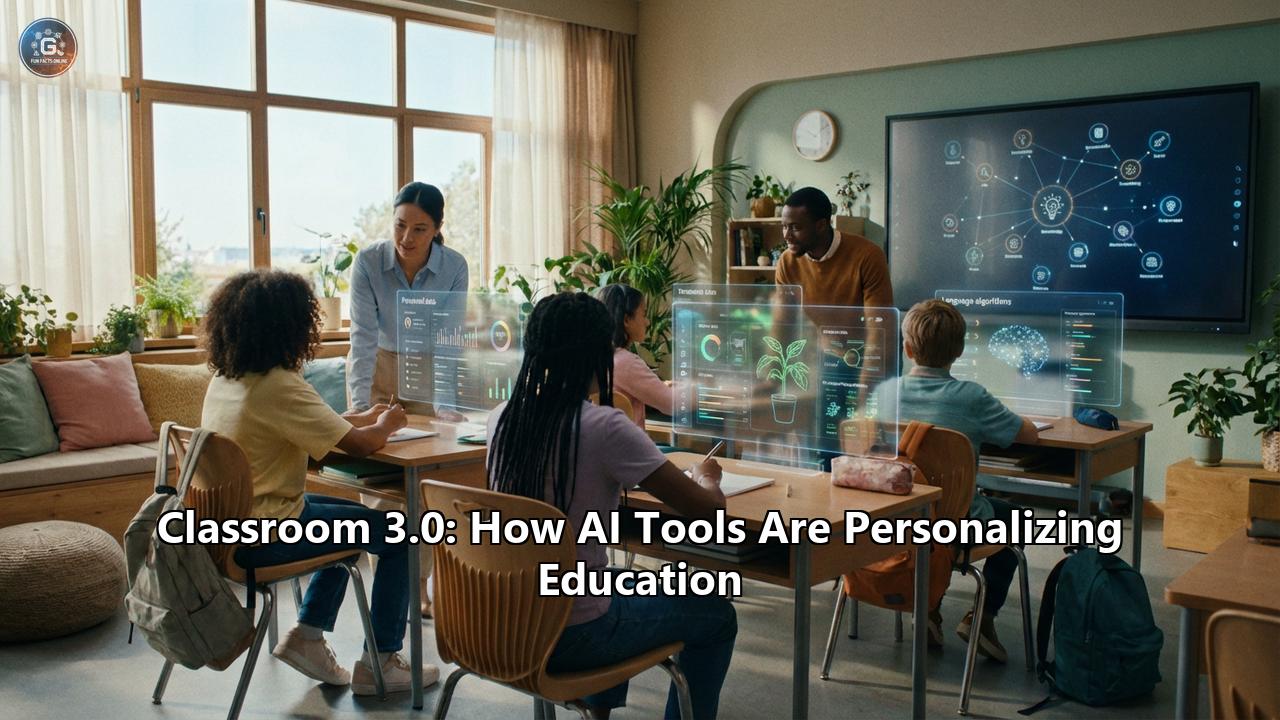
The faint hum of a computer server has replaced the scratching of chalk on a blackboard, but the most profound sound in the modern classroom is not the technology itself—it is the silence of students deeply engaged in work that was made specifically for them. We have entered the era of Classroom 3.0, a pedagogical revolution where the "factory model" of education—one size fits all, delivered en masse—is finally being dismantled. In its place rises a hyper-personalized, adaptive, and data-driven ecosystem powered by Artificial Intelligence.
For over a century, the education system struggled with Bloom’s "2 Sigma Problem": the finding that the average student tutored one-to-one performs two standard deviations better than students educated in a conventional classroom. It was an economic impossibility to provide a human tutor for every child on Earth. Today, however, AI has rendered that impossibility obsolete. By 2026, we are no longer just digitizing textbooks; we are personalizing the very neural pathways of learning.
This is the comprehensive story of how AI tools are reshaping education, moving us from the static curriculum of the past to the living, breathing, and adapting Classroom 3.0.
Part I: The Evolution of the Learning Space
To understand the magnitude of Classroom 3.0, we must first contextualize the eras that preceded it. The history of the classroom is a history of information delivery mechanisms.
Classroom 1.0: The Factory Model (Industrial Age)
Classroom 1.0 was built for the industrial economy. It prioritized standardization, compliance, and rote memorization. Knowledge was scarce and held exclusively by the teacher and the textbook. The structure was rigid: rows of desks facing forward, bell schedules reminiscent of factory shifts, and a standardized curriculum that treated every 10-year-old as having the exact same cognitive needs. If a student fell behind, they were "remedial"; if they surged ahead, they were "disruptive" or bored. The system was designed for the average, a mathematical phantom that does not exist.
Classroom 2.0: The Digital Facelift (Information Age)
The turn of the millennium brought the internet, and with it, Classroom 2.0. We saw the introduction of Smartboards, laptops, and Learning Management Systems (LMS) like Blackboard and Canvas. However, Classroom 2.0 was largely a skeuomorphic shift—we took old processes and digitized them. A PDF textbook is still a static textbook. A Zoom lecture is still a lecture. While access to information exploded, the method of instruction remained largely linear. Technology was an add-on, a distraction, or at best, a more efficient filing cabinet. The fundamental dynamic of one teacher broadcasting to thirty students remained unchanged.
Classroom 3.0: The Adaptive Ecosystem (The AI Age)
Classroom 3.0 is not about hardware; it is about agency and adaptability. In this model, the learner is at the center. Technology moves from being a tool to being an infrastructure—an invisible layer of intelligence that supports every interaction.
- The Shift: From "Teacher-Centric" to "Learner-Centric."
- The Method: From "Standardized" to "Hyper-Personalized."
- The Role of Tech: From "Presentation" to "Prediction and Adaptation."
In Classroom 3.0, AI tools act as force multipliers. They do not replace the teacher; they liberate them. By offloading the cognitive load of grading, data tracking, and basic remediation to algorithms, teachers are freed to do what no machine can: mentor, inspire, and facilitate complex emotional and social growth.
Part II: The Science of Personalization
How does AI actually personalize education? It’s not magic; it’s a convergence of three distinct technologies: Adaptive Learning Algorithms, Natural Language Processing (NLP), and Predictive Analytics.
1. The Adaptive Loop
Traditional software follows a decision tree: If answer is wrong, show error message. AI adaptive systems, however, function like a topographical map.
Imagine a student, Maya, learning algebra. She struggles with quadratic equations. A traditional platform might just make her repeat the quiz. An AI platform, such as Century Tech or DreamBox, analyzes why she got it wrong.
- Did she fail because she doesn't understand the formula?
- Did she fail because of a simple calculation error?
- Did she fail because she actually lacks the foundational knowledge of factoring, which was taught three weeks ago?
The AI diagnoses the root cause—a gap in factoring—and immediately reroutes Maya’s learning path. It serves her a micro-lesson on factoring, verifies her mastery, and then brings her back to quadratics. This is "scaffolding" at scale. The system is constantly recalibrating the "Zone of Proximal Development" (Vygotsky’s theory) for every single student simultaneously.
2. Generative AI and the Socratic Method
With the advent of Large Language Models (LLMs) like GPT-4o, Claude 3.5, and Gemini, personalization has moved from multiple-choice logic to conversational depth.
Tools like Khanmigo (by Khan Academy) do not just give answers. They are programmed to act as Socratic tutors.
- Student: "What is the answer to this physics problem?"
- Khanmigo: "I can't give you the answer, but let's look at the forces acting on the object. What acts on the ball when it's in the air?"
This conversational interface allows students to ask "stupid" questions without fear of judgment. It allows for infinite patience. An AI tutor never gets tired, never gets frustrated, and is available at 2 AM. This is the democratization of elite tutoring.
3. Predictive Analytics and Early Intervention
In Classroom 2.0, a teacher realized a student was failing when they graded the midterm exam. By then, it was often too late.
In Classroom 3.0, predictive analytics act as an early warning radar. Systems can analyze thousands of data points—time spent on a task, mouse movement hesitation, click patterns, and even sentiment analysis from discussion board posts.
If a student’s engagement drops by 15% over two weeks, the AI flags the teacher: "Student X is showing signs of disengagement and is at high risk of falling behind in Module 4." The teacher can intervene before the failure happens. This shifts the pedagogical model from reactive to proactive.
Part III: The Toolkit – The Engines of Classroom 3.0
The abstract concepts of AI are manifesting in tangible, powerful tools that are currently reshaping schools (K-12) and Higher Education.
1. The Intelligent Tutors
- Khanmigo: Perhaps the gold standard for GenAI in schools. It sits inside the Khan Academy ecosystem, guiding students through math, science, and humanities. It also assists teachers by generating lesson hooks and rubric criteria.
- Duolingo: Long known for gamification, its "Duolingo Max" tier uses GPT-4 to explain why an answer was wrong (Roleplay and Explain My Answer features), turning language learning into a two-way conversation rather than rote translation.
- Synthesia & HeyGen: These AI video generation tools allow educators to create avatars that speak in over 60 languages. A history teacher can create a lecture where "Abraham Lincoln" explains the Gettysburg Address, or translate their own lecture into Spanish and Mandarin for ESL students, preserving their own voice and lip-sync.
2. The Grading and Assessment Bots
- Gradescope: This tool has revolutionized STEM grading in universities. It uses computer vision to group similar answers together. If 50 students make the exact same calculation error, the professor grades it once, and the AI applies that feedback to all 50 papers instantly. It creates consistency and saves hundreds of hours.
- Turnitin & GPTZero: The "policing" side of AI. While controversial, these tools are evolving to detect AI-generated plagiarism, though the focus is shifting from "detection" to "process tracking" (monitoring the document history to ensure human effort).
3. The Content Architects
- Curipod: A tool that generates interactive slide decks in seconds. A teacher types "Lesson on Photosynthesis for 5th graders," and Curipod builds slides, polls, word clouds, and open-ended drawing tasks.
- Diffit: A game-changer for differentiation. A teacher can take a complex text (e.g., a NASA article), and Diffit will instantly rewrite it into three different reading levels (5th grade, 8th grade, 11th grade) and generate summary questions for each. This ensures that a dyslexic student and a gifted student can discuss the same topic, accessing the content at their own level.
4. The Accessibility Engines
- Microsoft Immersive Reader: While older, its integration of AI has made it potent. It can isolate parts of speech, read text aloud in natural voices, and translate picture dictionaries.
- Otter.ai & Fireflies: For students with auditory processing disorders or ADHD, these tools transcribe lectures in real-time, summarizing key points and capturing action items. The student doesn't need to panic about taking notes; they can focus on listening.
Part IV: The Human Impact
The introduction of these tools is not just a technical upgrade; it is a sociological shift in the classroom.
The Student Experience: Agency and Mastery
In the traditional classroom, time is the constant and learning is the variable. The class moves on to Chapter 5 on Tuesday, whether you understood Chapter 4 or not.
Classroom 3.0 flips this: Learning is the constant, and time is the variable. This is "Mastery Learning."
With AI tools, a student can spend three weeks on Chapter 4 if they need to, while their peer moves to Chapter 6. The stigma of "being behind" dissipates because the screen is private. The "shame factor" of raising one's hand to ask a "dumb question" is eliminated when the question is directed at a chatbot.
- Case Study: In a pilot program using adaptive math software, students who were two years behind grade level caught up in a single semester because the software relentlessly targeted their foundational gaps (e.g., fractions) rather than forcing them to fail at the current curriculum (e.g., algebra).
The Teacher Experience: From Lecturer to Facilitator
The fear that "AI will replace teachers" is largely unfounded. Instead, AI replaces the drudgery of teaching.
According to a McKinsey report, teachers spend 20-40% of their time on administrative tasks (grading, attendance, lesson planning). Classroom 3.0 automates this.
- The New Role: The teacher becomes a "Learning Engineer" and a mentor. When the AI handles the delivery of content and the grading of quizzes, the teacher is free to walk around the room. They spend their time doing small-group interventions, leading Socratic seminars, and managing the emotional climate of the room.
- Burnout Reduction: By generating lesson plans, rubrics, and emails to parents in seconds, AI tools are a potential cure for the chronic teacher burnout crisis that has plagued the profession post-2020.
Part V: The Challenges and The Ethics
We cannot paint a utopian picture without addressing the significant risks. Classroom 3.0 brings "The Datafication of Childhood."
1. Privacy and Surveillance
To personalize learning, AI needs data. A lot of it. It needs to know not just what a student knows, but how they think, when they get tired, and what motivates them.
- The Risk: Who owns this data? If a 3rd grader tells an emotional support chatbot about troubles at home, is that reported? Will a "permanent record" of a student's cognitive struggles prevent them from getting into college ten years later?
- The Regulation: Frameworks like GDPR (Europe) and COPPA (USA) are struggling to keep up. Schools must navigate the fine line between "helpful monitoring" and "Orwellian surveillance."
2. The Bias in the Algorithm
AI models are trained on human data, which is historically biased.
- The Risk: If an algorithm predicts which students are "at risk" of dropping out based on historical data, it may unfairly flag students from minority or lower socioeconomic backgrounds, creating a self-fulfilling prophecy. If the training data for an essay grader prefers "academic standard English," it may penalize students who write in African American Vernacular English (AAVE) or other dialects, labeling them as "less intelligent."
3. The "Cheating" Crisis and the Death of the Essay
The immediate reaction to ChatGPT was panic. "The essay is dead!"
- The Reality: The essay as a test of memory is dead. The essay as a test of thinking must evolve. We are moving toward "Process Assessment." Instead of grading the final paper, teachers (and AI tools) grade the version history, the prompt engineering, and the critique.
- Cognitive Atrophy: There is a valid fear that if AI does the thinking for us, students will lose the ability to synthesize information. The counter-argument is the calculator. We no longer calculate square roots by hand, yet we still do math. AI may simply shift the cognitive baseline higher.
4. The Digital Divide 2.0
In the past, the divide was having a computer vs. not having one. In Classroom 3.0, the divide is access to premium AI.
- The Gap: Wealthy districts will afford "Khanmigo" ($4/student/month) and enterprise licenses for adaptive platforms. Underfunded districts will rely on the free, less capable, or ad-supported versions of these tools. This could exacerbate the achievement gap, creating a tier of students who have "AI Tutors" and a tier who do not.
Part VI: The Future Landscape (2026-2030)
As we look toward the latter half of the decade, the integration will deepen. We are moving toward "Agentic AI".
Agentic Workflows
Current AI waits for a prompt. Agentic AI acts on goals.
- Scenario: A teacher sets a goal: "Ensure all students master photosynthesis by Friday."
- The Agent: The AI analyzes the class data. It automatically assigns a video to Group A, a reading passage to Group B, and schedules a small-group seminar for Group C. It emails the parents of three students who are absent, sending them the materials. It creates a quiz based on the specific misconceptions revealed in yesterday's exit ticket. It does this autonomously, asking the teacher only for approval.
VR/AR and Experiential Learning
Classroom 3.0 will merge with the spatial web. Apple Vision Pro and Meta Quest headsets, powered by AI, will allow for "impossible field trips."
- Instead of reading about the Roman Forum, students will walk through it. An AI guide (resembling Julius Caesar) will answer their questions in real-time, adapting the complexity of his language to the age of the student.
- Medical students will practice surgery on AI-generated holographic patients that bleed, react, and have complications specific to the learning objectives of the day.
Lifelong Learning Credentials
The concept of a "degree" may fragment. AI-driven platforms allow for "micro-credentialing." A student might leave high school not just with a diploma, but with verifiable, blockchain-backed certifications in Python, Data Literacy, and Project Management, earned through adaptive coursework that they completed at their own pace.
Conclusion: The Human in the Loop
Classroom 3.0 is not a story about machines taking over; it is a story about humanity scaling up.
For too long, we have treated education as a scarcity—scarce attention from teachers, scarce resources, scarce time. AI creates abundance. It gives every child a tutor. It gives every teacher a teaching assistant.
However, the "human in the loop" remains the critical fail-safe. An AI can teach a child how to read, but it cannot teach them to love reading. An AI can grade an essay on ethics, but it cannot instill empathy. The schools that succeed in this new era will be those that use AI to handle the transfer of information, so that humans can focus on the transformation of the soul.
As we embrace these tools, we must remain vigilant guardians of privacy and equity, but we must also be bold optimists. The tools to solve the global education crisis are finally in our hands. The classroom is no longer a box; it is an infinite network of personalized possibilities. Welcome to Classroom 3.0.
Reference:
- https://openelms.com/2026/01/learning-technology-trends-2026-ai-driven-future/
- https://www.eschoolnews.com/innovative-teaching/2026/01/01/draft-2026-predictions/
- https://www.almabetter.com/bytes/articles/the-future-of-learning-top-ai-tools-for-students-in-2026
- https://www.ecampusnews.com/digital-innovation/2026/01/01/draft-2026-predictions/
- https://medium.com/@meisshaily/how-ai-education-tools-will-revolutionize-learning-by-2026-2ee506818f25
- https://www.engageli.com/blog/ai-in-education-statistics
- https://strata-hq.co.uk/blog/best-ai-education-tools-2026
- https://www.iseazy.com/glossary/education-3-0/
- https://www.enrollify.org/blog/ai-in-education-statistics
- https://devoxsoftware.com/blog/the-next-wave-of-adaptive-learning-and-strategic-roadmap-2026/
- https://cdn-dynmedia-1.microsoft.com/is/content/microsoftcorp/microsoft/bade/documents/products-and-services/en-us/education/2025-Microsoft-AI-in-Education-Report.pdf
- https://academync.com/articles/ai-privacy-risks-in-education-how-to-protect-student-data-from-ai-tools-2025
- https://www.mdpi.com/2227-7102/15/3/343
- https://www.frontiersin.org/journals/education/articles/10.3389/feduc.2025.1565938/full
- https://rsisinternational.org/journals/ijriss/articles/the-influence-of-privacy-bias-and-surveillance-concerns-on-teachers-willingness-to-use-artificial-intelligence-in-education/
- https://elearningindustry.com/ai-in-education-personalized-learning-platforms