
The Frankenstein Event: An Accidental Discovery
It began with a mistake—or rather, a moment of confusion—in a laboratory tank at the Marine Biological Laboratory in Woods Hole, Massachusetts. Dr. Kei Jokura and his team were conducting routine research on Mnemiopsis leidyi, a translucent, walnut-sized marine invertebrate commonly known as the warty comb jelly. These creatures are standard subjects in marine biology, known for their resilience and their shimmering, rainbow-colored comb rows. But on this particular day, Jokura noticed something that shouldn’t have existed.
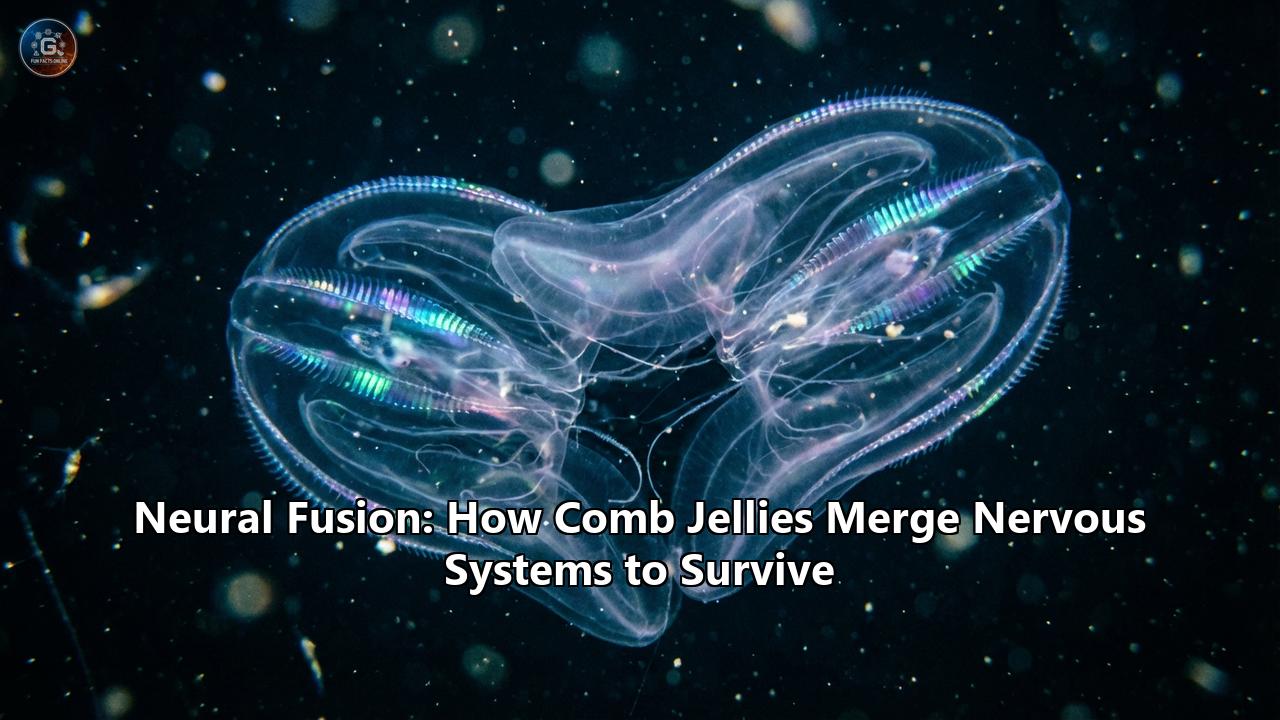
Floating in the tank was a comb jelly that looked wrong. It was unusually large and possessed two distinct aboral ends (the rear of the animal) and two sensory apical organs instead of the usual one. It looked as if two separate animals had been stitched together.
To the untrained eye, it might have appeared to be a birth defect or a conjoined twin. But to Jokura and his colleagues, it sparked a radical hypothesis. Could these ancient, gelatinous creatures have fused together?
To test this, the team performed what they later jokingly referred to as "Frankenstein experiments." They took separate individuals of Mnemiopsis leidyi, surgically removed small portions of their varied lobes (wings) to create injury sites, and placed them in close contact.
The results were staggering. In 9 out of 10 trials, the two injured jellies did not just heal; they merged. Within a single night, the boundary between the two animals vanished. They became a single, seamless entity. But the true shock came when the researchers prodded one side of the new, fused creature. The entire body flinched. The nervous systems had not just touched; they had integrated. The two animals were now thinking, feeling, and reacting as one.
One Mind, Two Bodies: The Mechanics of Neural Fusion
The fusion of two nervous systems is a concept that belongs in the realm of science fiction. In the vast majority of the animal kingdom, such a feat is biologically impossible. If you were to graft a nerve from one human to another, the recipient's immune system would attack the foreign tissue, and even if immunosuppressed, the complex synaptic connections would fail to wire together meaningfully.
Yet, the comb jellies achieved this in hours. The study, published in Current Biology in late 2024, detailed how mechanical stimulation applied to one lobe of the fused animal resulted in a synchronized muscle contraction on the opposite side. This "startle response" confirmed that action potentials—the electrical signals that carry information through nerve cells—were traveling freely across the fusion site.
Within just two hours of fusion, 95% of the muscle contractions were completely synchronized. This speed suggests that the neurons of Mnemiopsis leidyi possess a unique architecture that allows for rapid reconnection.
The Syncytial Nerve Net: Vindicating Golgi
To understand how this is possible, we must look at the microscopic structure of the ctenophore nervous system. For over a century, neuroscience has been dominated by the Neuron Doctrine, proposed by Santiago Ramón y Cajal, which states that the nervous system is made of discrete, individual cells (neurons) that communicate across gaps called synapses. This theory displaced Camillo Golgi’s Reticular Theory, which argued that the nervous system was a continuous meshwork, or "syncytium," where nerve cells were physically fused.
While the Neuron Doctrine holds true for humans and almost all other animals, recent electron microscopy studies on ctenophores have dropped a bombshell: Golgi was partially right.
Research indicates that the nerve net of Mnemiopsis leidyi is, at least in part, syncytial. Their neurons are not always separated by synapses; instead, they can be fused, sharing a continuous membrane and cytoplasm. This "fused" architecture likely facilitates the rapid merging of two individuals. When the tissues of two injured comb jellies touch, their nerve nets may simply "plug in" to one another, restoring the continuous meshwork without the need to re-establish complex synaptic architecture from scratch.
The Death of the "Self": A Lack of Allorecognition
The ability to fuse raises a profound biological question: How do these animals distinguish "self" from "other"?
In almost all metazoans (multicellular animals), there is a sophisticated system known as allorecognition. This is the biological I.D. card system that allows your immune system to recognize your own cells and attack anything else—be it a virus, a bacteria, or a kidney transplant from another person.
The fusion of Mnemiopsis leidyi suggests they lack this system entirely, or at least possess a version of it so primitive that it does not prevent fusion with others of their species. When the tissues of two comb jellies meet, they do not see an invader; they see an opportunity.
This absence of allorecognition is incredibly rare. Even simple organisms like hydra or sponges usually have mechanisms to reject grafts from genetically distinct individuals. The fact that Mnemiopsis lacks this barrier suggests that, for them, the survival benefit of quickly sealing a wound—even if it means merging with a neighbor—outweighs the risks of losing genetic individuality.
Digestive Integration
The fusion wasn't limited to nerves. The researchers observed that the digestive tracts also merged. When they fed fluorescently labeled brine shrimp to one "mouth" of the fused chimera, the food particles were visible traveling through the canals of both fused bodies. The creature could eat with one mouth and nourish the entire dual-body system. However, interestingly, they did not defecate in unison; the waste was expelled from the two separate anuses at different times, suggesting that while the input was shared, the output control remained somewhat localized.
The Conqueror of the Seas: Profile of an Invader
To fully appreciate this discovery, one must understand the animal behind it. Mnemiopsis leidyi is not just a passive jelly drifting in the current; it is one of the most resilient and successful invasive species on the planet.
Native to the western Atlantic coast, from the US to South America, the "sea walnut" has conquered the world. In the 1980s, it was accidentally introduced into the Black Sea via the ballast water of cargo ships. In an ecosystem devoid of its natural predators, the population exploded.
- The Black Sea Collapse: At its peak in 1989, there were an estimated 400 specimens per cubic meter of water in the Black Sea. The jellies devoured the zooplankton that local fish relied on, causing a catastrophic collapse of the anchovy fisheries and devastating the local economy.
- A Voracious Predator: Unlike jellyfish that wait for prey to hit their tentacles, Mnemiopsis is an active hunter. It creates a hydrodynamically silent current using its cilia to suck prey into its mouth, effectively acting as a stealth vacuum cleaner.
- The "Colloblast" Weapon: They do not sting. Instead of the venomous nematocysts found in jellyfish (cnidarians), ctenophores possess colloblasts—specialized cells on their tentacles that burst upon contact, releasing a spiral filament coated in a super-strong adhesive. They literally glue their prey to death.
This history of extreme resilience and adaptability aligns perfectly with the new discovery of their fusion capabilities. An animal that can regenerate from a fraction of its body, withstand vast temperature and salinity changes, and now, fuse with its neighbors to survive injury, is a true biological tank.
Aliens Among Us: The Evolutionary Context
Ctenophores are often described as the "aliens of the sea," and genetically, this is not far from the truth. There is a fierce, ongoing debate in evolutionary biology known as the "Ctenophore-first" vs. "Porifera-first" hypothesis.
Traditionally, sponges (Porifera) were considered the oldest, most basal lineage of animals because they lack tissues and nervous systems. However, genomic analysis has repeatedly suggested that Ctenophores might actually be the sister group to all other animals.
If Ctenophores branched off before sponges, it implies one of two earth-shattering possibilities:
- The Common Ancestor had a Nervous System: The ancestor of all animals had a nervous system, which sponges and placozoans subsequently lost.
- Independent Evolution: The nervous system evolved twice. Once in the lineage leading to Ctenophores, and independently in the lineage leading to jellyfish, humans, and all other animals.
The discovery of the syncytial (fused) nerve net supports the second hypothesis. It suggests that ctenophores built a brain using a completely different architectural blueprint than the rest of the animal kingdom. They are, in a sense, a separate experiment in complex life—an alternate evolutionary path that nature took 600 million years ago.
Rewriting the Rules of Regeneration
The implications of this study extend far beyond marine biology. Mnemiopsis leidyi has now provided a model for "scarless wound healing" and "perfect tissue integration" that medicine can currently only dream of.
- Regenerative Medicine: Humans are terrible at regeneration. We patch wounds with scar tissue, which lacks the function of the original skin. Comb jellies heal by regenerating the exact tissue architecture that was lost. Understanding the molecular signals that allow their nerves to reconnect so seamlessly could provide targets for nerve regeneration therapies in humans.
- Transplant Science: The lack of immune rejection in Mnemiopsis fusion offers a unique window into the mechanics of tolerance. While we cannot simply "turn off" the human immune system, studying how these jellies manage to integrate foreign tissue without inflammation could inspire new approaches to organ transplantation.
Conclusion: The Indivisible Jelly
The discovery that Mnemiopsis leidyi can fuse into a single, synchronized entity is a reminder that our definitions of "individual" are not universal. In the human world, we are solitary fortresses, biologically walled off from one another. In the world of the comb jelly, the boundaries of the self are fluid.
They are ancient, they are resilient, and they are stranger than we ever imagined. As they drift through the ocean's twilight zone, flashing their rainbow lights, they carry with them the secrets of the first nervous systems and the potential to rewrite the rules of life itself. The "sea walnut" is no longer just an invasive pest; it is a window into the deep, alternate history of evolution.
Reference:
- https://scitechdaily.com/when-two-become-one-the-astonishing-fusion-of-comb-jellies/
- https://www.sci.news/biology/mnemiopsis-leidyi-rapid-physiological-integration-13322.html
- https://www.advancedsciencenews.com/fused-comb-jellies-share-their-secrets-of-regeneration/
- https://www.biorxiv.org/content/10.1101/2022.08.14.503905.full
- https://pmc.ncbi.nlm.nih.gov/articles/PMC10661669/
- https://publicdomainreview.org/collection/illustrations-of-the-nervous-system-golgi-and-cajal/
- https://www.iucngisd.org/gisd/species.php?sc=95
- https://en.wikipedia.org/wiki/Mnemiopsis
- https://mrsdmarine.weebly.com/cnidarianctenophora.html
- https://ocean.si.edu/ocean-life/invertebrates/sea-walnut-mnemiopsis-leidyi
- https://en.wikipedia.org/wiki/Colloblast
- https://pmc.ncbi.nlm.nih.gov/articles/PMC6278862/
- https://narrowriver.org/ctenophora/