
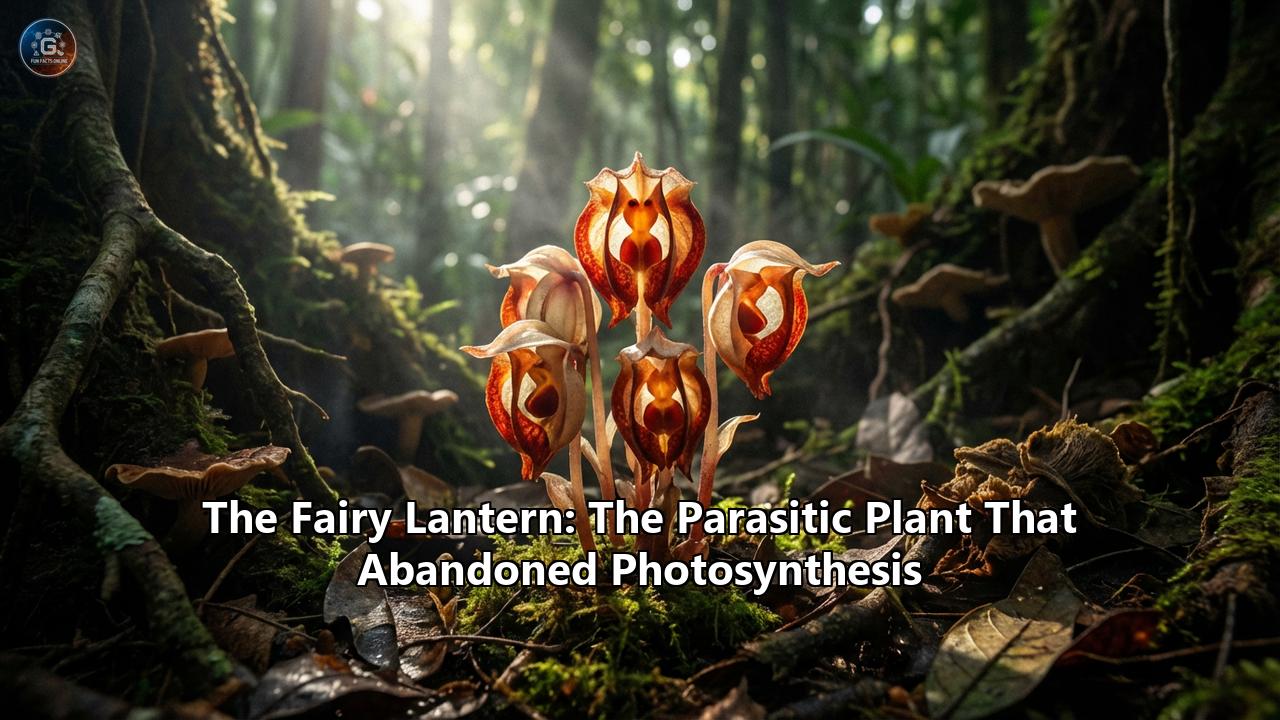
Deep within the damp, shadowed understories of ancient rainforests and—improbably—in the lost wetlands of industrial Chicago, there exists a biological anomaly that defies our most basic understanding of plant life. We are taught from a young age that plants are green, that they worship the sun, and that they perform a miraculous alchemy called photosynthesis to turn light into sugar. But evolution is a tinkerer, not a rule-follower, and in the dark corners of the plant kingdom, it has crafted a rebel: the Fairy Lantern.
Known to science as the genus Thismia, these are plants that have abandoned the sun. They have no green leaves, no chlorophyll, and no need for light. Instead, they live a subterranean existence, stealing their energy from fungi in a complex, three-way biological heist. They emerge from the soil only briefly, pushing up alien, translucent flowers that look less like blossoms and more like glass lanterns, jellyfish, or creatures from a deep-sea trench.
This is the story of the Fairy Lantern—a plant that traded the sun for the underworld, the mysteries of its theft-based survival, and the frantic, often heartbreaking quest by scientists to find them before they vanish forever.
The Great Betrayal: Abandoning Photosynthesis
To understand just how strange a Fairy Lantern is, one must first appreciate the evolutionary corner it painted itself into. For over a billion years, the lineage of plants has been defined by the chloroplast—the tiny cellular engine that captures solar energy. It is the foundation of almost all life on land. To give it up is evolution’s version of selling one’s soul.
The Fairy Lanterns belong to a group of plants known as mycoheterotrophs. The term comes from the Greek: myco (fungus), hetero (other), and troph (feeding). Unlike "autotrophs" (self-feeders like oaks or roses), these plants cannot make their own food. But unlike direct parasites (like mistletoe) that tap into a tree's branches, mycoheterotrophs are more devious. They tap into the wood-wide web.
Beneath the forest floor lies a vast network of fungal mycelium—thread-like structures that connect trees and plants. Usually, this is a mutualistic relationship: fungi give trees mineral nutrients from the soil, and trees give fungi sugary carbon from photosynthesis. The Fairy Lantern hacks this system. It plugs into the fungus, but gives nothing back. It is a biological hacker, siphoning off the carbon that the fungus collected from a nearby tree. In essence, the Fairy Lantern is eating the sunlight captured by a tree fifty feet away, using a fungus as a straw.
This lifestyle has profound consequences. Because they don't need light, Thismia have lost their leaves, which have been reduced to tiny, scale-like vestiges on their stems. They have no need to be green, so they appear in ghostly shades of white, translucent blue, or fiery orange and red. And because they don't need to reach for the canopy, they remain tiny—often no larger than a matchstick—hiding in the leaf litter, invisible until the moment they bloom.
Anatomy of a Ghost: The Lantern Flower
The "Fairy Lantern" name is not merely poetic; it is descriptively accurate. The flowers of Thismia are often urn-shaped or bell-shaped, fused into a structure that resembles a tiny lantern sitting on the forest floor.
Consider the mitre. In many species, the petals (or tepals) do not open wide like a daisy. Instead, they remain fused at the tips, forming a roof or a dome over the flower's mouth. This creates a small, enclosed chamber. Inside this chamber lies the plant’s reproductive organs, suspended like the filament of a lightbulb.
The architecture is bizarre and varied:
- ---Thismia neptunis--- looks like a creature from a fever dream, with three long, antenna-like protrusions rising from its flower, resembling a trident or a satellite dish.
- ---Thismia panamensis---, found in the Neotropics, has a fleshy, lantern-like body that can change color from varying shades of brown to greenish-white, blending perfectly with rotting leaves.
- ---Thismia kobensis---, a Japanese species, features complex internal structures designed to trap specific pollinators.
Why look like a lantern? It’s all about the target audience. Thismia are not pollinated by bees or butterflies—creatures of the sun. They are pollinated by the denizens of the damp dark: fungus gnats.
These tiny flies (families Sciaridae and Mycetophilidae) are weak fliers that breed in decaying organic matter. Thismia flowers often smell faintly of fungus or rotting vegetation to lure them in. The "lantern" shape may act as a trap or a guide. In some species, once a gnat enters the flower through specific openings, the internal anatomy is like a lobster trap; it is easy to get in, but the geometry forces the gnat to exit via a specific path that ensures it brushes against the pollen.
Recent research on Thismia tentaculata has shown that this relationship is incredibly specific. Despite many insects visiting the flowers, only one specific species of gnat (a Corynoptera species) was found to carry the pollen. This dangerous game of relying on a single pollinator and a single fungal partner makes the Fairy Lantern exceptionally vulnerable to extinction.
*The Lost Ghost of Chicago: Thismia americana---
No story of the Fairy Lantern is complete without the haunting tale of Thismia americana. It is a botanical mystery that reads like a noir detective novel set in the wetlands of the American Midwest.
In 1912, a 23-year-old graduate student named Norma Pfeiffer was conducting fieldwork in the wetlands near Lake Calumet, on the far South Side of Chicago. It was a landscape of wet prairie and swale, sandwiched between encroaching steel mills and railroad tracks. There, peeking out of the mud, she found a tiny, marble-sized flower. It was white, translucent, and striped with delicate blue-green lines.
It shouldn't have been there.
The genus Thismia is almost exclusively tropical, found in the steamy jungles of Southeast Asia and the Amazon. Finding a Thismia in Chicago was biologically akin to finding a penguin in the Sahara. Its closest relatives were not in nearby Indiana or Wisconsin, but in Australia and New Zealand.
Pfeiffer described the species as Thismia americana. For five years, she studied the population, documenting its life cycle. But the industrial machine of Chicago was relentless. A barn was built over part of the site. Drainage patterns changed. By 1917, the flowers stopped appearing.
For over a century, botanists have hunted for Thismia americana. "Thismia Hunts" became a rite of passage for local naturalists. They crawled on hands and knees through the remaining fragments of Chicago’s wetlands, hoping that a dormant seed or tuber might have survived. But it has never been seen again. It is the only plant species ever discovered in Chicago that is endemic solely to Chicago, and we likely paved over it before we even understood what it was.
However, a glimmer of hope emerged in 2023, not in Chicago, but in Japan.
*The Resurrection: Thismia kobensis---
In 1992, a single specimen of a new Fairy Lantern species, Thismia kobensis, was found in Kobe, Japan. But before it could be properly studied, its habitat was destroyed by the construction of an industrial complex. It was presumed extinct—a "one-hit wonder" of the botanical world.
Thirty years later, in 2023, Professor Kenji Suetsugu and his team found it again. About 20 miles from the original site, hidden in a forest plantation, Thismia kobensis was alive.
This rediscovery was explosive for one major reason: morphology. When researchers examined the resurrected Thismia kobensis, they realized it bore a striking resemblance to the lost Thismia americana of Chicago. In fact, it is likely the closest living relative of the Chicago ghost.
This connection rewrites the history of the genus. It suggests that millions of years ago, the ancestors of these plants migrated across the Bering Land Bridge—the land connection between Asia and North America that once allowed mammoths and humans to cross. The Chicago Thismia was not a random anomaly; it was a relict, a survivor of an ancient migration that got stranded in the Midwest as the climate changed, only to be wiped out by industrialization at the very moment it was discovered.
The Invisible Web: How They Steal
The physiology of Thismia is a marvel of microscopic engineering. Because they cannot photosynthesize, their survival depends entirely on their ability to manipulate fungi.
The interface happens in the roots. Thismia roots are often vermiform (worm-shaped) or coralloid (coral-shaped), designed to maximize surface area. When fungal hyphae penetrate the cells of the Thismia root, the plant does not fight them off. Instead, it invites them in—to a point.
Inside the root cells, the plant creates a specialized compartment. It allows the fungus to grow coils of hyphae, called pelotons. In a normal mycorrhizal relationship, the fungus would trade nutrients here. But in Thismia, the plant waits until the peloton is fully formed and nutrient-rich, and then it digests it. It essentially farms the fungus, harvesting the carbon that the fungus laboriously transported from a nearby photosynthetic tree.
This is a dangerous game. The fungus is not a passive victim; it is an organism with its own defenses. Evolutionarily, Thismia has had to develop complex chemical signaling to trick the fungus into thinking it is a partner, or to suppress the fungus's immune response long enough to steal the goods.
This complexity is why you cannot grow a Fairy Lantern in a pot. You can't just water it. You would need to grow a specific species of tree, infect that tree with a specific species of Rhizophagus fungus, and then introduce the Thismia—and even then, the delicate balance is nearly impossible to maintain in captivity. They are plants that demand a wilderness.
The Global Hunt: New Discoveries in the Shadows
While Thismia americana may be gone, we are currently in a Golden Age of Thismia discovery. Because they are so small and appear so briefly, they are incredibly easy to miss. As scientists and citizen scientists look closer at the forest floor, new species are popping up like mushrooms.
- Malaysia: In 2024 and 2025, researchers described Thismia selangorensis and Thismia aliasii in Malaysia. Both are critically endangered, known from fewer than 20 individuals. T. selangorensis was found near a popular picnic site, proving that these rare gems might be hiding in plain sight, threatened by the careless footfall of a tourist.
- The Amazon: In Brazil, new species like Thismia mantiqueirensis are being described from the Atlantic Rainforest, a biodiversity hotspot that is heavily fragmented.
- Borneo: The rediscovery of Thismia neptunis in 2018 made headlines worldwide. It hadn't been seen since Italian botanist Odoardo Beccari drew it in 1866. Its strange, alien appearance—like a squid stuck in the ground—captured the public imagination and highlighted how little we know about the rainforest floor.
Conservation: The Lanterns are Flickering
The plight of the Fairy Lantern is a warning light for global biodiversity. These plants are hyper-specialists. They need a specific microclimate (damp, shady, thick leaf litter), a specific fungal partner, and a specific insect pollinator. If you cut down the trees, the fungus dies. If the fungus dies, the Thismia starves. If the soil dries out or warms up due to climate change, the gnats disappear, and the Thismia cannot reproduce.
Almost every known species of Thismia is listed as Threatened, Endangered, or Data Deficient. Many are known from only a single location. They are the first to vanish when a forest is disturbed. They are indicators of an ecosystem's integrity—biological proof that the complex web of tree, soil, fungus, and insect is intact.
The Allure of the Unseen
Why should we care about a tiny, leafless parasite that looks like a jellybean and lives in the mud?
Because the Fairy Lantern challenges our arrogance. We think we have mapped the world. We think we understand how nature works: sun feeds plant, plant feeds animal. Thismia upends the table. It reminds us that there are networks of energy and life flowing beneath our feet that are invisible to us. It reminds us that nature is not just a collection of solar panels, but a dark, complex, interdependent web of theft, cooperation, and survival.
To find a Fairy Lantern is to be let in on a secret. It is a glimpse into the deep time of evolution, a look at a lineage that decided, millions of years ago, to turn off the lights and go underground. And as the story of the Chicago Thismia warns us, if we do not look closely, and tread carefully, we might extinguish these lanterns before we even know they are there.
So, the next time you are walking in an old-growth forest, look down. Ignore the towering trees and the green ferns. Look at the rotting leaves. Look for a flash of orange, a translucent white dome, a tiny alien structure rising from the decay. You might just find a fairy.
Reference:
- https://www.dnainfo.com/chicago/20160714/south-deering/you-can-help-find-this-plant-which-hasnt-been-seen-chicago-since-1916/
- https://www.technologynetworks.com/applied-sciences/news/new-fairy-lantern-flower-species-discovered-in-malaysia-397951
- https://www.slagglasscity.org/dispatches/after-slag/ghost-story/
- https://en.wikipedia.org/wiki/Thismia
- https://www.eurekalert.org/news-releases/980826
- http://www.wetlands-initiative.org/featured-news/2016/8/18/gone-but-not-forgottenthismia-centennial-hunt-at-indian-ridge-marsh
- https://www.researchgate.net/publication/398085231_Thismia_selangorensis_Thismiaceae_a_new_mitriform_fairy_lantern_species_from_Selangor_Malaysia
- https://fungimag.com/summer-2022-articles/V15I3_Gnats_LR.pdf
- https://pmc.ncbi.nlm.nih.gov/articles/PMC5853022/
- https://botany.one/2018/09/fungus-gnats-see-red-when-pollinating/
- https://www.reddit.com/r/folklore/comments/14cu4jt/did_any_folklore_creatures_use_lanterns_or/
- https://www.realclearscience.com/blog/2018/03/24/the_mystery_of_thismia_americana_the_parasitic_plant_found_only_in_chicago.html
- https://www.sciencenews.org/article/parasitic-fairy-lantern-plant-science
- https://pmc.ncbi.nlm.nih.gov/articles/PMC12680943/
- https://blog.pensoft.net/2025/12/02/new-critically-endangered-fairy-lantern-discovered-in-malaysia/