
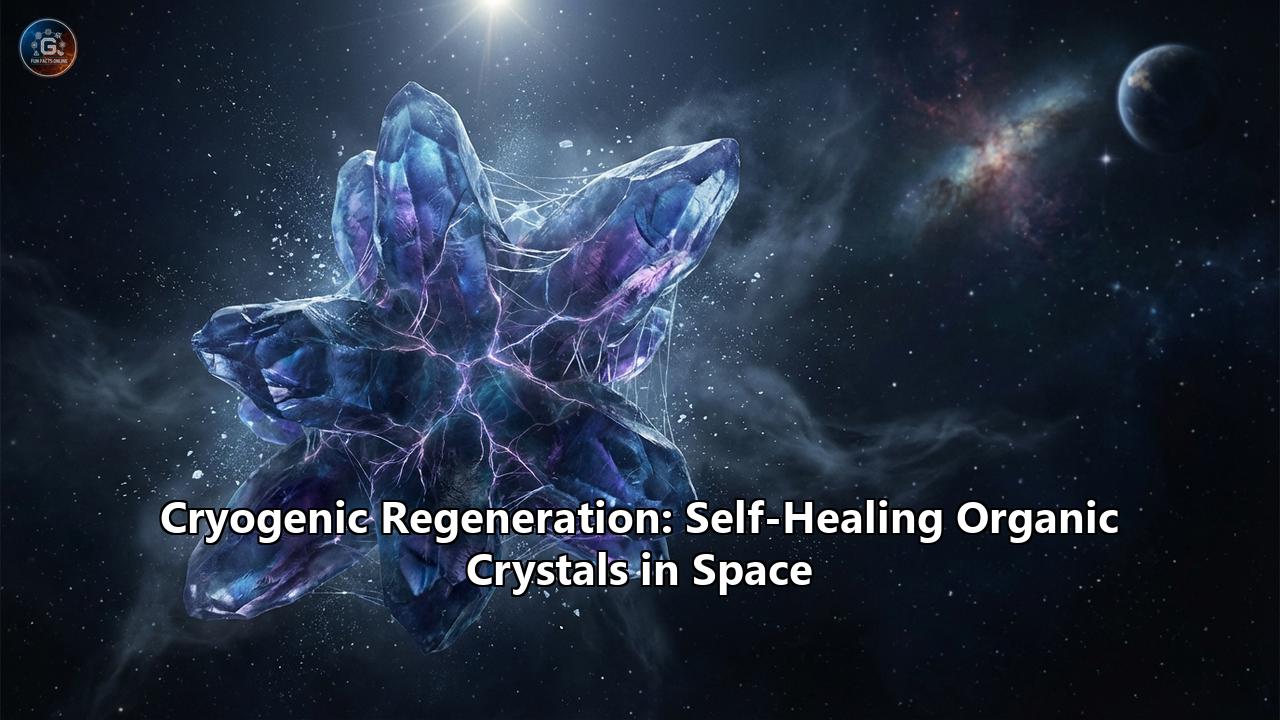
Space is not merely an empty void; it is a graveyard of temperature extremes. While we often romanticize the fiery re-entry of spacecraft, the silent, creeping cold of the cosmos is equally deadly. In the shadow of Earth or on the surface of an icy moon like Europa, temperatures plunge to hundreds of degrees below zero. At these cryogenic depths, the materials we trust to keep astronauts alive and machines functioning—polymers, rubbers, and metals—undergo a catastrophic transformation. They lose their flexibility, becoming brittle as glass. A single micro-fracture, invisible to the naked eye, can propagate instantly, shattering a hull or breaching a seal.
History has etched this lesson in sorrow. The 1986 Space Shuttle Challenger disaster was ultimately a failure of material science in the cold; a rubber O-ring, stiffened by a frigid Florida morning, failed to seal. In deep space, where temperatures dip to -270°C, the challenge is exponentially harder. For decades, engineers have dreamed of "self-healing" materials that could repair these inevitable cracks. But there was a catch: traditional self-healing requires heat. It relies on the diffusion of molecules—a process that is effectively frozen solid in the deep freeze of space. Until now.
In early 2026, a team of researchers from NYU Abu Dhabi and Jilin University shattered this scientific dogma. They unveiled a new class of "smart" organic crystals capable of self-repairing at -196°C (77 K), the boiling point of liquid nitrogen. This breakthrough, centered on a material known as PBDPA, promises to usher in a new era of "immortal" spacecraft components, optical sensors that heal their own lenses, and machines that grow stronger in the very environment that used to destroy them.
The Crystal Paradox: Hard but Healing
To understand the magnitude of this discovery, we must first unlearn a basic intuition about materials. We typically divide solids into two camps: "hard and brittle" (like diamonds or salt crystals) and "soft and healing" (like skin or rubber).
Self-healing polymers have existed for years. If you scratch a self-healing phone screen case, the polymers flow back together over time, often aided by warmth from your hand. This is diffusion: molecules wiggling around to patch a gap. But in the vacuum of space, diffusion is dead. At cryogenic temperatures, molecular motion grinds to a halt. A self-healing polymer in space is just a frozen, broken plastic.
Crystals, on the other hand, are defined by their rigidity. Their atoms are locked in a perfect, repeating lattice. Break a crystal, and it stays broken. Or so we thought.
Professor Panče Naumov and his colleagues discovered that PBDPA—a small, orange-colored organic molecule with a complex structure—defies this rule. It is a crystal, yet it heals. And remarkably, it heals better when it is cold.
The secret lies not in the random wiggling of molecules (diffusion), but in electrostatics. The PBDPA molecules are "dipolar," meaning they have a distinct positive end and a negative end, acting like tiny, powerful magnets locked in a grid.
Imagine breaking a bar magnet. If you bring the pieces back together, they snap into place with a satisfying click, held by invisible magnetic fields. PBDPA works on a similar principle but at the molecular level. When the crystal fractures, the exposed surfaces bristle with unrequited electrical charges. Even at -196°C, where physical movement is impossible, these electric fields remain active. As soon as the fractured faces are pressed back together—perhaps by the natural thermal contraction of a spacecraft hull—the dipole-dipole interactions "zip" the crystal back together.
The result is a seamless repair. In testing, the healed crystals recovered their full mechanical strength and, crucially, their optical transparency. They could transmit light just as well as a pristine crystal, a feat that is nearly impossible with traditional glued or patched materials.
The Microgravity Advantage: Growing "Perfect" Healers
While the discovery of PBDPA on Earth is revolutionary, its true potential may only be unlocked in orbit. This brings us to the second half of the equation: Microgravity Manufacturing.
For over three decades, from the Space Shuttle to the International Space Station (ISS), astronauts have been growing crystals in space. On Earth, gravity acts like a bully in the petri dish. As crystals grow from a solution, gravity causes convection currents—heavier fluid sinks, lighter fluid rises. This turbulence creates defects, twists, and imperfections in the crystal lattice.
In the weightlessness of the ISS, these currents vanish. Crystals grow in a purely diffusive environment, organizing themselves atom by atom with mathematical precision. The result is crystals that are larger, purer, and more structurally perfect than anything we can produce on the ground.
For a material like PBDPA, perfection is power. Since its self-healing mechanism relies on the precise alignment of positive and negative poles, any defect in the crystal structure acts as a barrier to healing. A "space-grown" PBDPA crystal would theoretically possess a near-perfect lattice alignment, maximizing the dipole forces.
NASA and commercial space partners are already looking at "In-Space Production Applications" (InSPA). We are moving from an era where we bring materials to space, to an era where we build materials in space, for space. Imagine a factory module on the upcoming Axiom Station, quietly growing vats of self-healing organic crystals. These aren't just raw materials; they are the spare parts for the station itself.
Applications: The Immortal Machine
The implications of Cryogenic Regeneration extend far beyond patching cracks. This technology enables entirely new concepts in mission architecture.
1. Self-Aligning Optical SensorsDeep space probes like the James Webb Space Telescope rely on mirrors and lenses that must maintain alignment to within a fraction of a nanometer. The cold of space warps and cracks these delicate instruments. An optical sensor made of PBDPA-coated crystals could suffer a micro-fracture from a micrometeoroid impact or thermal stress and simply "blink" it away. Because the healing restores 99% of optical transparency, the telescope would effectively repair its own vision without human intervention.
2. The Europa LanderNASA’s plans to explore Europa, the icy moon of Jupiter, involve landing on a surface that is -160°C. A traditional rover's wheels and joints would face immense stress. Cryogenic self-healing crystals could be integrated into the composite materials of the rover's chassis. If the landing impact cracks a strut, the extreme cold—usually the enemy—would actually preserve the dipole alignment, allowing the rover to "heal" its leg by simply compressing the fracture.
3. "Living" Spacesuit VisorsA crack in a spacesuit visor is a death sentence. Current polycarbonates are strong but degrade under UV radiation and thermal cycling. A laminated layer of organic self-healing crystal could serve as a failsafe. If a piece of debris strikes the visor, the crystal layer would maintain structural integrity, snapping back together to prevent a catastrophic decompression.
4. Data Storage and ElectronicsOrganic crystals are also semiconductors. PBDPA has shown promise not just as a structural material but as an electronic one. We could envision "organic electronics" that can survive the harsh radiation and cold of space better than silicon. If a cosmic ray disrupts the crystal lattice of a memory chip, the material’s natural electrostatic forces could help realign the structure, preserving the data stored within.
The Future: A New Paradigm for Space Exploration
The discovery of cryogenic regeneration marks a philosophical shift in how we design for space. For 60 years, we have fought against the environment. We built heavy, armored shells to resist the cold. We built redundant systems because we assumed things would break and stay broken.
PBDPA teaches us to work with the environment. It uses the cold to stabilize the crystal and uses the vacuum to prevent chemical degradation. It suggests a future where spacecraft are not static metal cans, but dynamic, organic-inorganic hybrids that respond to injury like living things.
As we look toward the Moon, Mars, and the icy giants beyond, we will need machines that are as resilient as the explorers who command them. We are entering the age of the "regenerative spacecraft"—vessels that heal, endure, and survive the long, frozen dark. The crystals growing in the labs of NYU Abu Dhabi and soon, perhaps, in the microgravity racks of the ISS, are the first seeds of this new frontier.
Reference:
- https://menafn.com/1110629155/Abu-Dhabi-Researchers-Create-Material-That-Heals-Itself-In-Extreme-Cold
- https://www.youtube.com/watch?v=eq17jxXitHE
- https://www.zawya.com/en/press-release/research-and-studies/breakthrough-organic-crystalline-material-repairs-itself-in-extreme-cold-temperatures-squ61gr7
- https://ournarratives.net/molecular-regeneration-inside-dr-pance-naumovs-groundbreaking-research-on-self-healing-crystals/
- https://scienceblog.com/when-crystals-heal-themselves-in-the-deep-freeze/
- https://www.researchgate.net/figure/Structure-and-self-healing-of-PBDPA-crystals-at-different-temperatures-a-The-chemical_fig1_398380031
- https://pubmed.ncbi.nlm.nih.gov/41350428/
- https://www.researchgate.net/figure/Crystal-structure-and-electronic-properties-of-PBDPA-a-The-conformation-of-the-molecule_fig3_398380031
- https://www.researchgate.net/publication/398380031_Cryogenically_self-healing_organic_crystals
- https://www.nasa.gov/blogs/spacestation/2025/02/05/space-navigation-test-plasma-crystal-research-top-wednesday-science-schedule/