
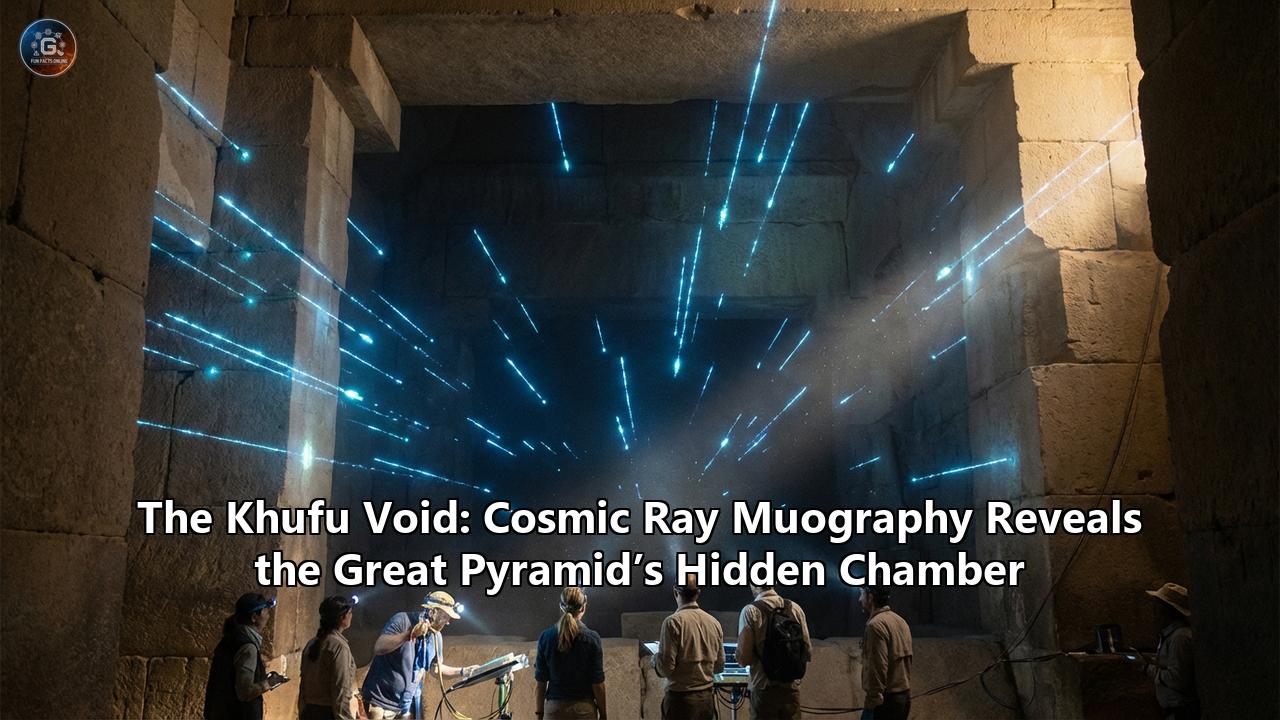
The desert wind scours the Giza Plateau, as it has for forty-five centuries, but the silence of the Great Pyramid is no longer absolute. Deep within the limestone mountain of Khufu, subatomic particles are telling a story that no hieroglyph ever recorded. For generations, we believed the map of the Great Pyramid was complete—King’s Chamber, Queen’s Chamber, Grand Gallery, Subterranean Chamber. We were wrong.
As we stand in the early months of 2026, the world of Egyptology is holding its collective breath. The announcement by Dr. Zahi Hawass of a "major revelation" to be unveiled this year has reignited a fervor not seen since the opening of Tutankhamun’s tomb. But this discovery was not made with dynamite or pickaxes; it was made with shadows from the stars. The "Khufu Void"—a massive, plane-sized cavity suspended in the heart of the pyramid—has moved from a ghostly data anomaly to the brink of physical exploration.
This is the definitive account of the Khufu Void: the science that found it, the theories that attempt to explain it, and the high-stakes mission currently unfolding to breach the final sanctuary of the Fourth Dynasty.
Part I: The Whisper of the Muons
To understand the magnitude of the discovery, one must first understand the ghostly messengers that revealed it. The Great Pyramid is a fortress of 2.3 million stone blocks, a structure so dense that it defies standard X-rays or ground-penetrating radar beyond a few meters. To see inside, scientists had to rely on a source of radiation that originates not from a machine, but from the cosmos itself.
The Cosmic Rain
Every second, the Earth is bombarded by high-energy primary cosmic rays—protons and atomic nuclei stripped of their electrons, traveling across the galaxy at nearly the speed of light. When these particles smash into the upper atmosphere, they trigger a cascade of secondary particles. Among these is the muon.
Muons are the heavy cousins of electrons. They are unstable, existing for only 2.2 microseconds before decaying, yet they travel so fast that relativistic time dilation allows them to reach the Earth’s surface. They rain down on us constantly; as you read this sentence, roughly 100 muons have passed through your body.
Crucially for archaeologists, muons behave like high-energy X-rays. They can pass through hundreds of meters of solid rock, but they are slowly absorbed as they do so. The denser the material, or the longer the path, the fewer muons make it through. By placing a detector beneath or beside a massive object like a pyramid, scientists can count the muons arriving from different directions. If the pyramid were solid rock, the muon count should be uniform based on the thickness of the stone. But if there is a hole—a void—more muons will pass through than expected. The "shadow" of the pyramid will appear lighter in that specific spot.
The ScanPyramids Mission
In October 2015, a daring collaboration was launched under the authority of the Egyptian Ministry of Antiquities. The ScanPyramids project brought together the Faculty of Engineering at Cairo University and the Heritage Innovation Preservation (HIP) Institute from France. They were joined by particle physicists from Nagoya University (Japan), KEK (Japan), and CEA (France).
Their goal was not to dig, but to look. They deployed three distinct muon detection technologies to ensure that any anomaly found was real, not a glitch.
- Nuclear Emulsion Plates (Nagoya University): These are essentially high-tech photographic films. Sensitive to charged particles, they were placed in the Queen’s Chamber, the lowest accessible room in the superstructure. Like developing a long-exposure photograph, these plates sat in the dark for months, catching muons raining down through the pyramid’s core.
- Scintillator Hodoscopes (KEK): These electronic detectors use plastic scintillator bars that flash with light when a muon hits them. They were also placed in the Queen’s Chamber but offered real-time data, allowing the team to verify the emulsion plate findings quickly.
- Micromegas Gas Detectors (CEA): These telescope-like instruments were placed outside the pyramid, facing the north face. They were designed to look for cavities near the surface, validating the methodology.
For two years, the team collected data. The results, published in the journal Nature in November 2017, sent shockwaves through the scientific community. The detectors in the Queen’s Chamber had found a significant "excess" of muons coming from a region directly above the Grand Gallery.
They called it the ScanPyramids Big Void (SP-BV). It was not a small crack or a few missing stones. It was a massive cavity, at least 30 meters (98 feet) long, with a cross-section similar to the Grand Gallery itself. It was the first major internal structure found in the Great Pyramid since the 19th century.
Part II: Anatomy of a Ghost
What do we know about the Big Void? Physically, it is an enigma wrapped in stone.
- Location: It hovers roughly 40 to 50 meters above the Queen’s Chamber, situated almost directly above the Grand Gallery.
- Dimensions: The muon data indicates a length of at least 30 meters. Its height and width are less certain but appear to rival the Grand Gallery (8.6 meters high, 2 meters wide at the floor, 4 meters at the bottom of the corbels).
- Orientation: Initially thought to be horizontal, newer analyses suggest it might be inclined, mirroring the slope of the Grand Gallery below it. This detail is crucial for the "internal ramp" theories.
- Isolation: There are no known corridors connecting to it. It appears to be completely sealed, a time capsule untouched since Khufu’s funeral barge was dismantled.
The discovery was met with a mix of exhilaration and skepticism. Zahi Hawass, the titan of Egyptian archaeology, was initially dismissive. "The pyramid is full of voids," he famously said in 2017, suggesting the data might just be showing gaps between the irregular core masonry. He cautioned against using the word "discovery" until a physical entrance was found.
But the physics held up. The probability of the muon excess being a statistical error was less than one in a million. The void was there. The question shifted from "Is it real?" to "What is it?"
Part III: The 2023 Breakthrough – The North Face Corridor
While the Big Void grabbed headlines, the ScanPyramids team was quietly investigating a second anomaly. On the north face of the pyramid, just above the original entrance used by tourists today, sits a massive chevron structure. Four huge limestone blocks lean against each other in an inverted 'V'. For centuries, Egyptologists assumed this was merely a structural arch to distribute weight over the descending corridor.
The muons disagreed. They showed a small void directly behind the chevrons.
In early 2023, the team made their move. They didn't need to drill through meters of rock. They realized that a small joint between the chevron blocks was just wide enough—mere millimeters—to insert a boroscope.
On March 2, 2023, the world saw the first images from inside the ScanPyramids North Face Corridor (SP-NFC).
The endoscopic camera revealed a rectangular passage with a gabled (triangular) ceiling. It was roughly 9 meters long, 2.1 meters wide, and 2.3 meters high. It was empty. The floor was rough blocks, not the polished paving of the known chambers. The ceiling was a "saddle vault" of limestone beams.
Crucially, the corridor didn't go anywhere. It ended in a solid wall of limestone.
The Significance of the Corridor
This discovery changed everything.
- Validation: It proved the muon technology was accurate to within centimeters. If the muons said there was a corridor behind the chevrons, and we found one, then the muons saying there is a massive void above the Grand Gallery must be trusted.
- Architectural Clues: The gabled ceiling of the North Face Corridor is identical to the ceiling of the Queen’s Chamber and the stress-relieving chambers above the King’s Chamber. This suggests a specific function: weight distribution.
- The "Shadow" Tomb: Zahi Hawass, reversing his earlier skepticism, seized on this discovery. At a press conference, he speculated that this corridor might be protecting something beneath it. "I believe that the burial chamber of King Khufu was not found yet," he declared. He hypothesized that the true burial chamber could be hidden behind the solid wall at the end of this corridor, or perhaps the corridor acts as a stress-reliever for a room located below it.
Part IV: Theories of the Big Void
If the North Face Corridor is the appetizer, the Big Void is the feast. What function could a 30-meter-long hall serve in the heart of the pyramid? The theories range from the pragmatic to the fantastical.
Theory A: The Relieving Chamber
The Argument: The Great Pyramid weighs 6 million tons. The internal pressures are immense. The King’s Chamber is protected by five layers of massive granite beams (the "relieving chambers") and a gabled limestone roof to divert the weight. The Grand Gallery, with its corbeled walls, is also a structural marvel. Some engineers argue that the Big Void is simply a "construction gap" or a relieving space designed to protect the Grand Gallery from collapsing under the weight of the masonry above it. The Counter-Argument: The Grand Gallery is built with corbeling (stepped walls) specifically to support weight. It has stood for 4,500 years without cracking. Why would the architects build a second, massive gallery above it just to protect the first? It seems like structural overkill, or perhaps a misunderstanding of Egyptian engineering confidence. Furthermore, relieving chambers are usually directly above the room they protect. The Big Void appears to be separated by a significant layer of rock.Theory B: The Internal Ramp (Jean-Pierre Houdin)
The Argument: French architect Jean-Pierre Houdin has spent decades arguing that the Great Pyramid was built from the inside out using an internal spiral ramp. He proposed this long before the ScanPyramids data.According to Houdin, the bottom third of the pyramid was built using an external ramp, but the top two-thirds required an internal tunnel spiraling up behind the outer casing. He also theorized a "counterweight" system used to haul the massive 60-ton granite beams of the King’s Chamber. This system would require a long, sliding track—a second Grand Gallery—where a counterweight could move up and down.
The Fit: The dimensions of the Big Void (30m+ length, similar cross-section to the Grand Gallery) fit Houdin’s "counterweight slide" theory perfectly. If the void is inclined, it supports this hypothesis even more. It could be the fossilized remains of the construction engine itself.Theory C: The "Real" Burial Chamber
The Argument: This is the Holy Grail. The King’s Chamber contains a red granite sarcophagus, but it is roughly finished and has no lid. No mummy was ever found (though grave robbers are the usual suspects). However, Khufu’s father, Sneferu, built three pyramids. The Red Pyramid has a burial chamber located high up in the structure.Some Egyptologists speculate that the King’s Chamber we know was a decoy, or a "statue chamber" (serdab), and the true burial took place in a hidden suite of rooms. The Big Void is large enough to be a "Grand Gallery" leading to a final, higher sanctuary.
The Clues: In the "Great Pit" of the subterranean chamber, and in the Queen’s Chamber shafts, there are oddities that suggest changes in plan. If Khufu feared tomb robbers, he might have engineered the ultimate misdirection: a massive, obvious King’s Chamber that was never used.Theory D: The Primal Mound (The "Island of Creation")
The Argument: A more esoteric theory suggests the void represents the "Isle of Creation" in Egyptian mythology. The pyramid represents the primeval mound rising from the waters of chaos. The void could be a deliberate "nothingness" incorporated into the design for religious reasons—a pocket of chaos or potentiality sealed inside the order of the stone. While poetic, this is difficult to prove archaeologically.Part V: The 2026 Mission – "We’re Going In"
This brings us to the present: January 2026. The waiting game is over.
In late 2025, Dr. Zahi Hawass, speaking at the Sharjah International Book Fair, dropped the bombshell. He announced that a new mission was underway, with a definitive "unveiling" scheduled for 2026.
"The Team"The new phase involves a collaboration of the original ScanPyramids scientists and a new wave of explorers. Notably, American businessman and history enthusiast Matt Beall has been linked to the funding and promotion of this new phase, signaling a high-production-value documentation of the event.
The TechnologyThe 2026 mission is not just about more muons. It is about access.
The primary obstacle to exploring the Big Void is that there are no known corridors leading to it. We cannot just walk in. Drilling a hole through 40 meters of limestone is risky and destructive, violating the core tenet of modern archaeology: conservation.
However, the 2026 plan relies on a multi-stage approach:
- Precision Muography: New, ultra-sensitive detectors have been placed in the Grand Gallery and the relieving chambers to map the exact boundaries of the Void to within a few centimeters. This creates a 3D "digital twin" of the anomaly.
- Microrobotics: The team is developing a new class of exploration robots. Unlike the "Djedi" robot that explored the Queen’s Chamber shafts in 2011, these new bots are designed to fit through boreholes less than an inch wide.
- The "Keyhole" Injection: The plan—though officially unconfirmed—is rumored to involve drilling a micro-hole from the relieving chambers (Davison’s Chamber) or the top of the Grand Gallery wall. A fiber-optic "snake" robot would be inserted. This robot isn't just a camera; it is equipped with LIDAR to map the interior of the void instantly and spectrographic sensors to "smell" the air (looking for organic decay, incense, or cedar wood).
If the camera enters the Big Void and sees:
- Rough Blocks: It validates the "weight relieving" or "construction gap" theory. Interesting for engineers, disappointing for the public.
- A Sloped Track with Grease/Wood Traces: It validates Houdin’s internal ramp/counterweight theory. A triumph for engineering history.
- Polished Walls and Hieroglyphs: It changes history. It would be the first intact royal chamber found in the Great Pyramid.
- A Sealed Door: The mystery continues for another decade.
Part VI: The Historical Echo
To understand why the 2026 mission is so electrifying, we must look at the history of those who tried to crack Khufu’s safe before.
Al-Ma'mun (820 AD): The Caliph of Baghdad, driven by tales of treasure and ancient science, instructed his men to batter their way into the pyramid. They heated the stones with fire and cracked them with cold vinegar. They bypassed the true entrance (hidden behind a hinged block) and tunneled blindly until they hit the Descending Passage. They found the King’s Chamber empty. Legend says they found a "statue of a man" with a breastplate of gold, but this is likely a fable. Al-Ma'mun’s tunnel is still the entrance tourists use today. Howard Vyse (1837): The Gunpowder Archaeologist. Vyse grew frustrated with the lack of discoveries and used dynamite to blast his way into the "relieving chambers" above the King’s Chamber. He found graffiti—workmen’s marks naming "Khufu"—which remains the primary evidence linking the pyramid to the Pharaoh. His methods were brutal, but effective. The Robot Era (1993-2011):- Upuaut II (1993): German engineer Rudolf Gantenbrink sent a small rover up the southern shaft of the Queen’s Chamber. After 60 meters, it hit a limestone door with copper handles. The world gasped.
- Pyramid Rover (2002): Zahi Hawass drilled a hole through that door on live TV. Behind it... was another door.
- Djedi (2011): A more advanced robot looked behind the first door and saw the back of the "copper handles" (they were small loops) and floor markings written in red ochre.
The Big Void is the culmination of this lineage. We have moved from battering rams to dynamite to robots to cosmic rays.
Part VII: The Shadow of Khufu
Who was the man behind the mountain? Khufu (Cheops in Greek) ruled during the 4th Dynasty, the golden age of the Old Kingdom. Despite building the largest stone monument in history, we have only one distinct portrait of him: a tiny, 3-inch ivory statue found at Abydos. His face is calm, confident, perhaps a bit stern.
Herodotus, writing 2,000 years later, called him a tyrant who enslaved his people. Modern archaeology at the "Lost City of the Pyramid Builders" (excavated by Mark Lehner) suggests otherwise. The workers were well-fed on beef and beer, organized into "gangs" with names like "The Drunks of Menkaure." They were likely a corvée workforce—paying their tax in labor during the flood season—rather than whipped slaves.
If the Big Void contains Khufu’s true burial, it could answer the question of his character. Would the tomb be filled with gold, like Tutankhamun’s? Or would it be austere, reflecting the solar theology of the Old Kingdom, where the King’s soul ascended to join Ra in the sky? The "Pyramid Texts" (found in later pyramids) suggest the King became a star. Perhaps the void is empty because it was never meant to hold a body, but a soul.
Part VIII: The Engineering of Eternity
As we await the 2026 revelation, it is worth pausing to appreciate the sheer audacity of the Great Pyramid’s construction, which the Big Void highlights.
The pyramid is aligned to true north with an accuracy of 3/60ths of a degree. The base is level to within 2 centimeters. It contains 2.3 million blocks, some weighing up to 80 tons (the granite beams).
If the Big Void is a construction feature, it reveals a level of planning that borders on the miraculous. It means the architects—led by Khufu’s vizier, Hemiunu—anticipated the internal stresses of the structure 20 years in advance. They knew that the Grand Gallery needed a buffer. Or they knew that they would need a massive internal void to act as a counterweight run for the granite beams.
The ScanPyramids data has also revealed "thermal anomalies" on the surface—stones that remain warmer or cooler than their neighbors at sunset. This suggests airflow from deep within. The pyramid is not a solid rock; it is a "breathing" machine. The "air shafts" in the King’s and Queen’s chambers (which point to Orion and the Polar Stars) are part of this ventilation or religious aiming system.
Part IX: The Skeptics and the Dreamers
Not everyone is convinced the Big Void will yield gold or mummies.
The Skeptics:Many structural engineers argue that the void is a "sand-filled" cavity. Ancient builders often used sand as a filler in difficult spaces. If the robot drills in and finds a wall of sand, it will be an anticlimax for the media, but a fascinating data point for engineers.
Others suggest it is a "structural flaw" that occurred during construction—a collapse or a mistake that was walled off and built over.
The Dreamers:The alternative history community has latched onto the Big Void. Theories of ancient power plants, resonant chambers, or "Atlantean" libraries abound. While these are rejected by mainstream science, the very existence of a "secret chamber" fuels the fire.
However, the most compelling "dream" is the archaeological one. The 4th Dynasty is a black hole of information compared to the New Kingdom. We have no royal mummies from this period that are indisputably identified. Finding Khufu—or even his grave goods, his journals (like the papyri of Merer found at the Red Sea), or his ritual equipment—would rewrite the textbooks.
Part X: Conclusion – The Final Door
We stand on the precipice of discovery. The ScanPyramids project has done something that was thought impossible: it found a new room in the most studied building on Earth without lifting a single stone.
The "Khufu Void" is more than just empty space. It is a vessel for our curiosity. For 4,500 years, it has held its breath, suspended in the dark, pressing down on the Grand Gallery.
In 2026, when the light of a fiber-optic cable finally pierces that darkness, we will not just be looking into a room. We will be looking into the mind of the architect who built it. We will be looking into the ambition of a King who wanted to conquer death.
Whether it is a tomb, a machine, or a mistake, the Void reminds us that the past is not dead. It is waiting. And thanks to the silent rain of cosmic muons, we have finally found the key.
The Great Pyramid has guarded its secrets for four and a half millennia. It has weathered earthquakes, looters, tourists, and wars. But it cannot hide from the stars. The Void is real. The mission is go. And the world is watching.
Reference:
- https://www.youtube.com/watch?v=AAxelvcgH1g
- https://www.youtube.com/watch?v=49870qW9pQ8
- https://www.youtube.com/watch?v=FNM4ijoswC4
- https://www.academia.edu/36320958/Is_the_Great_Pyramids_Big_Void_in_fact_caused_by_two_construction_space_zones_flanking_the_Grand_Gallery_Looking_for_plausible_interpretations_of_the_ScanPyramids_data_set
- https://www.archaeology.wiki/blog/2023/03/03/unknown-room-discovered-in-the-great-pyramid/
- https://en.wikipedia.org/wiki/ScanPyramids
- https://www.youtube.com/watch?v=fFrldU81lP4
- https://www.sci.news/archaeology/cosmic-ray-muons-hidden-structure-khufus-pyramid-11715.html
- https://www.jpost.com/archaeology/article-873314
- https://www.reddit.com/r/ancientegypt/comments/1ale0vb/what_is_the_most_likely_theory_regarding_the/
- https://www.livescience.com/cosmic-rays-reveal-hidden-30-foot-long-corridor-in-egypts-great-pyramid
- https://arkysite.wordpress.com/wp-content/uploads/2018/04/dlightbody20181.pdf
- https://archaeology.brown.edu/sites/default/files/papers/Rigby2016.pdf