
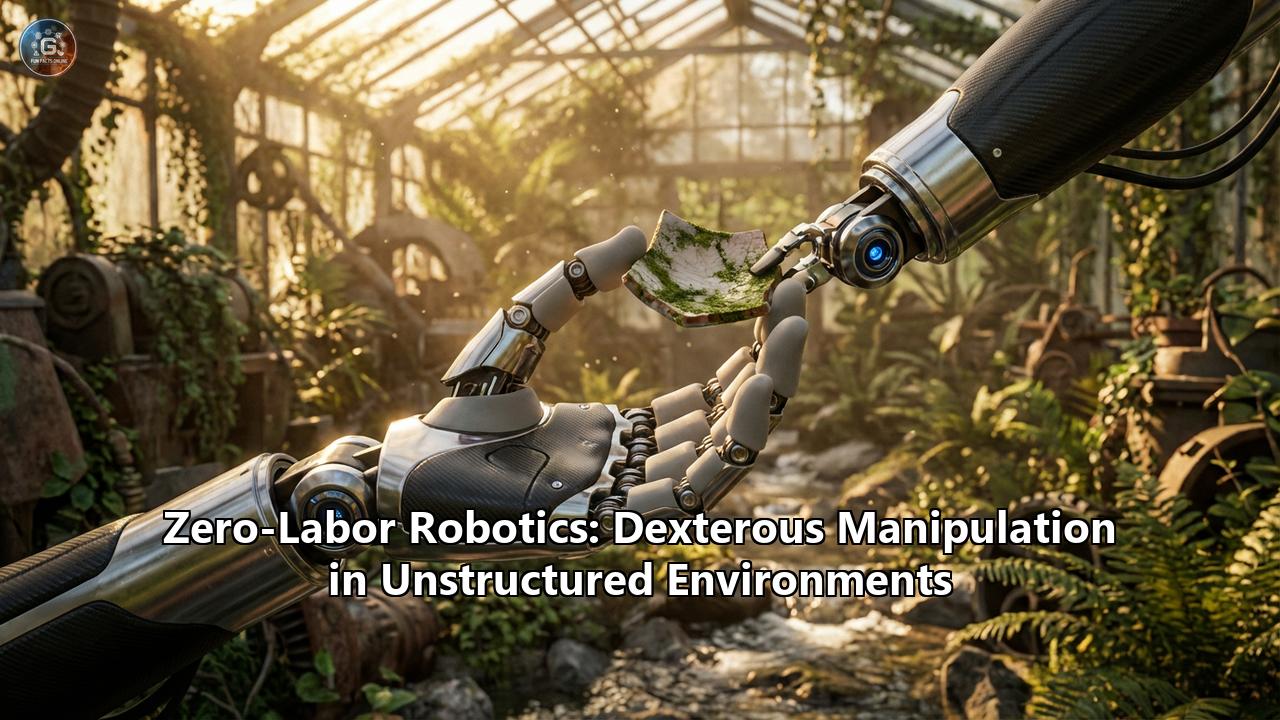
The dawn of the "Zero-Labor" era is not merely a promise of automation; it is a fundamental reimagining of the physical world’s operating system. For decades, robotics has been confined to the rigid "cages" of industrial assembly lines—structured, predictable, and blind to the nuances of reality. A robot could weld a car door with sub-millimeter precision, provided the door was in the exact same spot, down to the micron, every single time. Move the door an inch, or swap it for a different model, and the machine would fail, often catastrophically.
Today, however, we are witnessing a tectonic shift. We are moving from automation—the repetition of pre-programmed tasks—to autonomy—the intelligent negotiation of unstructured, chaotic environments. This is the age of Dexterous Manipulation in Unstructured Environments, a technological frontier where robots are learning to peel fruit without bruising it, fold laundry in a cluttered bedroom, and repair satellites in the vacuum of space.
This article explores the rise of Zero-Labor Robotics, dissecting the "Brain-Cerebellum-Body" synergy driving these machines, the specific breakthroughs in 2024-2026 that have made this possible, and the profound economic and social implications of a world where physical labor is increasingly optional.
I. The Core Challenge: Why "Easy" is Hard
To understand the magnitude of the current revolution, one must first confront Moravec’s Paradox. Formulated in the 1980s by Hans Moravec, Rodney Brooks, and Marvin Minsky, it observes that high-level reasoning requires very little computation, but low-level sensorimotor skills require enormous computational resources. In other words, teaching a computer to beat a grandmaster at chess is relatively easy; teaching a robot to walk across a messy room or tie a shoelace is agonizingly difficult.
This paradox has been the primary bottleneck for robotics. Traditional robots are "position-controlled"—they move from coordinate A to coordinate B. But the real world is not a coordinate system. It is a messy, dynamic flux of soft objects, changing lighting, and unpredictable obstacles. A "Zero-Labor" robot cannot just follow a path; it must perceive its environment, reason about physics, and adapt its actions in milliseconds.
Defining the Unstructured Environment
An "unstructured environment" is any setting where the layout is not known a priori or changes dynamically.
- The Home: A living room with scattered toys, a sleeping cat, and different lighting conditions throughout the day.
- The Farm: An orchard where every branch grows differently, wind moves the leaves, and fruit varies in ripeness and softness.
- The Disaster Zone: A collapsed building where rubble is unstable and terrain is uneven.
In these environments, a robot needs Dexterous Manipulation—the ability to perform complex, contact-rich tasks with hands or end-effectors. This goes beyond simple "pick and place." It involves sliding, rolling, re-orienting objects within the hand (in-hand manipulation), and modulating force to handle a steel wrench or a raw egg with equal competence.
II. The Technological Trinity: Brain, Cerebellum, and Body
The breakthrough that has unlocked Zero-Labor Robotics in the mid-2020s is the convergence of three distinct technological pillars, often described as the "Brain-Cerebellum-Body" synergy.
1. The Brain: Embodied AI and Large Action Models (LAMs)
The "Brain" of the new robot is no longer a static code base but a dynamic AI model. The explosion of Large Language Models (LLMs) and Vision-Language Models (VLMs) has birthed RobotGPTs.
- Semantic Understanding: Unlike old robots that saw pixels, these systems see concepts. A VLM-equipped robot doesn't just see a "brown blob"; it identifies a "wilted apple" and infers "I should probably not pick this."
- Large Action Models (LAMs): These are AI models trained not just on text or images, but on trajectories of movement. By ingesting millions of hours of video of humans performing tasks, models like Google DeepMind’s ALOHA Unleashed (2024) can generalize skills. A robot taught to pick up a red cup can figure out how to pick up a blue mug without retraining.
- Sim-to-Real Transfer: Reinforcement Learning (RL) allows robots to practice a task billions of times in a simulated physics engine (like NVIDIA’s Isaac Sim) before ever moving a physical muscle. In 2025, algorithms mastered the ability to transfer this "muscle memory" to the real world with near-zero adaptation time, solving the "reality gap" that plagued earlier researchers.
2. The Cerebellum: Active Perception and Haptics
If the brain decides what to do, the cerebellum handles how to do it. This involves the high-frequency feedback loops that keep a robot from crushing a wine glass.
- Haptic Feedback: The sense of touch has been the missing link. New sensors from companies like BrainCo and GelSight provide high-resolution tactile maps, allowing robots to feel texture, slip, and hardness. This data is fed into the control loop, enabling "reflexes"—if an object starts to slip, the robot tightens its grip instantly, faster than a human could react.
- Active Perception: Instead of passively taking photos, modern robots move their cameras or heads to get a better look, peering around occlusions to find a grasp point on a hidden fruit or tool.
3. The Body: Soft Robotics and Anthropomorphic Hands
The hardware has finally caught up to the software.
- Multi-Fingered Hands: The Shadow Robot Company and Tesla’s Optimus hands have moved beyond simple pincers to 5-fingered dexterous hands with 20+ degrees of freedom. These allow for "in-hand manipulation"—rotating a screw with the fingers without moving the wrist.
- Soft Robotics: For delicate items, rigid metal is a liability. MIT’s RoboGrocery project (2024-2025) introduced soft, silicone-based grippers that conform to the shape of an object. These grippers use air pressure or fluid dynamics to gently envelope a peach or a bag of chips, providing a secure grip without localized pressure points that causes bruising.
III. Sector Revolution: Zero-Labor in Practice
The theory is fascinating, but the application is where the "Zero-Labor" economy becomes tangible. Four sectors—Agriculture, Logistics, Manufacturing, and the Home—are currently undergoing a radical transformation.
1. Agriculture: The Autonomous Harvest
Farming is the ultimate unstructured environment. No two apples are alike, and the ground is never flat. Yet, the agricultural sector faces a desperate labor shortage (projected at 2+ million workers globally by 2030), driving a rapid shift to "Zero-Labor" farming.
- The Orchard: Startups like Nanovel (Israeli AgTech) have deployed AI-powered citrus pickers. These are not simple shakers; they are multi-armed robots that use advanced computer vision to identify ripe fruit inside dense foliage. They extend telescopic arms, use a vacuum gripper to cradle the fruit, and a cutter to snip the stem—replicating the delicate motion of a human hand.
- 24/7 Farming: Companies like John Deere and Monarch Tractor have fully autonomous tractors that do not require a driver in the cab. These machines use stereo cameras and AI to navigate fields, distinguishing between crops and weeds. They can till, plant, and spray day and night, stopping only to recharge or refuel.
- The Impact: This shift decouples food production from labor availability. A "zero-labor" farm can harvest at the exact moment of peak ripeness, regardless of whether it’s 3 AM or a national holiday, significantly reducing food waste and increasing yield.
2. Logistics & Retail: The "Holy Grail" of Picking
Warehouses have long been automated, but only for moving pallets. The "Holy Grail" has always been piece-picking—reaching into a bin of random items (a teddy bear, a lipstick, a bottle of vitamins) and packing them into a box.
- Amazon Sparrow: Unveiled as a major leap forward, Sparrow was Amazon’s first robotic system capable of detecting, selecting, and handling individual products. Unlike its predecessors that lifted heavy pallets, Sparrow uses a suction-cup array and computer vision to handle millions of different items. It represents the shift from "macro" logistics to "micro" dexterity.
- Ocado’s On-Grid Robotic Pick (OGRP): In the UK, Ocado has pioneered a "hive" mind warehouse. Their OGRP system sits atop a massive grid of moving bins. Using deep reinforcement learning, these arms have learned to pick tens of thousands of grocery items. The system uses "behavioral cloning"—watching human pickers to learn how to handle complex items (like a net of oranges vs. a rigid box)—and then refines that skill via RL.
- Handling the Delicate: MIT’s "RoboGrocery" innovation addressed the final frontier: bagging. Using soft sensors and vision, the system can distinguish between a crushable loaf of bread and a heavy can of soup. It creates a packing strategy on the fly, placing heavy items at the bottom and delicate ones on top—a cognitive task that was previously exclusive to humans.
3. Manufacturing: The "Lights-Out" Factory
"Lights-out manufacturing" refers to factories that run fully autonomously, requiring no lighting because robots don't need to see with visible light. While FANUC in Japan has operated a lights-out robot-building factory since 2001, the concept has evolved in 2025 from mass production to flexible production.
- The Shift to High-Mix: The old lights-out factories made one thing a million times. The new 2025 factories, like Xiaomi’s smartphone plant or Gree’s 5.5G factory, handle "high-mix, low-volume" production. Mobile manipulators (robots on wheels with arms) roam the floor, changing tools and reconfiguring assembly lines on the fly.
- Dexterity in Assembly: Robots are now capable of complex assembly tasks, like threading a wire through a small hole or snapping a flexible plastic clip into place—tasks that rely heavily on tactile feedback.
- Economic Resilience: These factories are immune to pandemics, labor strikes, and skill shortages. They offer a level of production consistency that human labor simply cannot match, with defect rates dropping to near zero.
4. The Home: The "Zero Labor Home" Vision
Perhaps the most personal application is the domestic sphere. At CES 2026, LG Electronics crystallized this with their "Zero Labor Home" vision, headlined by the CLOiD robot.
- Beyond the Vacuum: Unlike a Roomba that blindly bumps into walls, CLOiD and its competitors (like Samsung’s Ballie or Tesla’s Optimus Gen 3) are mobile manipulators. They can load a dishwasher, pick up laundry from the floor, and pour a glass of water.
- The "Affectionate Intelligence": LG coined this term to describe AI that understands context. It’s not just about washing dishes; it’s about knowing when to do it so as not to disturb the homeowner, or recognizing that a child’s toy is "precious" and should be placed on a shelf, not in the trash.
- The Clutter Problem: The home is the ultimate "adversarial" environment for a robot. Recent breakthroughs in VLA (Vision-Language-Action) models allow these robots to reason about clutter. "To pick up the sock, I must first move the chair," is a chain-of-thought process that is now computationally feasible on-device.
IV. The Economic and Social Landscape
The transition to Zero-Labor Robotics is not just a technical upgrade; it is a socio-economic earthquake.
The Labor Gap vs. Displacement
The primary driver for this adoption is not cost-cutting, but labor scarcity.
- The Shortage: By 2030, the global manufacturing and logistics sectors face a projected shortage of over 2.1 million workers. In agriculture, the average age of a farmer in the US and Japan is nearing 60. There are simply not enough humans willing to perform dull, dirty, and dangerous jobs.
- The Productivity Boom: Automation allows for "super-productivity." A robot doesn't take breaks, doesn't get injured, and improves with every software update. Economic models suggest this could add trillions to the global GDP by 2030.
The Human Role: From Doer to Orchestrator
The narrative of "robots taking jobs" is shifting to "robots changing jobs." The role of the human worker is evolving from manual manipulation to supervision and orchestration.
- Remote Pilots: In Ocado’s warehouses, if a robot encounters an item it can't figure out (an "exception"), it pings a human. The human looks at a screen, clicks on the grasp point, and the robot executes the move. The robot then learns from this interaction, meaning the human only has to solve that specific problem once.
- Robot Wranglers: A new class of blue-collar jobs is emerging—technicians responsible for maintaining the fleet, calibrating sensors, and managing the physical-digital interface.
V. Bottlenecks and Roadblocks
Despite the optimism, significant hurdles remain before we reach a true Zero-Labor utopia.
- Power Consumption: Running massive AI models (like GPT-4o or Gemini) requires immense energy. For a mobile robot running on batteries, this is a critical limitation. There is a "compute vs. endurance" trade-off. While cloud offloading helps, latency makes it dangerous for real-time dexterity tasks.
- Latency and Bandwidth: For telesurgery or remote orchestration, even a 50ms delay can be catastrophic. The rollout of 5.5G and 6G networks is a prerequisite for the widespread adoption of reliable remote-controlled robotics.
- Data Scarcity: We have trillions of tokens of text to train LLMs, but we lack a comparable dataset for physical interaction. Collecting high-quality data of robots failing and succeeding in the real world is slow and expensive.
- Safety and Ethics: As robots become more autonomous, the risk of "bad choices" increases. A robot trained on biased data might treat different users differently, or fail to recognize a safety hazard in a culturally specific context. Ensuring value alignment in physical agents is an active area of research.
VI. The Future: 2030 and Beyond
Looking ahead, the trajectory is clear. The distinction between "digital" and "physical" tasks will blur.
- The App Store for Matter: We will likely see an ecosystem where developers write "skills" for robots just as they write apps for phones. A developer in Prague could write a "folding a fitted sheet" algorithm and sell it to millions of robot owners worldwide.
- General Purpose Humanoids: By 2030, general-purpose humanoid robots (like those from Tesla, Figure, or Agility Robotics) may drop in price to comparable levels of a small car ($20k-$30k). At this price point, they become viable not just for factories, but for small businesses and nursing homes.
- The End of Chores: The ultimate promise of Zero-Labor Robotics is the return of time. Just as the washing machine freed households from hours of manual scrubbing, the next generation of robots promises to free humanity from the remaining physical drudgery of survival—cleaning, sorting, picking, and packing.
In conclusion, Zero-Labor Robotics is not about erasing human effort; it is about elevating it. By solving the challenge of dexterous manipulation in unstructured environments, we are building a world where machines handle the "what is" so that humans can focus on "what could be." The "easy" problems of the physical world are finally becoming easy for our machines, unlocking a future of unprecedented abundance and creativity.
Reference:
- https://tabular.email/blog/examples-of-automation
- https://www.tdipacksys.com/blog/trends-in-robotic-packing/
- https://www.forbes.com/sites/parmyolson/2017/11/30/grocery-robot-hand-ocado/
- https://ocadointelligentautomation.com/systems/on-grid-robotic-pick
- https://www.youtube.com/watch?v=QhFEeMh2Ius
- https://www.geekwire.com/2023/amazons-sparrow-is-leaving-the-nest-trailblazing-warehouse-robot-is-ready-for-a-wider-rollout/
- https://en.orionstar.com/blog-detail.html?id=83
- https://www.aboutamazon.com/news/operations/amazon-introduces-sparrow-a-state-of-the-art-robot-that-handles-millions-of-diverse-products
- https://bosch-sds.com/wp-content/uploads/2024/09/Lights-Out-Manufacturing_-Revolutionizing-the-Factory-Floor-with-Automation.pdf
- https://www.whatissixsigma.net/the-industrial-vision-for-2025-lights-out-factories/