
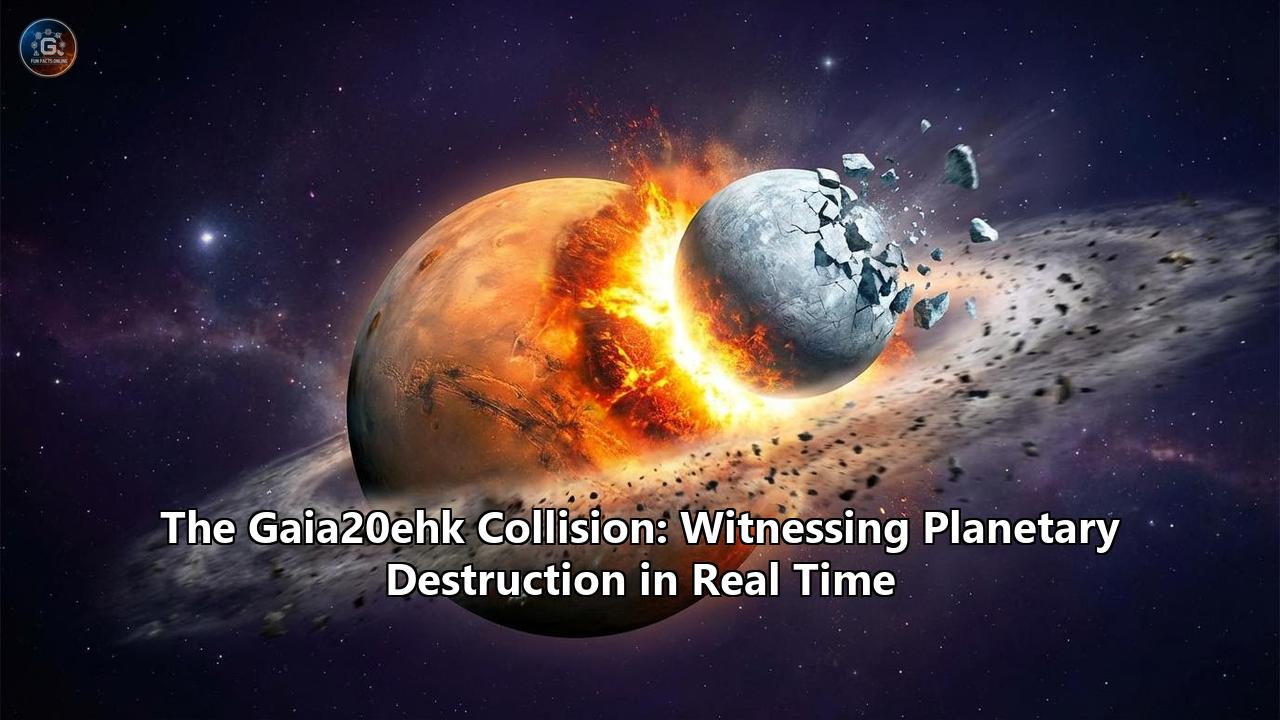
For millennia, humanity has looked up at the night sky and perceived a realm of perfect, immutable tranquility. The stars appear as fixed points of light, eternally stable and profoundly silent. However, modern astrophysics has progressively shattered this illusion, revealing a universe that is dynamic, chaotic, and relentlessly violent. Stars explode, black holes tear apart anything that strays too close, and galaxies collide in slow-motion ballets of gravity. Yet, among the most elusive and scientifically invaluable events are the catastrophic collisions between planets.
Because planets do not emit their own visible light and are dwarfed by the brilliance of their host stars, witnessing their destruction is an incredibly rare feat of observational astronomy. But the cosmos has finally offered us a front-row seat. Thanks to the meticulous analysis of archival data and the combined power of multiple space-based telescopes, astronomers from the University of Washington have documented the real-time collision of two massive planetary bodies.
The event took place approximately 11,000 light-years from Earth, nestled within the southern constellation of Puppis. The host star, cataloged as Gaia20ehk (and alternatively known as Gaia-GIC-1 or AT 2020tdg), was an otherwise unremarkable, young F5-type main-sequence star. By piecing together decades of telescopic data across both visible and infrared spectrums, researchers have reconstructed a cosmic car crash of unimaginable proportions—a cataclysm that bears a striking and haunting resemblance to the ancient impact that gave birth to our own Earth-Moon system 4.5 billion years ago.
This discovery, published in The Astrophysical Journal Letters on March 11, 2026, marks a watershed moment in time-domain astronomy and astrobiology. It bridges the gap between theoretical models of planetary formation and direct observational evidence, answering fundamental questions about how worlds are built, destroyed, and reshaped in the violent crucible of young star systems.
The Needle in the Archival Haystack
The revelation of Gaia20ehk's planetary collision was not the result of a telescope being pointed at the right place at the exact right time. Instead, it was a triumph of "data archeology"—the painstaking process of sifting through massive repositories of archival astronomical records.
Anastasios (Andy) Tzanidakis, a doctoral candidate in astronomy at the University of Washington, was reviewing old telescope data from 2020 when he noticed an anomaly. He was investigating the light curves of various stars—graphs that plot a star's brightness over time. For a stable main-sequence star like Gaia20ehk, the light curve should be a flat, predictable horizontal line. The star, which is about 30 percent more massive than our Sun (1.3 Solar Masses), had reached the stable stage of its life, meaning its nuclear fusion engine was burning steadily without intrinsic fluctuations.
However, Gaia20ehk was behaving in a way that defied the standard models of stellar behavior. The star's baseline brightness in the Gaia G-band was a relatively faint magnitude of 18.8. Before 2014, the light output was, as Tzanidakis described it, "nice and flat". But then, the data showed a series of strange interruptions. Between 2014 and 2017, the star's light experienced three distinct, short-lived dips in brightness. During these events, the star's luminosity plummeted by an average of 25 percent, with each dimming phase lasting around 200 days.
In the world of transit photometry—the method by which most exoplanets are discovered—a dip in a star's light usually indicates that a planet has passed (or "transited") in front of the star, blocking a fraction of its light. But a 25 percent drop in brightness is unimaginably massive. For context, when Jupiter—the largest planet in our solar system—passes in front of the Sun, it blocks only about 1 percent of the Sun's light. Whatever was obscuring Gaia20ehk was gargantuan, asymmetric, and dynamically changing.
Then, things escalated. Following the three distinct dips, the star's behavior transitioned from unusual to completely chaotic. Starting around 2019 and peaking in 2021, the star's light curve collapsed into a deep, erratic, and persistent decline. The star's magnitude dropped from 18.8 to over 20.8, meaning the amount of visible light reaching Earth's telescopes had been drastically choked off.
"Right around 2021, it went completely bonkers," Tzanidakis noted. "I can't emphasize enough that stars like our sun don't do that. So when we saw this one, we were like 'Hello, what's going on here?'".
The flickering and dimming were not intrinsic to the star's fusion processes. Gaia20ehk was not pulsating or dying. Instead, an immense, opaque cloud of rocks, dust, and debris had seemingly materialized out of nowhere, establishing an orbit that perfectly crossed the line of sight between the star and observers on Earth.
The Infrared Smoking Gun
While a sudden influx of dust can explain the dimming of visible light, it begs an immediate question: where did the dust come from? In astronomy, sudden, massive debris clouds around mature stars are exceptionally rare. The team found themselves stumped by the unprecedented nature of the fluctuation—short, distinct dips followed by absolute optical chaos.
The breakthrough came when Tzanidakis's colleague, Dr. James Davenport, an assistant research professor of astronomy at the University of Washington and lead author of the study, suggested pivoting their analytical approach. If visible light was being blocked, they needed to look at the system through a different set of eyes: infrared telescopes.
Visible light can easily be scattered and absorbed by fine cosmic dust, much like how a thick fog obscures the headlights of an oncoming car. Infrared light, however, has longer wavelengths that can pierce through dusty environments. More importantly, dust that absorbs high-energy visible light from a host star will heat up and re-radiate that energy as heat, which glows brightly in the infrared spectrum.
To investigate, the researchers tapped into data from NASA's NEOWISE (Near-Earth Object Wide-field Infrared Survey Explorer) mission, specifically looking at the W1 and W2 infrared bandpasses, as well as data from the SPHEREx mission and the NASA IPAC Infrared Science Archive.
The results were astonishing and provided the smoking gun the team needed. "The infrared light curve was the complete opposite of the visible light," Tzanidakis explained. "As the visible light began to flicker and dim, the infrared light spiked".
This inverse relationship confirmed two crucial facts. First, the material blocking the star was not a cold, dark interstellar cloud drifting by; it was exceptionally hot, glowing fiercely in the infrared. Second, the sudden onset of this hot material pointed directly to a singular, violent kinetic event.
When two massive planetary bodies collide, the sheer kinetic energy of their orbital velocities is instantly converted into thermal energy. The immense friction and shockwaves liquefy planetary mantles, vaporize rock, and eject millions of megatons of superheated magma and silicate dust into space. The team was not just watching a dusty eclipse; they were witnessing the thermal afterglow of two destroyed worlds.
Anatomy of a Planetary Catastrophe
Armed with combined visible and infrared data, astronomical models allowed the team to reconstruct the timeline and physics of the Gaia20ehk collision with remarkable precision. The event was not a sudden, unpredictable ambush, but rather the fatal conclusion of an orbital dance that had likely been destabilizing for millions of years.
Before the collision, the system housed at least two massive planetary bodies—likely protoplanets or fully formed rocky worlds—sharing a precarious orbital neighborhood. Analysis of the star's light curve before the high-amplitude optical variability revealed a subtle periodic modulation of 380.5 days. Assuming circular orbits around the 1.3 Solar Mass star, this orbital period places the planets at a distance of roughly 1.1 Astronomical Units (AU), or about 165 million kilometers (100 million miles) from Gaia20ehk. This is almost exactly the same distance at which the Earth orbits the Sun (1.0 AU, or 150 million kilometers).
Planets generally maintain stable orbits, but gravitational perturbations—perhaps from a migrating gas giant further out in the system, or orbital resonances that slowly stretched their paths into ellipses—caused their trajectories to intersect.
The collision unfolded in two distinct phases, perfectly mapping to the bizarre light curve Tzanidakis discovered:
Phase 1: The Grazing Encounters (2014–2017)Planetary collisions are rarely perfect head-on bullseyes. As the two bodies spiraled closer together, their immense gravitational fields locked them into a doomed binary embrace. During their closest approaches (periapsis), they began to physically clip each other.
"At first, they had a series of grazing impacts, which wouldn't produce a lot of infrared energy," Tzanidakis noted. These grazing encounters generated the three distinct 25-percent dips in the star's visible light. Like two cosmic grinding stones, the planets sheared off each other's atmospheres and outer crusts. The resulting debris trailed behind them, temporarily blocking the star's light before dissipating or falling back to the surfaces. However, these impacts acted as a massive braking mechanism. With each scrape, the planets lost orbital angular momentum, virtually guaranteeing a final, terminal impact.
Phase 2: The Catastrophic Merger (2019–2021)By late 2019, the orbits had decayed completely. The two bodies slammed into each other in a catastrophic core-to-core merger. The energies released in such an event defy human comprehension. Temperatures at the point of impact would have exceeded tens of thousands of degrees, instantly vaporizing billions of tons of rock and metal.
"Then, they had their big catastrophic collision, and the infrared really ramped up," said Tzanidakis.
The physical bodies of the planets were pulverized and reshaped, leaving behind a sprawling, expanding cloud of superheated plasma, molten rock droplets, and microscopic silicate dust. This localized, dense cloud is what caused Gaia20ehk to go "completely bonkers" in 2021, as the debris stretched out along the orbital path, unevenly and patchily choking off the star's visible light while blazing like a beacon in the infrared.
Echoes of Theia: The Giant Impact Hypothesis
Beyond the sheer spectacle of witnessing planetary destruction, the Gaia20ehk collision carries profound implications for astrobiology and our understanding of our own origins. The architecture of the event is an almost uncanny mirror of the most important day in Earth's history.
Roughly 4.5 billion years ago, our solar system was a violent, crowded place. Earth, then a young, volatile protoplanet, shared its orbital space with a Mars-sized body named Theia. In an event known as the Giant Impact Hypothesis, Theia collided with the early Earth. The glancing blow liquefied Earth's surface and ejected a massive ring of debris into orbit. Over a relatively short astronomical timeframe—perhaps as little as a few months to a few years—that ring of superheated debris coalesced and cooled under its own gravity to form the Moon.
The similarities between the ancient Earth-Theia impact and the modern Gaia20ehk collision are striking. Both events feature rocky bodies colliding. Both events occurred in the habitable zone of their respective stars—specifically around the 1.0 to 1.1 AU mark. And both events generated a massive circumstellar dust cloud capable of coalescing into secondary bodies.
"There are only a few other planetary collisions of any kind on record, and none that bear so many similarities to the impact that created the Earth and moon," Tzanidakis emphasized.
The existence of our Moon is widely considered by astrobiologists to be a crucial factor in making Earth a habitable world. The Moon's immense gravitational pull stabilizes Earth's axial tilt, preventing wild, catastrophic swings in global climate. It drives the ocean tides, which may have been instrumental in coaxing early marine life to transition to land. Understanding how common these moon-forming impacts are in the galaxy is therefore inextricably linked to the search for extraterrestrial life.
"How rare is the event that created the Earth and moon? That question is fundamental to astrobiology," Dr. Davenport pointed out. "If we can observe more moments like this elsewhere in the galaxy, it will teach us lots about the formation of our world".
Currently, the dust mass detected around Gaia20ehk is estimated to be less than 1 percent of the mass of Earth's Moon. However, this figure only accounts for the fine, microscopic dust that is efficient at absorbing and scattering light. Deep within that expanding dust cloud, larger chunks of molten rock, planetesimals, and perhaps the surviving, newly-merged core of the planets are entirely undetectable to our current instruments. They are hidden in the fiery fog of their own destruction.
The Lifecycle of Debris: Waiting for an Exomoon
What happens next to the pulverized remains of these two planets? The laws of orbital mechanics and thermodynamics dictate a fascinating future for the Gaia20ehk system, albeit one that will play out on timescales far beyond a human lifespan.
Currently, the debris is in a highly energetic, chaotic state. The material is continuously colliding with itself, grinding larger boulders down into fine dust, while the intense radiation from the F5 host star pushes the lightest microscopic particles outward via stellar wind and radiation pressure. However, the bulk of the mass will remain bound in its 1.1 AU orbit, completing a revolution roughly every 380 days.
Over the next few centuries to millennia, the superheated cloud will begin to radiate its thermal energy out into the cold vacuum of space. As the infrared glow fades, the vaporized silicates will condense into solid microscopic glass and rock droplets. This expanding ring of material will eventually cool down to the point where gravity overtakes thermal expansion.
Once the material is sufficiently cool, the process of accretion will begin anew. Dust will clump into pebbles, pebbles will crash together to form boulders, and boulders will merge into moonlets. Because the debris is clustered at the site of the impact, the dense ring will likely collapse into one or more large spherical bodies.
"At that distance, the material could eventually cool down enough to solidify into something similar to our Earth-moon system," Tzanidakis noted. Scientists predict it could take anywhere from a few years for the dust to visibly settle, to a few million years for a fully fledged exomoon to coalesce from the wreckage. Because the host star's light will not be sufficient to keep the debris perpetually vaporized, the formation of a rocky moon around whatever planetary core survived the impact is highly probable.
A New Era of Time-Domain Astronomy
The discovery of the Gaia20ehk collision is a testament to the evolving nature of astronomical research. Historically, astronomy was a static science—taking a single, deep snapshot of the sky and categorizing what was there. Today, astronomy is firmly in the "time-domain" era, where the sky is continuously recorded like a global security camera, allowing scientists to watch the universe change in real-time.
This discovery relied on an armada of terrestrial and orbital observatories. The initial optical alerts were generated by the Gaia Photometric Science Alerts (GPSA) system, which continuously monitors billions of stars for sudden changes in brightness. Archival visible light data was pulled from the SkyMapper Survey, the DECam Plane Survey (DECAPS), and the Microlensing Telescope Network (KMTNet) operating out of Chile and South Africa. On the infrared side, the critical thermal data was provided by the NEOWISE and SPHEREx missions.
Dr. Davenport highlighted the philosophical shift this represents in observational astronomy. The team was not looking through a telescope eyepiece; they were mining databases. By utilizing decades of continuous data, they are detecting slowly evolving phenomena—astronomical stories that unfold over the course of a decade rather than a single night. "Not many researchers are looking for phenomena in this way, which means that all kinds of discoveries are potentially up for grabs," Davenport explained.
The Gaia20ehk event joins a very short, exclusive list of extreme circumstellar events. In recent years, astronomers have observed sudden dust production around stars like ASASSN-21qj and the famous "Tabby's Star" (KIC 8462852), which also exhibited bizarre, unexplained dimming. However, while Tabby's Star generated dozens of exotic theories (including the infamous "alien megastructure" hypothesis) before being attributed to dust, Gaia20ehk offered a clear, undeniable thermal signature of a planetary collision.
As we look to the immediate future, our capacity to find these catastrophic events is about to increase exponentially. The upcoming Legacy Survey of Space and Time (LSST), conducted by the Simonyi Survey Telescope at the NSF-DOE Vera C. Rubin Observatory in Chile, will begin its operations shortly. Equipped with the largest digital camera ever constructed, the Rubin Observatory will image the entire visible night sky every few days, generating petabytes of light curve data.
Dr. Davenport estimates that with the unprecedented sensitivity and coverage of the Rubin Observatory, astronomers could identify nearly 100 planetary impacts in the next decade alone. Furthermore, sustained monitoring of targets like Gaia20ehk using ultra-sensitive instruments like the James Webb Space Telescope (JWST) will allow astrophysicists to develop intricate, 3D models of collision geometries, debris masses, and elemental compositions. We will move from simply noticing that planets have collided to analyzing the exact chemical makeup of their vaporized mantles.
The Poetic Symmetry of the Cosmos
There is a profound, almost poetic symmetry in the discovery of the Gaia20ehk collision. When we look up at the constellation of Puppis and observe this star, we are not seeing it as it is today. Because the star is 11,000 light-years away, the light carrying the signature of this planetary destruction has been traveling through the interstellar void for 110 centuries.
When the two massive planets actually smashed into one another in the Gaia20ehk system, humanity on Earth was in the midst of the Neolithic Revolution. The last Ice Age was ending, the woolly mammoth was walking the tundra, and human beings were just beginning to invent agriculture and build the first permanent settlements. The flash of infrared light from those dying worlds raced across the galaxy, entirely unnoticed, while human civilization rose, empires fell, and technology advanced from stone tools to space-faring telescopes. Finally, in the 2020s, human instruments were sensitive enough to catch the light just as it washed over our solar system.
The destruction of the worlds orbiting Gaia20ehk is a stark reminder of the fragile, temporary nature of planetary systems. The Earth itself was born from exactly this kind of violence, forged in the fires of the Hadean eon and stabilized by the sacrificial impact of Theia. To witness the same process unfolding across the galaxy is to look into a cosmic mirror.
As the glowing dust around Gaia20ehk slowly cools and begins the million-year process of building a new moon, it serves as a testament to the universe's ultimate recycling program. From the absolute annihilation of two planets, a new, potentially habitable orbital system is being born. Through the meticulous work of modern astronomers, we are no longer just passive observers of a static sky, but active witnesses to the violent, magnificent, and continuous rebirth of the cosmos.
Reference:
- https://www.labrujulaverde.com/en/2026/03/astronomers-witness-a-planetary-collision-for-the-first-time-11000-light-years-from-earth/
- https://www.iflscience.com/we-may-have-just-seen-a-planet-across-the-galaxy-get-its-own-version-of-our-moon-82828
- https://arxiv.org/html/2603.10952v1
- https://www.labrujulaverde.com/2026/03/astronomos-presencian-por-primera-vez-una-colision-planetaria-a-11000-anos-luz-de-la-tierra
- https://www.researchgate.net/publication/230999194_The_Two_Micron_All_Sky_Survey_2MASS
- https://www.infobae.com/america/ciencia-america/2026/03/11/descubren-huellas-directas-de-un-impacto-entre-planetas-en-una-estrella-a-11-mil-anos-luz/
- https://www.washington.edu/news/2026/03/11/uw-astronomers-spot-planet-collision-evidence/