
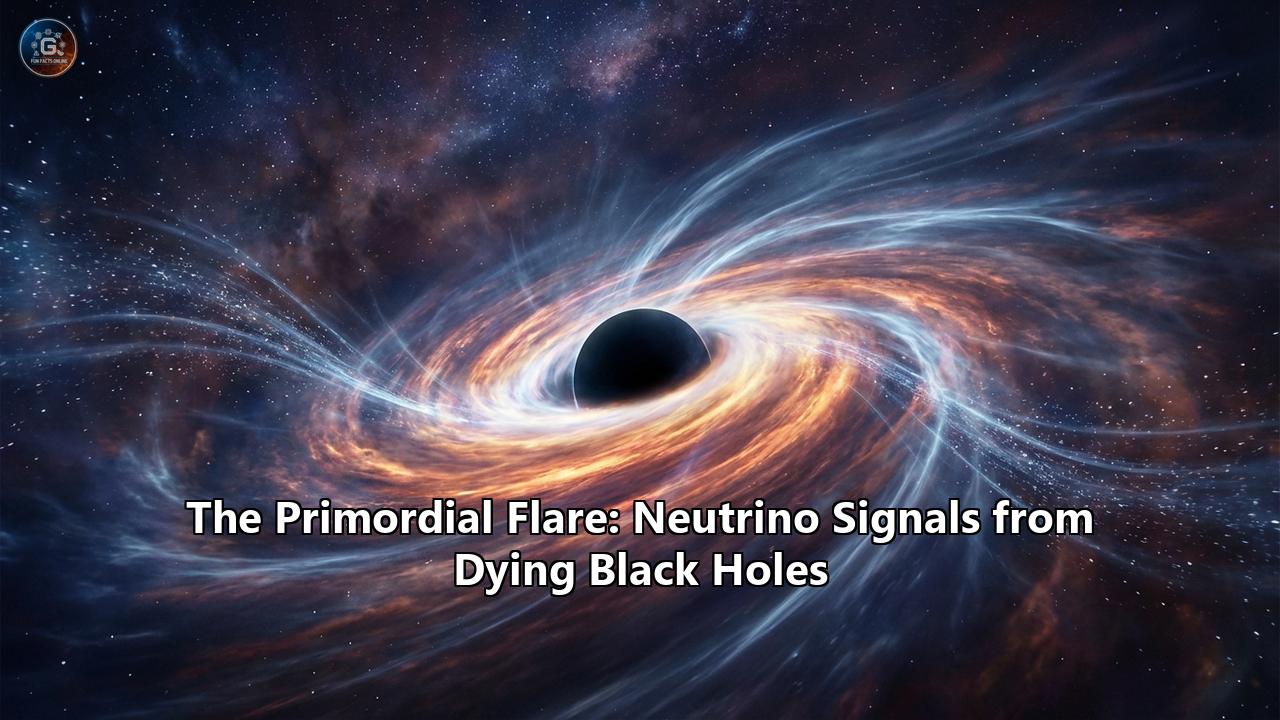
The deep ocean is a place of crushing darkness, a world where the sun’s reach fades into nothingness. Yet, it was here, amidst the silent currents of the Mediterranean Sea, that humanity may have caught its first glimpse of a cosmic funeral pyre burning at the edge of physics.
On February 13, 2023, the KM3NeT observatory—a grid of sensors anchored to the abyss—detected a "ghost particle" of staggering power. It was a neutrino, but not just any neutrino. This subatomic traveler carried an energy of roughly 220 peta-electronvolts (PeV), a punch so violent it dwarfed the capabilities of our most advanced particle accelerators.
For months, the signal was an anomaly, a jagged peak in the data that defied easy explanation. But recent theoretical work has begun to coalesce around a chilling and majestic possibility: we did not merely see a particle; we witnessed the death scream of a primordial black hole.
This is the story of the Primordial Flare—the final, cataclysmic burst of a black hole evaporating into pure energy, and the neutrino signal that traveled across eons to tell us about it.
The Ghosts of the Big Bang
To understand the significance of this signal, we must first look back to the very first moments of the universe. In the chaotic fraction of a second following the Big Bang, the cosmos was a hot, dense soup of fundamental particles. It was a time of violence and inconsistency, where quantum fluctuations rippled through the fabric of expanding space.
Standard cosmological models suggest that in some regions, these fluctuations were dense enough to collapse under their own gravity, bypassing the need for stars to form and die. These collapsed pockets of space-time became Primordial Black Holes (PBHs).
Unlike the stellar-mass black holes we observe today—monsters born from the supernovae of giant stars—PBHs could be incredibly small. Some might have formed with the mass of a mountain, compressed into the size of a proton. Others might be the mass of an asteroid, squeezed into a space smaller than an atom.
For decades, these objects have been the "dark horse" of cosmology. They are a leading candidate for Dark Matter, the invisible scaffolding that holds galaxies together. If the universe is teeming with trillions of these microscopic singularities, they would be invisible to our telescopes, revealing themselves only through their gravity... and, eventually, their death.
The Hawking Paradox: Smaller is Hotter
Black holes are famously known as objects from which nothing can escape, not even light. But in 1974, the legendary physicist Stephen Hawking threw a wrench into this absolute rule. By applying quantum mechanics to the event horizon—the point of no return—Hawking discovered that black holes are not truly black. They glow.
This phenomenon, known as Hawking Radiation, arises from the constant creation of "virtual particles" near the horizon. In a quantum magic trick, one particle falls in while its partner escapes, stealing a tiny fraction of the black hole’s energy.
Here is where the physics becomes counter-intuitive. For a massive black hole, like the supermassive giant at the center of the Milky Way, this radiation is agonizingly slow and cold—a temperature so low it is virtually undetectable.
But the equations dictate that a black hole’s temperature is inversely proportional to its mass. The smaller the black hole, the hotter it gets.
A black hole the mass of the sun radiates at a temperature of a mere billionth of a Kelvin. But a primordial black hole, having spent 13.8 billion years slowly leaking energy, would eventually reach a critical threshold. As it shrinks, it gets hotter. As it gets hotter, it radiates faster. This creates a runaway feedback loop.
The Final Flare
The life of a primordial black hole is a slow fade followed by a sudden, violent crescendo. For billions of years, it is a quiet, cold object drifting through the galactic halo. But as it sheds mass and shrinks to the size of a subatomic particle, its temperature skyrockets into the trillions of degrees.
In its final seconds, the black hole ceases to be a gravitational trap and becomes a particle accelerator of godlike proportions. It effectively "explodes," not in a chemical sense, but by converting its remaining mass into a burst of every particle species in existence.
This is the Primordial Flare.
During this final burst, the black hole spews out a "cornucopia" of particles: photons (light), electrons, quarks, and, crucially, neutrinos. Because the temperatures involved approach the Planck scale—the absolute limit of known physics—this explosion provides a window into high-energy realms we can never hope to replicate on Earth.
It was this theoretical flare that physicists believe KM3NeT may have detected.
The Signal from the Abyss
The event labeled KM3-230213A was singular. A neutrino energy of ~220 PeV is difficult to produce with standard astrophysical objects like blazars or supernovae remnants. Those objects tend to produce a spectrum of energies that tapers off. The KM3NeT event looked less like a taper and more like a "spike"—consistent with the monochromatic burst expected from a dying singularity.
However, the detection brought with it a scientific tension. If the universe is filled with enough primordial black holes to explain Dark Matter, and if they are exploding frequently enough for us to catch one, we should have seen more of them.
Specifically, the IceCube Neutrino Observatory in Antarctica, which has been staring at the sky for over a decade, should have detected dozens of these flares. But IceCube’s data has remained stubbornly silent on this front. This discrepancy—the "tension" between KM3NeT’s detection and IceCube’s silence—threatened to derail the theory.
A Dark Solution
The resolution to this mystery has come from a team of theoretical physicists, including researchers from MIT and UMass Amherst. In papers published in late 2025 and early 2026, they proposed an elegant, albeit exotic, solution.
What if primordial black holes aren't just simple gravitational drains? What if they carry a "dark charge"?
The Standard Model of particle physics describes the matter we can see. But if PBHs are indeed Dark Matter, they might interact with a "hidden sector" of physics. The researchers calculated that if PBHs were formed with a specific property related to this dark sector, their evaporation would look different.
As these "dark" PBHs evaporate, they would preferentially emit particles into the dark sector until the very final moments. This would suppress the steady stream of lower-energy neutrinos that IceCube would have easily seen. However, in the final millisecond of the black hole's life, the "dark charge" would discharge in a catastrophic breakdown, releasing a singular, ultra-high-energy spike of neutrinos.
This model fits the data perfectly. It explains why we haven't seen a background "hum" of dying black holes (satisfying IceCube) but allows for the occasional, solitary scream of a high-energy neutrino (explaining KM3NeT).
The Implications: A Triple Discovery
If this hypothesis holds, the detection of KM3-230213A is not just an astronomical curiosity. It would represent a "Triple Crown" discovery in physics, arguably the most significant since the discovery of the Higgs Boson.
- Proof of Hawking Radiation: despite being a cornerstone of modern theoretical physics, Hawking Radiation has never been directly observed. Confirming that black holes evaporate would validate the marriage of Quantum Mechanics and General Relativity.
- Discovery of Dark Matter: Confirming PBHs as the source of the flare would finally identify the nature of Dark Matter, solving a mystery that has plagued astronomy for nearly a century.
- New Physics: If the "dark charge" model is required to explain the data, it provides our first tangible evidence of a "dark sector"—a hidden realm of particles and forces that exist parallel to our own.
The Watchers in the Water
The scientific community is now on high alert. Telescopes and neutrino detectors around the world are being recalibrated to look for the specific signatures of these "Primordial Flares."
Future observatories, such as the proposed GRAND (Giant Radio Array for Neutrino Detection) project, will scan the horizon for the radio signals that should accompany these neutrino bursts. If we can correlate a neutrino spike with a gamma-ray burst or a radio pulse, the evidence will be irrefutable.
For now, we are left with the profound image of the event itself. Somewhere in the dark halo of our galaxy, an object older than the stars themselves—a tiny, dense knot of spacetime forged in the fires of the Big Bang—reached the end of its long life. It didn't fade away quietly. It raged against the dying of the light, releasing its entire essence in a single flash of impossible energy.
And billions of miles away, at the bottom of a human ocean, a sensor blinked. We are finally listening.
Reference:
- https://www.youtube.com/watch?v=X-afruuGKkg
- https://www.zmescience.com/space/neutrino-2023-event-exploding-black-hole/
- https://www.universetoday.com/articles/is-there-a-link-between-primordial-black-holes-neutrinos-and-dark-matter
- https://www.space.com/astronomy/black-holes/did-astronomers-see-a-black-hole-explode-an-impossible-particle-that-hit-earth-in-2023-may-tell-us
- https://astrobites.org/2025/12/20/neutrino-primordial-black-hole/
- https://physics.stackexchange.com/questions/16943/what-are-the-final-particles-emitted-from-an-evaporating-black-hole
- https://physics.stackexchange.com/questions/492677/when-we-are-talking-about-black-hole-evaporation-what-exactly-happens
- https://en.wikipedia.org/wiki/Hawking_radiation
- https://www.reddit.com/r/AskPhysics/comments/1kg3pp9/whats_left_when_a_black_hole_evaporates/
- https://news.mit.edu/2025/could-primordial-black-holes-last-burst-explain-mysteriously-energetic-neutrino-0918
- https://www.thebrighterside.news/post/record-breaking-neutrino-points-to-exploding-primordial-black-hole/