
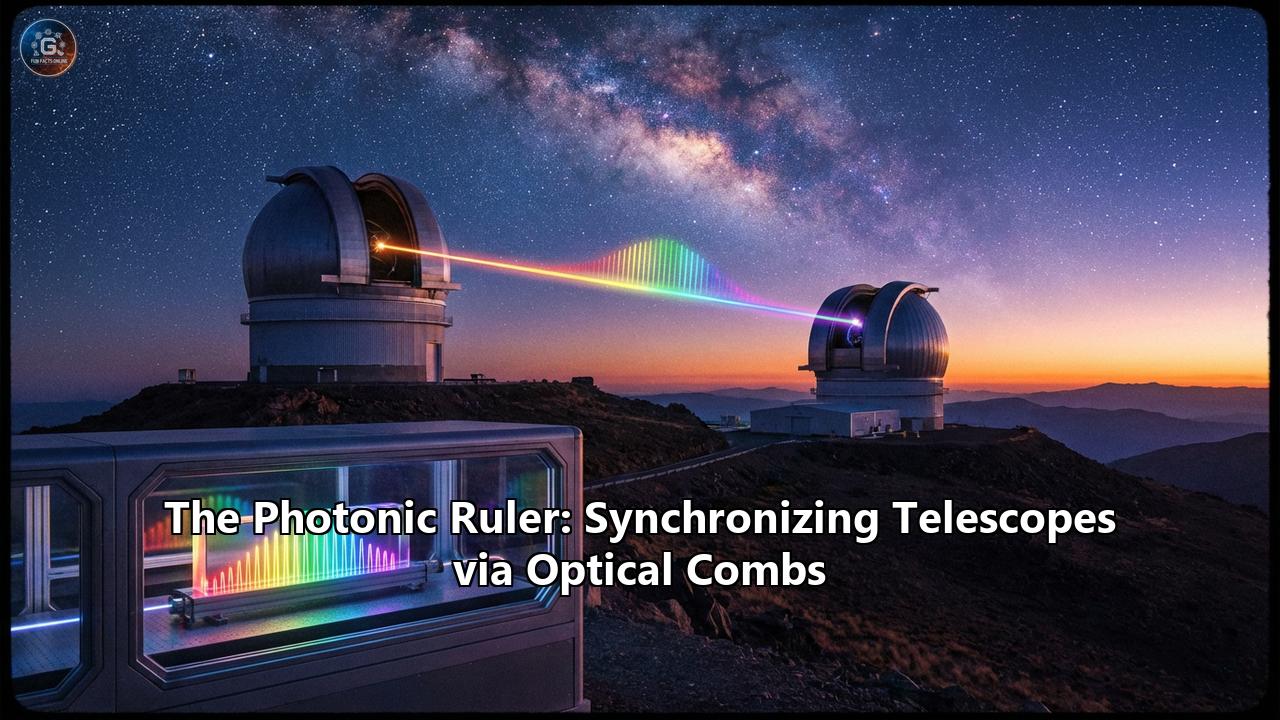
The Great Pyramids were built with knotted ropes and wooden rods. The Industrial Revolution was forged with steel calipers and vernier scales. The Information Age was clocked by the vibration of quartz crystals. But the next era of human discovery—the one that will map the event horizons of black holes, video-record the birth of planets, and perhaps find the first true twin of Earth—is being built with a ruler made of light.
This is the story of the Optical Frequency Comb, a device so precise it earned its inventors a Nobel Prize, and so revolutionary it is currently rewriting the rulebook of astronomy. To the uninitiated, it is a laser. To the astrophysicist, it is the "Photonic Ruler," a bridge that connects the ultra-fast oscillations of light with the countable ticks of a clock, allowing us to synchronize telescopes across continents with the precision of a single atom’s heartbeat.
In the high-stakes world of modern astronomy, bigger is better. We build larger mirrors to catch more light and spread antennas wider to see finer details. But there is a limit to how big a single telescope can be before it collapses under its own weight. To go beyond that, we must break the telescope apart, scattering its pieces across the Earth—or even into space—and linking them together to act as one giant, planetary eye. This technique, known as interferometry, relies on one crucial, terrifyingly difficult requirement: synchronization.
For decades, we have relied on the best atomic clocks to keep these distant eyes blinking in unison. But as we push to see the shadow of a black hole or the atmosphere of an exoplanet, atomic clocks are no longer enough. We need something faster, stabler, and more precise. We need the comb.
Part I: The Ruler of Light
To understand why the optical frequency comb is such a paradigm shift, we must first understand the problem of measuring light.
For centuries, measurement was physical. You held a ruler against an object and counted the hash marks. When we started measuring time, we used pendulums, then springs, then the vibration of quartz crystals. In 1967, humanity made a quantum leap by defining the second not by the rotation of the Earth, but by the oscillation of a cesium atom: 9,192,631,770 ticks per second. This microwave frequency became the heartbeat of the modern world, synchronizing GPS, the internet, and power grids.
But light oscillates much, much faster—hundreds of trillions of times per second. If a microwave cesium clock is a ruler with hash marks every inch, a beam of visible light is a ruler with hash marks every nanometer. For decades, scientists had a problem: they had no "gearbox" to connect the two. They could count the slow ticks of a microwave clock, and they could see the fast color of a laser, but they couldn't count the laser's oscillations directly. The electronics simply weren't fast enough. It was like trying to count the spinning blades of a jet engine with a stopwatch.
Enter the Optical Frequency Comb.
Invented in the late 1990s by John L. Hall and Theodor W. Hänsch (who shared the 2005 Nobel Prize in Physics for it), the comb acts as a reduction gear for light. It emits a train of ultra-short laser pulses—lasting only femtoseconds (quadrillionths of a second). In the frequency domain, this train of pulses looks like a series of evenly spaced spikes, resembling the teeth of a hair comb.
The magic lies in the math. The frequency of each "tooth" is determined by two simple numbers: the repetition rate of the pulses (which is slow enough to be measured by standard electronics) and an offset frequency. By locking these two parameters to an atomic clock, the entire comb becomes a perfect ruler. If you shine an unknown laser light against this comb, you can measure its frequency by seeing which "tooth" it beats against.
Suddenly, scientists could count optical frequencies as easily as radio waves. They had forged a link between the radio spectrum (time) and the optical spectrum (color). They had built a photonic ruler. And astronomers immediately saw its potential to do the impossible.
Part II: The Exoplanet Hunter
Calibrating the Search for Earth 2.0The first great revolution brought by the photonic ruler wasn't in synchronizing telescopes, but in calibrating them.
One of the Holy Grails of modern astronomy is finding an "Earth analog"—a rocky planet orbiting a sun-like star in the habitable zone. The primary method for finding these worlds is the Radial Velocity method. As a planet orbits a star, its gravity tugs on the star, causing it to wobble back and forth. When the star moves towards us, its light is squashed (blue-shifted); when it moves away, its light is stretched (red-shifted).
To find a Jupiter-sized planet, you need to detect a wobble of about 13 meters per second—roughly the speed of a springing tiger. We’ve been able to do this for years. But Earth is small. Its gravitational tug on the Sun causes a wobble of only 9 centimeters per second. That is the speed of a Galapagos tortoise.
Detecting a shift that tiny in the light of a star hundreds of light-years away requires a spectrograph (a prism that splits light into a rainbow) with almost magical stability. Traditional calibration methods, like thorium-argon gas lamps, provide a reference spectrum, but the lines are unevenly spaced and drift over time due to pressure and temperature changes. Trying to find an Earth-like planet with a gas lamp calibrator is like trying to measure a microscopic bacteria with a wooden yardstick that warps in the humidity.
The optical frequency comb changed the game.
When an "Astrocomb"—a frequency comb designed for astronomy—is injected into a spectrograph, it lays down thousands of perfectly spaced, perfectly bright reference lines. It is a ruler that never warps, never ages, and never drifts, because it is locked to the fundamental constants of physics.
The ELT and HIRESCurrently, the European Southern Observatory is building the Extremely Large Telescope (ELT) in the Atacama Desert of Chile. With a main mirror 39 meters across, it will be the biggest eye on the sky. Its flagship instrument, the HIRES (High Resolution Spectrograph), is being designed with an astrocomb at its heart.
With the precision of the comb, HIRES will not just look for exoplanets; it will perform "Doppler tomography." It will be able to detect the expansion of the universe in real-time (the Sandage-Loeb test) by measuring how the redshift of distant quasars changes over a decade. It will check if the fundamental constants of nature, like the fine-structure constant, are actually constant or if they have changed since the Big Bang.
None of this would be possible without the comb. But while the comb serves as a ruler inside the instrument, its most daring application is to act as a lifeline between them.
Part III: The Earth-Sized Eye
Synchronizing the Event Horizon TelescopeOn April 10, 2019, the world saw the unseeable: a picture of the supermassive black hole at the center of galaxy M87. The image—a fiery donut of doomed matter circling a central darkness—was captured by the Event Horizon Telescope (EHT).
The EHT is not a single telescope. It is a Very Long Baseline Interferometer (VLBI). It links radio dishes from Greenland to the South Pole, from Hawaii to France. By recording the radio waves arriving at each dish and combining them later in a supercomputer, the EHT acts as a single telescope the size of the Earth.
The resolution of an interferometer depends on two things: the distance between the telescopes (the baseline) and the frequency of the light being observed. To see sharper details, you either move the telescopes further apart (impossible on Earth) or you observe at higher frequencies (shorter wavelengths).
This is where the headache begins.
In VLBI, every telescope must record the arrival time of radio waves with perfect synchronization. Currently, this is done using Hydrogen Maser atomic clocks at each site. These clocks are incredibly stable, but they operate in the microwave regime. As the EHT moves to higher frequencies—from 230 GHz to 345 GHz and eventually into the terahertz range—the tiny phase errors (jitter) in the microwave clocks get multiplied.
Imagine two dancers trying to move in perfect unison while listening to a beat. If the music is slow (low frequency), they can stay in sync easily. But if the music speeds up to a frenetic blur (high frequency), even a millisecond of delay makes them crash into each other. The Hydrogen Masers provide a slow, steady beat. The telescopes need to dance to a frenetic one.
The KAIST ExperimentThis is where the optical comb enters the network. In a landmark experiment, researchers at KAIST (Korea Advanced Institute of Science and Technology) and the Korean VLBI Network demonstrated that an optical frequency comb could act as a "phase-coherent" link between the atomic clock and the telescope receiver.
Instead of relying on standard electronic frequency synthesizers (which add noise), the comb takes the pure, stable tick of the atomic clock and "up-converts" it to the optical domain, then generates the high-frequency radio signals needed by the telescope with significantly less noise.
This "photonic microwave generation" means that future arrays could observe at much higher frequencies—0.87mm or even shorter wavelengths—without the synchronization falling apart. This would allow us to see the "photon ring" of a black hole, a razor-sharp feature predicted by General Relativity that is currently just too blurry to resolve.
Part IV: The Network Layer
White Rabbit and the Flying CombIf the comb is the ruler, how do we stretch it across the world?
In a traditional VLBI array like the EHT, the telescopes are disconnected. They record data onto hard drives along with the ticks of their local atomic clock, and the "synchronization" happens months later when the hard drives are flown to a central building and played back together. This is called "e-VLBI."
But for the next generation of arrays, like the Square Kilometre Array (SKA) being built in Australia and South Africa, the telescopes are connected by fiber optics. Here, the goal is to distribute a single central clock signal to hundreds of dishes spread over thousands of kilometers.
The White Rabbit ProtocolThe challenge is that fiber optic cables expand and contract with temperature. A 100km fiber buried underground might stretch by a few meters between day and night. For light traveling at 200,000 km/s, a few meters is a massive timing error.
To solve this, scientists adapted a technology from CERN called White Rabbit. Originally designed to time particle collisions in the Large Hadron Collider, White Rabbit is an Ethernet-based protocol that constantly measures the time it takes for a signal to travel down the fiber and bounce back. It dynamically adjusts for the stretching of the cable, achieving sub-nanosecond synchronization.
When you combine White Rabbit with optical frequency combs, you get something extraordinary. You can send the "teeth" of the comb down the fiber. The comb acts as a carrier, transferring the ultra-stable phase of the central clock to every antenna in the array. This allows thousands of cheap radio antennas to behave with the stability of a single multi-billion-dollar instrument.
Free-Space Links: The 1.3km LeapBut what if you can't run a fiber cable? What if your telescopes are on opposite mountain peaks, or one is on the ground and one is in space?
Recent experiments have demonstrated "Comb-to-Comb Stabilization" over free space. In a test reported in Nature Photonics, scientists synchronized two optical combs separated by 1.3 kilometers of open air. They fired a laser beam through the atmosphere, battling turbulence that makes stars twinkle. By using active feedback loops to cancel out the atmospheric distortion, they transferred the clock signal with femtosecond precision.
This proves that we can create a "virtual fiber" through the air. It opens the door to synchronizing arrays of drones, high-altitude balloons, or satellites, creating a shifting, dynamic telescope swarm that can reshape itself to capture different targets.
Part V: The Future Frontier
Optical Interferometry and the Planet Formation ImagerThe ultimate dream of the Photonic Ruler is to leave radio waves behind entirely and perform Optical Long Baseline Interferometry.
Radio waves are centimeters or millimeters long. Visible light waves are hundreds of nanometers long—a million times smaller. If we could link optical telescopes the way we link radio telescopes (VLBI), we would achieve resolution a million times higher. We could resolve the continents on an exoplanet or watch a star being eaten by a black hole in real-time.
But "Optical VLBI" has always been considered impossible. To interfere light waves from two separate telescopes, you need to know the arrival time of the light to within a fraction of a wavelength—meaning you need attosecond (billionth of a billionth of a second) timing precision. No electronic clock can do this.
However, the Planet Formation Imager (PFI) project is eyeing the comb as the solution. The concept is Heterodyne Interferometry with Frequency Combs.
In this futuristic setup, you don't try to physically combine the light beams (which requires complex vacuum tunnels and mirrors). Instead, at each telescope, you mix the incoming starlight with a local laser (Local Oscillator). This "down-converts" the light to a radio frequency that can be recorded digitially.
In the past, this failed because the local lasers weren't stable enough; they introduced too much noise. But if you lock the local laser at each telescope to an optical frequency comb, and synchronize those combs, you suddenly have a "perfect" reference.
The PFI proposes using this technology to link mid-infrared telescopes over kilometers. The goal is to peer into the dusty disks around young stars and image the heat signatures of baby planets as they form—witnessing the birth of solar systems.
Part VI: The Quantum Connection
The story of the comb doesn't end with classical physics. It extends into the quantum realm.
As we build these synchronized networks of combs, we are inadvertently laying the infrastructure for the Quantum Internet. The same phase-stable links used to sync telescopes can be used to transmit entangled photons.
Researchers are exploring Quantum-Assisted Interferometry, where entangled photons are shared between telescopes to increase sensitivity beyond the classical diffraction limit. By using optical combs to distinguish extremely specific frequency modes, we can filter out the noise of the universe and detect signals that are currently invisible.
Conclusion: The Ruler of the Cosmos
We are transitioning from the age of electronics to the age of photonics. For the last century, our exploration of the universe was limited by how fast we could push electrons through a wire. Now, we are learning to measure the universe with the very thing it is made of: light.
The Optical Frequency Comb is more than just a tool; it is the metronome of the future. It is the heartbeat that will synchronize the giant ears of the SKA in the African desert. It is the ruler that will measure the wobble of a star to find a second Earth. And it is the bridge that will one day link telescopes in space to reveal the faces of black holes.
In the silence of the observatory, the comb hums—a train of light pulsing quadrillions of times a second, counting the universe, one femtosecond at a time.
Reference:
- https://arxiv.org/abs/2511.07679
- https://www.mdpi.com/2079-9292/14/5/970
- https://validate.perfdrive.com/?ssa=7b307348-d423-69ec-3c6b-8c7b65bc8b68&ssb=06968257302&ssc=https%3A%2F%2Fopg.optica.org&ssi=0569d0d2-d3hy-3521-c0fb-2ace214a41a9&ssk=botmanager_support@radware.com&ssm=80939454943147704133897856733694&ssn=a9a9ebc30ae8e037b7833662e68e05a52acb967215b3-de95-f955-aef90c&sso=2371655-a061-5bf39f59b546c60f8b93d7f921b0940d22e06afd47e0be55&ssp=54129130251770291049177022652321892&ssq=01119461827535049551018274422035609150942&ssr=MTgwLjE4OC4xNzQuMjg=&sst=python-requests%2F2.32.3&ssv=&ssw=
- https://validate.perfdrive.com/?ssa=7831956e-e557-8fac-0eea-ddaf485f6113&ssb=50457281026&ssc=https%3A%2F%2Fopg.optica.org&ssi=4e62182a-d3hy-0c00-5494-9d8cb35c8b77&ssk=botmanager_support@radware.com&ssm=81247185187798407100930456125359&ssn=f5c7bfc1d4b35286e5584c42cc5c0b562061980bc402-62d2-410d-321fc0&sso=dad440d-3806-be9b47fc52d46913c089cf0d801cb8a4ba103eae738449fa&ssp=94817540381770265981177025504308223&ssq=12669851827956821436418279143951485786201&ssr=MTgwLjE4OC4xNzQuMjg=&sst=python-requests%2F2.32.3&ssv=&ssw=
- https://en.wikipedia.org/wiki/Frequency_comb
- https://lesia.obspm.fr/VIRA/absbook/node83.html
- https://www.youtube.com/watch?v=UgiBYZ2oZT4
- https://validate.perfdrive.com/?ssa=0f9769ee-75b5-4f24-ed02-5627c9656cd8&ssb=31398261290&ssc=https%3A%2F%2Fopg.optica.org&ssi=6833c74f-d3hy-96a8-7194-2b0049922112&ssk=botmanager_support@radware.com&ssm=79387080303197766107761084260319&ssn=52ba463a675bafb3d62aa122c1ffaec782d31f507d9b-1e4d-96bd-deb6e0&sso=94c2abd-d9c7-4747c9a985c42a97ae95170b7c1dce461c33def09dbc75a4&ssp=40893215691770291597177029795730864&ssq=98503371828731696744818287553655442394468&ssr=MTgwLjE4OC4xNzQuMjg=&sst=python-requests%2F2.32.3&ssv=&ssw=
- https://arxiv.org/abs/2501.05691
- https://www.net.in.tum.de/fileadmin/TUM/NET/NET-2021-05-1/NET-2021-05-1_14.pdf
- https://www.oscilloquartz.com/en/products-and-services/technology/what-are-white-rabbit-timing-systems
- https://arxiv.org/abs/1407.7032