
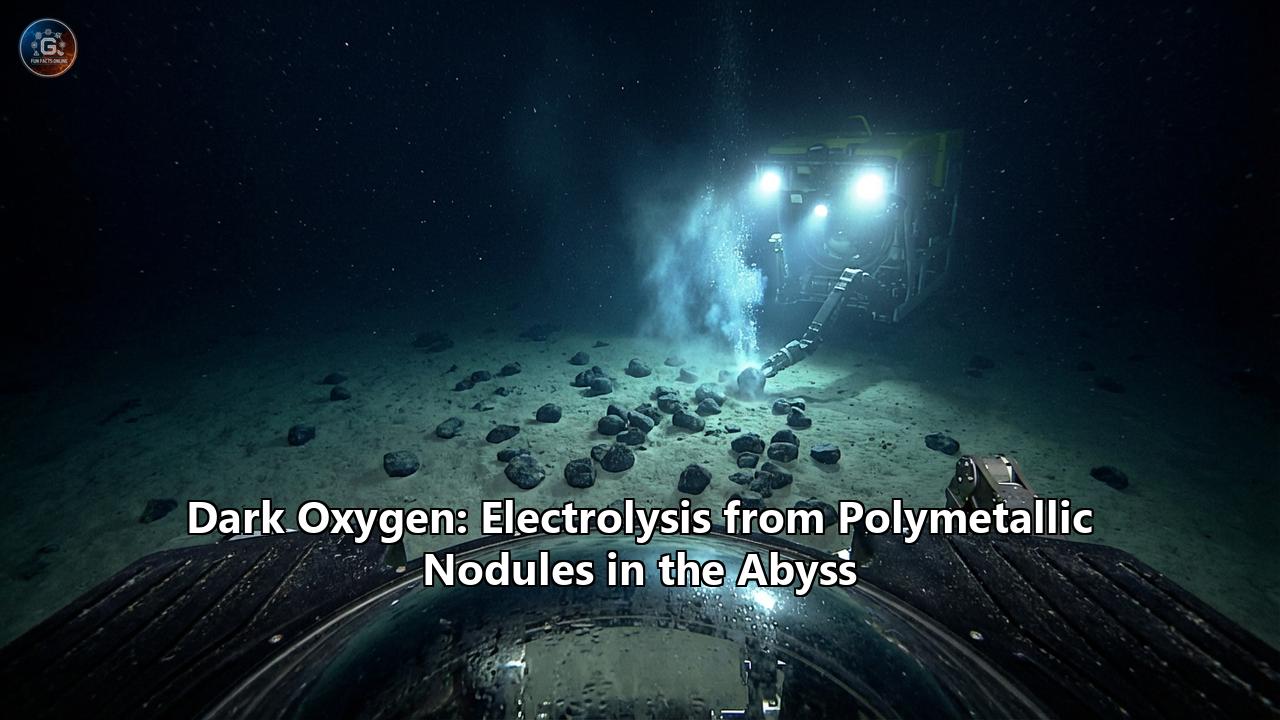
The abyss was supposed to be a place of consumption, not creation. For over a century of oceanographic science, the prevailing dogma of the deep ocean—that vast, crushing darkness covering nearly half our planet—was one of slow, inevitable decay. We believed that the bottom of the sea was the final resting place for the sun’s energy. Life there was thought to exist only by scavenging the "marine snow," the detritus of dead plankton and fecal matter drifting down from the sunlit surface, or by huddling around violent hydrothermal vents, feeding on chemical soup. Oxygen, the breath of life, was assumed to be a gift solely from above, manufactured by phytoplankton and plants, sinking into the depths via cold, dense currents. The seafloor was a tomb, kept alive only by the charity of the sun.
But in the summer of 2024, the darkness spoke back. A team of scientists, drifting miles above the Clarion-Clipperton Zone in the Pacific, pulled up sensors that had been registering the impossible for nearly a decade. They found that the abyss was not just a tomb, but a factory. There, in the absolute blackness, 4,000 meters down, stones were breathing. This is the story of "Dark Oxygen," a discovery that has shattered the fundamental laws of marine biology, threatened the nascent industry of deep-sea mining, and forced us to rewrite the history of life on Earth—and perhaps, life in the universe.
Part I: The Anomalous Signal
To understand the magnitude of this discovery, one must first understand the environment in which it occurred. The Clarion-Clipperton Zone (CCZ) is a fracture in the Earth's crust that spans 4.5 million square kilometers between Hawaii and Mexico. It is an abyssal plain, a flat, mud-slicked wasteland that sits under four kilometers of water. At this depth, the pressure is roughly 400 atmospheres—equivalent to having a small car balanced on your thumb. The temperature hovers just above freezing. And, most importantly, it is dark. Not the darkness of a moonless night, which is teeming with photons compared to the abyss, but a total, suffocating physical absolute. Sunlight penetrates, at best, a few hundred meters into the ocean. By the time you reach the abyssal plain, the sun is a memory that hasn't existed for a thousand years.
In this world, oxygen is a finite currency. It is dissolved in the seawater, brought down by the "thermohaline circulation," the great global conveyor belt of ocean currents that sinks cold, oxygen-rich water at the poles. Once that water reaches the bottom, the oxygen is slowly consumed by the sparse life forms that dwell there: sea cucumbers, xenophyophores, ghost octopuses, and bacteria. In every benthic chamber experiment ever conducted—where scientists seal off a patch of mud to measure gas exchange—the result has been a downward slope. Oxygen goes down as life breathes it in. It never, ever goes up.
Andrew Sweetman, a professor at the Scottish Association for Marine Science (SAMS), knew this rule better than anyone. In 2013, he was leading an expedition in the CCZ, deploying landers to measure the "benthic flux," the breathing rate of the seafloor. When his landers returned to the surface and he downloaded the data, he saw something that made no sense. The oxygen levels inside the sealed chambers hadn't dropped. They had risen.
"I told my students, 'Put the sensors back in the box. They're broken,'" Sweetman later recounted. It was the only logical conclusion. Sensors drift; electronics fail under pressure; calibration goes off. The idea that oxygen was being produced in the dark was akin to finding a perpetual motion machine or a fire burning without fuel. It was scientifically offensive.
For nearly a decade, Sweetman and his team treated this data as a glitch. They sent the sensors back to the manufacturer, who recalibrated them and certified they were working perfectly. They used different methods, different brands of sensors, and different landers. Yet, in 2021 and 2022, when they returned to the Pacific aboard the sleek research vessels of the modern era, the "glitch" returned. In the silence of the abyss, oxygen was surging.
It wasn't until Sweetman decided to employ a backup method—a non-electronic chemical analysis called the Winkler titration method—that the denial finally broke. The Winkler method is old-school chemistry: reagents, color changes, manual titration. It doesn't glitch. When the fluid samples from the black depths turned the specific shade of amber-yellow that indicates high oxygen concentration, Sweetman realized he had been throwing away the discovery of a lifetime for ten years.
The oxygen was real. The abyss was breathing. But how?
Part II: The Batteries in the Rock
The culprit was lying in plain sight, scattered across the seabed like spilled potatoes. They are called polymetallic nodules. To the untrained eye, they are ugly, lumpen rocks, black and charcoal-grey, ranging in size from a golf ball to a large potato. They sit loosely on the sediment, half-buried in the abyssal mud.
But these are not ordinary stones. They are time capsules and chemical anomalies. Polymetallic nodules form over millions of years, growing by the precipitation of metals from seawater around a nucleus—a shark’s tooth, a fragment of shell, or a piece of basalt. They grow at a geological crawl, adding just a few millimeters every million years. A fist-sized nodule held in your hand is older than the human species, older than the continents in their current configuration. It may have started forming when dinosaurs walked the Earth.
Their composition is what makes them the most coveted stones on the planet today. They are almost pure metal ore: manganese, nickel, cobalt, copper, and rare earth elements. They are, effectively, the physical manifestation of the periodic table’s transition metals.
Sweetman’s team began to suspect that the nodules were involved in the oxygen production because the phenomenon only occurred where the nodules were present. When they measured the sediment alone, oxygen dropped as expected. When they included the nodules, oxygen spiked.
The hypothesis they formed was audacious: Seawater Electrolysis.
We learn electrolysis in high school chemistry. If you put two electrodes in water and run a current through them, you can split the water molecule ($H_2O$) into its constituent gases: hydrogen and oxygen. But this requires a battery, a power source. There are no power outlets in the abyss.
Or so we thought. The team realized that the nodules themselves were electrically active. They are composed of layers of different metal oxides—manganese oxide, iron hydroxide—mixed with nickel and cobalt. These metals have different electrochemical potentials. When disparate metals interact in a salt solution (and seawater is the ultimate salt solution), electrons can flow. The nodule is a "geobattery."
To test this, the team brought nodules up to the ship and, for the first time, applied a voltmeter to their wet, bumpy surfaces. The reading was shocking. A single nodule could generate a voltage of up to 0.95 volts.
To split seawater, you need a theoretical minimum of 1.23 volts, though in practice, due to "overpotential" (the energy hurdle to get the reaction moving), you need about 1.5 volts. A single nodule wasn't quite enough. But nature rarely works in isolation. The nodules in the CCZ are packed densely, often touching. The researchers realized that when nodules cluster together, they can act in series, like batteries stacked in a flashlight. The combined voltage across a cluster of these ancient stones could easily exceed the 1.5-volt threshold.
The mechanism was laid bare: The Earth’s seafloor is covered in trillions of natural batteries. For millions of years, in the absolute dark, these stones have been silently stripping electrons from water molecules, releasing free oxygen into the deep ocean. They called it "Dark Oxygen."
Part III: The Industrial Leviathan
The timing of this discovery could not have been more dramatic. The Clarion-Clipperton Zone is not just a scientific curiosity; it is the battlefield for the next great industrial resource war.
For decades, mining companies have eyed the CCZ with hunger. The green energy transition—the shift from fossil fuels to electric power—requires batteries. Massive batteries for cars, for grid storage, for the electrification of our civilization. These batteries require nickel, cobalt, manganese, and copper. Terrestrial sources of these metals are problematic: they are found in conflict zones, their mining involves deforestation and child labor, and the ore grades are declining.
The CCZ, however, contains more cobalt and nickel than all known land reserves combined. It is a treasure chest sitting on the bottom of the world, waiting to be picked up.
Enter The Metals Company (TMC), a Canadian mining firm that has become the face of deep-sea mining. TMC has argued, with considerable logic, that harvesting nodules is the lesser of two evils. There are no forests to cut down in the abyss, no indigenous populations to displace, no children to exploit. They liken the process to harvesting potatoes: a collector vehicle crawls along the bottom, sucking up the nodules and leaving the mud behind (mostly).
TMC had actually funded some of Sweetman’s research, expecting the data to confirm that the environment was stable and manageable. Instead, the "Dark Oxygen" paper, published in the prestigious journal Nature Geoscience, dropped a bomb on their business model.
If the nodules are not just rocks, but active oxygen factories, then removing them is not just resource extraction; it is the destruction of a planetary lung.
The reaction was swift and fierce. When the news broke, mining stocks shuddered. TMC released a rebuttal that was unusually aggressive for the scientific world. They accused the study of being "flawed" and "misleading." They suggested that the oxygen readings were artifacts of the methodology, perhaps air bubbles trapped in the equipment or chemical contamination. They argued that the voltage measured was insufficient to sustain electrolysis at a scale that mattered.
The conflict highlights a profound disconnect between two ways of viewing the Earth. To the miner, the nodule is a commodity, defined by its price per ton of nickel. To the oceanographer, the nodule is now a "keystone species" of the geological world, a vital organ of the deep ocean.
The implications for mining are devastating. The International Seabed Authority (ISA), the UN-affiliated body headquartered in Jamaica that governs the high seas, is currently writing the "Mining Code"—the rulebook for how extraction will occur. If the Dark Oxygen theory holds, the environmental impact assessments for mining are all wrong.
Mining doesn't just remove the nodules. It creates "sediment plumes"—clouds of silt kicked up by the harvesters. If these plumes settle on nearby nodules, they could insulate the electrical connection between the rock and the seawater, shutting off the geobattery. You wouldn't even need to mine a specific area to kill it; you would just need to dust it. If the deep-sea ecosystem relies on this extra boost of oxygen to survive in the stagnant depths, turning off the batteries could lead to a mass asphyxiation event across millions of square kilometers.
Part IV: Rewriting the Book of Life
While the miners and the environmentalists sharpened their knives, the biologists were staring at the ceiling, lost in thought. The discovery of Dark Oxygen doesn't just change the future of the ocean; it changes the past.
For nearly a century, the "Great Oxidation Event" (GOE) has been the cornerstone of Earth history. The story goes that roughly 2.4 billion years ago, cyanobacteria evolved photosynthesis. They learned to hack sunlight to split water, releasing oxygen as a waste product. Before this, Earth was anoxic; after this, the atmosphere filled with oxygen, allowing for the evolution of complex, aerobic life (like us).
We have always assumed that oxygen requires light. Therefore, we assumed that aerobic life must have evolved in shallow waters, bathed in the sun.
But the nodules in the abyss are ancient. The chemical conditions that create them have existed for eons. If the Earth has a mechanism to produce oxygen in the dark, through simple geology and chemistry, then oxygen might have been available in the deep ocean millions or billions of years before the first cyanobacteria bloomed.
This is a paradigm shift of staggering proportions. It suggests that the "primordial soup" where life began might not have been an anaerobic stew. There could have been pockets of oxygen—oases of aerobic potential—clinging to metal-rich rocks in the Hadean deep. Life could have learned to breathe oxygen in the dark, long before it learned to eat the sun.
This theory aligns with some puzzling fossil evidence. There are traces of aerobic metabolism that seem to predate the Great Oxidation Event. Until now, these were dismissed as anomalies or evidence of "whiffs" of oxygen from unknown sources. The nodules provide the source.
Furthermore, this discovery extends its reach beyond Earth. We are currently hunting for life on "Ocean Worlds" like Europa (a moon of Jupiter) and Enceladus (a moon of Saturn). These worlds have vast, salty oceans hidden beneath kilometers of ice. Sunlight never touches these waters. Astrobiologists have pinned their hopes on hydrothermal vents as energy sources, but the lack of oxygen has always been a bottleneck for complexity. You can get single-celled slime with chemical energy, but to build a fish, or a squid—something that burns energy to move and hunt—you generally need the high-octane fuel that is oxygen.
If geobatteries exist on Earth, they likely exist on Europa. If the rocky core of Enceladus is rich in metals (which it is), and the ocean is salty (which it is), then the dark oceans of the outer solar system might be oxygenated. The ceiling for life on those worlds has just been raised. We are no longer looking for mere slime; we are looking for things that breathe.
Part V: The Ecology of the Impossible
What lives in the Dark Oxygen zone? The CCZ is not a desert. It is one of the most biodiverse places on Earth, though the life is strange and slow.
There are the Xenophyophores, giant single-celled organisms that can grow to the size of a basketball. They are fragile, intricate structures made of sediment and glue, looking like delicate sponges. They are known to concentrate heavy metals in their bodies—perhaps a connection to the electric environment they inhabit?
There is the Gum Squirrel (Psychropotes longicauda), a sea cucumber that looks bizarrely like a gummy candy with a large tail, which it uses to sail across the mud.
There are the Ghost Octopuses (Casper octopods), pale, translucent creatures that lay their eggs specifically on the stalks of dead sponges—sponges that grow exclusively on polymetallic nodules.
These creatures live in a world of extreme energy scarcity. Evolution here is a game of efficiency. If there is a localized source of oxygen—a "halo" of O2 around each nodule—it stands to reason that life would adapt to utilize it. The nodules might function like campfires in a frozen wilderness, with microbial communities huddling close to the source of the gas.
Sweetman’s research suggests that the oxygen production is not constant; it pulses. It might react to changes in ocean currents, temperature, or even the movement of animals brushing against the rocks (cleaning the contacts, so to speak). This creates a dynamic, electrically charged ecosystem that we have barely begun to map.
If we mine the CCZ, we are removing the anchor points of this web. The Ghost Octopus loses its nesting ground. The microbes lose their oxygen source. The "battery" is removed, and the lights go out.
Part VI: The Geobattery Mechanism in Depth
To fully appreciate the "Dark Oxygen" phenomenon, we must delve deeper into the electrochemistry. How does a rock become a battery?
The key lies in the layering. A polymetallic nodule is not a homogeneous lump. If you cut one in half, it looks like a target, with concentric rings of varying colors and textures. These rings represent different geological eras, different sedimentation rates, and different metal compositions.
Some layers are rich in Vernadite ($\delta-MnO_2$), others in Todorokite. These minerals have different "Fermi levels"—different appetites for electrons. In the presence of seawater, which acts as an electrolyte (a fluid that conducts electricity), ions move between these layers.
The surface of the nodule acts as a catalyst. A catalyst is a substance that lowers the energy required for a chemical reaction to occur. Manganese oxide is a well-known catalyst for the "Oxygen Evolution Reaction" (OER). In industrial electrolyzers (used to make green hydrogen fuel), we use expensive metals like iridium or platinum to catalyze this reaction. In the abyss, nature uses manganese and nickel.
The reaction at the surface (the anode) looks like this:
$$2H_2O \rightarrow O_2 + 4H^+ + 4e^-$$
Two water molecules are ripped apart, releasing one molecule of oxygen gas, four protons (acidifying the water slightly), and four electrons.
Those electrons have to go somewhere. They travel through the conductive body of the nodule to a cathodic site, where they likely participate in a reduction reaction, such as converting oxidized manganese back to a reduced state, or perhaps reducing trace metals in the water.
The discovery that the surface voltage can reach nearly 1 volt is the smoking gun. It implies that the nodule is constantly charged. Where does the energy come from to maintain this charge? This is the subject of intense debate.
Some physicists suggest it is a "corrosion potential"—the rock is slowly oxidizing or reacting with the water, spending its stored chemical energy like a slow-burning fuse. Since the nodules grow over millions of years, this release of energy is incredibly slow, but steady.
Others suggest a "piezoelectric" effect, where the immense pressure of the deep ocean, or the friction of bottom currents, generates the charge.
A more exotic theory involves the "semiconductor" properties of the metal oxides. Could they be harvesting weak thermal gradients? Or even interacting with the background radiation of the Earth?
Whatever the power source, the result is clear: The seafloor is electrically alive.
Part VII: The Political Tsunami
The ripples of this discovery have reached the halls of the United Nations. The International Seabed Authority (ISA) is an organization caught in an existential crisis. It was created with a dual mandate: to facilitate the mining of the deep sea for the benefit of mankind, and to protect the marine environment. These two goals are now in direct collision.
For years, the ISA has been moving toward finalizing the mining code. Nations like Nauru, sponsoring The Metals Company, have triggered a "two-year rule," a legal clause that forces the ISA to allow mining to proceed if regulations aren't finished in time. The clock is ticking.
But the "Dark Oxygen" paper has armed the opposition. A coalition of countries—including Germany, France, Chile, and Pacific Island nations like Vanuatu—has called for a moratorium (a pause) on deep-sea mining. They argue that we cannot manage what we do not understand. If we didn't know the seafloor produced oxygen until 2024, what else don't we know?
The "Precautionary Principle" is the legal weapon of choice here. It states that if an action has a suspected risk of causing harm to the public or the environment, the burden of proof that it is not harmful falls on those taking the action. The miners must now prove that removing the oxygen source won't cause a collapse. Proving a negative in a system as complex as the Pacific Ocean is nearly impossible.
The Metals Company is fighting back with data of their own, but the public relations battle is shifting. The narrative of "clean battery metals" is tarnished if those metals come at the cost of the Earth's "hidden lung."
Part VIII: The Future of the Abyss
We stand at a crossroads. One path leads to the industrialization of the deep. Giant crawlers, resembling combine harvesters the size of houses, will descend into the dark. They will vacuum up the nodules, pumping them up 4-kilometer long riser pipes to support vessels. The nodules will be processed into batteries that power our Teslas and iPhones, helping to decarbonize the atmosphere. But the price will be the silence of the abyss, the extinguishing of the geobatteries, and the unknown consequences of severing a planetary oxygen line.
The other path leads to preservation and science. We declare the abyss a wilderness, a scientific park. We study the geobatteries to understand how to design better catalysts for our own energy needs (biomimicry). We use the CCZ as a laboratory to understand the origins of life. We find other ways to build batteries—recycling, new chemistries like sodium-ion or iron-air—that don't require deep-sea metals.
The discovery of Dark Oxygen is a humbling reminder of our ignorance. We have mapped the surface of Mars better than our own ocean floor. We assumed the abyss was dead, and it turned out to be electric. We assumed it was a sink, and it turned out to be a source.
As we gaze down into the black water, we must realize that we are not looking into a void. We are looking into a machine—a vast, silent, electric machine that has been humming since the dawn of time, breathing life into the dark. The question is no longer just "what is down there?" The question is: "Do we have the right to unplug it?"
Part IX: The Scientific Aftermath and Future Research
Since the publication of the 2024 paper, the scientific community has mobilized. New expeditions are being planned not just to the CCZ, but to other nodule fields—the Peru Basin, the Indian Ocean, and the Cook Islands EEZ.
Researchers are designing new sensors that are immune to the electrical interference of the nodules. They are developing "benthic Rovers"—autonomous robots that can crawl from stone to stone, measuring the electrical field of the seafloor in 3D.
Geochemists are racing to replicate the reaction in the lab. If we can understand exactly how a lump of manganese oxide splits seawater with such low energy input, we might revolutionize the green hydrogen industry. Currently, making hydrogen from water is energy-intensive. If nature has found a "shortcut" using specific mineral structures, we could mimic it to solve our energy crisis on the surface, without destroying the source in the deep.
The debate over the "Origin of Life" is also heating up. Evolutionary biologists are running simulations of "Geobattery Worlds"—models of early Earth where oxygen pockets around nodules drive the evolution of complex cells. If these models work, they could solve the "Energetic Gap" in evolution—the difficult jump from simple bacteria to complex eukaryotes.
Part X: Conclusion
The story of Dark Oxygen is a story of human hubris and the resilience of nature. It teaches us that the Earth is far more complex, and far more integrated, than we imagined. The separation between the "geosphere" (rocks) and the "biosphere" (life) is an illusion. In the deep, the rocks are the life-support system.
As the political and economic battles rage over the fate of the Clarion-Clipperton Zone, the nodules sit in the dark, as they have for millions of years, quietly cracking water molecules, releasing tiny bubbles of oxygen into the crushing pressure. They are the silent witnesses to our indecision.
Whether they remain there, breathing in the dark, or are hauled to the surface to power our hungry civilization, depends on the choices we make in the next few years. The abyss has revealed its secret. Now, the burden of knowledge belongs to us.
Extended Analysis: The Geophysics of the "Deep Lung"
To fully grasp the "Dark Oxygen" phenomenon, we must step back and look at the planetary scale. The ocean is often described as a single, massive organism. The surface waters are the skin, photosynthesizing and exchanging gas with the atmosphere. The currents are the veins, distributing heat and nutrients. We used to think the deep ocean was merely the fat—inert storage. Now, we see it as a secondary, hidden metabolic system.
The total mass of polymetallic nodules in the CCZ is estimated at 21 billion tons. If even a fraction of these are active geobatteries, the total oxygen output is significant not necessarily for the global atmosphere (the volume of the ocean is too vast), but for the local sediment chemistry.
The sediment of the abyss is an "oxidizing" environment. This is unusual. Usually, mud at the bottom of water bodies becomes "anoxic" (oxygen-free) a few centimeters down, as bacteria eat up all the oxygen. But in the CCZ, the sediment remains oxygenated much deeper. Scientists used to think this was just because the sedimentation rate was so slow. Now, the geobattery hypothesis offers a better explanation: the rocks are actively pumping oxygen into the mud.
This changes how we understand carbon burial. The ocean creates a "carbon sink" when dead matter falls to the bottom and gets buried, locking that carbon away from the atmosphere. If the seafloor is an active oxidizing reactor, it might be "burning" that carbon (turning it back into CO2) more efficiently than we thought. This means the deep ocean might be less of a carbon locker and more of a carbon incinerator. This has massive implications for climate change models. If we disturb this layer, do we change the rate of carbon burial?
The Human Element: The Crew of the Expedition
It is worth documenting the human moment of discovery. Andrew Sweetman was not looking for glory; he was looking for baseline data. The expedition involved days of monotony—deploying landers, waiting 48 hours, retrieving them, rinsing mud, processing samples.
The "Eureka" moment was not a shout, but a whisper of confusion. It was the refusal of the data to fit the model. It highlights the importance of "anomaly hunting" in science. In an age of Big Data and AI, where algorithms smooth out the noise, Sweetman’s discovery came from looking at the "noise" and realizing it was a signal.
The tension on the ship when the Winkler titrations confirmed the oxygen rise was palpable. It meant that every textbook on the shelf in the ship’s library was, in one specific chapter, wrong. It meant that the environmental impact statements filed by mining companies—documents that cost millions to produce—were based on incomplete physics.
The Corporate Counter-Narrative
It is important to represent the mining perspective fairly. The Metals Company (TMC) argues that the "Dark Oxygen" is a localized, minor phenomenon. They point out that the voltage is low. They argue that the vast majority of deep-sea life is microbial and resilient.
Their central argument is moral: The world is burning. Climate change is the existential threat. To stop it, we need to electrify everything. To electrify, we need metals. Indonesia (the world’s largest nickel producer) is destroying rainforests to get nickel. The Congo is using child labor for cobalt. The deep sea, they argue, is a desert compared to the rainforest. Is it not better to disturb a few worms and rocks in the pitch black than to burn down the lungs of the planet (the Amazon)?
This is the "utilitarian" argument. But the "Dark Oxygen" discovery undermines the premise that the deep sea is a desert. If it is a unique, alien ecosystem powered by electric rocks, its value is infinite. You cannot replace an alien biosphere once it is gone.
The Astro-Biological Connection: Enceladus
Let us cast our minds to Saturn. The moon Enceladus shoots plumes of water into space. The Cassini probe flew through these plumes and tasted salt, silica, and organic molecules. We know there is a global ocean under the ice.
The problem with Enceladus has always been energy. It is too far from the sun for photosynthesis. The ice is too thick. We assumed any life there would be methanogens—slow, simple bacteria eating hydrogen from vents.
But if the rocky core of Enceladus is covered in polymetallic nodules (a reasonable assumption given the prevalence of these elements in asteroids and comets), and if the tidal flexing of Saturn provides the pressure/friction, then the floor of Enceladus could be a giant oxygen factory.
High oxygen means high energy. High energy means you can have predation. You can have complexity. You can have eyes, fins, brains. The "Dark Oxygen" discovery makes Enceladus the most likely place in the solar system to find animal life, not just microbial life. It shifts the focus of NASA and ESA missions. We don't just need to look for heat; we need to look for voltage.
Final Thoughts on the Abyss
We name our eras after stones: The Stone Age, the Bronze Age, the Iron Age. We are currently in the Silicon Age. But we are rushing toward the "Battery Age," dependent on Lithium, Cobalt, and Nickel.
It is a supreme irony that the very stones we need to power our future are the ones that are already powering the deep past. We are reaching into the engine room of the planet to steal the pistons for our own cars.
The discovery of Dark Oxygen is a warning. It tells us that the Earth is not a warehouse of resources. It is a living, breathing, electrical entity. Every time we pull a thread, we find it is connected to a tapestry we cannot see. The abyss is no longer dark; it is illuminated by the faint, electric glow of our own ignorance, and the sudden, shocking spark of truth.
The nodules are breathing. The question remains: Will we let them continue?
Reference:
- https://www.youtube.com/watch?v=YtjuF1YDqo8
- https://www.canadianminingjournal.com/news/scientists-discover-dark-oxygen-being-produced-by-seabed-metals/
- https://www.theguardian.com/environment/article/2024/jul/22/dark-oxygen-in-depths-of-pacific-ocean-could-force-rethink-about-origins-of-life
- https://www.popularmechanics.com/science/energy/a62119416/ocean-nodule-battery/
- https://www.sams.ac.uk/news/sams-news-dark-oxygen-discovery.html
- https://www.popularmechanics.com/science/environment/a69849400/scientists-found-dark-oxygen-below-sea-level/
- https://geoexpro.com/nodules-may-indeed-be-battery-rocks/
- https://www.greenpeace.org.au/article/dark-oxygen-discovery-in-the-pacific-ocean/
- https://www.youtube.com/watch?v=bGc1Z-BxKXY
- https://en.wikipedia.org/wiki/Dark_oxygen_production
- https://kurious.ku.edu.tr/en/news/dark-oxygen-in-deep-ocean/
- https://illuminem.com/illuminemvoices/scientists-discover-dark-oxygen-being-produced-more-than-13000-feet-below-the-ocean-surface
- https://www.helmholtz.de/en/newsroom/article/eine-neue-sauerstoff-quelle-in-der-tiefsee-1/
- https://www.discovermagazine.com/dark-oxygen-is-changing-the-calculus-of-extraterrestrial-life-46537
- https://eos.org/articles/metallic-nodules-create-oxygen-in-the-oceans-abyss
- https://www.iglobenews.org/dark-oxygen/
- https://www.sgmk.edu.pl/discovery-of-dark-oxygen-at-the-bottom-of-the-ocean-offers-new-perspective-on-the-origins-of-life/
- https://www.popsci.com/science/dark-oxygen-ocean/
- https://legacy.soalliance.org/soablog/dark-oxygen-deep-sea
- https://www.smithsonianmag.com/smart-news/scientists-who-found-mysterious-dark-oxygen-on-the-ocean-floor-plan-a-new-expedition-hoping-to-settle-disputes-180985889/
- https://www.mdpi.com/2075-163X/11/10/1132
- https://deep-sea-conservation.org/oxygen-production-polymetallic-noduces-deepsea/
- https://impossiblemetals.com/blog/impossible-metals-view-on-the-dark-oxygen-paper-published-in-nature/
- http://www.ysxbcn.com/down/upfile/soft/201076/12-p060.pdf