
Introduction: The Silent Hum of the Delta
In the collective imagination, Ancient Egypt is a land of golden silence—of pharaohs sleeping in limestone pyramids, of hieroglyphs etched into silent temple walls, and of the dry, preserving breath of the desert. But there was another Egypt, a loud, pungent, bustling Egypt that lived and breathed in the wet, fertile mud of the Nile Delta. This was the engine room of the empire, a place not of silence, but of industrial cacophony: the grinding of stone, the roar of kilns, the shouting of merchants, and the overwhelming, brine-soaked scent of fish.
For centuries, the wet soil of the Delta concealed its secrets far better than the dry sands of the south. The high water table and the shifting branches of the Nile swallowed cities whole, erasing the daily lives of the common people while the stone monuments of the south endured. But the mud is finally beginning to speak.
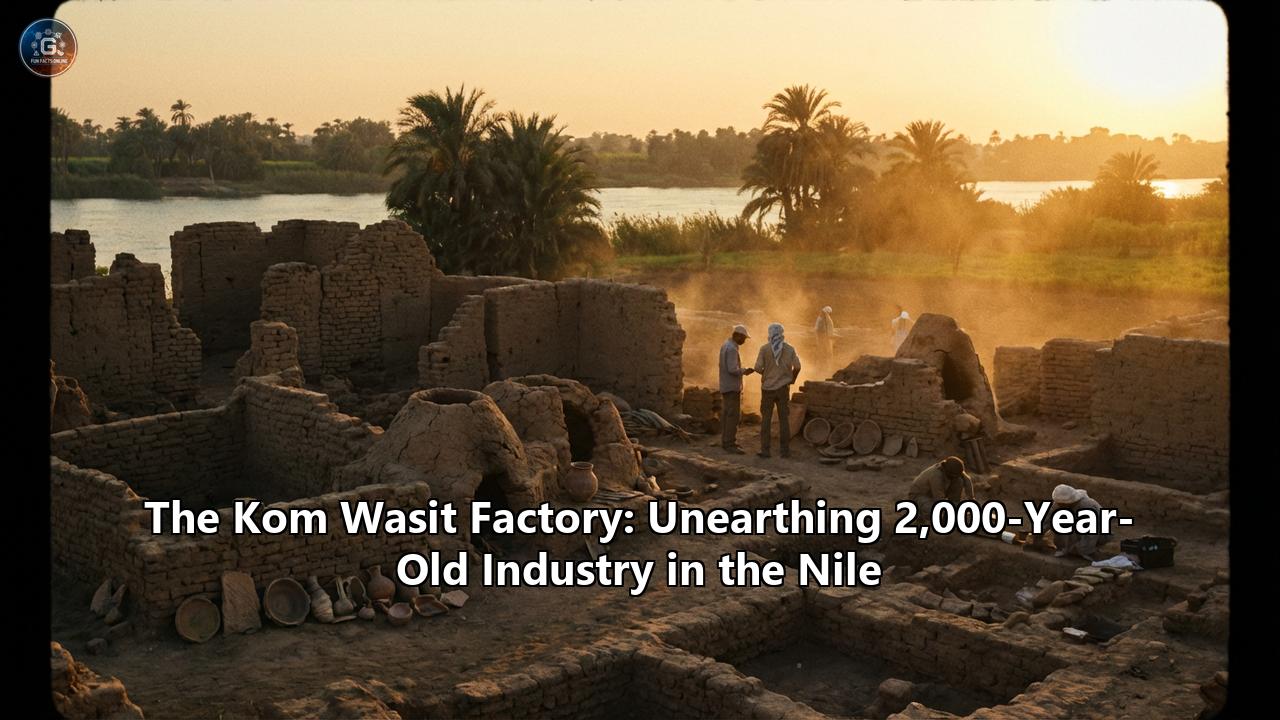
In a groundbreaking revelation that has sent ripples through the archaeological community, a joint mission between the Egyptian Supreme Council of Antiquities and the University of Padua has unearthed a sprawling industrial complex at the site of Kom Wasit. Dating back over 2,000 years to the Late Period and the early Ptolemaic era, this site offers something far more valuable than gold: a snapshot of the working machinery of ancient civilization.
Here, in the Beheira Governorate, archaeologists have not just found a temple or a tomb; they have found a factory. They have found the workshops where the famous "Egyptian Blue" faience was fired, the vats where the empire’s food was processed, and the tools still lying where the workers left them. And, layered atop this industrial hum, they found the quiet solemnity of a Roman-era cemetery, where the industrial hub was eventually reclaimed by the dead.
This article is a journey into that lost world. We will walk through the rooms of this ancient factory, smell the fermenting fish sauce that was the ketchup of the ancient world, watch the artisans craft amulets for the gods, and stand silently over the graves of children buried in wine jars. This is the story of Kom Wasit.
Chapter 1: The Discovery – Peeling Back the Layers of Time
The archaeological site of Kom Wasit, along with its sister site Kom al-Ahmer, lies about 50 kilometers southeast of Alexandria. To the untrained eye, these "koms" (mounds) might appear as nothing more than hills rising from the flat agricultural tapestry of the Nile Delta. But to an archaeologist, a kom is a layer cake of history, a vertical timeline of human occupation built up over millennia as mudbrick houses dissolved and were built over, again and again.
The mission, led by Dr. Cristina Mondin of the University of Padua and Mohamed Abdel-Badie of the Egyptian Antiquities Sector, has been working in this region to map the ancient nome (district) capital of Metelis. The region was once a thriving hub, positioned strategically near the Canopic branch of the Nile, serving as a gateway between the Mediterranean trade routes and the Egyptian interior.
The breakthrough came with the discovery of a large, structured building that did not fit the pattern of a domestic house or a religious temple. It was utilitarian, segmented, and dense with debris. As the team carefully brushed away the soil, the layout of a massive industrial complex began to emerge.
The "Factory" LayoutThe structure identified is a large architectural unit divided into at least six distinct rooms. Unlike the chaotic organic growth of a village, this building was planned for efficiency. The walls were thick, designed to insulate or perhaps contain the heat and smells of the processes within.
Dr. Mohamed Ismail Khaled, Secretary-General of the Supreme Council of Antiquities, announced the find as a pivot point in understanding the "daily life" of the Delta. While we have ample evidence of how kings lived, we have precious little evidence of how the economy actually functioned on the ground. The Kom Wasit factory fills that void. It shows us the organized, large-scale production of goods intended not just for local consumption, but likely for export across the Mediterranean.
The stratigraphy of the site reveals a timeline of heavy usage. The workshops were active primarily during the Late Period (26th–30th Dynasties, roughly 664–332 BC) and continued into the early Ptolemaic Period. This was a time of immense change in Egypt, as the land came under the influence of Persians, Greeks, and eventually Romans. The factory at Kom Wasit was operating at the crossroads of these civilizations, producing goods that would have been bought by Egyptians and Greeks alike.
But as the political landscape shifted, so did the settlement. By the Roman period, the industrial roar had faded. The factory was abandoned, its roofs likely collapsed, and the area was repurposed by the local population for a very different use: a necropolis. The overlay of these two worlds—the hyper-active industrial zone and the silent city of the dead—provides a unique duality to the site, which we will explore in depth.
Chapter 2: The Industrial Heart – Inside the Ancient Factory
Imagine walking into this building in 400 BC. The first thing that would hit you is not the sight of the workers, but the heat and the noise. The complex was a hive of multi-disciplinary craftsmanship. It was not a factory in the modern sense of a single assembly line, but rather a "guild house" or a conglomerate of workshops operating side-by-side.
The archaeological team identified three main zones of production based on the artifacts and refuse found in each room:
- The Fish Processing Zone: Identified by thousands of bones.
- The Faience and Ceramics Zone: Identified by amulets and kiln debris.
- The Metal and Stone Zone: Identified by slag, tools, and unfinished statues.
This clustering of industries suggests a centralized management. In the ancient world, such complexes were often attached to temples or local governors who controlled the resources. The temple of Metelis likely owned this factory, receiving the raw materials—fish from the Nile, copper from the desert mines, natron from the Wadi Natrun—and turning them into tradeable wealth.
The preservation of the "work in progress" is what makes Kom Wasit so special. Usually, archaeologists find finished goods in tombs or broken goods in trash heaps. Here, they found unfinished goods. They found the mistakes, the half-carved blocks, the items discarded mid-production. This allows us to reverse-engineer the techniques of the ancient masters.
Chapter 3: The Scent of Wealth – The Salted Fish Industry
Of all the rooms in the complex, two stand out for their sheer biological density. In these chambers, the excavation team recovered approximately 9,700 fish bones.
This was not a kitchen. This was a processing plant for one of the most valuable commodities in the ancient Mediterranean: Salted Fish and Fish Sauce.
The Ancient Craving for UmamiIn a world without refrigeration, preserving protein was a matter of life and death. But the Egyptians, and later the Greeks and Romans, turned preservation into a culinary art. The Nile Delta, with its marshes and river branches, was teeming with fish—Tilapia, Nile Perch, and Catfish.
The massive accumulation of bones at Kom Wasit suggests the production of botargo (salted roe) or specific cuts of salted fish. However, the presence of such a large volume of bones also points toward the production of a fish sauce, similar to the Roman garum or liquamen.
The ProcessThe process was visceral and pungent. Workers would bring baskets of fresh catch from the nearby canals.
- Gutting: The fish were gutted. The entrails were often saved for the highest-quality sauces, while the flesh was salted.
- Salting: The fish were layered in large vats with copious amounts of salt. The salt drew the moisture out of the flesh, creating a brine that prevented rot and allowed beneficial fermentation.
- Fermentation: The vats were left in the sun for months. Enzymes in the fish guts would break down the proteins, liquefying them into a golden-brown sauce rich in glutamates—pure liquid umami.
This sauce was the "ketchup" of antiquity. It was used to season everything from boiled vegetables to roasted meats. It was a major export. The fact that this factory existed in the 5th century BC, before the Roman conquest, shows that the Egyptians were already industrializing this process, possibly exporting to the Greek world where garos was already popular.
The Economic ImpactThe 9,700 bones are a testament to volume. This was not a small family operation; this was mass production. The salt likely came from the nearby salt pans of the Delta or the Wadi Natrun. The ceramic jars (amphorae) found on-site were the shipping containers.
This industry linked Kom Wasit to a global network. A jar of salted fish from this factory could end up on a table in Athens, exchanged for olive oil or wine. The smell of the factory, while likely overpowering to the workers, was the smell of money.
Chapter 4: Tjehenet – The Science of Egyptian Faience
Adjacent to the fish processing rooms, the atmosphere shifted from the organic tang of brine to the acrid, dry heat of the kilns. Here, the team discovered the workshops of the Faience Makers.
Faience, known to the Egyptians as Tjehenet ("that which gleams" or "dazzling"), was not clay. It was the ancient world's first high-tech synthetic material—a type of non-clay ceramic made of silica (sand or crushed quartz), lime, and soda (natron), colored with copper minerals to achieve that iconic turquoise-blue hue.
The Discovery of the AmuletsThe mission found numerous faience amulets in various stages of completion. This is crucial. Finding a finished amulet tells you about religion; finding an unfinished one tells you about technology.
The presence of these workshops at Kom Wasit confirms that the site was a major center for religious manufacturing. The amulets produced here—Djed pillars (stability), Ankhs (life), Udjat eyes (protection)—were small, portable, and affordable. They were the mass-market theology of the day, worn by everyone from farmers to nobility.
The Manufacturing TechniqueThe artisans at Kom Wasit likely used the efflorescence technique.
- The Paste: They mixed the ground quartz with the alkali salts and copper colorant into a paste.
- The Molding: This paste was pressed into fired clay molds.
- The Drying: As the object dried, the water evaporated, drawing the salts and copper to the surface, forming a white, powdery crust.
- The Firing: When placed in the kiln, this crust melted and fused, creating the brilliant, glass-like blue glaze that we see today.
The discovery of kiln debris and slag indicates the high temperatures achieved here. The ability to control temperature was a guarded secret. If the kiln was too cool, the glaze wouldn't fuse; too hot, and the object would melt into a blob. The master craftsmen of Kom Wasit were chemists as much as they were artists.
Chapter 5: The Artisans’ Workshop – Stone, Metal, and the Unfinished Hand
The factory’s versatility is further highlighted by the discovery of workshops dedicated to metalwork and stone carving.
The Unfinished StatuesOne of the most evocative finds was a collection of unfinished limestone statues. In archaeology, an unfinished piece is often more informative than a masterpiece. It freezes the action. We can see the tool marks of the chisel, the guide lines painted in red ochre by the master draftsman to guide the apprentice's hand.
These statues suggest that Kom Wasit was not just producing utilitarian goods (fish) or small trinkets (amulets) but also high-art devotional objects for temples and household shrines. The presence of these sculptors implies a hierarchy of skill on-site, from the laborers hauling fish baskets to the highly trained artists carving the likenesses of gods.
Metal Tools and WeaponsThe metal workshops would have been noisy and dangerous. Though the specific metal artifacts are currently undergoing conservation, the presence of metal production facilities (slag, crucibles) points to the manufacturing of bronze or iron tools.
In the Late Period, iron was becoming more common, but bronze was still the standard for statuary and many tools. The workshop likely repaired the tools used in the fish factory (knives, hooks) and the agricultural tools for the surrounding farms, creating a self-sustaining industrial ecosystem.
Chapter 6: Metelis – The Lost Capital of the Delta
To understand the factory, we must understand the city it served. Metelis (the Greek name for the Egyptian Per-Ha-Neb-Imenth) was the capital of the 7th Lower Egyptian Nome.
For a long time, the exact location and nature of Metelis were obscured by the shifting Nile. The excavations at Kom Wasit and Kom al-Ahmer have finally pinned down this lost metropolis.
The Twin CitiesIt appears that the settlement drifted over time. Kom Wasit was the hub during the Late Period and early Ptolemaic era. However, as the Ptolemaic period ended and the Roman era began, the center of gravity shifted a few kilometers south to Kom al-Ahmer.
Why the shift? The Nile is a fickle neighbor. A silting up of a canal or a change in the river's course could kill a city's economy overnight, forcing the population to migrate to the new riverbank. The abandonment of the Kom Wasit factory coincides with this shift. The industrial complex wasn't destroyed by war; it was likely abandoned because the water moved, or the economy changed, leaving the sturdy walls to be swallowed by the sand.
This abandonment paved the way for the site's second life.
Chapter 7: The Roman Necropolis – A City of the Dead
Centuries after the fires of the faience kilns had gone cold and the smell of fish sauce had faded, the people of the nearby Roman settlement returned to Kom Wasit. They did not come to work; they came to bury their dead.
The archaeological mission uncovered a Roman-period necropolis built directly into the ruins of the old industrial complex. This layering is poetic: the place of production became a place of rest.
Burial TypologiesThe diversity of the burials indicates a stratified society. The archaeologists identified three distinct methods of interment:
- Simple Pit Burials: Bodies placed directly into the earth. These were likely the graves of the poor, the laborers who worked the fields or the new workshops of Kom al-Ahmer.
- Anthropoid Ceramic Coffins: These are clay coffins, roughly shaped like a human. They are a fascinating blend of Egyptian tradition (the desire for a coffin) and local resource availability (clay was cheaper than imported wood). They often feature stylized faces, modeled with wide eyes and simple features, staring up at the sky.
- Amphora Burials: The most poignant of all.
Chapter 8: The Children of the Amphorae – A Study in Grief and Ritual
Among the most touching discoveries at Kom Wasit were the burials of children and infants inside large amphorae.
In the Roman world, the amphora was the standard shipping container—a large, two-handled jar used for wine, oil, or fish sauce. But when these jars broke or served their purpose, they were often repurposed as coffins for the very young.
The "Enpotmos" RitualPlacing a child in a jar was not an act of disrespect; it was an act of protection. The womb-like shape of the amphora was thought to symbolize a return to the earth, a second womb for the child who left the world too soon.
To create these coffins, the parents would carefully crack the neck or the side of the jar to widen the opening. The child’s body, wrapped in linen, was slid inside. Sometimes, the shards were placed back over the opening like a puzzle, sealed with mud or plaster to protect the small body from the weight of the earth and scavengers.
The discovery of these amphora burials at Kom Wasit speaks to the high infant mortality rate of the ancient world, but also to the tenderness of the parents. These were not anonymous disposals; they were careful burials, often clustered together.
The Gold EarringsIn one of these burials, or perhaps near them in a female grave, the team found a pair of gold earrings. Delicate and finely crafted, these earrings belonged to a young girl.
Gold was rare and expensive. For a family to bury such wealth with a child suggests that despite the "industrial" nature of the area, there was significant wealth here. It also suggests the grief of the parents—sending their daughter into the afterlife with her most precious possession, so she would be beautiful in the Field of Reeds.
Chapter 9: Bio-Archaeology – The Lives Behind the Bones
The mission did not just recover artifacts; they recovered the people themselves. The skeletal remains of 23 individuals were excavated from the necropolis.
Dr. Cristina Mondin and her team are currently conducting a detailed bio-archaeological analysis of these bones, but preliminary results have already painted a picture of the population.
Health and DietSurprisingly, the initial analysis suggests that these people were in relatively good health.
- No Violent Trauma: There were no signs of war wounds or execution, suggesting a period of relative peace in the region.
- Good Nutrition: The bones do not show severe signs of malnutrition (like cribra orbitalia). This makes sense; they were living in the breadbasket of Egypt, with ample access to grain, vegetables, and, thanks to the local industry, plenty of fish protein.
However, further study will likely reveal the occupational stress markers on their bones. Years of lifting heavy amphorae, grinding grain, or hunching over faience molds would leave tell-tale signs of arthritis and spinal compression. These bones will eventually tell us not just how they died, but how they worked.
Chapter 10: Economic Networks – The Delta’s Connection to the World
The findings at Kom Wasit shatter the idea that inland Delta villages were isolated backwaters. The presence of imported Greek pottery is the smoking gun of international trade.
The Greek ConnectionThe factory dates to the 5th century BC. This is before Alexander the Great conquered Egypt. Yet, we find Greek ceramics here. This proves that trade networks were robust long before the political takeover.
Greek merchants were likely sailing down the Canopic branch of the Nile, stopping at Naucratis (the Greek trading colony) and Metelis. They brought wine and olive oil in their distinctive jars and left with the salted fish and faience amulets produced at Kom Wasit.
The Amphorae as DataThe amphorae found at the site are like ancient barcodes. The shape of the handles, the clay fabric, and the stamps on the rims tell archaeologists exactly where they came from—Rhodes, Cnidus, Gaza, or North Africa. This allows us to map the commercial veins that pumped blood into the heart of Kom Wasit. The factory was a node in a globalization network that spanned the known world.
Conclusion: The Enduring Legacy of Kom Wasit
The excavation at Kom Wasit is far more than a collection of walls and bones. It is a resurrection of the mundane, which is often the most magical part of history.
We often look at the Pyramids and wonder at the kings who built them. But at Kom Wasit, we look at the unpolished limestone and the fish bones and wonder at the people who lived there. We see the sweat of the fish-salters, the focus of the faience-makers, the grief of the parents burying a child in a jar, and the pride of a girl wearing her gold earrings.
This discovery reminds us that the Nile Delta is the final frontier of Egyptian archaeology. Beneath the wet fields of alfalfa and cotton, entire cities are waiting. The "factory" at Kom Wasit was once a loud, smelly, vital engine of the Egyptian economy. Today, it is silent, but thanks to the work of the Egyptian-Italian mission, its story is finally being told.
As we analyze the data from this 2,000-year-old industrial hub, we are learning that the ancients were not so different from us. They built industries, they traded across oceans, they took pride in their craft, and they mourned their children with deep, enduring love. Kom Wasit is a mirror across millennia, reflecting the eternal human endeavor to build, to create, and to survive.
Reference:
- https://english.ahram.org.eg/News/559586.aspx
- https://nilescribes.org/2017/12/16/in-the-field-with-the-kom-al-ahmer-and-kom-wasit-project/
- https://www.worldhistory.org/Egyptian_Faience/
- https://www.thecollector.com/fetal-infant-burial-classical-antiquity/
- https://www.taylorfrancis.com/books/mono/10.4324/9781315269825/story-garum-sally-grainger
- https://files01.core.ac.uk/download/pdf/11424403.pdf
- https://en.wikipedia.org/wiki/Garum
- https://en.wikipedia.org/wiki/Egyptian_faience
- https://www.metmuseum.org/essays/egyptian-faience-technology-and-production
- https://www.researchgate.net/figure/nfant-of-6-9-months-in-age-buried-in-an-amphora-mid-1st-c-AD-in-the-Porta-Nocera_fig3_284273472