
The scent of roasting meat and the thick, acrid smoke of sacrificial fires once filled the air, rising above the coastal plains of Euboea. The ground would tremble beneath the rhythmic, thunderous march of three thousand heavily armed hoplites, the galloping hooves of six hundred cavalrymen, and the grinding wooden wheels of sixty war chariots. This was the Artemisia, the grandest and most spectacular spring festival of ancient Euboea. A colossal military and religious procession that snaked its way along the twelve-kilometer Sacred Way from the powerful city-state of Eretria to the sanctuary of its ultimate protector. For centuries, the epicenter of this magnificent devotion was the Sanctuary of Artemis Amarysia, an architectural marvel and a repository of immense wealth, political power, and spiritual reverence.
Yet, despite its fame, its wealth, and its mention in the great historical texts of antiquity, the earth swallowed the sanctuary whole. For over a hundred years, modern archaeologists scoured the Greek landscape, desperately searching for the legendary temple, only to be met with dirt, disappointment, and the mocking silence of history. It became one of the greatest archaeological enigmas of the Mediterranean—a ghost temple.
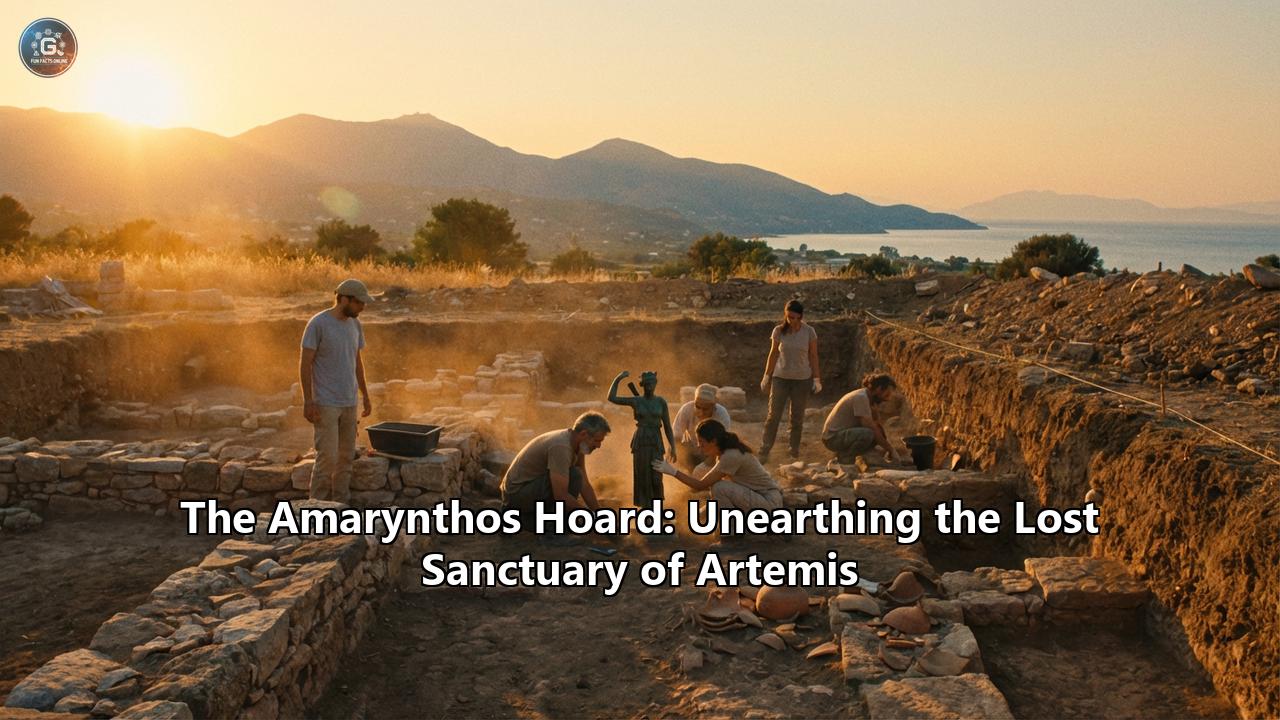
That is, until the soil of Amarynthos finally gave up its secrets. Unveiled by the relentless dedication of the Swiss School of Archaeology in Greece (ESAG) in collaboration with the Ephorate of Antiquities of Euboea, the discovery of the Sanctuary of Artemis Amarysia and the breathtaking "Amarynthos Hoard" stands out as one of the most stunning archaeological triumphs of the 21st century. It is a story of ancient grandiosity, an epic textual detective hunt, and a subterranean trove of gold, weapons, and exotic artifacts that fundamentally rewrites our understanding of ancient Greek religion and society.
The Goddess of the Hunt and the City-State
To understand the magnitude of this discovery, one must first understand the deity at its center. Artemis is widely known in Greek mythology as the virgin goddess of the hunt, the wilderness, wild animals, and the moon. However, in the socio-political fabric of ancient Eretria, her role transcended the forests. Artemis Amarysia was the absolute safeguard of the civic state. Ranked first in the Eretrian pantheon alongside her brother, Apollo Daphnephoros, she was not just a deity to be appeased; she was the divine sovereign of the region.
The sanctuary at Amarynthos was a pan-Euboean cult center. Its influence radiated far beyond the island of Euboea, reaching into Attica, where a localized cult of Amarysia was even established in the Athenian deme of Athmonon (the root of the modern Athenian suburb of Maroussi). Pausanias, the famous Greek traveler and geographer of the 2nd century AD, noted that the origins of this widespread devotion traced back entirely to Amarynthos.
The sanctuary functioned as the beating heart of Eretrian diplomacy and governance. It was the "epiphanestatos topos"—the most highly visible and privileged place for displaying the official deeds, treaties, and decrees of the Eretrian polis. If the city forged an alliance, won a war, or passed a critical law, it was carved into stone and erected in the shadow of Artemis’s temple. Furthermore, the temple complex served as the state treasury, guarding the wealth of the city within its sacred, inviolable bounds.
The Century-Long Hunt and the Geographer’s Blunder
How does a sanctuary of such monumental political and physical scale simply vanish? The blame, it turns out, lay largely on the shoulders of Strabo, the 1st-century BC Greek geographer.
In the tenth book of his famed Geography, Strabo dedicated a chapter to the island of Euboea, documenting its cities, its people, and its landmarks. When detailing the location of the Sanctuary of Artemis Amarysia, the surviving manuscripts of Strabo’s texts recorded the distance from the city walls of Eretria as seven stadia—approximately 1.25 kilometers (or less than a mile).
For generations, brilliant minds treated this text as gospel. In the year 1900, the American School of Classical Studies launched ambitious excavations in the immediate suburban periphery of Eretria, expecting to strike the marble foundations of the great temple. They found nothing. Decades later, eminent archaeologists, including the renowned Sir John Boardman in the 1950s, followed the traditional localization based on Strabo’s measurement, focusing their efforts in the same fruitless vicinity.
The breakthrough required not a shovel, but a scalpel taken to ancient texts. In the early 1970s, Swiss historian and epigrapher Denis Knoepfler began to suspect that history had been victimized by a simple, yet catastrophic, clerical error. As Knoepfler meticulously cross-referenced historical texts, the logistics of the grand military parade, and sporadic findings of stray inscriptions in villages further east, a theory took shape. In ancient Greek numerical notation, numbers were represented by letters. Knoepfler hypothesized that a Byzantine monk copying Strabo’s original manuscript had made a fateful paleographic mistake: confusing the symbol for 60 (the letter xi, ξ) with the symbol for 7 (the letter zeta, ζ).
If the true distance was 60 stadia, the sanctuary was not sitting in the suburbs of Eretria; it was located roughly 11 kilometers away. This exact distance aligns with a coastal plain near the modern town of Amarynthos, specifically at the foot of a hill known locally as Paleoekklisies (meaning "Old Churches").
Between 2003 and 2007, armed with this revolutionary textual hypothesis, ESAG and the Greek Ephorate of Antiquities deployed large-scale geophysical surveys in the olive groves around Paleoekklisies. The radar signaled massive anomalies beneath the soil. When trial trenches were finally opened in 2007, the earth yielded the monumental foundations of a massive stoa (a covered walkway or portico) buried two meters deep. The architecture was undeniably public and imposing. They had found the lost complex.
The 2017 Epiphany: A Name in the Clay
While the 2007 discovery was a monumental vindication of Knoepfler’s theory, the definitive, undeniable proof of the deity’s identity arrived a decade later. In the summer of 2017, excavators pulled terracotta roof tiles from the earth. Stamped directly into the ancient clay was the name of the goddess: Artemis.
Alongside the tiles, the earth surrendered stone bases inscribed with dedications to the sacred triad: Artemis, Apollo, and their mother, Leto. An intact stele was unearthed shortly after, dating to around 300 BC, emanating from the highest authorities of Eretria, explicitly stating it was to be erected "in the sanctuary of Artemis in Amarynthos" (Ἀρτέμιδος ἐν Ἀμαρύνθωι). The century-long hunt was over. The lost sanctuary had been found.
The Hundred-Foot Temple (The Hekatompedon)
As excavations expanded, the true architectural and ritualistic nature of the sanctuary began to emerge in staggering detail, particularly during the 2020 to 2023 campaigns. At the core of the sanctuary, archaeologists painstakingly uncovered the remains of a magnificent temple dating back to the 7th century BC (the Archaic period).
The building held several architectural surprises that defied conventional expectations of Greek temples. First was its shape. Rather than the standard rectangular design that dominates classical Greek architecture, the floor-plan of this early temple was apsidal—meaning it featured a semi-circular apse at one end. This design is remarkably unusual for the period.
Second was its awe-inspiring scale. The temple measured exactly 34 meters in length. In the ancient Greek metric system, this corresponds precisely to 100 feet. The temple was a hekatompedon (a hundred-foot building), a "perfect" geometric and architectural measurement reserved for monuments of the highest sacred importance.
Yet, this colossal structure was not immune to disaster. Evidence etched into the soil—in the form of scorched earth and charred materials—revealed that the 100-foot temple was partially destroyed by a massive fire in the second half of the 6th century BC. The Eretrians, likely devastated by the damage to their patron goddess's home, temporarily shored up the ruins using mud-brick walls to keep the cult alive. Shortly after, around 500 BC, the damaged structure was entirely demolished to make way for a second, even more monumental temple, marking a shift toward grander classical aesthetics and an explosion of wealth.
Blood and Ash: The Mechanics of Ancient Sacrifice
Perhaps the most visceral and startling discoveries made within the foundations of the Archaic temple were the remnants of the cult's blood rituals. In classical Greek religion, animal sacrifices were the primary method of communion with the gods. Typically, these bloody affairs took place on grand stone altars located outside the temple, in the open air of the sanctuary enclosure. This kept the sacred interior (the naos or cella, where the cult statue resided) free from the stench of blood, the mess of butchery, and the blinding smoke of the fire.
At Amarynthos, however, the rules were different. Archaeologists discovered massive stone hearths and altars situated directly inside the 100-foot temple.
The archaeological record paints a vivid, sensory picture of what transpired within these walls. A prized animal—perhaps a goat, sheep, or bull—would be led in a procession through the monumental doors. After the ritual slaughter and butchering, specific portions of the animal, typically the fat-wrapped bones and inedible offal reserved for the deity, were placed upon these interior stone platforms and set ablaze.
Thick, compacted layers of ash, heavy with calcined (burned) animal bones, were found blanketing the interior altars. The smoke, carrying the savory scent of roasted meat up to the heavens to please Artemis, likely escaped through designed openings in the temple's roof. The interior of the temple would have been a profoundly intense environment: illuminated by the flickering, greasy light of the sacrificial fires, heavy with smoke, and echoing with the chants of priests and the prayers of hoplite warriors.
The Amarynthos Hoard: A Subterranean Treasury
When the first Archaic temple was destroyed and the massive rebuilding effort commenced around 500 BC, the Eretrians did not simply throw away the sacred objects that had survived the fire. To the ancient Greeks, objects dedicated to a god belonged to that god forever. They could not be repurposed or discarded. Instead, they were carefully gathered and buried within the sanctuary in sacred deposits.
The excavation of these deposits yielded what can only be described as a spectacular hoard. The earth released over 600 extraordinary objects, painting a picture of a sanctuary swimming in elite wealth and international connections.
The Amarynthos Hoard represents the cross-section of a deeply militaristic and widely connected society. The artifacts include:
Weapons of War: Fitting for a goddess honored by a parade of three thousand hoplites, the temple was flush with armaments. Archaeologists pulled iron swords, intact bronze shields, and a bronze helmet from the dirt. These were likely the spoils of war, stripped from defeated enemies and dedicated to Artemis as thanks for her protection in battle, or the personal dedications of retiring Eretrian soldiers. The presence of heavy iron double chisels, likely tools associated with the mechanics of the animal sacrifices or temple construction, was also noted. Precious Adornments: The deposit shimmered with personal wealth. Excavators uncovered an array of gold jewelry, delicate silver rings, glass ornaments, and semi-precious stones. Faience seals, crafted in the shape of scarabs—an undeniably orientalizing and Egyptian aesthetic—demonstrate that the worshippers at Amarynthos were not isolated. They were tied into the vast maritime trade networks of the Mediterranean. The Egyptian Ivory Head: Among the hundreds of votive offerings, one object stood out as a masterpiece of exotic origin. Archaeologists discovered a finely chiseled, meticulously carved ivory sculpture of a human head bearing distinct Egyptian features. When first pulled from the soil, it was nearly unrecognizable, caked in millennia of earth and decay. Following painstaking restoration by conservation experts, the sheer quality of its workmanship was revealed. It is a stark reminder that pilgrims and traders from distant lands, or Euboean mercenaries returning from the shores of the Nile, brought unimaginably exotic gifts to lay at the feet of the Greek goddess. The Goddess and the Deer: The hoard also contained numerous painted terracotta figurines and ceramic and bronze vessels used for ritual pouring (libations). One of the most evocative finds was a stone statuette, approximately 31 centimeters high, dating to the Archaic period. It depicts a female figure tenderly holding an animal in her arms—most likely a deer or a fawn. This is almost certainly a representation of Artemis herself, the "Mistress of Animals" (Potnia Theron), capturing the dual nature of the goddess as both a deadly huntress and a compassionate protector of the wild.A Stone Archive of Euboean History
While the gold and ivory capture the imagination, the stone inscriptions found at the sanctuary capture the historical narrative. The temple functioned as a massive, open-air archive for the Eretrian state.
Through the decades of excavation, crucial treaties have been brought to the surface. A 40-line inscription dating to the late 5th century BC details the terms under which the smaller, neighboring town of Styra was absorbed into the larger polis of Eretria. Another treaty, dating to 400 BC, outlines an alliance between Eretria and Histiaia, a city in northern Euboea.
Perhaps most poignant is a decree discovered during the 2019 season, dating to around 300 BC. It was issued by the probouloi (the highest civic authority of Eretria) to honor a college of five magistrates with golden crowns for their military actions. This was likely during the turbulent period when the Macedonian King Demetrios Poliorcetes seized Evia. Because the honored men were citizens of Eretria, the stele was proudly displayed in the Artemision—the heart of Eretrian identity—rather than the urban sanctuary of Apollo, which was usually reserved for decrees honoring foreigners.
Echoes from the Bronze Age: A Prehistoric Cult
As with many of the most sacred sites in Greece, the sanctity of Amarynthos did not begin with the classical Greeks. Deep trial trenches dug beneath the floor of the Archaic temples revealed that the spiritual magnetism of the site reaches back into the mists of prehistory.
Beneath the 7th-century BC temple, archaeologists found the remains of an even older building from the 9th or 8th century BC (the Geometric period), accompanied by bronze animal figurines. Going deeper still, they uncovered a beautifully preserved terracotta bull’s head dating to the Late Bronze Age (around 1200 BC).
But the story goes further back. The adjacent Paleoekklisies hill, which casts its shadow over the sanctuary, was occupied as early as the 3rd millennium BC (the Early Bronze Age). Excavations on the hill's slopes have revealed imposing stone walls, believed to be an elaborate fortification system built by a highly organized, early society that maintained maritime contact with the Cycladic islands.
By the 2nd millennium BC, during the height of the Mycenaean civilization, "Amarynthos" was already a recognized and vital location. In fact, the name of the town (a-ma-ru-to) is explicitly recorded in Linear B script on the clay administrative tablets found in the archives of the Mycenaean palace at Thebes, across the sea in Boeotia.
The archaeological evidence paints a continuous line of human reverence. For over three thousand years, through the rise and fall of Bronze Age citadels, through the fiery destruction of Archaic temples, and into the grand classical era, people were drawn to this specific patch of earth to seek the favor of the divine. The focus of human activity eventually shifted from the fortified hill down to the coastal plain, where the great sanctuary was officially founded, but the sacred nature of the landscape remained unbroken.
Conclusion: The Goddess Returns
Today, the ongoing Greek-Swiss excavations at Amarynthos continue to reshape the landscape of classical archaeology. With every trench dug and every layer of soil carefully brushed away, the ancient world becomes vividly present. Extensive surveys are currently mapping the ancient landscape, tracing the precise route of the Sacred Way, identifying ancient agricultural zones, and uncovering the quarries that birthed the temple's magnificent stones.
The discovery of the Sanctuary of Artemis Amarysia and the unearthing of the Amarynthos Hoard is a triumph of interdisciplinary archaeology. It proves that the ancient texts, even when flawed by a single erroneous letter, still hold the keys to lost worlds if read with a critical, brilliant eye.
Artemis Amarysia has finally been woken from her long, subterranean slumber. Where there was once only a quiet olive grove, the footprint of a monumental hundred-foot temple now stands exposed to the Mediterranean sun. The gold has been polished, the Egyptian ivory restored, and the stone treaties read aloud once more. The smoke of the sacrifices has long since dissipated, and the thunder of the war chariots has faded into the wind, but through the unparalleled discoveries at Amarynthos, the majestic spirit of ancient Euboea lives on, immortalized in the dirt, the stone, and the breathtaking treasures of the goddess.
Reference:
- https://www.researchgate.net/publication/323155945_Recent_research_at_the_Sanctuary_of_Artemis_Amarysia_in_Amarynthos_Euboea
- https://www.esag.swiss/amarynthos/sanctuary-of-artemis/
- https://www.esag.swiss/amarynthos-2021/
- https://www.esag.swiss/amarynthos/
- https://www.esag.swiss/artemis-the-lost-temple/
- https://arkeonews.net/a-glorious-temple-inside-which-sacrifices-were-performed-was-found-in-the-sanctuary-of-artemis-amarysia-on-greek-island-of-euboea/
- https://www.archaeology.wiki/blog/2022/09/21/new-finds-in-the-sanctuary-of-artemis-amarysia/
- https://www.cambridge.org/core/services/aop-cambridge-core/content/view/78291EB394B3A0A61815BB276333DC35/S0570608418000121a.pdf/recent-research-at-the-sanctuary-of-artemis-amarysia-in-amarynthos-euboea.pdf
- https://www.archaeology.wiki/blog/2024/01/10/sanctuary-of-artemis-amarysia-a-100-foot-temple-for-the-goddess/
- https://www.esag.swiss/amarynthos2023/
- https://archaeologymag.com/2024/01/animal-sacrifices-at-artemis-amarynthos-sanctuary/
- https://www.heritagedaily.com/2024/01/excavation-of-artemis-temple-reveals-evidence-of-animal-sacrifices/150230