
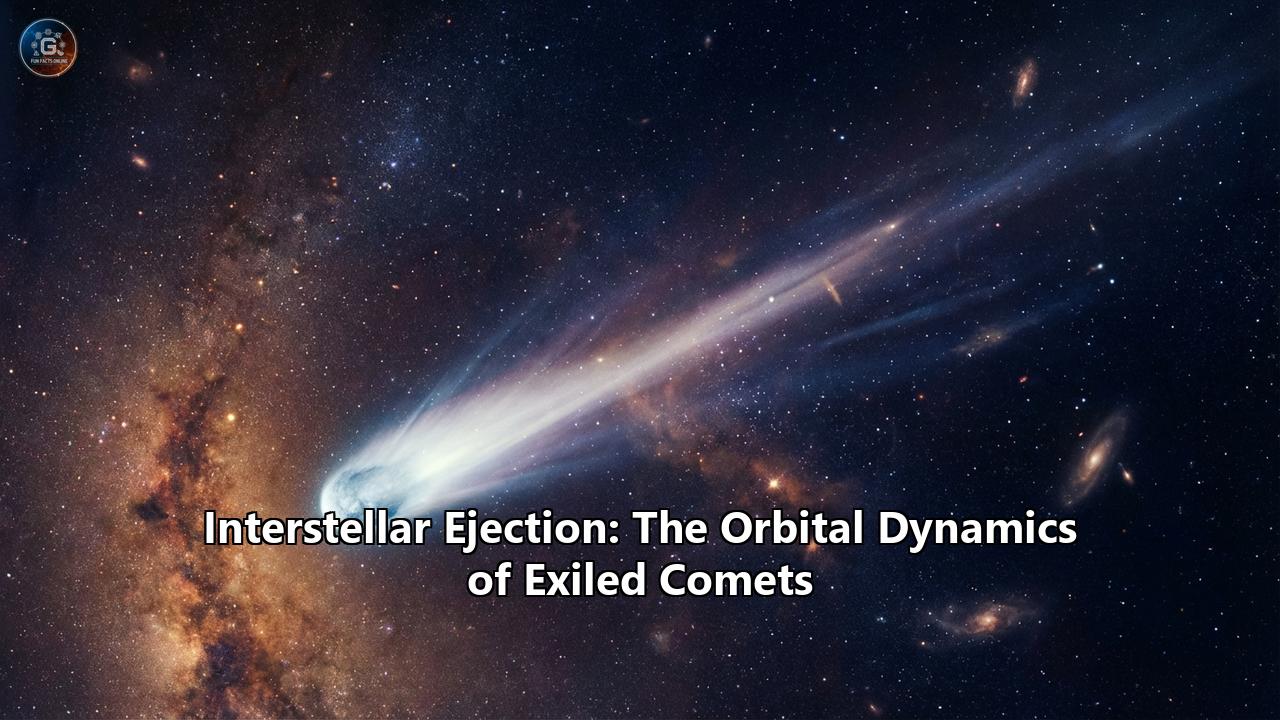
Imagine a rock made of primordial ice, dust, and frozen gases, born in the chaotic infancy of our solar system 4.6 billion years ago. For billions of years, it has drifted in the dark, silent expanse of the Oort Cloud, a frozen sentinel waiting in the twilight between the Sun's domain and the interstellar void. Suddenly, a subtle gravitational nudge—perhaps from a passing star, or the collective hum of the Milky Way's galactic tide—sends it plunging inward. As it dives toward the Sun, it awakens, sprouting a magnificent, glowing tail of plasma and dust. But this spectacular display is a swan song. As it crosses the orbit of Jupiter, it strays too close to the gas giant. In a violent, invisible transaction of momentum, the comet's trajectory is forever altered. Its elliptical loop is snapped. It is accelerated beyond the solar system's escape velocity, doomed to wander the Milky Way as a rogue, exiled wanderer.
This is the phenomenon of interstellar ejection—a continuous, dynamic process that has shaped the architecture of our solar system and seeded the galaxy with countless trillions of icy vagabonds. The orbital dynamics behind these ejections represent some of the most elegant and chaotic physics in astrophysics. It is a story of conic sections, gravitational slingshots, and the relentless, unforgiving mathematics of the n-body problem.
The Architecture of the AbyssTo understand how a comet is exiled, we must first understand where it lives and how it is bound to the Sun. Comets are the leftover building blocks of planetary formation. When the protoplanetary disk coalesced into the planets we know today, not all the material was incorporated. In the inner solar system, the intense heat of the young Sun vaporized volatile compounds like water, ammonia, and carbon monoxide, leaving behind rocky asteroids. But beyond the "frost line," in the frigid outer reaches, these volatiles remained frozen, clumping together with silicate dust to form comets—often aptly described as "dirty snowballs."
Today, these icy bodies reside primarily in two distinct reservoirs. The first is the Kuiper Belt, a thick, donut-shaped ring extending from the orbit of Neptune (about 30 Astronomical Units, or AU) out to roughly 50 AU. The Kuiper Belt is the source of short-period comets, those that complete an orbit in less than 200 years.
The second, far more vast and mysterious reservoir is the Oort Cloud. First theorized by Dutch astronomer Jan Oort in 1950, the Oort Cloud is a spherical shell enveloping the entire solar system, stretching from about 2,000 AU to a staggering 100,000 AU. The comets residing here are long-period comets, taking thousands or even millions of years to complete a single revolution.
Ironically, the Oort Cloud itself is a product of ancient ejections. During the turbulent youth of the solar system, the giant planets—Jupiter, Saturn, Uranus, and Neptune—underwent complex orbital migrations. As they shifted positions, their immense gravitational fields scattered the remaining icy planetesimals. Some were consumed, smashing into the planets or the Sun. Others were thrown entirely out of the solar system. But a significant fraction were flung outward into highly eccentric orbits, just barely clinging to the Sun's gravitational tether. Over billions of years, the subtle gravitational tugs of the galaxy rounded out these extreme orbits, creating the spherical Oort Cloud we theorize today. The comets in the Oort Cloud are already the survivors of one great scattering; to be ejected into interstellar space is to be subjected to a second, final exile.
The Laws of the TetherThe fate of any object in space is dictated by its orbital energy, a delicate balance between its kinetic energy (its energy of motion) and its gravitational potential energy (its bound state to a massive body like the Sun). In the framework of classical orbital mechanics, the specific orbital energy ($\epsilon$) of a comet is a constant, defined by the equation:
$\epsilon = \frac{v^2}{2} - \frac{\mu}{r}$
where $v$ is the comet's velocity, $\mu$ is the standard gravitational parameter of the Sun, and $r$ is the distance from the Sun.
If $\epsilon < 0$, the comet is bound to the Sun. Its path traces a closed loop—either a circle or an ellipse. All stable planets, asteroids, and periodic comets reside in this negative energy state.
If $\epsilon = 0$, the comet has exactly enough energy to escape the Sun's gravity, but its velocity will approach zero as its distance reaches infinity. This is a parabolic trajectory, the mathematical boundary between captivity and freedom.
If $\epsilon > 0$, the comet has excess kinetic energy. It will escape the Sun's gravitational well and retain a residual "excess velocity" ($v_\infty$) even when it is infinitely far away. This is a hyperbolic trajectory, the signature of an exile.
Astronomers classify these orbits using a geometric parameter known as eccentricity ($e$). A perfect circle has an eccentricity of 0. An ellipse has an eccentricity between 0 and 1. A parabola is exactly 1, and a hyperbola is greater than 1. When astronomers spot a comet, they meticulously track its position over time to calculate its osculating orbit—the idealized Keplerian orbit it would follow if only the Sun were influencing it. If the calculated eccentricity is slightly greater than 1, they know they are looking at a ghost—an object that is in the process of leaving the solar system forever, or a visitor from another star passing through.
The ExecutionersIf a comet in the Oort Cloud is securely bound to the Sun in an elliptical orbit (albeit a very long one), what causes it to break free? The transition from a bound, elliptical orbit ($e < 1$) to an unbound, hyperbolic orbit ($e > 1$) requires an injection of kinetic energy. In the frictionless vacuum of space, this energy is stolen from the orbital momentum of the planets.
The Jovian BouncerJupiter is the undisputed heavyweight champion of the solar system, containing more than twice the mass of all the other planets combined. Because of its immense gravity, Jupiter acts as a cosmic bouncer, heavily regulating the traffic of incoming comets. When a long-period comet dives into the inner solar system, its path often crosses the orbital plane of the giant planets. If the comet happens to pass behind Jupiter (relative to Jupiter's direction of motion), it will be accelerated by Jupiter's gravity.
This is the exact same mechanism space agencies use to propel probes to the outer solar system—a gravity assist, or gravitational slingshot. As the comet swings around Jupiter, it borrows a microscopic fraction of Jupiter's orbital angular momentum. To Jupiter, this loss is infinitesimal; its orbit around the Sun shrinks by an unmeasurable fraction of an atom's width. But for the tiny comet, the gained kinetic energy is monumental. Its velocity surges, pushing its specific orbital energy from negative to positive. As the comet recedes from the Sun, it will never stop. It has been violently promoted to interstellar status.
Studies of orbital dynamics reveal that Jupiter is incredibly efficient at this. Simulations indicate that a significant fraction of Oort Cloud comets that enter the inner solar system are eventually ejected. While Jupiter does act as a shield—sometimes taking direct hits to protect the inner planets, as witnessed with Comet Shoemaker-Levy 9 in 1994—it is far more likely to simply toss the intruder out the cosmic door.
The Silent Tides of the GalaxyWhile Jupiter reigns supreme in the inner solar system, the outer edges of the Oort Cloud are governed by much subtler forces. At 50,000 AU, the Sun's gravitational grip is vanishingly weak. A comet moving at these distances travels at a sluggish pace, barely a few meters per second relative to the Sun. Here, the dominant perturbations come from the Milky Way itself.
The "galactic tide" is the differential gravitational pull exerted by the massive disk of the Milky Way. Just as the Moon's gravity pulls on Earth's oceans to create tides, the gravitational field of the galaxy stretches and squeezes the Oort Cloud. Over tens of millions of years, the galactic tide slowly alters the perihelion (closest approach to the Sun) of Oort Cloud comets. It can lower the perihelion, causing a comet to drop into the planetary zone where Jupiter awaits. Alternatively, the galactic tide can unbind the comet entirely, gently peeling it away from the Sun's grasp and setting it adrift in the interstellar medium.
Stellar InterlopersThe Sun is not stationary; it is orbiting the center of the galaxy at 230 kilometers per second, bobbing up and down through the galactic disk. As it travels, it frequently passes near other stars. Roughly every million years, a star passes within a few light-years of the Sun, plowing directly through or near the outer Oort cloud.
When a rogue or passing star pierces the Oort Cloud, its gravity acts like a bowling ball crashing through pins. It drastically alters the orbits of millions of comets. Some are sent spiraling inward to become spectacular naked-eye comets for our distant descendants; others are instantly given enough kinetic energy to exceed the Sun's escape velocity, joining the rogue population of the galaxy.
A Two-Way Street (The Incoming Ambassadors)If our solar system has been hemorrhaging comets into interstellar space for 4.6 billion years, then the galaxy must be awash with trillions of exiled icy bodies. Consequently, our solar system must occasionally sweep up the exiles from other star systems. For decades, astronomers predicted the existence of interstellar objects passing through our neighborhood, but it wasn't until recently that technology allowed us to catch them in the act.
In 2017, the Pan-STARRS telescope in Hawaii detected 1I/’Oumuamua, a cigar-shaped or pancake-like object tearing through the solar system with a staggering eccentricity. Its extreme velocity at infinity proved beyond any doubt that it was not bound to the Sun. It was our first confirmed interstellar visitor. Two years later, amateur astronomer Gennadiy Borisov discovered 2I/Borisov, a true interstellar comet exhibiting a classic coma and tail, revealing a composition rich in carbon monoxide, likely formed in an ultra-chilly alien stellar nursery.
The detection of these objects revolutionized orbital dynamics. They confirmed that the ejection mechanisms we observe in our own solar system are ubiquitous across the cosmos. Furthermore, ongoing discoveries continue to enrich this field. For instance, the identification of 3I/ATLAS (C/2025 N1), an interstellar comet discovered in July 2025, has offered astronomers unprecedented data. 3I/ATLAS arrived on a retrograde, highly inclined orbit with an eccentricity exceeding 6, coming from the general direction of Sagittarius. Traveling at a blistering perihelion velocity of nearly 68 km/s, this comet demonstrated incredible activity, including the emission of X-rays generated by the violent interaction between its coma and the solar wind—an extraordinary, historic phenomenon for an interstellar body. Spectroscopic analysis of 3I/ATLAS revealed that its ice and dust composition is remarkably similar to local comets, implying that the chemical processes forming comets in distant alien stellar nurseries are fundamentally akin to our own.
By studying these incoming visitors, we are effectively looking at a mirror image of our own ejected comets. An object like 2I/Borisov or 3I/ATLAS is simply someone else's exile, cast out by an alien gas giant or passing rogue star billions of years ago.
Into the VoidWhat is the ultimate fate of a comet once it is ejected from its home star?
As an exiled comet speeds away from the Sun, moving beyond the orbit of Neptune, beyond the Kuiper Belt, and through the diffuse Oort Cloud, it begins to experience a profound transformation. The spectacular coma and sweeping tails of gas and dust that characterized its brief, violent plunge through the inner solar system dissipate. The solar radiation driving the sublimation of its surface ices fades into a cold, distant glimmer. The comet enters a deep freeze, dropping to temperatures just a few degrees above absolute zero.
It becomes a dark, inert chunk of dirty ice, a ghost ship sailing the interstellar void. Bereft of a host star to illuminate it, it is functionally invisible. It will travel in a roughly straight line relative to the local stars, following its own independent orbit around the supermassive black hole at the center of the Milky Way. Its journey will last for billions of years.
Yet, this dark voyage may hold the key to one of the most profound mysteries in science: the origin of life. The theory of lithopanspermia suggests that the basic building blocks of life—amino acids, complex organic molecules, or perhaps even dormant, freeze-dried microbial spores—could be transported between star systems by these exiled comets. We know that solar system comets are rich in organic chemistry. If a comet forms in a system where life has taken hold, or if it sweeps up biological material during a close pass to an inhabited planet, it could serve as a cosmic ark. As it drifts through the galaxy, its icy bulk provides heavy shielding against the deadly cosmic radiation of deep space. Millions of years later, this exiled comet might crash into a young, sterile world in a distant star system, delivering a payload of water, organics, and the seeds of life.
The Mathematical Poetry of the N-Body ProblemMapping the trajectory of a comet to determine if it will become an exile pushes the limits of modern computational physics. When a comet is out in the Oort cloud, predicting its motion requires calculating the gravitational tug of the Sun, all eight planets, the major moons, the galactic tide, and passing stars. This is a manifestation of the infamous n-body problem.
Unlike the two-body problem (just the Sun and a comet), which can be solved with elegant, exact algebraic equations, the n-body problem has no general analytical solution. The orbital dynamics are inherently chaotic. A comet's trajectory exhibits extreme sensitivity to initial conditions—the hallmark of a chaotic system.
Astronomers measure this chaos using a concept called the Lyapunov time, which represents the timescale over which two nearly identical orbits will diverge exponentially. For many cometary orbits, particularly those crossing the paths of the giant planets, the Lyapunov time is astonishingly short, sometimes just a few hundred or thousand years. This means that if our measurement of a comet's position is off by even a few meters today, our prediction of where it will be in a thousand years could be off by millions of kilometers. We cannot say with absolute certainty whether a specific comet will strike a planet, fall into the Sun, or be ejected into interstellar space. We can only run thousands of computer simulations, varying the initial parameters by microscopic amounts, to determine the statistical probability of its exile.
This mathematical unpredictability means that the solar system is not a static, clockwork machine. It is a breathing, evolving entity. It is a leaky ship, constantly shedding mass into the surrounding galaxy.
The Galactic PollinatorsThe phenomenon of interstellar ejection forces us to reconsider the boundaries of our solar system. We often imagine the Sun, planets, and comets as an isolated island in the vacuum of space. But orbital dynamics reveal a different reality. The solar system is deeply connected to the broader galactic environment.
Every time Jupiter flexes its gravitational muscle and hurls a comet into the abyss, it is contributing to a galaxy-wide exchange program. Over the 4.6 billion years of its existence, our Sun has likely exiled trillions of comets, a total mass equivalent to dozens of Earths, scattering our primordial history into the Milky Way. These exiles carry the specific isotopic signatures and chemical fingerprints of our solar nebula far beyond our reach.
Simultaneously, we are bathed in the exiles of other stars. The space between the stars is not empty; it is a dense, intersecting web of trajectories, a highway of rogue comets, asteroids, and perhaps even orphaned planets. The exiled comets are the true galactic wanderers. They are the cosmic pollinators, bridging the unfathomable distances between stars, carrying water, carbon, and the silent stories of their birth. They remind us that gravity is not just a force that binds; it is also a force that liberates, executing the ultimate cosmic slingshot to cast the frozen remnants of creation into the eternal dark.
Reference:
- https://en.wikipedia.org/wiki/Oort_cloud
- https://thesolarsystem.fandom.com/wiki/Oort_cloud
- https://arxiv.org/pdf/0911.4381
- https://science.nasa.gov/learn/basics-of-space-flight/chapter1-3/
- https://arxiv.org/pdf/2008.07647
- https://www.centauri-dreams.org/2025/07/10/3i-atlas-observing-and-modeling-an-interstellar-newcomer/
- https://modernengineeringmarvels.com/2025/09/09/rare-interstellar-comet-3i-atlas-shows-surprising-similarities-to-local-comets/
- https://news.ssbcrack.com/probing-the-mysteries-of-interstellar-comet-3i-atlas-the-upcoming-jupiter-encounter/
- https://en.clickpetroleoegas.com.br/Interstellar-comet-3i-Atlas-emits-X-rays-for-the-first-time-in-history%3B-brightness-of-400-000-km-intrigues-scientists-and-reveals-cosmic-interactions-never-before-observed-in-the-solar-system./