
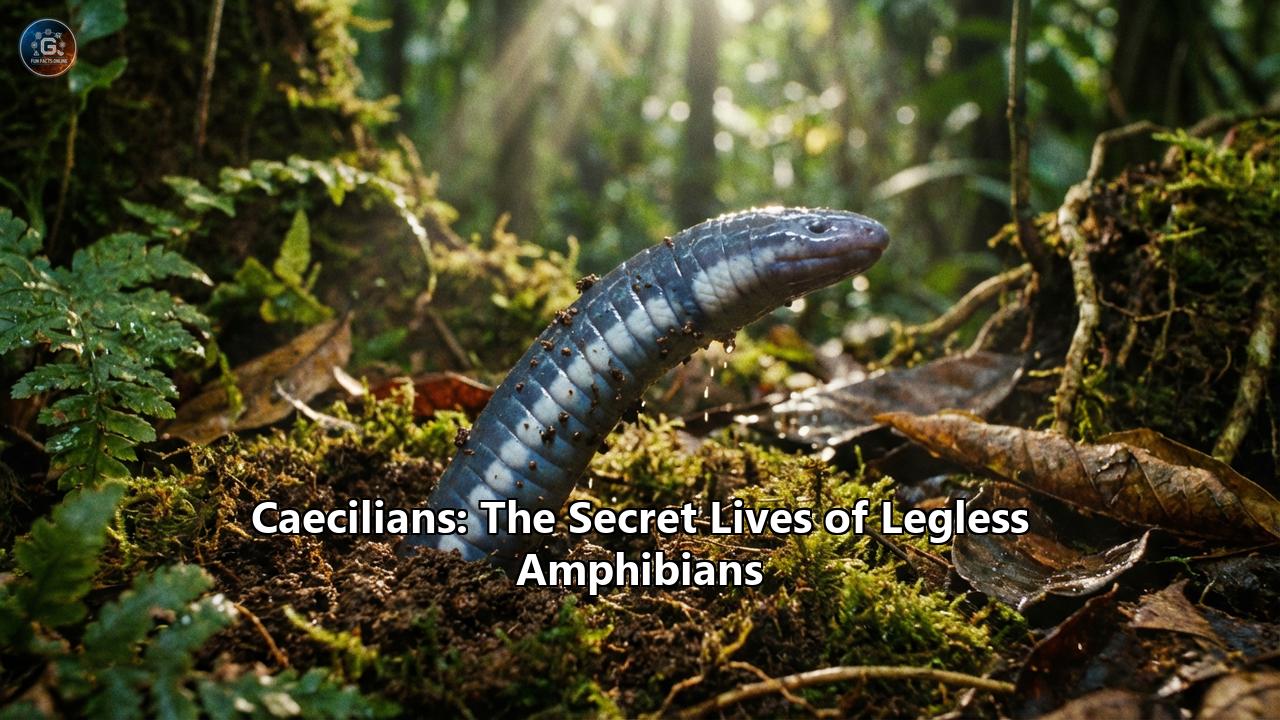
If you were to design a creature to haunt the nightmares of the squeamish, you might craft something that looks like a snake but isn't one; something that moves with the relentless, piston-like drive of a worm but possesses a skull as hard as granite; something that lives in the dark, slimy underbelly of the tropical earth and feeds its young with its own living flesh. You would, in short, design a caecilian.
Yet, to dismiss the Order Gymnophiona as merely the stuff of nightmares is to overlook one of the most evolutionarily successful, anatomically bizarre, and behaviorally complex groups of vertebrates on our planet. For millions of years, while dinosaurs rose and fell and mammals scurried in the shadows, these "naked snakes" were perfecting the art of the subterranean life, conquering the wet tropics of the world with a toolkit of biological innovations that science is only just beginning to understand.
This is not a story of a primitive remnant of a bygone age. This is the story of a highly specialized, venomous, skin-eating, milk-producing, burrowing machine that has managed to keep its secrets hidden beneath our feet for eons. This is the secret life of the legless amphibians.
Part I: The Phantom Lineage
To understand the caecilian is to grapple with a ghost. For over a century, herpetologists and paleontologists have fought bitter academic wars over where exactly these creatures fit into the tree of life. They are Lissamphibians—a group that includes frogs (Anura) and salamanders (Caudata)—but they are the estranged cousins who left the family reunion early and took a very different path home.
The Deep Time Mystery
The fossil record of caecilians is notoriously poor, a result of their delicate, small bones and the acidic, tropical soils they inhabit, which are terrible for fossilization. For decades, the oldest known caecilian was Eocaecilia micropodia, a creature from the Early Jurassic of Arizona. Eocaecilia was a "missing link" made manifest; unlike modern caecilians, it still possessed tiny, vestigial legs. It was a snapshot of a transition, a moment in time where a salamander-like ancestor was descending into the mud, trading limbs for leverage.
But Eocaecilia also deepened the mystery. By the Jurassic, it was already highly specialized. Where did it come from? The answer may lie in a controversial fossil named Chinlestegophis jenkinsi, discovered in the Triassic rocks of Colorado. Described in 2017, this creature suggests that caecilians are the last survivors of the Stereospondyls, a group of crocodile-like amphibians that dominated the waterways of the Triassic. If this hypothesis holds, caecilians are not just weird frogs; they are the enduring legacy of a lineage thought to have been wiped out 200 million years ago. They are living fossils in the truest sense, carrying the anatomical blueprints of a pre-dinosaur world in their skulls.
The Gondwanan Split
The distribution of modern caecilians is a living map of the ancient supercontinent Gondwana. They are found in South America, Africa, the Seychelles, India, and Southeast Asia—fragments of a once-unified landmass.
When Gondwana began to tear itself apart during the Jurassic and Cretaceous, caecilian populations were rafted away on drifting continents. The connection between African and Indian caecilians is particularly telling. The family Chikilidae, recently discovered in Northeast India, diverged from its closest African relatives (the Herpelidae) around 140 million years ago, just as the Indian plate began its long, lonely voyage north across the Tethys Ocean. This makes the caecilians of India not merely local amphibians, but ancient immigrants that rode a tectonic ark for millions of years before crashing into Asia.
Part II: The Anatomy of a Burrower
A caecilian is not simply a tube. It is a masterpiece of bio-engineering designed to solve a specific problem: how to move through a medium that is heavier and denser than yourself, without using arms or legs.
The Stegokrotaphic Skull
The head of a caecilian is a battering ram. Unlike the open, lightweight skulls of frogs, the caecilian skull is "stegokrotaphic"—solidly roofed with bone. Over millions of years, the temporal openings found in other tetrapods have closed up, and the individual bones have fused together to form a rigid, bullet-shaped helmet.
This ossification allows the caecilian to perform "head-first burrowing." The animal rams its snout into the soil, compressing the earth, then uses its internal muscles to pull its body forward. But a solid skull presents a problem: where do you put the jaw muscles? In most animals, jaw muscles bulge outwards when contracted. In a tunnel that fits your body exactly, there is no room for bulging cheeks.
Nature’s solution in caecilians is the "Dual Jaw-Closing Mechanism," a feature unique among vertebrates.
- The Adductors: Like other animals, they have adductor muscles to pull the jaw up.
- The Interhyoideus Posterior: This is the game-changer. Caecilians have co-opted a muscle from the neck and attached it to a lever on the back of the jaw (the retroarticular process). When this muscle contracts, it pulls back on the lever, swinging the jaw shut with immense force.
This system allows the caecilian to keep its head sleek and streamlined while still delivering a bite powerful enough to crush the chitinous exoskeletons of termites or the bodies of earthworms. It is a biting mechanism designed by a claustrophobe.
The Hydrostatic Piston
Behind the skull lies a body that moves like a piston. The skin of a caecilian is not attached loosely to the muscle as it is in a dog or a human. Instead, the skin is largely independent of the trunk muscles. The animal moves using "internal concertina locomotion." The vertebral column bunches up inside the skin, anchoring the rear of the body, and then pushes the head forward. Then, the skin is pulled up to meet the head. It is a movement of eerie smoothness, allowing them to traverse tunnels without the friction that would stop a snake in its tracks.
The Tentacle: Seeing with Touch
Caecilian eyes are a study in regression. In many species, they are tiny, covered by skin, or even buried beneath the skull bones, capable of detecting little more than light and dark. To navigate the eternal night of the subsoil, caecilians evolved a unique sensory organ found in no other animal: the tentacle.
Located between the nostril and the eye, the tentacle is a retractable feeler. But it is not just a tactile probe. It is a complex chemosensory device. The tentacle is lubricated by the Harderian gland (which in other animals lubricates the eye) and is connected to the vomeronasal organ (Jacobson's organ). The caecilian extends the tentacle, touches the soil, retracts it, and wipes the chemical cues directly onto its sensory array. It is, effectively, a way to "taste-touch" the world, allowing them to track earthworms through the dirt with the precision of a bloodhound.
Part III: The Venom Revolution
For decades, the dogma was clear: amphibians are poisonous (passive defense), but not venomous (active delivery). A poison dart frog will kill you if you eat it, but it cannot inject you. Snakes, on the other hand, are the masters of venom.
In 2020, this dogma was shattered by a team studying the Ringed Caecilian (Siphonops annulatus) in Brazil. They discovered glands at the base of the teeth—not the skin—that produced enzymes similar to those found in snake venom, such as phospholipase A2. Even more shockingly, these glands originated from the dental lamina, the same tissue that gives rise to the venom glands of vipers and cobras.
This discovery rewrites the history of venom. It suggests that the oral venom system might be an ancient trait of early tetrapods, predating the snakes by a hundred million years. For the caecilian, this venom is likely a tool for subduing prey. Earthworms, their primary food, can be surprisingly strong and fast in their own burrows. A quick injection of a paralytic or digestive toxin turns a struggle into a meal. The "naked snake" is, in fact, a venomous predator.
Part IV: Reproductive Horrors and Miracles
If caecilian anatomy is efficient, their reproductive biology is nothing short of science fiction. This is where the order Gymnophiona truly flaunts its diversity, employing strategies that range from the grotesque to the surprisingly tender.
The Phallodeum
All caecilians practice internal fertilization. Male caecilians possess an intromittent organ called the phallodeum. This fleshy tube, extruded from the cloaca, often has spines or hooks to anchor the male to the female during copulation—a necessity when you are two slippery tubes trying to mate in a muddy tunnel.
Maternal Dermatophagy: The Skin Eaters
In 2006, scientists observing the African species Boulengerula taitana noticed something disturbing. The hatchlings were equipped with specialized, hook-like teeth that looked nothing like the teeth of the adults. They were not eating worms. They were eating their mother.
This behavior is called "maternal dermatophagy." During the brooding period, the mother’s skin undergoes a transformation. It becomes paler, thicker, and rich in fats and lipids. The babies swarm over her, tearing off strips of this nutrient-rich epidermis with their hooked teeth. The mother stands stoically while she is flayed alive by her offspring, regenerating her skin every few days to provide the next meal.
This extreme form of parental investment was later found in the South American Siphonops annulatus, proving that this behavior is likely an ancient caecilian trait, evolved before the separation of Africa and South America. It is a grim, yet effective, transfer of energy.
The Milk of the Amphibian
Just when science thought it had seen the peak of caecilian weirdness, 2024 brought a new revelation. Researchers studying Siphonops annulatus noticed that the skin-eating wasn't the only food source. The hatchlings would congregate at the mother's vent (cloaca) and emit high-pitched clicking sounds. In response, the mother would release a thick, white, lipid-rich fluid.
Milk.
Functional lactation, previously thought to be the exclusive domain of mammals (and a few outliers like pigeons or tsetse flies), had been discovered in an egg-laying amphibian. The "milk" is secreted from hypertrophied glands in the oviduct. The acoustic signaling of the babies—begging for food—indicates a level of social communication and maternal responsiveness previously unimagined in amphibians. The definition of "mammal-like" behavior had to be widened to include the wet, legless dwellers of the Brazilian soil.
Viviparity and Uterine Cannibalism
About 75% of caecilian species do not lay eggs at all. They are viviparous (live-bearing). But they do not have a placenta like humans. Instead, the embryos develop inside the oviduct. Once they exhaust their yolk sacs, they do not sit idly. They use specialized fetal teeth to scrape the lining of the mother’s oviduct, stimulating the secretion of "uterine milk," which they consume. In some species, they may even eat the other eggs or smaller embryos. By the time they are born, they are fully formed miniature adults, having passed their larval stage entirely within the womb.
Part V: A Global Tour of the Families
To appreciate the caecilian is to appreciate their global conquest. Let us tour the major families and the unique adaptations they have spawned.
South America: The Aquatic Giants and the Milk Mothers
The Amazon is the kingdom of the Typhlonectidae. These are the aquatic caecilians. Some, like Typhlonectes natans, have shed the burrowing lifestyle for the water. They have developed a vertical fin on their tail end for swimming and give birth to live young. They are the "rubber eels" of the pet trade, docile and strange.
But the true monster of this family is Atretochoana eiselti. Discovered in the Madeira River, this animal can reach lengths of over 80 centimeters (nearly 3 feet). It is grey, flabby, and eyeless. When photos of it first hit the internet, it was dubbed the "penis snake" for its phallic appearance. But its anatomy is even more shocking: it has no lungs. It is the largest tetrapod in the world to lack lungs, breathing entirely through its skin. It lives in the fast-flowing, oxygen-rich waters of the Amazon basin, a giant wraith that suffocates if taken out of the water.
Also in South America are the Siphonopidae, the home of our milk-producing Siphonops. These are terrestrial burrowers, masters of the chemical signal, and the devoted mothers of the caecilian world.
Africa: The Skull-Eyes
In Africa, we find the Herpelidae (including the skin-eating Boulengerula) and the bizarre Scolecomorphidae. The latter are the only vertebrates whose eyes are attached to their tentacles. When they retract the tentacle, the eye is pulled deep into the skull, beneath the bone. When they extend the tentacle, the eye pops out. It is a "jack-in-the-box" eye, an adaptation that protects the delicate organ while burrowing but allows for light sensing when near the surface.
Asia: The Tailed Primitives and the Newcomers
Southeast Asia is home to the Ichthyophiidae. These are often considered the most "primitive" caecilians because they retain a true tail (a section of body with vertebrae behind the cloaca) which other families have lost. They are often colorful, with bright yellow stripes running down their dark purple bodies—aposematic coloration warning predators of their toxic skin secretions.
In Northeast India lies the territory of the Chikilidae. For over a century, the only known specimen from this group was misclassified. It wasn't until 2012 that extensive soil-digging expeditions revealed them to be a distinct family, an ancient lineage that has been burrowing in the Indian subcontinent since the age of the dinosaurs. They are key evidence of the "Indigascar" landmass theory.
The Seychelles: Island Dwarfs
The granitic islands of the Seychelles are home to the Grandisoniidae (formerly Indotyphlidae). These island endemics include the "Petite Praslin caecilian" (Hypogeophis pti), one of the smallest caecilians in the world, growing to only about 10 centimeters. They represent a unique island radiation, evolving in isolation for 60 million years, shrinking to fit the limited microhabitats of their island home.
Part VI: Caecilians and the Human World
For most of human history, caecilians have existed on the periphery of our consciousness—rarely seen, often misunderstood.
Myths and Misconceptions
In the folklore of the Himalayas, caecilians are sometimes called "back-ache snakes." The myth goes that merely seeing one (or stepping over one) can cause debilitating back pain. In the Western Ghats of India, they are often feared as being more venomous than cobras, leading to them being killed on sight with salt and kerosene.
In Brazil, the legends of the Minhocão—a giant, earthworm-like cryptid said to uproot trees and trench through the earth—may have been inspired by sightings of large caecilians like Caecilia thompsoni or the lungless Atretochoana. While the cryptid is exaggerated to mythical proportions, the essence of the creature—a powerful, subterranean tube—is pure caecilian.
In Cameroon, the Oku people classify the caecilian Crotaphatrema lamottei as "Kefa-ntie," a category of "poisonous" burrowing things. If a person kills one, they believe they will develop sores, a curse that can only be lifted by a ritual involving chicken blood and snail shells.
The Pet Trade: The "Rubber Eel"
The only contact most Westerners have with caecilians is through the aquarium trade. Typhlonectes natans is frequently sold under the name "rubber eel" or "cecilia worm." They are popular for their oddity—dog-like in their smell-based foraging, wrapping around food items like a constrictor snake. However, they are frequently kept in poor conditions. They are amphibians, not fish; they have sensitive, permeable skin that is easily burned by aquarium chemicals or infected by fungi. The "rubber eel" in the pet shop tank is often a wild-caught survivor of a stressful supply chain, a silent ambassador for a misunderstood order.
Part VII: The Invisible Extinction
The final chapter of the caecilian story is a warning. Because they live underground and are hard to find, caecilians are the "Data Deficient" capital of the amphibian world. We do not know how many species have already gone extinct.
We do know they are not immune to the threats facing their legged cousins. The Chytrid fungus (Batrachochytrium dendrobatidis), the plague that has decimated frog populations worldwide, has been found on caecilians. While their subterranean habits might offer some protection from the temperature-sensitive fungus, it also means that mass die-offs would happen out of sight, deep in the soil.
Furthermore, caecilians are soil specialists. When a rainforest is bulldozed for agriculture, the soil is compacted, dried out, and poisoned with pesticides. The complex, aerated, humid soil structure that caecilians rely on is destroyed. They cannot fly to a new forest; they cannot walk to a new pond. They are trapped in the earth that is dying around them.
Conclusion: The Alien Beneath
Caecilians challenge our bias towards the visible. We value the eagle for its flight and the tiger for its stripe, but we ignore the tube of muscle moving through the dark. Yet, in the caecilian, we find a creature that has survived mass extinctions, drifted on continents, evolved venom, milk, and skin-feeding, all without ever seeing the sun.
They are a reminder that evolution is not a ladder upward toward humans, but a branching tree where "success" can look like a blind, limbless cylinder swimming through the mud. As we walk through the tropical forests, we must remember that the ground beneath our boots is not lifeless dirt. It is a frontier, and down there, in the roots and the rot, the naked snakes are living lives of quiet, slimy complexity.
Reference:
- https://amphibiaweb.org/lists/Ichthyophiidae.shtml
- https://www.encyclopedia.com/environment/encyclopedias-almanacs-transcripts-and-maps/asian-tailed-caecilians-ichthyophiidae
- https://kids.kiddle.co/Ichthyophiidae
- https://biodb.com/taxa/fish-caecilians/
- https://news.mongabay.com/2012/03/featured-video-new-family-of-legless-amphibians-discovered/
- https://caminhoslanguages.com/blog/brazilian-folklore/
- https://www.thebhs.org/publications/the-herpetological-bulletin/issue-number-88-summer-2004/2904-hb088-03/file
- https://news.mongabay.com/2017/10/seychelles-home-to-new-species-of-caecilian-a-legless-amphibian/
- https://timetree.org/public/data/pdf/Gower2009Chap51.pdf
- https://www.thehindu.com/sci-tech/science/New-family-of-limbless-amphibians-found/article13318667.ece
- https://en.wikipedia.org/wiki/Chikilidae
- https://pmc.ncbi.nlm.nih.gov/articles/PMC3350690/
- https://amphibiaweb.org/lists/Chikilidae.shtml
- https://amphibiaweb.org/lists/Grandisoniidae.shtml
- https://en.wikipedia.org/wiki/Caecilian