
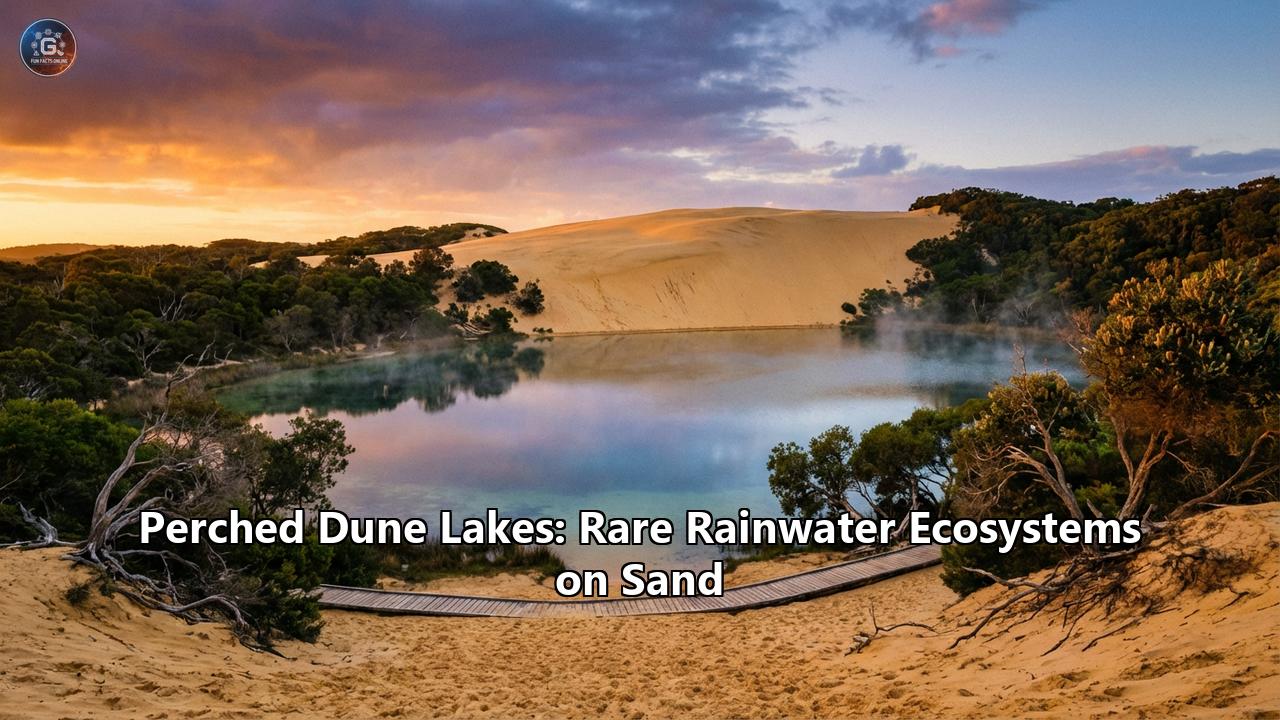
Imagine standing in the heart of a desert, or what appears to be one. All around you, vast undulating waves of silica sand stretch to the horizon, a blinding white ocean frozen in time. The sun beats down, heating the grains until they shimmer. By all laws of nature, this place should be arid, a parched landscape where water is a fleeting visitor. But then, you crest a dune, and the impossible happens.
Lying before you is a body of water so blue it rivals the sapphire depths of the ocean, yet so clear you can count the grains of sand on the bottom, ten meters down. It is cool, fresh, and sweet. It has no river feeding it, no stream draining it, and it sits high above the groundwater table, suspended like a magic trick on top of the porous sand.
This is a Perched Dune Lake. It is one of nature’s rarest and most fragile paradoxes—a permanent freshwater ecosystem thriving in a landscape designed to drain water away.
To the Butchulla people of K’gari (Fraser Island), these lakes are the "eyes of the land," watching the sky. To ecologists, they are "windows into the past," ancient chemical vaults that store the history of climate change in their sediments. To the traveler, they are simply miracles.
This article invites you to step off the beaten path and dive into the mysterious world of perched dune lakes. From the rainforest-fringed jewels of Australia to the ephemeral lagoons of Brazil and the crystal basins of New Zealand, we will explore the science, the stories, and the secrets of these rainwater ecosystems on sand.
Part I: The Geology of a Miracle
The Paradox of Water on Sand
To understand why a perched dune lake is so special, one must first respect the nature of sand. Sand is the ultimate sieve. Pour a bucket of water onto a beach, and it vanishes instantly, filtering down to the water table below. This is why most sand islands and dune systems are dry on the surface.
So, how does a lake—some covering hundreds of hectares—form on top of a giant pile of sand?
The answer lies in a geological process that takes thousands of years, a recipe requiring three specific ingredients: wind, vegetation, and time.
The "Coffee Rock" Foundation
The secret to a perched lake is invisible from the surface. Buried deep beneath the white silica sands lies a layer of natural cement known to geologists as indurated sand and to locals as "coffee rock."
This rock is not volcanic or sedimentary in the traditional sense. It is a chemical byproduct of the forest itself.
- Accumulation: Over millennia, trees and shrubs (like the Scribbly Gum and Paperbark Tea Tree) grow on the dunes. When they die and decay, they release tannins and humic acids—the same compounds that turn tea brown.
- Leaching: Rainwater washes these acidic compounds down through the porous sand, stripping away iron and aluminium oxides from the grains (a process called podzolization).
- Cementing: Eventually, this chemical cocktail hits a depth where it accumulates. The humic acids bind the sand grains together with the aluminium and iron, hardening into a concrete-like, impermeable layer.
This layer is the "saucer" that holds the lake. Because this saucer is often well above the regional groundwater table, the lake is said to be "perched." It is completely cut off from the underground aquifers. Its only source of water is the rain that falls directly into it or runs off the surrounding dune slopes.
The Three Types of Dune Lakes
It is crucial to distinguish true perched lakes from their cousins, as they are often confused by travelers:
- Perched Lakes (The True Rare Breed): Rainwater collected in a saucer of coffee rock high above sea level. (e.g., Lake McKenzie).
- Window Lakes: Formed when a depression in the dunes is so deep it dips below the water table, exposing the groundwater like a window. These are fed by the aquifer, not just rain. (e.g., Lake Wabby).
- Barrage Lakes: Formed when a moving sand dune blocks a watercourse or spring, creating a natural dam.
The article focuses on the Perched Lakes, the purest and most chemically isolated of them all.
Part II: K’gari (Fraser Island) – The Global Capital
If perched dune lakes have a capital city, it is K’gari (formerly Fraser Island) off the coast of Queensland, Australia. This World Heritage site is the largest sand island on Earth and is home to over 40 of the world’s perched lakes—more than half the global total.
Boorangoora (Lake McKenzie): The Sapphire Jewel
The most famous of them all is Lake McKenzie, known to the Butchulla people as Boorangoora.
The Water:Boorangoora defies logic. Most perched lakes are stained brown by the same tannins that created the coffee rock (known as "black water" lakes). Yet, McKenzie is crystal clear, fading into a startling turquoise.
- Why? The answer is a natural filtration system. The sand surrounding the lake is nearly 100% pure silica. As rainwater runs down the dunes into the lake, the silica acts as a micro-filter, stripping impurities. Furthermore, the organic matter at the bottom is stable, sealed off, preventing the tea-colored staining common elsewhere.
Swimming in Lake McKenzie is like swimming in distilled water. It is oligotrophic, meaning it has almost no nutrients. It is also highly acidic, with a pH often around 4.0 to 4.5—similar to tomato juice. This acidity and lack of nutrients mean very few aquatic species can survive here. There are no large fish, no weeds, and no slime. Just pure, soft water that feels like silk on the skin due to the lack of dissolved minerals.
The Legend of Boorangoora:For the Butchulla people, this lake is sacred. The name Boorangoora translates to "Waters of Wisdom." It was not traditionally a place for swimming, but for decision-making. The Wise Ones would gather on the white shores to listen to the messages carried on the breeze. The lake is seen as the "eyes of K’gari," the spirit of the island, looking back up at the sky. Stories warn that one must approach these waters with respect; to muddy them is to insult the land itself.
Lake Boomanjin: The Red Giant
While McKenzie gets the fame, Lake Boomanjin holds the record. It is the largest perched lake in the world, covering nearly 200 hectares. Unlike McKenzie, Boomanjin is a classic "black water" lake. Its waters are a deep, rusty red, resembling tea or cola.
This color comes from the Wallum heathlands surrounding it. The tea trees drop leaves rich in tannins into the water, dyeing it. While it looks murky, the water is pristine. The red hue blocks UV light, creating a cool, dark sanctuary for small, specialized fish species like the Honey Blue-eye (Pseudomugil mellis), which has evolved to thrive in this acidic, tannin-rich environment.
Lake Birrabeen: The Quiet Sister
Often called "McKenzie’s twin," Lake Birrabeen offers the same blinding white silica sand and crystal-clear water but without the crowds. It demonstrates the fragility of these systems; situated in a different dune catchment, it relies entirely on the stability of the surrounding vegetation to maintain its water levels. If the dunes shift or the vegetation burns, the lake could vanish.
Part III: The Crystal Gems of New Zealand (Kai Iwi)
Across the Tasman Sea, on the North Island of New Zealand, lies another cluster of these rare geological formations: the Kai Iwi Lakes (Taharoa Domain).
The Trio: Taharoa, Waikare, and Kai Iwi
Located north of Dargaville, these three lakes are renowned for their staggering clarity and depth.
- Lake Taharoa: The deepest and clearest, plummeting to 37 meters. It is so clear that submerged vegetation grows at depths of 24 meters, deeper than almost anywhere else in the country.
- Lake Waikare: The water-skier’s playground, yet still ecologically vital.
- Lake Kai Iwi: The smallest and most historically significant.
"Food for the People"
The name Kai Iwi translates from Māori as "Food for the People" (Kai = Food, Iwi = People/Bone). Historically, these lakes were vital food baskets. While perched lakes are generally nutrient-poor, the Māori harvested eels (tuna) and freshwater crayfish (kōura) here. The lakes were also places of healing; warriors wounded in battle were brought to the shores of Taharoa to recuperate, the pristine waters believed to cleanse wounds and speed recovery.
The Dune Lake Galaxias
Biologically, the Kai Iwi lakes are an evolutionary laboratory. They are home to the Dune Lake Galaxias (Galaxias sp.), a tiny freshwater fish found nowhere else on Earth.
This fish is a "landlocked" relic. Its ancestors migrated between the sea and freshwater, but as the dunes formed and the lakes became perched and isolated, the fish were trapped. Over thousands of years, they evolved into a distinct species, smaller and adapted to the specific chemistry of these dune waters. They are a living testament to the isolation of perched ecosystems.
Part IV: The Desert Mirages of Brazil (Lençóis Maranhenses)
In northeast Brazil, the concept of the "dune lake" is taken to a surreal extreme. The Lençóis Maranhenses National Park looks like the Sahara Desert, but it hides a wet secret.
The Ephemeral Lagoons
Unlike the permanent lakes of K’gari or Kai Iwi, the lakes of Lençóis Maranhenses are interdunal lagoons. They form only during the rainy season (January to June), when torrential tropical rains pour onto the dunes.
The water collects in the valleys between the crescent-shaped barchan dunes. While not always sitting on "coffee rock," they are held by an impermeable layer of mud and rock beneath the sand.
- Lagoa Azul (Blue Lagoon) and Lagoa Bonita (Beautiful Lagoon) are the most famous.
- The Phenomenon: Between July and September, these lagoons are at their peak—thousands of turquoise and emerald pools dotting the white sand for as far as the eye can see. By October, the relentless wind and sun begin to evaporate them, and by December, many have vanished completely, leaving only dry sand.
The Fish That Sleeps in the Sand
The most mind-bending aspect of the Brazilian dune lakes is the life within them. When the lagoons dry up, where do the fish go?
The Wolf Fish (Traíra) has developed a survival strategy straight out of science fiction. As the water evaporates, the fish burrows deep into the mud at the bottom of the lagoon. It enters a state of dormancy (aestivation), slowing its metabolism to a near-halt. It sleeps in the damp mud beneath the baking hot sand for months. When the rains return and the lagoon fills, the fish "wakes up," wriggles out of the mud, and swims again. This cycle of death and resurrection defines the ecology of this unique dune system.
Part V: The American Cousins (Florida & Oregon)
The United States hosts a variation of this phenomenon, particularly in Florida (South Walton County) and Oregon. However, a distinction must be made.
Florida’s Coastal Dune Lakes: The "Outfall" Connection
Walton County, Florida, boasts 15 named coastal dune lakes (e.g., Western Lake, Eastern Lake). These are rare and precious, often cited alongside those in Australia and Madagascar. However, they differ from the "true" perched lakes of Fraser Island in one key way: The Outfall.
These lakes are separated from the Gulf of Mexico by a natural sand berm. Periodically, heavy rains raise the lake level until it breaches the berm, creating a channel (outfall) that rushes into the sea. This connection allows saltwater to flow back in during high tides.
- Brackish Stew: As a result, Florida’s dune lakes are a mix of fresh and salt water (brackish). You might find a freshwater bass swimming near a saltwater mullet. This intermittent connection makes them dynamic, ever-changing estuaries, distinct from the chemically stable, sealed perched lakes of Australia.
Oregon’s Deflation Plains
In the Oregon Dunes National Recreation Area, lakes like Cleawox and Siltcoos form in "deflation plains"—areas where the wind has scoured the sand down to the water table. While some are perched on older terraces, many are "window" lakes. They are cooler, deeper, and surrounded by dense coniferous forests, offering a darker, moodier atmosphere than their tropical counterparts.
Part VI: Life in the Acid – The Ecology of Perched Lakes
How does life survive in water that is as acidic as vinegar and has fewer nutrients than tap water? The flora and fauna of perched lakes are specialists, survivors of a harsh paradise.
The "Acid Frogs"
In Australia, a group of amphibians known colloquially as "acid frogs" (such as the Wallum Sedgefrog, Litoria olongburensis) has evolved to thrive here.
- The Adaptation: Most frog larvae (tadpoles) would perish in such acidic water; their gills would burn, and their development would fail. Acid frogs have developed a tolerance to the low pH.
- The Benefit: By breeding in waters that kill their competitors (and predators), they have secured a safe nursery.
The Carnivorous Plants
Because the water and the surrounding sand are so nutrient-poor (lacking nitrogen and phosphorus), plants cannot get food from the soil. Instead, they turn to murder.
The margins of perched lakes are often carpeted in Sundews (Drosera). These tiny, glittering plants have sticky tentacles. When an insect lands, lured by the "dew," the tentacles curl around it, digesting it to extract the nitrogen the soil cannot provide.
The Reed Beds
Fringing the lakes are usually dense stands of Lepironia reeds and Paperbark Tea Trees (Melaleuca). These plants are the guardians of the lake. Their roots bind the coffee rock, preventing the "saucer" from cracking. Their leaves drop into the water, replenishing the acidity that keeps the ecosystem free of invasive species. It is a closed loop of life.
Part VII: The Fragile Balance – Threats to the Miracle
Despite their ancient origins, perched dune lakes are incredibly fragile. They are "closed systems," meaning whatever goes in, stays in. They do not flush themselves out like a river.
1. The "Sunscreen Sheen"
The biggest immediate threat to lakes like McKenzie is tourism. Every year, thousands of visitors swim in its waters. They wear sunscreen, lotions, insect repellent, and hair products.
- The Impact: These chemicals wash off into the water. In a normal lake, bacteria would break them down, or a river would wash them away. In a sterile, acidic, closed perched lake, these chemicals accumulate. They can form a surface sheen that blocks oxygen or alters the delicate pH balance, potentially allowing algae to bloom and turning the crystal water green.
- The Solution: Parks authorities now urge visitors to "wash off before you jump in" and avoid wearing sunscreen in the water, promoting the use of protective clothing (rash vests) instead.
2. The Sediment Gap (Climate Change)
Recent research on K’gari has revealed a frightening history. By coring the sediment at the bottom of the lakes, scientists found a "gap" in the timeline between 7,500 and 5,500 years ago.
- The Meaning: The lakes dried out. During a slightly warmer and drier period in history, the rain stopped, evaporation increased, and the lakes vanished.
- The Warning: As climate change pushes global temperatures higher and alters rainfall patterns, there is a real risk that these lakes could dry up again. Unlike a dam that can be refilled, once the organic "coffee rock" seal dries out and cracks, the lake might never hold water again.
3. Invasive Species
In New Zealand’s Kai Iwi lakes, the introduction of the Gambusia (Mosquito fish) has devastated the native Galaxias population. These aggressive little fish nip the fins of the natives and eat their eggs.
In Australia, the Cane Toad is a threat, though the acidity of the perched lakes acts as a natural barrier—cane toad tadpoles cannot survive the low pH. This makes perched lakes one of the last safe havens for native frogs, provided the water chemistry isn't altered by pollution.
Conclusion: A Call to Respect
Perched dune lakes are more than just beautiful swimming holes. They are geological accidents, ecological islands, and cultural sanctuaries. They are a testament to the power of nature to create abundance out of scarcity—turning barren sand and dead leaves into sapphire waters and vibrant life.
Visiting a perched dune lake is a privilege. It is an encounter with an ecosystem that hangs in a delicate balance. Whether you are sitting in the silence of Boorangoora, watching the sunset over the ephemeral lagoons of Brazil, or searching for the tiny Galaxias in New Zealand, the message is the same:
Tread lightly.Do not bring chemicals into the water. Do not disturb the reeds that hold the basin together. Respect the stories of the people who have guarded these waters for millennia. These lakes are the eyes of the earth, and they are watching how we treat them.
Quick Facts: The World's Notable Perched Dune Lakes
| Lake Name | Location | Type | Key Feature |
| :--- | :--- | :--- | :--- |
| Lake McKenzie (Boorangoora) | K'gari (Fraser Island), Australia | Perched | Crystal clear water, pure silica sand, "Waters of Wisdom". |
| Lake Boomanjin | K'gari (Fraser Island), Australia | Perched | Largest perched lake in the world (200ha). Red/Tea colored water. |
| Lake Birrabeen | K'gari (Fraser Island), Australia | Perched | "Twin" to McKenzie, less visited, equally clear. |
| Lake Taharoa | Northland, New Zealand | Dune Lake (Window/Perched features) | Deepest dune lake in NZ (37m), incredibly clear. |
| Kai Iwi Lake | Northland, New Zealand | Perched/Dune | Cultural history "Food for People", endangered fish habitat. |
| Lagoa Azul | Lençóis Maranhenses, Brazil | Interdunal Lagoon | Ephemeral (seasonal), turquoise water against white dunes. |
| Western Lake | Florida, USA | Coastal Dune Lake | Intermittent outfall to the Gulf, brackish water mix. |
| Lake Siltcoos | Oregon, USA | Drowned River Mouth/Dune | Largest lake on the Oregon coast, formed by dunes blocking a river. |
Glossary of Terms
- Indurated Sand: Sand grains cemented together by a chemical precipitate (like iron or organic matter), forming a hard rock.
- Coffee Rock: The specific type of indurated sand found on K'gari, formed by organic colloids (humic acids) cementing the sand.
- Oligotrophic: Water that is low in plant nutrients and usually rich in oxygen.
- Podzolization: A soil formation process where acid leaching removes iron and aluminium from the topsoil and deposits it in a lower layer (the B-horizon), creating coffee rock.
- Aestivation: A state of animal dormancy, similar to hibernation, characterized by inactivity and a lowered metabolic rate, entered in response to high temperatures and arid conditions.
Reference:
- https://fraser-tours.com/article/why-is-lake-mckenzie-so-clear
- https://fraser-tours.com/article/Lakes-on-fraser-island-differences
- https://www.kgarifraserisland.com.au/visit-lake-mckenzie-why-is-it-the-healing-spot-of-fraser-island/
- https://fraserislandtoursaustralia.com.au/blog/why-lake-mckenzie-is-so-special/
- https://www.atlasobscura.com/places/lake-mckenzie
- https://parks.qld.gov.au/parks/kgari-fraser/about/butchulla/culture
- https://en.wikipedia.org/wiki/Kai_Iwi_Lakes_Reserve
- https://heatherwhelanwriting.wordpress.com/2021/03/05/hidden-treasures-kai-iwi-to-pouto/
- https://www.coolwaterbeach.com/820-park
- https://www.wildingpines.nz/wilding-case-studies/kai-iwi-lakes
- https://www.dunescity.gov/siltcoos