
In the grand tapestry of the cosmos, astronomers have long relied on a standard blueprint to explain the architecture of planetary systems. It is a model forged from the observation of our own Solar System: small, dense, rocky worlds huddle close to the warmth of the star, while colossal gas giants dominate the cold, outer reaches. This "Snow Line" theory—where volatile compounds like water and ammonia freeze into solid grains only at great distances, allowing for the rapid accumulation of massive gaseous envelopes—has been the cornerstone of planetary science for decades. It is a logic that screams of order, physics, and inevitability.
But the universe, it seems, has little respect for our blueprints.
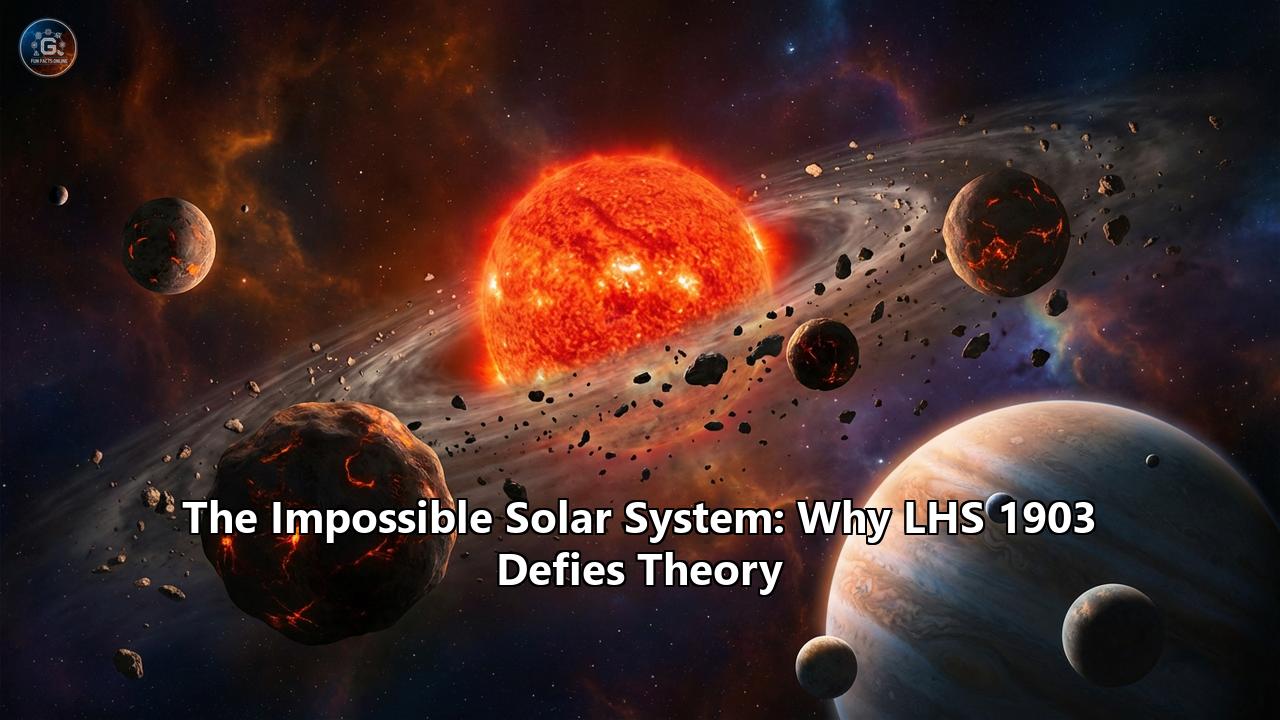
In February 2026, a discovery emerged from the data streams of the European Space Agency’s CHEOPS satellite that shattered this long-held conviction. The system in question orbits LHS 1903, a red dwarf star located approximately 116 light-years away in the constellation of Lynx. At first glance, it appeared to be just another multi-planet system, a common configuration in the Milky Way. However, as the data was refined and the densities of the worlds calculated, a startling anomaly crystallized. The planets were arranged in an order that should not exist: a rocky world, followed by two gas-rich sub-Neptunes, and then—defying all models of accretion and disk evolution—another rocky super-Earth sitting at the system's edge.
This is the story of LHS 1903, the "Impossible Solar System," and why it is forcing scientists to rewrite the history of how worlds are born.
Part I: The Standard Model and the Snow Line
To understand why LHS 1903 is such a provocateur, one must first appreciate the paradigm it violates. The "Nebular Hypothesis," refined over centuries from Kant and Laplace to modern astrophysics, posits that stars and planets form from the collapse of giant molecular clouds. As the cloud collapses, conservation of angular momentum flattens it into a spinning disk of gas and dust—the protoplanetary disk.
In the center, the protostar ignites. In the disk, dust grains collide and stick, growing from microns to centimeters, then to kilometers, eventually forming planetesimals. The crucial factor in this process is temperature. Close to the star, it is too hot for volatiles like water, methane, and ammonia to exist as solids. They remain gaseous, meaning the inner planets can only build themselves from metals and silicates (rock). Because these materials are rare compared to hydrogen and helium, these inner planets remain small and rocky—like Mercury, Venus, Earth, and Mars.
Further out, beyond the "Snow Line" (or Frost Line), temperatures drop sufficiently for volatiles to condense into solid ice grains. This sudden abundance of solid material allows planetesimals to grow rapidly, reaching a critical mass (about 10 times the mass of Earth) where their gravity becomes strong enough to capture hydrogen and helium gas directly from the disk. This runaway gas accretion creates the gas giants—Jupiter, Saturn, Uranus, and Neptune.
This model predicts a segregated universe: Rock on the inside, Gas on the outside. While migration theories (where gas giants spiral inward) have explained "Hot Jupiters," the reverse—a rocky planet forming after the gas giants, in the cold outer deprivations of the disk—was considered dynamically and physically implausible.
LHS 1903 has proven that "implausible" is not the same as "impossible."
Part II: The Red Dwarf Realm
LHS 1903 (also cataloged as TOI-1730) is an M-dwarf, a class of star that is the most common in the galaxy. Red dwarfs are cooler, smaller, and dimmer than our Sun. Because they are so dim, their "habitable zones" (where liquid water can exist) and their Snow Lines are much closer to the star than in our Solar System.
For years, M-dwarfs have been the darlings of exoplanet hunters. Their small size means that an orbiting planet blocks a larger percentage of the star's light during a transit, making detection easier. Their low mass means the gravitational tug of a planet creates a more pronounced "wobble," facilitating mass measurement. Systems like TRAPPIST-1, with its seven rocky worlds, proved that red dwarfs could host complex planetary families.
However, M-dwarfs are also chaotic hosts. They are prone to violent flares, especially in their youth, which can strip the atmospheres off of forming planets. This led to a hypothesis known as the "Radius Valley" or "Fulton Gap"—a scarcity of planets between 1.5 and 2.0 Earth radii. The theory suggests that planets in this range either hold onto their thick atmospheres (becoming sub-Neptunes) or lose them entirely to stellar radiation (becoming super-Earths).
When the Transiting Exoplanet Survey Satellite (TESS) first flagged LHS 1903 as a candidate system, it seemed to fit the standard red dwarf profile. It was a compact system with short orbital periods. But it was only when the University of Warwick team, led by Dr. Thomas Wilson, turned the precise eye of ESA’s CHEOPS (CHaracterising ExOPlanet Satellite) toward the star that the true nature of the system was revealed.
Part III: Anatomy of an Anomaly
The LHS 1903 system consists of four confirmed planets, tightly packed and orbiting with periods ranging from just a few days to roughly a month. To put their proximity in perspective, the entire system would fit comfortably inside the orbit of Mercury.
LHS 1903 b (The Inner Sentinel):The innermost planet is a classic rocky world. Orbiting blisteringly close to the star, it has a density consistent with silicates and iron. This fits the standard model perfectly; any atmosphere it might have gathered would have been blasted away by the young star's X-ray and UV radiation.
LHS 1903 c and LHS 1903 d (The Gaseous Middle):Moving outward, we encounter two planets that classify as "Sub-Neptunes" or "Mini-Neptunes." These worlds are larger than Earth but possess thick, extended envelopes of hydrogen and helium. Their low densities indicate that they retained their primordial gas. Again, this is not entirely unusual; in many red dwarf systems, we see a transition from rocky inner worlds to gaseous outer worlds.
LHS 1903 e (The Impossible World):Here is where the model breaks. The fourth and outermost planet, LHS 1903 e, orbits with a period of roughly 29 days. In a standard "inside-out" temperature gradient, this planet should be the most gaseous of them all. It resides in the cooler region of the system, where gas retention should be easiest. It is shielded from the most intense stellar stripping by distance and by the inner planets.
Yet, when Dr. Wilson’s team combined the transit data from CHEOPS with radial velocity measurements to determine the planet's mass and radius, the density numbers were unequivocal. LHS 1903 e is not a gas giant. It is not a puffy sub-Neptune. It is a dense, rocky Super-Earth.
The configuration reads: Rock — Gas — Gas — Rock.
It is a celestial sandwich that defies the physics of the protoplanetary disk. If the disk contained enough gas to build planets 'c' and 'd', why did planet 'e', forming further out in the deep reservoir of the disk, fail to gather any? If the star stripped the atmosphere of 'b', how did 'c' and 'd' survive, and why is 'e'—the safest of them all—naked?
Part IV: The Failure of Violent Theories
Faced with this puzzle, astronomers first turned to dynamic explanations. Could the system have been rearranged?
Planetary Migration:Ideally, planets do not stay put. They drift through the disk. It is possible that LHS 1903 e formed closer to the star and migrated outward? This is dynamically difficult. Outward migration usually requires specific resonance locks with other planets, and while resonances exist in many red dwarf systems, moving a massive rocky planet through the orbits of two gas giants without destabilizing the entire system or accreting gas along the way is a scenario that simulations struggle to replicate.
Giant Impacts:Another possibility was violence. perhaps LHS 1903 e was a gas giant, but a catastrophic collision with another planetary body stripped its atmosphere. While giant impacts are common (our own Moon is likely the result of one), they are messy. A collision massive enough to strip a gas giant's envelope usually leaves dynamic scars—eccentric orbits or significant inclination differences. LHS 1903’s planets, however, orbit in a relatively flat, circular plane. The system is too "quiet" to have recently suffered a celestial demolition.
Atmospheric Photoevaporation:Could the star be to blame? M-dwarfs can remain active for billions of years. But physics dictates that radiation intensity drops with the square of the distance. If the radiation was strong enough to strip the outermost planet 'e', it should have completely flayed planets 'c' and 'd' as well. The survival of the middle gas giants makes the "stellar wind" theory inapplicable to the outer world.
With the standard violent solutions ruled out, the team realized the answer must lie in the formation process itself. The anomaly wasn't an accident; it was a fossil record of a different kind of birth.
Part V: The Theory of Sequential Formation
The breakthrough came when the researchers abandoned the idea that all planets form simultaneously. The traditional view is that the protoplanetary disk collapses into planets roughly at the same time—a grand, synchronized baby boom.
But the LHS 1903 system points toward a Sequential Formation model, sometimes called "Inside-Out Planet Formation" (though the name is confusing in this context, as it refers to the sequence of formation, not the final composition gradient).
In this scenario, the planets of LHS 1903 did not pop into existence together. Instead, they formed one by one, like a localized assembly line moving outward from the star.
The Process:- Planet B Forms: A rocky core aggregates near the star. It consumes the local material.
- Planet C Forms: The "formation front" moves outward. Planet C forms in a region still rich in gas. It grows quickly, reaching the critical mass to pull in a thick envelope of hydrogen and helium, becoming a sub-Neptune.
- Planet D Forms: The wave moves further out. The disk is still healthy. Planet D also accretes a significant gas envelope.
- The Gas Depletion Event: By the time the formation wave reaches the orbit of Planet E, the disk has changed. Millions of years have passed. The star has been consuming gas; the earlier planets have been accreting it; and stellar winds have been blowing the lighter elements away.
When the "seed" for LHS 1903 e finally coalesced, the buffet was closed. The protoplanetary disk was "gas-depleted." There was plenty of dust and rock left—solids that drift more slowly—but the hydrogen and helium were gone. Planet E grew to a substantial size (1.7 times Earth's radius) by eating up the remaining planetesimals, but when it tried to grab an atmosphere, there was nothing there to grab.
It became a "failed giant"—a core that formed too late to dress itself in gas.
Part VI: Implications for Planetary Science
The confirmation of sequential, gas-depleted formation in LHS 1903 is a watershed moment for astrophysics. It provides the first clear observational evidence that planet formation is not a uniform event but a time-dependent process where the local environment evolves drastically during the birth of the system.
1. The "Radius Valley" Revisited:This discovery adds a new dimension to the Radius Valley debate. We can no longer assume that all rocky super-Earths are "stripped cores" of former gas giants. Some, like LHS 1903 e, may be "born dry." They are not victims of stellar violence but children of a starved disk. This distinction is vital for understanding the density and composition of exoplanets.
2. Pebble Accretion:This system strongly supports the "Pebble Accretion" model of planet formation. Traditional models relied on kilometer-sized rocks smashing together. Pebble accretion suggests that planets grow by sweeping up millimeter-sized dust grains (pebbles) that drift inward due to gas drag. The sequential nature of LHS 1903 fits this model: as the gas vanishes, the drag forces change, altering how and where pebbles accumulate.
3. The Diversity of Red Dwarf Systems:Since red dwarfs are the most common stars, LHS 1903 suggests that "sandwich" systems might be common throughout the galaxy. We may have missed them because our detection biases favor finding simple patterns. If sequential formation is standard for M-dwarfs, it complicates our search for "Earth 2.0."
Part VII: Life in a Sandwich System
What does this mean for habitability? The search for life is the driving force behind much of exoplanet science. LHS 1903 e, being a rocky world, naturally invites the question: Could it be habitable?
The sequential formation model paints a complex picture for water. In the standard model, comets from the outer system bombard the inner rocky worlds, delivering water (the "Late Heavy Bombardment" scenario). However, in LHS 1903, the middle gas giants (c and d) might act as gravitational gatekeepers. They could intercept volatile-rich bodies spiraling in from the outer disk, starving the inner world (b) of water.
But what of Planet E? It formed in the outer region. If it formed from "dry" rocks after the gas was gone, it might be a desert world. However, if it formed from icy pebbles that were left behind as the gas evaporated, it could be a "Water World"—a planet with a global ocean hundreds of kilometers deep, locked under a crushing atmosphere of steam or exotic ice.
Because LHS 1903 is a red dwarf, the habitable zone is close in. Depending on the exact luminosity of the star (which is 0.1% that of the Sun), Planet E might be too cold for liquid water on the surface, perhaps resembling a massive version of Jupiter's moon Europa—an ice shell protecting a liquid interior. Alternatively, if it has a thick greenhouse atmosphere (CO2 based, rather than H/He), it could be a temperate abode.
The lack of a hydrogen envelope is actually a good thing for habitability. Thick hydrogen atmospheres (like those on planets c and d) create crushing surface pressures and temperatures that suffocate life as we know it. By being "late to the party," Planet E avoided this fate. Its rocky surface is exposed to the cosmos, potentially allowing for a secondary atmosphere of nitrogen and carbon dioxide to form—the kind of atmosphere life needs.
Part VIII: The Future of Observation
LHS 1903 has transitioned from a data point to a priority target. The scientific community is already mobilizing the next generation of instruments to probe its secrets.
James Webb Space Telescope (JWST):The immediate next step is atmospheric characterization. JWST’s Near-Infrared Spectrograph (NIRSpec) can stare at LHS 1903 e as it transits. If the planet has an atmosphere (perhaps CO2 or methane), JWST will see the chemical fingerprints in the starlight filtering through the planet's rim. A detection of water vapor on Planet E would be a monumental finding, confirming that "late-bloomer" planets can retain volatiles.
PLATO and Ariel:ESA’s upcoming PLATO mission (launching later this decade) will look for more systems like this, helping us understand if LHS 1903 is a freak occurrence or a standard variation. The Ariel mission will survey the atmospheres of exoplanets, helping to determine if the "gas-rich" middle planets (c and d) have different chemical compositions than the "gas-poor" outer planet, which would confirm their formation from different reservoirs of disk material.
Part IX: A Universe of Infinite Variety
The discovery of LHS 1903 serves as a humbling reminder of our limited perspective. For centuries, we looked at the Solar System and assumed it was the template for the universe. We codified its structure into laws and taught them as fact.
First, the discovery of "Hot Jupiters" in the 1990s taught us that planets can migrate.
Then, the discovery of "Super-Earths" taught us that the universe loves planet sizes we don't even possess.
Now, LHS 1903 teaches us that the order of planets is not sacred. The assembly of a solar system is a dynamic, chaotic, and time-sensitive recipe.
The "Impossible Solar System" is not impossible; it is simply a manifestation of the complexity of fluid dynamics and gravity playing out over millions of years. It tells us that a star can birth a rocky world, then switch modes to build gas giants, and then—as the lights are turning out and the nursery is closing—squeeze out one final, rocky triumph.
LHS 1903 e stands as a lonely sentinel at the edge of its system, a rock where a giant should be. It is a monument to the changing winds of the protoplanetary disk, a world that exists only because it was late. And in its existence, it opens a door to a galaxy far more diverse, and perhaps far more habitable, than we ever dared to dream.
Part X: Detailed Analysis of the "Inside-Out" Mechanism
To truly grasp the significance of LHS 1903, we must delve deeper into the physics of the "Inside-Out" formation mechanism proposed by the researchers. This theory is a departure from the classical "Core Accretion" model in its timing, not necessarily its mechanics, but the implications are profound.
The Classical View vs. The Sequential ViewIn the classical view, the protoplanetary disk is a relatively static feeding ground (at least on formation timescales). Cores form where there is material. The "Snow Line" is a fixed boundary.
In the Sequential/Inside-Out view, the disk is an evolving organism.
- Viscous Spreading and Accretion: The disk is constantly draining onto the star. The density of gas drops exponentially over time.
- The Pressure Bump: Planets often form at "pressure bumps"—regions in the disk where gas pressure creates a trap for dust and pebbles. These bumps can migrate.
- The Formation Wave: As the first planet forms, it disturbs the disk, potentially creating a new pressure bump further out, triggering the formation of the next planet. This creates a chain reaction moving outward.
For LHS 1903, the timeline would have looked like this:
- T=0 to 1 Myr (Million Years): The star is young and violent. The disk is massive. Planet 'b' forms from iron and silicates near the star. It is too hot for gas accretion or ice.
- T=1 to 3 Myr: The formation front moves to the region of 'c' and 'd'. The disk is still rich in gas. These cores form and rapidly pull in the hydrogen envelope. They become Sub-Neptunes.
- T=3 to 5 Myr: The disk is dying. The gas is photo-evaporating (being blown away by the star) and accreting onto the star. The formation trigger reaches the orbit of 'e'.
- T=5+ Myr: Planet 'e' begins to assemble. The solids are there—perhaps icy pebbles that have drifted outward or local debris. The core grows to 5 or 10 Earth masses. It tries to initiate "runaway gas accretion," the process that built Jupiter. But the gas is too tenuous. The feeding tube is cut. Planet 'e' solidifies as a massive rocky terrestrial world, freezing in a state of arrested development.
Another fascinating variable in this equation is the role of radioactive isotopes. Short-lived radionuclides like Aluminum-26 (produced in supernovae) provide the heat that melts the interiors of young planets. If LHS 1903 formed in a cluster near a supernova, the inner planets might have been dehydrated by this internal heat. By the time Planet 'e' formed, the Aluminum-26 would have decayed significantly. This means Planet 'e' might have a different internal geology than Planet 'b'—cooler, perhaps less differentiated, or retaining more water in its mantle.
Part XI: Comparative Planetology: LHS 1903 vs. TRAPPIST-1 vs. The Solar System
Comparing LHS 1903 to its famous cousin, TRAPPIST-1, illuminates its uniqueness.
- TRAPPIST-1: Seven planets. All Earth-sized. All rocky (with varying water fractions). The planets are in a resonant chain, suggesting they formed further out and migrated inward together, like a train.
- LHS 1903: Four planets. Diverse sizes. Mixed compositions (Rocky-Gas-Gas-Rocky). No strong resonance chain.
The difference suggests that TRAPPIST-1 experienced smooth, large-scale migration that homogenized the system. LHS 1903 experienced a more staccato, interrupted formation history. It is the "broken" systems that often teach us more about physics than the "perfect" ones.
Compared to our Solar System:
- Solar System: Rocky inner (Mercury-Mars), Gas/Ice outer (Jupiter-Neptune). The classic Snow Line model.
- LHS 1903: Inverted at the edge.
The Solar System had a very massive, long-lived disk. Jupiter formed early and opened a gap, which shaped the rest of the system. In LHS 1903, the "Jupiters" (planets c and d) were not massive enough to open gaps or starve the outer system of solids, yet the gas ran out before the final planet could mature. It represents a "low-mass" analog to our system, where the processes were similar but the raw materials ran out too soon.
Part XII: The "Super-Earth" Mystery
LHS 1903 e also serves as a laboratory for the "Super-Earth" class of planets. We have no Super-Earths in our solar system; we jump from Earth (1 radius) to Neptune (3.8 radii). LHS 1903 e sits right in this gap (approx 1.7 radii).
Because it is rocky, it suggests that rocky planets can indeed grow quite large without becoming gas giants if the gas is removed. This challenges the idea that there is a strict mass limit for rocky worlds. In a gas-rich disk, a 5-Earth-mass core must become a gas giant. In a gas-poor disk, a 5-Earth-mass core remains a "Mega-Earth." LHS 1903 e is the proof of this environmental contingency.
Part XIII: A New Target for SETI?
While astronomers focus on biosignatures (methane, oxygen), the Search for Extraterrestrial Intelligence (SETI) looks for technosignatures. Systems like LHS 1903 are intriguing for SETI for a different reason: Interplanetary Travel.
The planets are packed very close together. The delta-v (energy) required to travel from Planet 'b' to 'e' is miniscule compared to traveling from Earth to Mars. If life arose on the temperate outer rock (e) or in the clouds of the middle worlds (c/d), the colonization of the entire system would be far easier than in our solar system. A civilization arising on LHS 1903 e would have two massive gas giants hanging in their sky, acting as distinct, reachable destinations.
Conclusion: The Unfinished Symphony
LHS 1903 is a system that looks unfinished. It is a snapshot of a construction site where the workers went home early, leaving the steel frame of a skyscraper (Planet e) without its glass facade (the atmosphere).
For humanity, staring out from our own well-ordered, gas-rich home, LHS 1903 is a jarring, beautiful reminder that we are one outcome of a chaotic process. The universe is not a factory producing identical solar systems. It is an artist's studio, littered with sketches, experiments, and "impossible" masterpieces.
As the CHEOPS data is archived and the JWST mirrors turn toward Lynx, the scientific community waits with bated breath. LHS 1903 e may be just a rock, but it is our rock—a stepping stone to understanding the infinite diversity of the dark beyond.
Reference:
- https://www.esa.int/Science_Exploration/Space_Science/Cheops/Cheops_discovers_late_bloomer_from_another_era
- https://www.eurekalert.org/news-releases/1116599
- https://www.nbcpalmsprings.com/2026/02/12/astronomers-discover-impossible-planetary-system-that-challenges-how-planets-form
- https://www.sciencenews.org/article/inside-out-planetary-system
- https://www.skyatnightmagazine.com/news/lhs-1903-inside-out-system
- https://www.sci.news/astronomy/cheops-rocky-exoplanet-lhs-1903e-14554.html
- https://thedebrief.org/astronomers-have-discovered-an-inside-out-planetary-system-thats-breaking-all-the-rules/
- https://earthsky.org/space/inside-out-planetary-system-formation-lhs-1903/
- https://timesofindia.indiatimes.com/science/astronomers-find-a-solar-system-in-the-milky-way-that-breaks-the-rules-of-planet-formation/articleshow/128303636.cms
- https://www.techspot.com/news/101047-newly-discovered-exoplanet-big-exist.html
- https://thebrighterworld.com/detail/Scientists-Make-Groundbreaking-Discovery-Planet-Found-Almost-as-Big-as-Its-Host-Star/NjY1NA
- https://www.unexplained-mysteries.com/news/394682/impossible-inside-out-solar-system-discovered-by-astronomers