
For millennia, humanity has gazed upon the cosmos, a silent, glittering expanse of stars and galaxies. Our understanding of the universe was built entirely on light—the visible light seen by the naked eye, the radio waves captured by large dishes, the X-rays detected by orbiting satellites. Every discovery, from the moons of Jupiter to the most distant galaxies, came to us through some form of electromagnetic radiation. But this torrent of light, for all it has revealed, only tells part of the story. It is a silent movie, a grand cosmic play with the sound turned off.
Now, we can hear it.
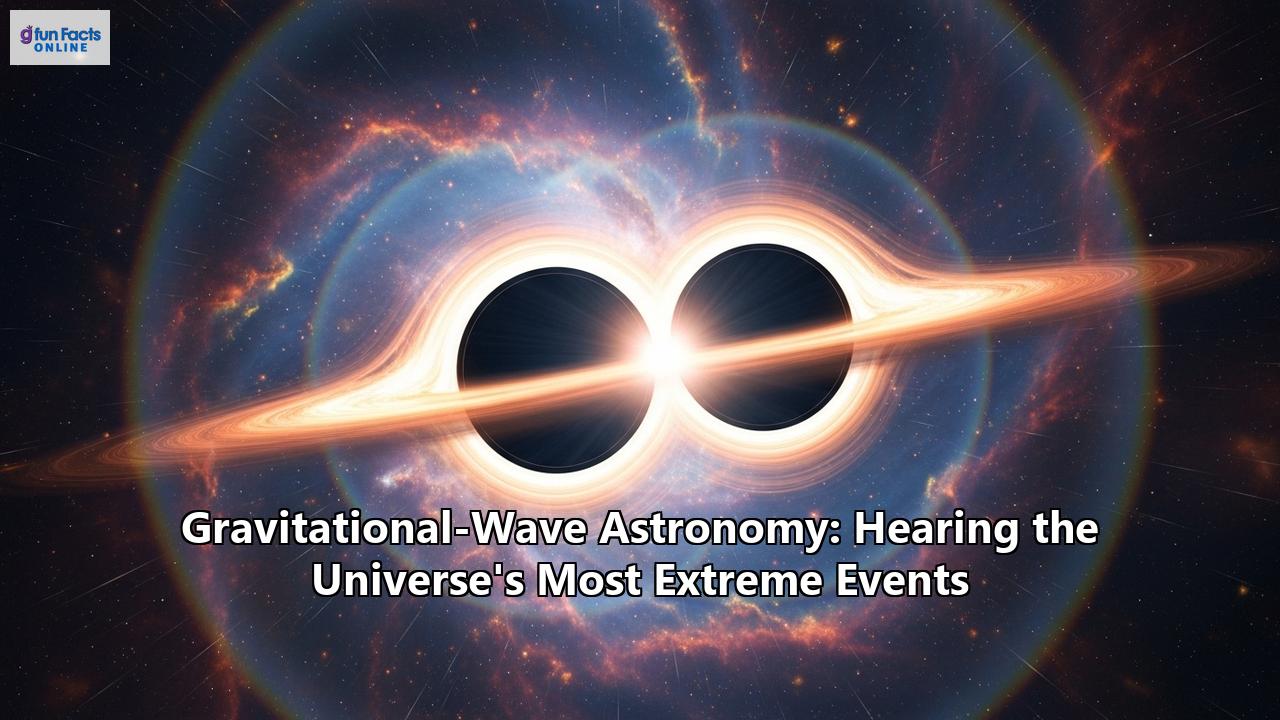
We have entered a new era of discovery, one where we can listen to the vibrations of spacetime itself. This is the era of gravitational-wave astronomy, a field that has transformed our ability to probe the universe's most enigmatic and violent phenomena. We are no longer just spectators; we are listeners, attuned to the cataclysmic symphonies produced by colliding black holes, merging neutron stars, and other extreme cosmic events that were previously hidden from our view.
Gravitational waves offer a fundamentally new way to observe the universe. Unlike light, which can be blocked and scattered by intervening dust and gas, gravitational waves travel through space virtually unimpeded. They carry with them direct, unblemished information about their powerful origins. Hearing these waves is akin to Galileo first pointing a telescope at the sky, a revolutionary shift that unveiled a universe far grander and more complex than ever imagined. We are on the cusp of a similar revolution, one that promises to answer some of the most profound questions in physics and cosmology and, undoubtedly, to pose new ones we have not yet even thought to ask.
The Symphony of Spacetime: What are Gravitational Waves?
To understand gravitational waves, one must first grasp the modern conception of gravity, a vision gifted to us by Albert Einstein. In 1915, he published his theory of general relativity, which remains the current description of gravitation in modern physics. It fundamentally reshaped our understanding of the cosmos, proposing that space and time are not separate, static entities, but are instead interwoven into a single, dynamic four-dimensional continuum known as spacetime.
Einstein proposed that massive objects don't just move through spacetime; they distort it. A popular analogy is to imagine spacetime as a stretched rubber sheet. Placing a bowling ball on the sheet causes it to sag or curve. This curvature dictates how other, smaller objects, like marbles, move. They aren't pulled by a mysterious force emanating from the bowling ball but are simply following the curved path laid out for them in the fabric of the sheet. In the same way, Earth orbits the Sun not because of a direct pull, but because it is following the straightest possible path through the spacetime curved by the Sun's immense mass.
General relativity, however, goes a step further. Einstein’s mathematics showed that if massive objects accelerate—if they change their speed or direction of motion—they will create ripples in the fabric of spacetime. These are not waves that travel in spacetime, but are rather waves of spacetime itself. Imagine moving the bowling ball on the rubber sheet; the disturbances you create would propagate outwards as ripples across the sheet. These are gravitational waves.
Any accelerating mass, even a person waving their hand, technically produces gravitational waves. However, the effect is infinitesimally small. To generate waves strong enough to be detected, even with our most sensitive instruments, requires events of almost unimaginable power and scale. The most potent sources of gravitational waves are cataclysmic cosmic events involving compact, massive objects like black holes and neutron stars. When these objects orbit each other at high speeds, they stir up spacetime, sending a continuous stream of gravitational waves radiating outwards.
These waves have several key properties:
- They travel at the speed of light, which is also the speed of gravity itself.
- They are invisible, but their effect is physical. As a gravitational wave passes by, it causes spacetime to stretch in one direction while simultaneously compressing it in a perpendicular direction.
- They are incredibly weak. The processes that generate gravitational waves are immensely energetic, but by the time they travel across millions or billions of light-years to reach Earth, their effect is minuscule. The stretching and squeezing of spacetime caused by a typical wave might change the distance between two points by less than one-thousandth the diameter of a proton.
- They pass through matter almost entirely unhindered. While light from distant stars can be blocked by interstellar dust clouds, gravitational waves will travel through planets, stars, and galaxies without being significantly scattered, providing a clear and direct line of sight to their source.
The existence of gravitational waves is a direct consequence of general relativity and stands in stark contrast to Newton's theory of gravity, which assumed gravity acted instantaneously across any distance. The detection of these waves was the final, triumphant confirmation of Einstein's century-old prediction and has opened a new, auditory window onto the cosmos. We can now listen to the universe's most extreme events, hearing the symphony of spacetime itself.
Reference:
- https://en.wikipedia.org/wiki/Gravitational_wave
- https://en.wikipedia.org/wiki/General_relativity
- https://www.space.com/17661-theory-general-relativity.html
- https://www.space.com/25088-gravitational-waves.html
- https://imagine.gsfc.nasa.gov/science/toolbox/gwaves1.html
- https://www.ligo.caltech.edu/page/what-are-gw
- https://www.esa.int/Science_Exploration/Space_Science/Gravitational_waves_dents_in_spacetime
- https://spaceplace.nasa.gov/gravitational-waves/en/
- https://www.vedantu.com/physics/gravity-waves
- https://simplifiednote.com/wp-content/uploads/2024/02/1.pdf
- https://simple.wikipedia.org/wiki/Gravitational_wave